フレデリック・ショパンの『練習曲集』は、1830年代に出版されたピアノのための練習曲集(独奏練習曲)3曲からなる。全27曲の練習曲があり、作品番号 10と作品番号25が付けられた12曲ずつの2つの独立した作品集と、作品番号のない3曲からなる作品集から構成されている。[1]
歴史
構成
ショパンの練習曲は、当時革命的なピアノ演奏スタイルの基礎を築きました。コンサートピアノのレパートリーの中でも、最も難解で、かつ情感豊かな作品の一つです。そのため、今でも人気があり、コンサートやプライベートステージで頻繁に演奏されています。[2]中には、非常に人気のある曲もあり、愛称が付けられています。例えば、作品10-3(悲しみ(Tristesse )または別れ( L'Adieu)と呼ばれることもあります)、革命的な作品(作品10-12)、黒鍵(作品10-5)、冬の風(作品25-11)などがあります。これらの愛称はショパンが作ったものではありません。[2]
全27曲の練習曲はショパンの生前に出版された。最初の12曲である作品10は1829年から1832年にかけて作曲され、1833年にフランス、ドイツ、イギリスで出版された。作品25の12曲の練習曲は1832年から1835年にかけて様々な時期に作曲され、1837年に同じ国々で出版された。最後の3曲は、イグナーツ・モシェレスとフランソワ=ジョセフ・フェティスが編纂した「ピアノ技法」シリーズの一部で、1839年に作曲されたが、作品番号は付与されていない。これらは1840年11月にドイツとフランスで、1841年1月にイギリスで出版された。[2]これらの初期版には通常、ショパンの手による1つの練習曲の原稿がいくつか添付されており、ショパンの友人ジュール・フォンタナが作成した追加のコピーや、ショパンの弟子カロル・ミクリによる版も含まれている。[2]
インパクト
ピアノ練習曲集は18世紀末から一般的であったが(ムツィオ・クレメンティ、ヨハン・バティスト・クラマー、イグナーツ・モシェレス、カール・ツェルニーらが最も重要な作品を作曲した)、ショパンの練習曲は全く新しい技術的課題を提示しただけでなく、コンサート・レパートリーの定番となった最初の作品となった。音楽的内容と技術的課題を、完全な芸術的形態で融合させている。[3]
フランツ・リストのような同時代の作曲家たちへのエチュードの影響は、リストがショパンとの出会い後に演奏会用エチュード集に改訂を加えたことから明らかです。シューマン、ドビュッシー、プロコフィエフ、ラフマニノフといった後進の作曲家たちも、ショパンのエチュードの影響を受けたエチュードを作曲しました。[4]
ポーランドの音楽学者タデウシュ・A・ジェリンスキは作品10について、「この曲は新しいピアノ様式とその独特の公式を整然と示しただけでなく、この様式を芸術的に高めたものでもあった」と記している。[5]ショパンの練習曲は今でもよく知られており、いくつかはポピュラー音楽、映画、テレビ番組にも採用されている。[要出典]
エチュード一覧

作品10
最初の練習曲集は1833年に出版されました(ただし、いくつかは1829年にすでに作曲されていました)。ショパンは当時23歳で、パリのサロンで作曲家およびピアニストとして既に名声を博しており、そこでフランツ・リストと知り合いました。後にショパンは全曲を「à mon ami Franz Liszt」(友フランツ・リストへ)と献呈しました。
Krystyna Kobylańskaによれば、8、9、10、11 は 1829 年 10 月/11 月、5 と 6 はおそらく 1830 年の夏、1 と 2 は 1830 年 11 月 2 日、12 はおそらく 1831 年 9 月、7 は 1832 年の春、4 は 1832 年 8 月 6 日、3 は 1832 年 8 月 25 日のものである。[全文引用が必要]
| 番号 | 鍵 | インシピット | オーディオ |
|---|---|---|---|
| 1位 | ハ長調 |  |
|
| 2位 | マイナー |  |
|
| 3位 | ホ長調 |  |
|
| 4位 | ハ短調 |  |
|
| 5番 | ト♭メジャー | ![\new PianoStaff << \new Staff = "Up" \with { \magnifyStaff #3/4 } << \new Voice \relative c' { \clef treble \tempo "Vivace" \set Score.tempoHideNote = ##t \tempo 4 = 116 \time 2/4 \key ges \major \ottava #1 \override TupletBracket.bracket-visibility = #'if-no-beam \tuplet 3/2 8 {ges'''16^\markup{\italic Britishe} ([bes des,] ges ees ges des [ges bes,] des ges, bes} \ottava #0 \omit TupletNumber \tuplet 3/2 8 {ges16 [bes des,] ges ees ges des [ges bes,] des ges, bes)} } >> \new Staff = "Down" \with { \magnifyStaff #3/4 } << \new Voice \relative c{ \clef brass \key ges \major \dynamicUp <ges' bes des ges>8-。 \f [<ges ces ees ges>-. <ges bes des ges>-.] r <ges, ges'>-. \p \sustainOn <ces' ees ges>-。 \sustainOff [<bes des ges>-.] r } >> >>](http://upload.wikimedia.org/score/r/a/rac8ztkkj85d9uaodvcntvocmhqiz4j/rac8ztkk.png) |
|
| 6番 | E ♭マイナー |  |
|
| 7番 | ハ長調 | 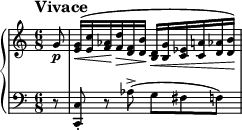 |
|
| 8番 | ヘ長調 |  |
|
| 9番 | ヘ短調 |  |
|
| 10番 | A ♭メジャー | ![\new PianoStaff << \new Staff = "Up" \with { \magnifyStaff #3/4 } << \new Voice \relative c' { \clef treble \tempo "Vivace assai" \set Score.tempoHideNote = ##t \tempo 4. = 152 \time 12/8 \key aes \major \partial 8 ees8 aes_\markup{\italic dolce} \(<c aes'> (bes) <des bes'>-> (b) <d b'> (c) <ees c'> (cis) <e cis'>-> (d) <f d'> (\hide r8)\) } >> \new Staff = "Down" \with { \magnifyStaff #3/4 } << \new Voice \relative c{ \clef bass \key aes \major \stemDown \mergeDifferentlyHeadedOn r8 aes_\markup{\italic legato} \sustainOn ([c' aes ees ees' aes,]) aes, ([c' aes ees ees' aes, \sustainOff ]) } \new Voice \relative c{ \stemUp s8 s4. ees2 s4 ees2 } >> >>](http://upload.wikimedia.org/score/3/f/3fviz8aiqponx41dw0h7pur43zdh1w9/3fviz8ai.png) |
|
| 11番 | E ♭メジャー |  |
|
| 12番 | ハ短調 |  |
作品25
ショパンの2番目の練習曲集は1837年に出版され、フランツ・リストの愛人マリー・ダグーに捧げられたが、その理由は不明である。
作品番号25はすべて、ショパンとブライトコップフ&ヘルテル社の間でドイツにおける出版権を付与する契約が締結された1835年6月30日より前に書かれた。
| 番号 | 鍵 | インシピット | オーディオ |
|---|---|---|---|
| 1位 | A ♭メジャー |  |
|
| 2位 | ヘ短調 | ![\new PianoStaff << \new Staff = "Up" \with { \magnifyStaff #3/4 } << \new Voice \relative c' { \clef treble \tempo "Presto" \set Score.tempoHideNote = ##t \tempo 2 = 112 \key f \minor \time 2/2 \partial 4 \override TupletBracket.bracket-visibility = #'if-no-beam \tupletSpan 4 c'4 \p (\tuplet 3/2 {c8_\markup{\italic molto \italic legato} [des b] c ees des c [des b!] c fis g} \omit TupletNumber \tuplet 3/2 {c, [des b] c ees des c [des b] c aes' f} \hide r16) } >> \new Staff = "Down" \with { \magnifyStaff #3/4 } << \new Voice \relative c{ \clef bass \key f \minor \tupletSpan 2 r4 \tuplet 3/2 {e \sustainOn (g' c,) bes! (g' c, \sustainOff) f, \sustainOn (aes' c,) aes (aes' c, \sustainOff)} s16 } >> >>](http://upload.wikimedia.org/score/c/9/c9ppp17yi9xp1uupb36nl79fjszrdaw/c9ppp17y.png) |
|
| 3位 | ヘ長調 | ![\new PianoStaff << \new Staff = "Up" \with { \magnifyStaff #3/4 } << \new Voice \relative c' { \clef treble \tempo "Allegro" \set Score.tempoHideNote = ##t \tempo 4 = 120 \key f \major \time 3/4 \partial 4 \stemDown c'4 _(f,8_\markup{\italic leggiero} [f']) c,_([c']) f,_(f') g,_([g']) c,,_([c']) g_(g') } \new Voice \relative c'{ \stemUp s4 d'16 c8. g16 f8. d'16 c8. d16 c8. a16 g8. d'16 c8。 } >> \new Staff = "Down" \with { \magnifyStaff #3/4 } << \new Voice \relative c{ \clef bass \key f \major \stemDown \dynamicUp r4 \p c8 \sustainOn_([f, \sustainOff]) c' \sustainOn_([f, \sustainOff]) c' \sustainOn_([f, \sustainOff]) c' \sustainOn_([f, \sustainOff]) c' \sustainOn_([f, \sustainOff]) c' \sustainOn_([f, \sustainOff]) } \new Voice \relative c{ \stemUp s4 a'16 [f] s8 a16 [f] s8 a16 [f] s8 bes16 [e,] s8 bes'16 [e,] s8 bes'16 [e,] } >> >>](http://upload.wikimedia.org/score/f/u/fuu4knjlersdfafjh11h05j9ho00p5x/fuu4knjl.png) |
|
| 4位 | マイナー | ![\new PianoStaff << \new Staff = "Up" \with { \magnifyStaff #3/4 } << \new Voice \relative c' { \clef treble \tempo "Agitato" \set Score.tempoHideNote = ##t \tempo 4 = 160 \key a \minor \time 2/2 \partial 4 r4 r8 <ea e'>-! r <a e' a>-! r <ad a'>-! r <gis e' gis>-! } >> \new Staff = "Down" \with { \magnifyStaff #3/4 } << \new Voice \relative c{ \clef bass \key a \minor \dynamicUp e4-> (a,8-! \p) [<e' a>-!] c-! <a' e'>-! b,-! [<f' d>-!] e-! <b' e>-! } >> >>](http://upload.wikimedia.org/score/s/v/sv5ljaqrubl2nct2kqch5nfvmuui6mm/sv5ljaqr.png) |
|
| 5番 | ホ短調 |  |
|
| 6番 | ト短調 | ![\new PianoStaff << \new Staff = "Up" \with { \magnifyStaff #3/4 } << \new Voice \relative c' { \clef treble \tempo "Allegro" \set Score.tempoHideNote = ##t \tempo 2 = 69 \key gis \minor \time 2/2 <b' dis>16_\markup{\italic sotto \italic voce} ([<cis e> <b dis> <cis e>] <b dis> <cis e> <b dis> <cis e> <b dis> [<cis e> <b dis> <cis e>] <b dis> <cis e> <b dis> <cis e> \hide r16) } >> \new Staff = "Down" \with { \magnifyStaff #3/4 } << \new Voice \relative c{ \clef bass \key gis \minor R1 s16 } >> >>](http://upload.wikimedia.org/score/3/l/3luxc7zckxsfouoban4h98auuweuesu/3luxc7zc.png) |
|
| 7番 | ハ短調 | ![\new PianoStaff << \new Staff = "Up" \with { \magnifyStaff #3/4 } << \new Voice \relative c' { \clef treble \key cis \minor \override Score.TimeSignature.stencil = ##f \tempo "Lento" \set Score.tempoHideNote = ##t \tempo 4 = 40 \time 10/4 s2 s1 r \revert Score.TimeSignature.stencil \bar "||" \time 3/4 } >> \new Staff = "Down" \with { \magnifyStaff #3/4 } << \new Voice \relative c{ \clef bass \key cis \minor \dynamicUp gis4 \p \< (dis'4. \! cis8 \> cis [bis \!] a'4. gis8 fisis16 \< gis a gis \! b \> ae eis fis eis gis fis a gis cis, dis \!) } >> >>](http://upload.wikimedia.org/score/s/5/s5khn93x7ecugduuxogs61xtbjcnxut/s5khn93x.png) |
|
| 8番 | ニ長調 | ![\new PianoStaff << \new Staff = "Up" \with { \magnifyStaff #3/4 } << \new Voice \relative c' { \clef treble \key des \major \tempo "Vivace" \set Score.tempoHideNote = ##t \tempo 2 = 69 \time 2/2 \tupletSpan 4 \stemUp \override TupletNumber.Y-offset = #-3 \override TupletNumber.X-offset = #3 \tuplet 3/2 {<ges' ees'>8_\markup{\italic molto \italic Legato}^([<aes f'> <ges ees'>] <aes f'> <ges ees'> <aes f'> <f des'> [<ges ees'> <g e'>] <bes ges'!> <aes f'> <f des'>)} } >> \new Staff = "Down" \with { \magnifyStaff #3/4 } << \new Voice \relative c{ \clef bass \key des \major \omit TupletNumber \omit TupletBracket \tuplet 3/2 {aes,8-.^\markup{\italic messa \italic voce} \sustainOn <c' aes'> ([<ees c'>] <aes ees'> <ees c'> <c aes'> \sustainOff) des,-. \sustainOn <des' aes'> ([<f des'>] <des aes'> <f des'> <des aes'> \sustainOff)} } >> >>](http://upload.wikimedia.org/score/c/i/ciu0qz8lqixy1xpx8kp7maud94nlbyk/ciu0qz8l.png) |
|
| 9番 | ト♭メジャー | 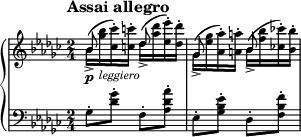 |
|
| 10番 | ロ短調 | ![\new PianoStaff << \new Staff = "Up" \with { \magnifyStaff #3/4 } << \new Voice \relative c' { \clef treble \key b \minor \tempo "Allegro con fuoco" \set Score.tempoHideNote = ##t \tempo 2 = 72 \time 2/2 \tupletSpan 4 \omit TupletBracket \tuplet 3/2 {<fis, fis'>8 \p ^(_\([<eis eis'> <fis fis'>] <g g'> <gis gis'> <a a'>\) <gis gis'>_\markup{\italic cresc. \italic poco \italic a \italic poco} _\([<fisis fisis'> <gis gis'>] <a a'> <ais ais'> <b b'>\)} \hide r16) } >> \new Staff = "Down" \with { \magnifyStaff #3/4 } << \new Voice \relative c{ \clef bass \key b \minor \tupletSpan 4 \omit TupletBracket \tuplet 3/2 {<fis,, fis'>8 _\([<eis eis'> <fis fis'>] <g g'> <gis gis'> <a a'>\) <gis gis'> _\([<fisis fisis'> <gis gis'>] <a a'> <ais ais'> <b b'>\)} s16 } >> >>](http://upload.wikimedia.org/score/3/p/3pya0osjvsivsaxuqsa3gl30qsvzkko/3pya0osj.png) |
|
| 11番 | マイナー |  |
|
| 12番 | ハ短調 | ![\new PianoStaff << \new Staff = "Up" \with { \magnifyStaff #3/4 } << \new Voice \relative c' { \clef treble \key c \minor \override Score.MetronomeMark.Y-offset = #10 \tempo "Molto allegro con fuoco" \set Score.tempoHideNote = ##t \tempo 2 = 80 \time 2/2 \stemUp \change Staff = "Down" ees,16^> \f ^([g \change Staff = "Up" ees' ees] g ees' ees g ees'^> [g, ees ees] g, ees ees \change Staff = "Down" g,) } >> \new Staff = "Down" \with { \magnifyStaff #3/4 } << \new Voice \relative c{ \clef bass \key c \minor \stemDown c,16 \sustainOn [g' cc] g' cc \change Staff = "Up" g' c [g \change Staff = "Down" c, c] gc, cg \sustainOff } >> >>](http://upload.wikimedia.org/score/6/r/6rseirngrpoqtokvma9wd1qw4phpdr8/6rseirng.png) |
3つの新しいエチュード
三つの新しい練習曲は、1839年にイグナーツ・モシェレスとフランソワ=ジョセフ・フェティスによるピアノ教本『ピアノ法』への寄稿として作曲されたが、作品番号は付与されていない。作品10や25ほど技術的には優れていないものの、ショパン独自の和声と構成のバランスの定式を保っている。モシェレス=フェティスの『ピアノ法』に初めて収録された後、3つの練習曲は1844年頃にモーリス・シュレザンジャーによってパリで個別に出版された(プレートMS 4102)。 [6] [7]
| 番号 | 鍵 | インシピット | 録音 |
|---|---|---|---|
| 1位 | ヘ短調 |  |
|
| 2位 | A ♭メジャー |  |
|
| 3位 | ニ長調 |  |
技術的側面と学生ガイド
ショパンのエチュードは技術的に要求が厳しく、たとえ弱い指であっても、スピード、アルペジオ、トリルなどの高度な技術が演奏者に要求される。 [8]
すべてのエチュードのために
- カゼッラ、アルフレッド。F.ショパン。ピアノフォルテの研究。ミラノ:エディツィオーニ・クルチ、1946年。
- コルトー、アルフレッド。フレデリック・ショパン。 12の練習曲、op. 10.ショパンの創作旅行記。パリ:サラベール校、1915年。
- コルトー、アルフレッド。フレデリック・ショパン。 12の練習曲、op. 25.ショパンの創作旅行記。パリ:サラベール校、1915年。
- ガルストン、ゴットフリード。シュトゥディエンブーフ[研究書]。 Ⅲ.アーベント[第3回リサイタル](フレデリック・ショパン)。ベルリン:ブルーノ・カッシラー、1910年。
選ばれたエチュード
- ブゾーニ、フェルッチョ。Klavierübung in zehn Büchern [10 冊のピアノ教本], zweite umgestaltete und bereicherte Ausgabe. Buch 8 (ショパンの変奏曲と変奏曲)。ライプツィヒ: ブライトコプフ & ヘルテル、1925 年。
- ゴドフスキー、レオポルド。Studien über die Etüden von Chopin (ショパンの練習曲の研究)。ニューヨーク: G. Schirmer Inc.、1899 (ベルリン: Schlesinger'sche Buch- und Musikhandlung、1903)。
- ヨゼフィ、ラファエル著『ピアノ練習曲集』教育版、ニューヨーク:G.シルマー、1901年。
言い換え
- ゴドフスキー、レオポルド。53ショパンの練習曲に関する研究。ニューヨーク: G. Schirmer Inc.、1899 (ベルリン: Schlesinger'sche Buch- und Musikhandlung、1903)。
- ウーラー、フリードリヒ。Achtzehn Studien zu Frédéric Chopins Etuden [原文のまま] [ショパンの練習曲に関する 18 の研究]。 In Motu Contrario [逆行運動]。ハイデルベルク:ウィリー・ミュラー、南ドイツ音楽協会、1958年。
ディスコグラフィー
![[アイコン]](http://upload.wikimedia.org/wikipedia/commons/thumb/1/1c/Wiki_letter_w_cropped.svg/1280px-Wiki_letter_w_cropped.svg.png) | このセクションは拡張が必要です。追加していただけると助かります。 (2025年8月) |
参照
参考文献
- ^ Davidoff, Josh (2020年2月28日). 「ショパンのエチュードガイド」WFMT . 2022年6月25日閲覧。
- ^ abcd Palmer, Willard A. 編 (1992).ショパンピアノ練習曲集, 実演版. 米国: Alfred Publishing Co. ISBN 0-7390-2497-3。
- ^ Ståhlbrand, Robert (2006). 「ショパンの練習曲集」. ピアノ協会. 2007年4月28日閲覧。
- ^ “Album Notes”. Harmonia Mundi . 1997年. 2007年9月29日時点のオリジナルよりアーカイブ。 2022年6月25日閲覧。
- ^ タデウス、ジエリンスキー A. (1993)。Chopin Życie i droga twórcza (ショパン – 彼の人生と芸術の道) (ポーランド語)。クラクフ: Polskie Wydawnictwo Muzyczne (ポーランドの音楽出版社)。 p. 238.
- ^ “3 つのヌーベル練習曲、B.130 (ショパン、フレデリック)”. IMSLP。国際楽譜ライブラリープロジェクト。2025 年10 月 27 日に取得。
- ^ “ピアノのための 3 練習曲 : composées pour la Méthode des methodes ([2e éd.]) / par F. Chopin”. Gallica (フランス国立図書館) (フランス語) 。2025 年10 月 27 日に取得。
- ^ クライン、アンドレアス(1989年5月)『ショパンのエチュード:ピアノ技術の向上に不可欠な教育ツール』(D Mus論文)ライス大学7ページ、hdl :1911/16247。
さらに読む
- ビューロー、ハンス・フォン。 「個別研究に関するコメント」アウゼルレーネ・クラヴィア・エチューデン・フォン・神父にて。ショパン。ミュンヘン:ヨス・アイブル、1880年。
- コレット、ロバート「練習曲、前奏曲、即興曲」『フレデリック・ショパン:人物と音楽家のプロフィール』アラン・ウォーカー編、ロンドン:バリー&ロックリフ、1966年。
- ツェルニー、カール『実用作曲学校』ロンドン:R.コックス社、[1848];再版、ニューヨーク:ダ・カーポ・プレス、1979年。
- デショーセ、モニーク。フレデリック・ショパン: 24 の練習曲 – 対 une 解釈。フォンデット:ヴァン・デ・ヴェルデ、1995年。
- アイゲルディンガー、ジャン=ジャック著『ショパン:弟子から見たピアニストと教師』ケンブリッジ大学出版局、1986年
- エキエル、ジャン編。 (全国版)「練習曲について」。 「パフォーマンスコメンタリー」。 「出典解説」。ショパンの練習曲。ワルシャワ:ポルスキー・ヴィダウニクトゥ・ムジチュネ、1999年。
- フィンロウ、サイモン。「27の練習曲とその前身」ジム・サムソン編『ケンブリッジ・コンパニオン・トゥ・ショパン』、ケンブリッジ:ケンブリッジ大学出版局、1992年。
- ガルストン、ゴットフリード。シュトゥディエンブーフ。 Ⅲ.アーベント(フレデリック・ショパン)。ベルリン:ブルーノ・カッシラー、1910年。
- ハネカー、ジェームズ。「習作――巨大な実験」『ショパン:その人間と音楽』ニューヨーク:チャールズ・スクリブナー・サンズ、1900年。
- アラン・コゴソフスキ著「ショパンの練習曲をマスターする」『ショパン:ピアノの天才』概要、電子書籍、2010年。
- ライヒテントリット、ヒューゴ。 「死ね、エテューデン」 Analyze der Chopin'schen Klavierwerke [ショパンのピアノ作品の分析]。バンドⅡ。ベルリン:マックス・ヘッセ・フェルラーク、1922年。
- リア王、アンジェラ・ショパンのグランド・エチュード。2007年2月5日。
- レオンツキー、ヤン:ショパンの解釈。練習曲 作品10と25。分析、解説、そして解釈上の選択。タルンヘルム版。
- ニークス、フレデリック『人間として、そして音楽家としてのショパン』ロンドン:ノヴェロ社、1888年。
- パデレフスキ、イグナシー・ヤン、ルドウィク・ブロナルスキー、ユゼフ・トゥルチンスキー編。 (「パデレフスキ」版)。 「現代版の登場人物」 "解説。"ショパン研究 (練習曲)。ワルシャワ: フリデリカ・ショピナ研究所、1949 年。
- サムソン、ジム。「バロックの反映」『ショパンの音楽』所収。ロンドン:ラウトレッジ・アンド・キーガン・ポール、1985年。
- シューマン、ロベルト。 「Die Pianoforte-Etuden, ihren Zwecken nach geordnet」[目的に従って分類されたピアノフォルテの練習曲]。Neue Zeitschrift für Musik No. 11、1836 年 2 月 6 日、p. 45.
- ツィンマーマン、エワルド編。 (ヘンレ版)。 「クリティッシャー・ベリヒト」(批評報告書)。ショパンの練習曲。ミュンヘン: G. ヘンレ フェルラーク、1983 年。
外部リンク

分析とスコア
- エチュード Op. 10、練習曲 Op. 25日、ケンブリッジ大学ショパン・オンラインにて
- エチュード Op. 10、練習曲 Op. 25:国際音楽楽譜ライブラリープロジェクトの楽譜
- Mutopia Project のエチュードの無料楽譜
- ハンス・フォン・ビューロー版『練習曲集』作品10と25(ミュンヘン:J.アイブル、1880年)シブリー音楽図書館デジタル楽譜コレクションより
- ショパンプロジェクトのサイトで、厳選されたエチュードのエントリーを検索し、オンデマンドの演奏を聴くことができます。
公演
- ショパン 24の練習曲 Op. YouTubeの 10 と 25 と 3 Nouvelles Études 、クラウディオ アラウ
- ショパン 24の練習曲 Op. YouTubeの 10 と 25 と 3 Nouvelles Études 、シュラ チェルカスキー
- ショパン 24の練習曲 Op. YouTubeの 10 と 25 と 3 Nouvelles Études 、アール ワイルド