In mathematics, the J-homomorphism is a mapping from the homotopy groups of the special orthogonal groups to the homotopy groups of spheres. It was defined by George W. Whitehead (1942), extending a construction of Heinz Hopf (1935).
Definition
Whitehead's original homomorphism is defined geometrically, and gives a homomorphism

of abelian groups for integers q, and . (Hopf defined this for the special case .)


The J-homomorphism can be defined as follows. An element of the special orthogonal group SO(q) can be regarded as a map
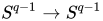
and the homotopy group ) consists of homotopy classes of maps from the r-sphere to SO(q). Thus an element of can be represented by a map


Applying the Hopf construction to this gives a map

in , which Whitehead defined as the image of the element of under the J-homomorphism.

Taking a limit as q tends to infinity gives the stable J-homomorphism in stable homotopy theory:

where is the infinite special orthogonal group, and the right-hand side is the r-th stable stem of the stable homotopy groups of spheres.

Image of the J-homomorphism
The image of the J-homomorphism was described by Frank Adams (1966), assuming the Adams conjecture of Adams (1963) which was proved by Daniel Quillen (1971), as follows. The group is given by Bott periodicity. It is always cyclic; and if r is positive, it is of order 2 if r is 0 or 1 modulo 8, infinite if r is 3 or 7 modulo 8, and order 1 otherwise (Switzer 1975, p. 488). In particular the image of the stable J-homomorphism is cyclic. The stable homotopy groups are the direct sum of the (cyclic) image of the J-homomorphism, and the kernel of the Adams e-invariant (Adams 1966), a homomorphism from the stable homotopy groups to . If r is 0 or 1 mod 8 and positive, the order of the image is 2 (so in this case the J-homomorphism is injective). If r is 3 or 7 mod 8, the image is a cyclic group of order equal to the denominator of , where is a Bernoulli number. In the remaining cases where r is 2, 4, 5, or 6 mod 8 the image is trivial because is trivial.


r 0 1 2 3 4 5 6 7 8 9 10 11 12 13 14 15 16 17 1 2 1 1 1 1 2 2 1 1 1 1 2 2 1 2 1 24 1 1 1 240 2 2 1 504 1 1 1 480 2 2 2 2 24 1 1 2 240 22 23 6 504 1 3 22 480×2 22 24 1⁄6 −1⁄30 1⁄42 −1⁄30


Applications
Michael Atiyah (1961) introduced the group J(X) of a space X, which for X a sphere is the image of the J-homomorphism in a suitable dimension.
The cokernel of the J-homomorphism appears in the group Θn of h-cobordism classes of oriented homotopy n-spheres (Kosinski (1992)).

References
- Atiyah, Michael Francis (1961), "Thom complexes", Proceedings of the London Mathematical Society, Third Series, 11: 291–310, doi:10.1112/plms/s3-11.1.291, MR 0131880
- Adams, J. F. (1963), "On the groups J(X) I", Topology, 2 (3): 181, doi:10.1016/0040-9383(63)90001-6
- Adams, J. F. (1965a), "On the groups J(X) II", Topology, 3 (2): 137, doi:10.1016/0040-9383(65)90040-6
- Adams, J. F. (1965b), "On the groups J(X) III", Topology, 3 (3): 193, doi:10.1016/0040-9383(65)90054-6
- Adams, J. F. (1966), "On the groups J(X) IV", Topology, 5: 21, doi:10.1016/0040-9383(66)90004-8. "Correction", Topology, 7 (3): 331, 1968, doi:10.1016/0040-9383(68)90010-4
- Hopf, Heinz (1935), "Über die Abbildungen von Sphären auf Sphäre niedrigerer Dimension", Fundamenta Mathematicae, 25: 427–440
- Kosinski, Antoni A. (1992), Differential Manifolds, San Diego, CA: Academic Press, pp. 195ff, ISBN 0-12-421850-4
- Milnor, John W. (2011), "Differential topology forty-six years later" (PDF), Notices of the American Mathematical Society, 58 (6): 804–809
- Quillen, Daniel (1971), "The Adams conjecture", Topology, 10: 67–80, doi:10.1016/0040-9383(71)90018-8, MR 0279804
- Switzer, Robert M. (1975), Algebraic Topology—Homotopy and Homology, Springer-Verlag, ISBN 978-0-387-06758-2
- Whitehead, George W. (1942), "On the homotopy groups of spheres and rotation groups", Annals of Mathematics, Second Series, 43 (4): 634–640, doi:10.2307/1968956, JSTOR 1968956, MR 0007107
- Whitehead, George W. (1978), Elements of homotopy theory, Berlin: Springer, ISBN 0-387-90336-4, MR 0516508
External links
- J-homomorphism at the nLab
