数学 において 、 フォンテーヌ周期環は ジャン=マルク・フォンテーヌ [1] によって最初に定義された 可換環 の集合であり、 -
進 ガロア表現 を分類するために使用されます
p
{\displaystyle p}
環B dR 環は 次のように定義されます。 を完備化とし ます
B
d R
{\displaystyle \mathbf {B} _{dR}}
C
p
{\displaystyle \mathbb {C} _{p}}
Q
p
¯
{\displaystyle {\overline {\mathbb {Q} _{p}}}}
E
~
+
=
限界 ←
× ↦
×
p
O
C
p
/
( p ) 。
{\displaystyle {\tilde {\mathbf {E} }}^{+}=\varprojlim _{x\mapsto x^{p}}{\mathcal {O}}_{\mathbb {C} _{p}}/(p).}
の元は、 となるような 元の
列である。 によって与えられる 自然な射影写像が存在する。また、 によって定義される
乗法写像(加法写像ではない)も存在する。
E
~
+
{\displaystyle {\チルダ {\mathbf {E} }}^{+}}
(
×
1
,
×
2
, … )
{\displaystyle (x_{1},x_{2},\ldots)}
×
i
∈
O
C
p
/
( p )
{\displaystyle x_{i}\in {\mathcal {O}}_{\mathbb {C} _{p}}/(p)}
×
i + 1
p
≡
×
i
( mod p )
{\displaystyle x_{i+1}^{p}\equiv x_{i}\!\!\!{\pmod {p}}}
f :
E
~
+
→
O
C
p
/
( p )
{\displaystyle f:{\tilde {\mathbf {E} }}^{+}\to {\mathcal {O}}_{\mathbb {C} _{p}}/(p)}
f (
×
1
,
×
2
, … ) =
×
1
{\displaystyle f(x_{1},x_{2},\dotsc)=x_{1}}
t :
E
~
+
→
O
C
p
{\displaystyle t:{\tilde {\mathbf {E} }}^{+}\to {\mathcal {O}}_{\mathbb {C} _{p}}}
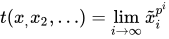
t (
×
,
×
2
, … ) =
限界
i → ∞
× ~
i
p
i
{\displaystyle t(x_{,}x_{2},\dotsc)=\lim _{i\to \infty}{\tilde {x}}_{i}^{p^{i}}}
, ここで、 は から へ の任意の持ち上げです 。
と の射影 の合成 は です
× ~
i
{\displaystyle {\tilde {x}}_{i}}
×
i
{\displaystyle x_{i}}
O
C
p
{\displaystyle {\mathcal {O}}_{\mathbb {C} _{p}}}
t
{\displaystyle t}
O
C
p
→
O
C
p
/
( p )
{\displaystyle {\mathcal {O}}_{\mathbb {C} _{p}}\to {\mathcal {O}}_{\mathbb {C} _{p}}/(p)}
f
{\displaystyle f}
ウィットベクトル の一般理論は、 任意の に対して 、 となる唯一の環準同型を与える。ここで は の タイヒ ミュラー 表現 を表す 。この環は 、イデアル に関する の 完備化として定義される 。最終的に、 体は の分数体となる 。
θ : W (
E
~
+
) →
O
C
p
{\displaystyle \theta :W({\tilde {\mathbf {E} }}^{+})\to {\mathcal {O}}_{\mathbb {C} _{p}}}
θ ( [ × ] ) = t ( × )
{\displaystyle \theta ([x])=t(x)}
× ∈
E
~
+
{\displaystyle x\in {\tilde {\mathbf {E} }}^{+}}
[ × ]
{\displaystyle [x]}
×
{\displaystyle x}
B
d R
+
{\displaystyle \mathbf {B} _{dR}^{+}}
B
~
+
= W (
E
~
+
) [ 1
/
p ]
{\displaystyle {\チルダ {\mathbf {B} }}^{+}=W({\チルダ {\mathbf {E} }}^{+})[1/p]}
カー ( θ :
B
~
+
→
C
p
)
{\displaystyle \ker(\theta :{\tilde {\mathbf {B} }}^{+}\to \mathbb {C} _{p})}
B
d R
{\displaystyle \mathbf {B} _{dR}}
B
d R
+
{\displaystyle \mathbf {B} _{dR}^{+}}
注釈
参考文献 Berger, Laurent (2004)、「 p 進表現 理論入門」、 Dwork理論の幾何学的側面 、第1巻、ベルリン:Walter de Gruyter GmbH & Co. KG、 arXiv : math/0210184 、 Bibcode :2002math.....10184B、 ISBN 978-3-11-017478-6 、 MR 2023292 ブリノン、オリヴィエ; コンラッド、ブライアン (2009)、CMIサマースクールのp進ホッジ理論に関するノート (PDF) 、 2010年2月5日閲覧 フォンテーヌ、ジャン=マルク (1982)、「Sur Certains Types de Representations p-Adiques du Groupe de Galois d'un Corps Local; Construction d'un Anneau de Barsotti-Tate」、 Ann。数学。 、 115 (3): 529–577 、 土井 :10.2307/2007012 ジャン=マルク・フォンテーヌ 編(1994)、 Périodes p-adiques 、Asterisque、vol. 223、パリ: Société Mathématique de France、 MR 1293969 






![{\displaystyle \theta ([x])=t(x)}](https://wikimedia.org/api/rest_v1/media/math/render/svg/633507185fc1ed9d657978b93f5888b99768b87c)

![{\displaystyle [x]}](https://wikimedia.org/api/rest_v1/media/math/render/svg/07548563c21e128890501e14eb7c80ee2d6fda4d)


![{\displaystyle {\チルダ {\mathbf {B} }}^{+}=W({\チルダ {\mathbf {E} }}^{+})[1/p]}](https://wikimedia.org/api/rest_v1/media/math/render/svg/98db2b42ca3b2727077f8430b9b674348052ae21)

