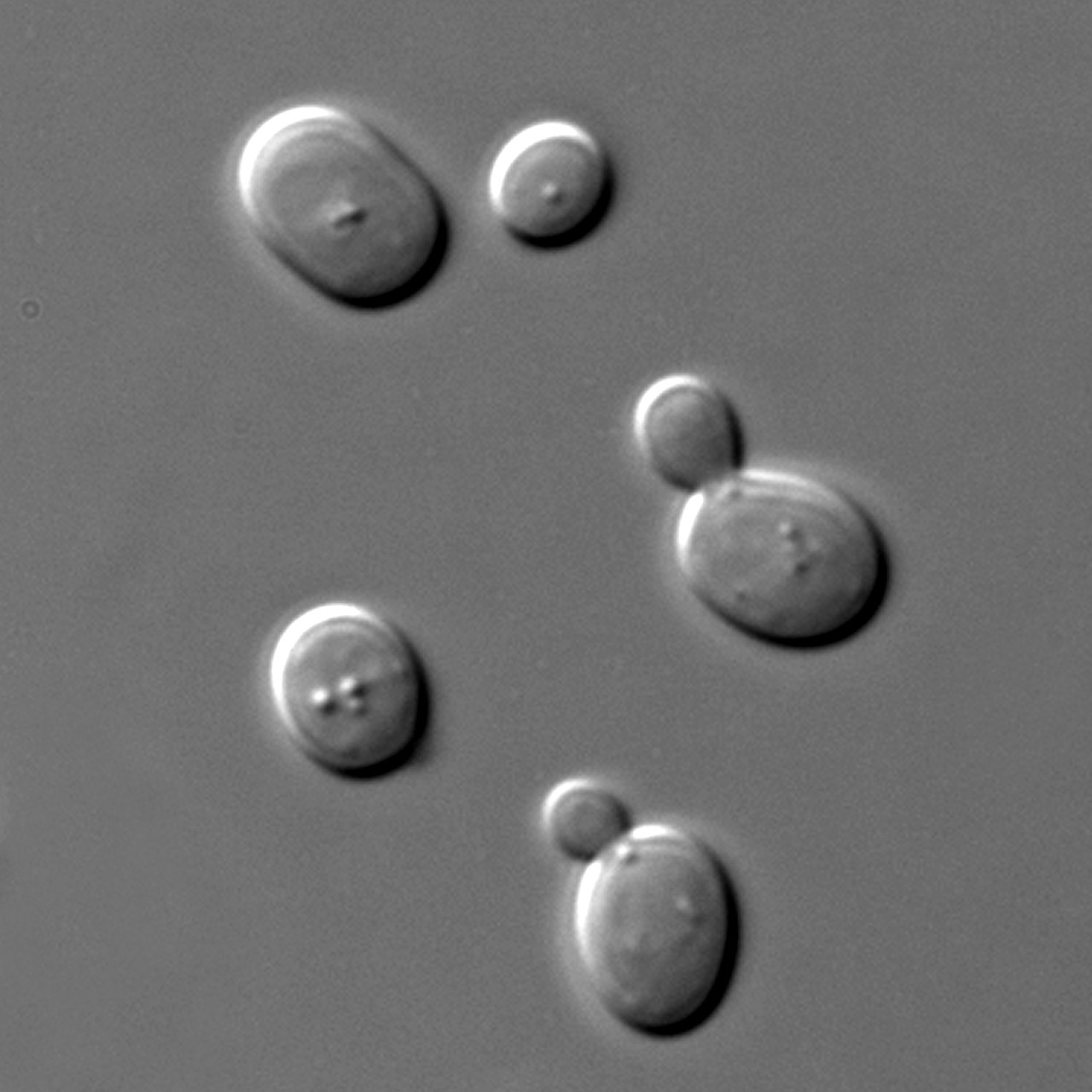
| Torula | |
|---|---|
Scientific classification 
| |
| Kingdom: | Fungi |
| Division: | Ascomycota |
| Class: | Saccharomycetes |
| Order: | Phaffomycetales |
| Family: | Phaffomycetaceae |
| Genus: | Cyberlindnera |
| Species: | C. jadinii
|
| Binomial name | |
| Cyberlindnera jadinii (Sartory, R. Sartory, Jos. Weill & J. Mey.) Minter, 2009
| |
| Synonyms | |
|
Homotypic, teleomorph
Heterotypic, anamorph
| |
Cyberlindnera jadinii, commonly known as torula in the food industry, is a species of yeast. It is used as a savory, protein-rich food ingredient as well as a food bait for insects. It is also commonly known as the anamorphic name Candida utilis, which has been discarded under the "one fungus, one name" change.
Taxonomic history
Lindnera jadinii was split from Pichia in 2008 under a genetic study.[3] Unfortunately the genus name Lindera was illegitimate, hence the change to Cyberlindnera jadinii in 2009.[4] The species was originally isolated from cow absesses. Natural populations are mainly diploid.[5]
Torula utilis, renamed Candida utilis in 1952, was originally isolated in flowers. It is also found as a contaminant in industrial fermentations, and also from human and animal sources. It represents a triploid, asexual lineage of C. jadinii.[5]
Use
Food flavoring
Torula, in its inactive form (usually labeled as torula yeast), is widely used as a flavoring in processed foods and pet foods. It is often grown on wood liquor, a byproduct of paper production, which is rich in wood sugars (xylose).[6] It is pasteurized and spray-dried to produce a fine, light grayish-brown powder with a slightly yeasty odor and gentle, slightly meaty taste.
Like the flavor enhancer monosodium glutamate (MSG), torula is rich in glutamic acid. Therefore, it has become a popular replacement among manufacturers wishing to eliminate MSG or hide flavor enhancer usage in an ingredients list. It also enables the marketing of "all-natural" ingredients.
Cyberlindnera jadinii (which in these contexts is often still labelled with its synonym Candida utilis) can be used, in a blend of various other yeasts, as secondary cheese starter culture "... to inoculate pasteurised milk, which mimic the natural yeast flora of raw milk and improve cheese flavour. Other functions of the added yeast organisms are the neutralisation of the curd (lactate degradation) and galactose consumption."[7]
Insect trap
Torula finds accepted use in Europe and California for the organic control of olive flies. When dissolved in water, it serves as a food attractant, with or without additional pheromone lures, in McPhail and OLIPE traps, which drown the insects. In field trials in Sonoma County, California, mass trappings reduced crop damage to an average of 30% compared to almost 90% in untreated controls.[8]
See also

References
- ^ Henneberg, W. (1926). Handbuch der Gärungsbakteriologie. Zweite Auflage. Zweite Band. Spezielle Pilzkunde. Verlag Paul Parey, Berlin. link.
- ^ "Synonymy of Cyberlindnera jadinii (Sartory, R. Sartory, Weill & J. Mey.) Minter, Mycotaxon 110: 474 (2009)". speciesfungorum.org. Species Fungorum/Index Fungorum (CABI databases). Retrieved 27 March 2017.
- ^ Kurtzman, Cletus P.; Robnett, Christie J.; Basehoar-Powers, Eleanor (September 2008). "Phylogenetic relationships among species of Pichia, Issatchenkia and Williopsis determined from multigene sequence analysis, and the proposal of Barnettozyma gen. nov., Lindnera gen. nov. and Wickerhamomyces gen. nov". FEMS Yeast Research. 8 (6): 939–954. doi:10.1111/j.1567-1364.2008.00419.x.
- ^ Minter, D.W. 2009. Cyberlindnera, a replacement name for Lindnera Kurtzman et al., nom. illegit. Mycotaxon. 110:473-476
- ^ a b Rupp, Oliver; Brinkrolf, Karina; Buerth, Christoph; Kunigo, Maya; Schneider, Jessica; Jaenicke, Sebastian; Goesmann, Alexander; Pühler, Alfred; Jaeger, Karl-Erich; Ernst, Joachim F. (October 2015). "The structure of the Cyberlindnera jadinii genome and its relation to Candida utilis analyzed by the occurrence of single nucleotide polymorphisms". Journal of Biotechnology. 211: 20–30. doi:10.1016/j.jbiotec.2015.06.423.
- ^ Blech, Zushe Yosef (2008). "Essays in Kashrus and Food Science". Kosher Food Production (2nd ed.). Ames, Iowa, USA: Wiley-Blackwell. John Wiley & Sons, Ltd. 311–312. doi:10.1002/9780813804750. ISBN 978-0-8138-2093-4.
- ^ Law, Barry A.; Tamime, Adnan (2010). Technology of Cheesemaking (2nd ed.). Society of Dairy Technology series. Chichester, West Sussex, United Kingdom: Wiley-Blackwell. John Wiley & Sons, Ltd. 204. doi:10.1002/9781444323740. ISBN 978-1-405-18298-0.
- ^ "Controlling Olive Fruit Fly at Home" (PDF). University of California Cooperative Extension. Archived from the original (PDF) on December 18, 2011. Retrieved 2010-05-01.