| The Chattri | |
|---|---|
 Looking southwards towards Brighton | |
Location of the Chattri within Brighton and Hove | |
| General information | |
| Type | War memorial |
| Architectural style | Orientalist |
| Location | Brighton and Hove, England, Deep Bottom, off A27, Patcham |
| Coordinates | 50°53′3″N 0°8′49″W / 50.88417°N 0.14694°W / 50.88417; -0.14694 |
| Elevation | 500 feet (150 m) |
| Construction started | August 1920 |
| Completed | December 1920 |
| Inaugurated | 1 February 1921 |
| Cost | £4,964 (£251,900 in 2023)[1] |
| Height | 29 feet (8.8 m) |
| Dimensions | |
| Diameter | 9 feet (2.7 m) |
| Design and construction | |
| Architect | Elias Cosmas Henriques |
| Architecture firm | William Kirkpatrick Ltd, Trafford Park, Manchester |


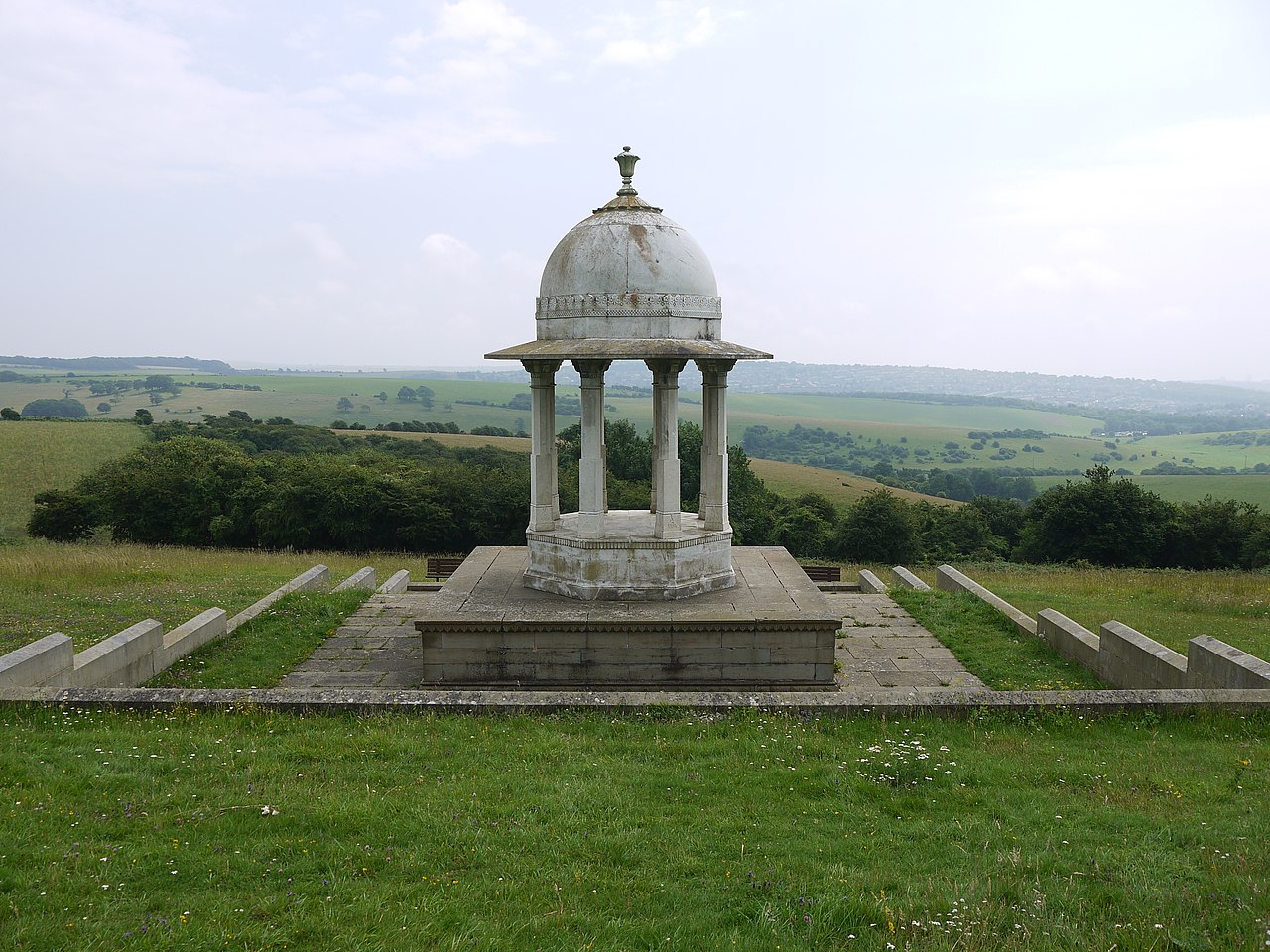
The Chattri is a war memorial in the English city of Brighton and Hove. It is sited 500 feet (150 m) above the city on the South Downs above the suburb of Patcham, and is accessible only by bridleway. It stands on the site where 53 (37 Hindu and 16 Sikh) Indian soldiers who fought for the British Empire were cremated during the First World War. The structure has Grade II listed status, reflecting its architectural and historic importance. In 2017, as part of the 100th anniversary of World War I, the site of the Chattri was dedicated as a Fields in Trust Centenary Field because of its local heritage and significance.[2]
Background: Indian soldiers in Brighton
Over 800,000 Indian soldiers fought for the British Empire during the First World War.[3] During the four years of fighting, thousands of wounded combatants were brought to Britain and many large buildings were converted into makeshift hospitals. Three such hospitals were established in Brighton, including one in the Royal Pavilion, a former royal palace known for its Indian-style architecture. In December 1914, 345 injured soldiers were transported to Brighton by train and were transferred to the hospitals.[3] The King and Queen, Mayor of Brighton, Chief Constable of Brighton and other dignitaries visited frequently, and careful arrangements were made at the Royal Pavilion to provide for the different dietary and other cultural requirements of Hindus, Sikhs and Muslims.[4]
Although the great majority of soldiers recovered from their injuries, some died. The 21[5] Muslim men who died were taken to the Shah Jahan Mosque in Woking, Surrey, and buried in accordance with Islamic tradition in a new cemetery.[4][6] The bodies of 53 Hindus and Sikhs were taken to a remote location high on the South Downs above Brighton, where a ghat (funeral pyre) was built so they could be cremated and their ashes scattered in the English Channel. This funeral rite was again carried out in line with religious custom.[4][6][7] In total, 18 men who were treated at the Royal Pavilion died, ten of whom were cremated on the ghat.[5] (The 56 other victims died at the Kitchener Hospital—now Brighton General Hospital—or a temporarily converted school at York Place.)[3][5]
Inception

In August 1915, soon after the last cremations at the ghat site, Lieutenant Das Gupta of the Indian Medical Service approached the Mayor of Brighton, Sir John Otter, with a proposal for a memorial to the Indian soldiers. After leaving office, Otter chaired Brighton's Indian Memorials Committee and became the driving force behind the project. He proposed a memorial on the site of the ghat, and another in Brighton town centre—the latter became the Indian Memorial Gate at the Royal Pavilion. The site of the ghat and the surrounding land were owned by Marquess of Abergavenny who, in 1916, donated it to the Borough of Brighton. Otter shared his proposal with the India Office (the government department responsible for administering India), which agreed to share the cost of the Chattri.[8][9]
Funds were raised during 1917. After delays caused by the need to dedicate all available resources to the war effort, in April 1918 a building firm, KirkPatrick Brothers of Trafford Park near Manchester, was awarded the contract to build the memorial. The main building material was marble; its arrival from Sicily was delayed by more than a year. Construction began in August 1920 and was completed by the end of the year.[10]
History
The Chattri was designed by E. C. Henriques, a junior architect from Bombay working for the Indian government, who was studying in England. Sir Samuel Swinton Jacob served as supervising architect. Jacob was an English architect who had worked in India and who helped pioneer the Indo-Saracenic architectural style.[11][12][13][14] Henriques waived a fee and accepted only reimbursement of expenses.[9]
Construction work started in August 1920 and continued until the end of that year.[15] A cottage was provided nearby for a caretaker. This added £1,117 (£56,700 in 2023)[1] to the final cost of £4,964 (£251,900 in 2023).[1]
Otter initially approached the Duke of Connaught (a member of the royal family and army officer who had worked with Indian troops), but the duke was due to be out of the country on the proposed date. The unveiling ceremony was held on 1 February 1921. Edward, Prince of Wales presided.[9]
Responsibility for the maintenance of the Chattri fell to the Borough of Brighton but the memorial was neglected in the years after the unveiling and was allowed to fall into disrepair. By the 1930s, the caretaker had died; no replacement was appointed and the cottage was demolished. The Imperial War Graves Commission (IWGC) and the India Office prompted the Borough Corporation into action in 1924, but complaints about the condition of the site continued. In 1939, the IWGC drew up a maintenance plan, which included abandoning 2-acre (0.81 ha) of surrounding land to focus on the monument itself. This was agreed, though the corporation was reluctant to pay for the restoration works and postponed them to 1942. By then, the Second World War was underway and the land had been requisitioned for military use so repairs were delayed further. The area was used for rifle practice and by the end of the war the Chattri was peppered with bullet holes. The military agreed to cover the cost of repair and restoration works when it relinquished the land in 1946.[15]
The Royal British Legion organised a pilgrimage to the Chattri on 18 September 1932, the first major event since the unveiling in 1921. The service included local dignitaries and military veterans, as well Sir Bhupendra Nath Mitra, the Indian high commissioner. The Legion resurrected the event in 1951 and it was held annually until 1999 when the Legion was unable to continue organising the event. Since 2000, a public ceremony has been held annually on the third Sunday in June, organised by the local Sikh community. The event is supported by local members of the Hindu community, armed forces, and veterans' associations.[15]
The Chattri was listed at Grade II by English Heritage on 20 August 1971.[12]
Architecture and location

The Chattri was built at the exact location where the funeral pyres were constructed for the cremation of the 53 soldiers.[4][16][17] This is a peaceful, isolated position on the South Downs, 500 feet (150 m) above Brighton and overlooking the city and the sea. The only access to the memorial is from a path off a bridleway between the A27 Brighton Bypass at Patcham and the Clayton Windmills at the top of the Downs.[16] The bridleway, which at that point runs along a ridge between Hogtrough Bottom and Deep Bottom, is part of the Sussex Border Path, and The Chattri is at the northern extremity of the City of Brighton and Hove, on the border with the Mid Sussex district of West Sussex.[18]
White marble from Sicily was used for the body of the memorial.[12] It sits on a plinth of grey stone which stands over three blocks of granite which cover the slabs used during the cremations.[16] The Chattri takes the form of a tall, domed pavilion, rising to 29 feet (8.8 m) to the finial at its apex.[11][16][17] The base is square, and the eight columns carrying the dome start with square bases before becoming octagonal halfway up. The base of the dome is then octagonal.[12][16] The plinth bears an inscription in English, Hindi, Punjabi and Urdu,[11][16] the text of which was prepared by Sir John Otter:[15]
To the memory of all Indian soldiers who gave their lives for the King-Emperor in the Great War, this monument, erected on the site of the funeral pyre where Hindus and Sikhs who died in hospital at Brighton passed through the fire, is in grateful admiration and brotherly love dedicated.[11][12]
Cremation Memorial
The names of the cremated dead are not listed on the Chattri memorial, but were belatedly listed on the Patcham Down Indian Forces' Cremation Memorial, erected in 2010 by the Commonwealth War Graves Commission. Most of the dead had been previously listed on the Indian Memorial at Neuve-Chapelle in France primarily for those missing on the Western Front and eight on the Hollybrook Memorial in Southampton which was primarily for soldiers who died at sea. The CWGC had decided in 2009 that as these men were not "missing" they deserved appropriate commemoration at the site they were cremated. The memorial stands within the grounds beside the lane approaching the Chattri. Its introduction is inscribed, in English, Hindi and Punjabi:[19]
In honour of these soldiers of the Indian Army whose mortal remains were committed to fire.[19]
Gallery
-
The Chattri Brighton noticeboard explaining the monument
-
Chattri Brighton viewed from the South South West at a distance
-
Chattri Brighton viewed from the West, with the Cremation Memorial (in foreground, right)
-
Chattri Brighton Patcham Down Indian Forces Cremation Memorial listing names of the fallen
-
Chattri Brighton, Inscription on the base of the Chattri
-
Chattri Brighton from the South West
-
Chattri Brighton from the West
-
Chattri Brighton from the North West
-
Chattri Brighton from the North North West
-
Chattri Brighton from the North



See also
- Grade II listed buildings in Brighton and Hove: C–D
- List of public art in Brighton and Hove
- Lions of the Great War, another memorial dedicated to Indian Soldiers who fought in the First World War.
Notes
- ^ a b c UK Retail Price Index inflation figures are based on data from Clark, Gregory (2017). "The Annual RPI and Average Earnings for Britain, 1209 to Present (New Series)". MeasuringWorth. Retrieved 7 May 2024.
- ^ "The Chattri, Brighton". Fields in Trust. Retrieved 3 December 2017.
- ^ a b c Bridgewater 2007, p. 76.
- ^ a b c d Delorme 1987, p. 61.
- ^ a b c "A More In-Depth History: Part IV". The Chattri Official Website. Tom Donovan. 1 September 2012. Archived from the original on 10 December 2013. Retrieved 22 November 2013.
- ^ a b "Brief History". The Chattri Official Website. Tom Donovan. 1 September 2012. Archived from the original on 8 September 2013. Retrieved 22 November 2013.
- ^ Bridgewater 2007, p. 77.
- ^ Donovan, Tom (2005). "In Depth History: Part 1 – Delay and Frustration – 1916–1920". The Chattri Memorial Group. Retrieved 13 January 2026.
- ^ a b c Collis, pp. 58–59.
- ^ Donovan, Tom (2005). "In Depth History: Part 2 – Construction". The Chattri Memorial Group. Retrieved 13 January 2026.
- ^ a b c d Bridgewater 2007, p. 75.
- ^ a b c d e Historic England. "The Chattri, at NGR TQ 304 103, on land north of A27 Road and east of A23 Road, Patcham (Grade II) (1379911)". National Heritage List for England. Retrieved 22 November 2013.
- ^ Dale 1989, p. 198.
- ^ Nairn & Pevsner 1965, p. 458.
- ^ a b c d Donovan, Tom (2005). "In Depth History: Part 3 – The British Legion Pilgrimage". The Chattri Memorial Group. Retrieved 13 January 2026.
- ^ a b c d e f Carder 1990, §122.
- ^ a b Bridgewater 2007, p. 74.
- ^ Philip's Street Atlas: East Sussex (Map) (1st (colour) ed.). 2½" = 1 mile. Cartography by Ordnance Survey. George Philip Ltd. 1997. p. 119. § E3. ISBN 0-540-07312-1.
- ^ a b CWGC. "Patcham Down Indian Forces Cremation Memorial {!} Cemetery Details". CWGC. Retrieved 25 March 2023.
Bibliography
- Barringer, Tim (2022). "Ambiguities of Imperial mourning: the Patcham Chattri". Art History. 45 (3): 570–597.
- Bridgewater, Peter (2007). An Eccentric Tour of Sussex. Alfriston: Snake River Press. ISBN 978-1-906022-03-7.
- Carder, Timothy (1990). The Encyclopaedia of Brighton. Lewes: East Sussex County Libraries. ISBN 0-86147-315-9.
- Dale, Antony (1989). Brighton Churches. London: Routledge. ISBN 0-415-00863-8.
- Delorme, Mary (1987). Curious Sussex. London: Robert Hale Ltd. ISBN 0-7090-2970-5.
- Nairn, Ian; Pevsner, Nikolaus (1965). The Buildings of England: Sussex. Harmondsworth: Penguin Books. ISBN 0-14-071028-0.
External links


- Doctor Brighton's Pavilion
