Relation between frequency- and time-domain behavior at large time
数学的解析 において 、 最終値定理 (FVT)は、 周波数領域 表現と 時間が無限大に近づくにつれて 時間領域で起こる挙動を関連付けるために使用されるいくつかの類似の定理の1つです。 [1] [2] [3] [4]
数学的には、 連続時間で(片側) ラプラス変換が ある場合、最終値定理は、次の条件を確立します。
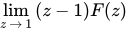
同様に、 離散時間で(片側) Z変換が ある場合、最終値定理は、次の条件を確立します。
f
(
t
)
{\displaystyle f(t)}
F
(
s
)
{\displaystyle F(s)}
lim
t
→
∞
f
(
t
)
=
lim
s
→
0
s
F
(
s
)
.
{\displaystyle \lim _{t\,\to \,\infty }f(t)=\lim _{s\,\to \,0}{sF(s)}.}
f
[
k
]
{\displaystyle f[k]}
F
(
z
)
{\displaystyle F(z)}
lim
k
→
∞
f
[
k
]
=
lim
z
→
1
(
z
−
1
)
F
(
z
)
.
{\displaystyle \lim _{k\,\to \,\infty }f[k]=\lim _{z\,\to \,1}{(z-1)F(z)}.}
アーベル終値定理は、 の時間領域の動作について仮定し、 を計算します。
逆に、タウバー終値定理は、 の周波数領域の動作について仮定し、 を計算します
( 積分変換についてはアーベル定理とタウバー定理を参照 )。
f
(
t
)
(or
f
[
k
]
)
{\displaystyle f(t){\text{ (or }}f[k])}
lim
s
→
0
s
F
(
s
)
.
{\textstyle \lim _{s\,\to \,0}{sF(s)}.}
F
(
s
)
{\displaystyle F(s)}
lim
t
→
∞
f
(
t
)
{\displaystyle \lim _{t\to \infty }f(t)}
(or
lim
k
→
∞
f
[
k
]
)
{\displaystyle {\text{(or }}\lim _{k\to \infty }f[k])}
推論する 限界 t → ∞ f ( t ) 以下の文では、表記は が0 に近づくこと を意味し 、一方、は が正の数を通じて 0 に近づくこと
を意味します。
‘
s
→
0
’
{\displaystyle {\text{‘}}s\to 0{\text{’}}}
s
{\displaystyle s}
‘
s
↓
0
’
{\displaystyle {\text{‘}}s\downarrow 0{\text{’}}}
s
{\displaystyle s}
標準最終値定理 の全ての極が 開左半平面か原点にあり、その 極は原点に最大で1つしかないとする。すると [5]
F
(
s
)
{\displaystyle F(s)}
F
(
s
)
{\displaystyle F(s)}
lim
t
→
∞
f
(
t
)
=
lim
s
→
0
s
F
(
s
)
.
{\displaystyle \lim _{t\to \infty }f(t)=\lim _{s\to 0}sF(s).}
とが 両方ともすべてのに対して存在するラプラス変換を持つ と仮定する。 が存在し、が 存在する 場合、 [3] :定理2.36 [4] :20 [6]
f
(
t
)
{\displaystyle f(t)}
f
′
(
t
)
{\displaystyle f'(t)}
s
>
0.
{\displaystyle s>0.}
lim
t
→
∞
f
(
t
)
{\displaystyle \lim _{t\to \infty }f(t)}
lim
s
→
0
s
F
(
s
)
{\displaystyle \lim _{s\,\to \,0}{sF(s)}}
lim
t
→
∞
f
(
t
)
=
lim
s
→
0
s
F
(
s
)
.
{\displaystyle \lim _{t\to \infty }f(t)=\lim _{s\,\to \,0}{sF(s)}.}
述べる
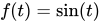
定理が成立するためには、両方の極限が存在する必要がある。例えば、 の場合 、 は存在しないが、 [3] : 例2.37 [4] : 20
f
(
t
)
=
sin
(
t
)
{\displaystyle f(t)=\sin(t)}
lim
t
→
∞
f
(
t
)
{\displaystyle \lim _{t\to \infty }f(t)}
lim
s
→
0
s
F
(
s
)
=
lim
s
→
0
s
s
2
+
1
=
0.
{\displaystyle \lim _{s\,\to \,0}{sF(s)}=\lim _{s\,\to \,0}{\frac {s}{s^{2}+1}}=0.}
改良タウバー逆最終値定理 が有界かつ微分可能で、
も 上で有界である とする 。 が ならば [ 7]
f
:
(
0
,
∞
)
→
C
{\displaystyle f:(0,\infty )\to \mathbb {C} }
t
f
′
(
t
)
{\displaystyle tf'(t)}
(
0
,
∞
)
{\displaystyle (0,\infty )}
s
F
(
s
)
→
L
∈
C
{\displaystyle sF(s)\to L\in \mathbb {C} }
s
→
0
{\displaystyle s\to 0}
lim
t
→
∞
f
(
t
)
=
L
.
{\displaystyle \lim _{t\to \infty }f(t)=L.}
拡張された最終値定理 の全ての極が左開半平面上か原点にある
と仮定する。その場合、以下のいずれかが生じる。
F
(
s
)
{\displaystyle F(s)}
s
F
(
s
)
→
L
∈
R
{\displaystyle sF(s)\to L\in \mathbb {R} }
と してそして
s
↓
0
,
{\displaystyle s\downarrow 0,}
lim
t
→
∞
f
(
t
)
=
L
.
{\displaystyle \lim _{t\to \infty }f(t)=L.}
s
F
(
s
)
→
+
∞
∈
R
{\displaystyle sF(s)\to +\infty \in \mathbb {R} }
として、 そしてと して
s
↓
0
,
{\displaystyle s\downarrow 0,}
f
(
t
)
→
+
∞
{\displaystyle f(t)\to +\infty }
t
→
∞
.
{\displaystyle t\to \infty .}
s
F
(
s
)
→
−
∞
∈
R
{\displaystyle sF(s)\to -\infty \in \mathbb {R} }
として、 そしてと して
s
↓
0
,
{\displaystyle s\downarrow 0,}
f
(
t
)
→
−
∞
{\displaystyle f(t)\to -\infty }
t
→
∞
.
{\displaystyle t\to \infty .}
特に、 がの多重極である場合 、ケース2または3が適用される [5]
s
=
0
{\displaystyle s=0}
F
(
s
)
{\displaystyle F(s)}
(
f
(
t
)
→
+
∞
or
f
(
t
)
→
−
∞
)
.
{\displaystyle (f(t)\to +\infty {\text{ or }}f(t)\to -\infty ).}
一般化された最終値定理 がラプラス変換可能である とする。 が存在し、 が 存在する
場合、
f
(
t
)
{\displaystyle f(t)}
λ
>
−
1
{\displaystyle \lambda >-1}
lim
t
→
∞
f
(
t
)
t
λ
{\textstyle \lim _{t\to \infty }{\frac {f(t)}{t^{\lambda }}}}
lim
s
↓
0
s
λ
+
1
F
(
s
)
{\textstyle \lim _{s\downarrow 0}{s^{\lambda +1}F(s)}}
lim
t
→
∞
f
(
t
)
t
λ
=
1
Γ
(
λ
+
1
)
lim
s
↓
0
s
λ
+
1
F
(
s
)
,
{\displaystyle \lim _{t\to \infty }{\frac {f(t)}{t^{\lambda }}}={\frac {1}{\Gamma (\lambda +1)}}\lim _{s\downarrow 0}{s^{\lambda +1}F(s)},}
ここで ガンマ関数 を表す 。 [5]
Γ
(
x
)
{\displaystyle \Gamma (x)}
アプリケーション 最終値定理は、 システムの長期安定性 を確立する際に応用されます 。
lim
t
→
∞
f
(
t
)
{\displaystyle \lim _{t\to \infty }f(t)}
推論する 限界 s → 0 s F ( s )
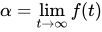
アーベル終値定理 が有界かつ測定可能であり、 すべてのに対して が存在すると 仮定する 。 [7]
f
:
(
0
,
∞
)
→
C
{\displaystyle f:(0,\infty )\to \mathbb {C} }
lim
t
→
∞
f
(
t
)
=
α
∈
C
.
{\displaystyle \lim _{t\to \infty }f(t)=\alpha \in \mathbb {C} .}
F
(
s
)
{\displaystyle F(s)}
s
>
0
{\displaystyle s>0}
lim
s
↓
0
s
F
(
s
)
=
α
.
{\displaystyle \lim _{s\,\downarrow \,0}{sF(s)}=\alpha .}
初等的証明 [7]
便宜上、 を と し、 とする 。 を とする と、 すべての に対して となる。すべて
の に対して と なる
ので
、
|
f
(
t
)
|
≤
1
{\displaystyle |f(t)|\leq 1}
(
0
,
∞
)
,
{\displaystyle (0,\infty ),}
α
=
lim
t
→
∞
f
(
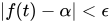
t
)
{\displaystyle \alpha =\lim _{t\to \infty }f(t)}
ϵ
>
0
,
{\displaystyle \epsilon >0,}
A
{\displaystyle A}
|
f
(
t
)
−
α
|
<
ϵ
{\displaystyle |f(t)-\alpha |<\epsilon }
t
>
A
.
{\displaystyle t>A.}
s
∫
0
∞
e
−
s
t
d
t
=
1
,
{\displaystyle s\int _{0}^{\infty }e^{-st}\,\mathrm {d} t=1,}
s
>
0
{\displaystyle s>0}
s
F
(
s
)
−
α
=
s
∫
0
∞
(
f
(
t
)
−
α
)
e
−
s
t
d
t
;
{\displaystyle sF(s)-\alpha =s\int _{0}^{\infty }(f(t)-\alpha )e^{-st}\,\mathrm {d} t;}
したがって
|
s
F
(
s
)
−
α
|
≤
s
∫
0
A
|
f
(
t
)
−
α
|
e
−
s
t
d
t
+
s
∫
A
∞
|
f
(
t
)
−
α
|
e
−
s
t
d
t
≤
2
s
∫
0
A
e
−
s
t
d
t
+
ϵ
s
∫
A
∞
e
−
s
t
d
t
≡
I
+
I
I
.
{\displaystyle |sF(s)-\alpha |\leq s\int _{0}^{A}|f(t)-\alpha |e^{-st}\,\mathrm {d} t+s\int _{A}^{\infty }|f(t)-\alpha |e^{-st}\,\mathrm {d} t\leq 2s\int _{0}^{A}e^{-st}\,\mathrm {d} t+\epsilon s\int _{A}^{\infty }e^{-st}\,\mathrm {d} t\equiv I+II.}
今、私たちが持っている
ものすべてについて
s
>
0
{\displaystyle s>0}
I
I
<
ϵ
s
∫
0
∞
e
−
s
t
d
t
=
ϵ
.
{\displaystyle II<\epsilon s\int _{0}^{\infty }e^{-st}\,\mathrm {d} t=\epsilon .}
一方、 は固定されているため、 であることは明らかであり 、が十分に小さい 場合は となります 。
A
<
∞
{\displaystyle A<\infty }
lim
s
→
0
I
=
0
{\displaystyle \lim _{s\to 0}I=0}
|
s
F
(
s
)
−
α
|
<
ϵ
{\displaystyle |sF(s)-\alpha |<\epsilon }
s
>
0
{\displaystyle s>0}
次の条件がすべて満たされていると仮定します。
f
:
(
0
,
∞
)
→
C
{\displaystyle f:(0,\infty )\to \mathbb {C} }
は連続的に微分可能であり、との両方 が ラプラス変換を持つ
f
{\displaystyle f}
f
′
{\displaystyle f'}
f
′
{\displaystyle f'}
絶対積分可能、つまり 有限である
∫
0
∞
|
f
′
(
τ
)
|
d
τ
{\displaystyle \int _{0}^{\infty }|f'(\tau )|\,\mathrm {d} \tau }
lim
t
→
∞
f
(
t
)
{\displaystyle \lim _{t\to \infty }f(t)}
存在し、有限である その後 [8]
lim
s
→
0
+
s
F
(
s
)
=
lim
t
→
∞
f
(
t
)
.
{\displaystyle \lim _{s\to 0^{+}}sF(s)=\lim _{t\to \infty }f(t).}
述べる
証明には 優勢収束定理 を用いる。 [8]
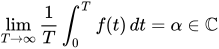
関数の平均の最終値定理 を連続かつ 有界な関数 とし、次の極限が存在するものと
する。
f
:
(
0
,
∞
)
→
C
{\displaystyle f:(0,\infty )\to \mathbb {C} }
lim
T
→
∞
1
T
∫
0
T
f
(
t
)
d
t
=
α
∈
C
{\displaystyle \lim _{T\to \infty }{\frac {1}{T}}\int _{0}^{T}f(t)\,dt=\alpha \in \mathbb {C} }
その後 [9]
lim
s
→
0
,
s
>
0
s
F
(
s
)
=
α
.
{\displaystyle \lim _{s\,\to \,0,\,s>0}{sF(s)}=\alpha .}
周期関数の漸近和の最終値定理 が連続かつ絶対積分可能である とする。 さらに、が 漸近
的 に周期関数の有限和に等しいとする。
f
:
[
0
,
∞
)
→
R
{\displaystyle f:[0,\infty )\to \mathbb {R} }
[
0
,
∞
)
.
{\displaystyle [0,\infty ).}
f
{\displaystyle f}
f
a
s
,
{\displaystyle f_{\mathrm {as} },}
|
f
(
t
)
−
f
a
s
(
t
)
|
<
ϕ
(
t
)
,
{\displaystyle |f(t)-f_{\mathrm {as} }(t)|<\phi (t),}
ここで は で絶対積分可能であり 、無限大でゼロとなる。すると
ϕ
(
t
)
{\displaystyle \phi (t)}
[
0
,
∞
)
{\displaystyle [0,\infty )}
lim
s
→
0
s
F
(
s
)
=
lim
t
→
∞
1
t
∫
0
t
f
(
x
)
d
x
.
{\displaystyle \lim _{s\to 0}sF(s)=\lim _{t\to \infty }{\frac {1}{t}}\int _{0}^{t}f(x)\,\mathrm {d} x.}
[10]
無限大に発散する関数の最終値定理 以下の条件をすべて満たすもの
とします。
f
(
t
)
:
[
0
,
∞
)
→
R
{\displaystyle f(t):[0,\infty )\to \mathbb {R} }
f
(
t
)
{\displaystyle f(t)}
ゼロで無限に微分可能である
f
(
k
)
(
t
)
{\displaystyle f^{(k)}(t)}
すべての非負整数に対してラプラス変換を持つ
k
{\displaystyle k}
f
(
t
)
{\displaystyle f(t)}
無限大に発散する
t
→
∞
{\displaystyle t\to \infty }
をラプラス変換すると、 は [11] のように無限大に発散する 。
F
(
s
)
{\displaystyle F(s)}
f
(
t
)
{\displaystyle f(t)}
s
F
(
s
)
{\displaystyle sF(s)}
s
↓
0.
{\displaystyle s\downarrow 0.}
が 測定可能で、(おそらく不正確な)積分が に対して収束するような 場合、
これは アーベルの定理
のバージョンです 。
h
:
[
0
,
∞
)
→
R
{\displaystyle h:[0,\infty )\to \mathbb {R} }
f
(
x
)
:=
∫
0
x
h
(
t
)
d
t
{\displaystyle f(x):=\int _{0}^{x}h(t)\,\mathrm {d} t}
x
→
∞
.
{\displaystyle x\to \infty .}
∫
0
∞
h
(
t
)
d
t
:=
lim
x
→
∞
f
(
x
)
=
lim
s
↓
0
∫
0
∞
e
−
s
t
h
(
t
)
d
t
.
{\displaystyle \int _{0}^{\infty }h(t)\,\mathrm {d} t:=\lim _{x\to \infty }f(x)=\lim _{s\downarrow 0}\int _{0}^{\infty }e^{-st}h(t)\,\mathrm {d} t.}
これを確認するには、 部分積分の 後 に最終値定理を適用することに注意する 。
f
′
(
t
)
=
h
(
t
)
{\displaystyle f'(t)=h(t)}
f
{\displaystyle f}
s
>
0
,
{\displaystyle s>0,}
s
∫
0
∞
e
−
s
t
f
(
t
)
d
t
=
[
−
e
−
s
t
f
(
t
)
]
t
=
o
∞
+
∫
0
∞
e
−
s
t
f
′
(
t
)
d
t
=
∫
0
∞
e
−
s
t
h
(
t
)
d
t
.
{\displaystyle s\int _{0}^{\infty }e^{-st}f(t)\,\mathrm {d} t={\Big [}-e^{-st}f(t){\Big ]}_{t=o}^{\infty }+\int _{0}^{\infty }e^{-st}f'(t)\,\mathrm {d} t=\int _{0}^{\infty }e^{-st}h(t)\,\mathrm {d} t.}
最終値定理により、左辺は 次のように収束する。
lim
x
→
∞
f
(
x
)
{\displaystyle \lim _{x\to \infty }f(x)}
s
→
0.
{\displaystyle s\to 0.}
実用上、 不定積分の収束性を確認するには、 不定積分に対するディリクレの検定が 役立つことが多い。一例として、 ディリクレ積分が 挙げられる。
lim
x
→
∞
f
(
x
)
{\displaystyle \lim _{x\to \infty }f(x)}
アプリケーション 最終値定理は 確率統計において、 確率変数のモーメント を計算するために応用されています。 連続確率変数の 累積分布関数 を とし 、 の ラプラス・スティルチェス変換を とします。 すると、 の - 次モーメントは次 のように計算できます。
この戦略では、
が連続で、 の各
関数 について と書きます。 各について、の 逆ラプラス変換 を と 書きます 。 を 取得し
、最終値定理を適用して を導き出します
。
lim
s
→
0
s
F
(
s
)
{\displaystyle \lim _{s\,\to \,0}{sF(s)}}
R
(
x
)
{\displaystyle R(x)}
X
{\displaystyle X}
ρ
(
s
)
{\displaystyle \rho (s)}
R
(
x
)
.
{\displaystyle R(x).}
n
{\displaystyle n}
X
{\displaystyle X}
E
[
X
n
]
=
(
−
1
)
n
d
n
ρ
(
s
)
d
s
n
|
s
=
0
.
{\displaystyle E[X^{n}]=(-1)^{n}\left.{\frac {d^{n}\rho (s)}{ds^{n}}}\right|_{s=0}.}
d
n
ρ
(
s
)
d
s
n
=
F
(
G
1
(
s
)
,
G
2
(
s
)
,
…
,
G
k
(
s
)
,
…
)
,
{\displaystyle {\frac {d^{n}\rho (s)}{ds^{n}}}={\mathcal {F}}{\bigl (}G_{1}(s),G_{2}(s),\dots ,G_{k}(s),\dots {\bigr )},}
F
(
…
)
{\displaystyle {\mathcal {F}}(\dots )}
k
,
{\displaystyle k,}
G
k
(
s
)
=
s
F
k
(
s
)
{\displaystyle G_{k}(s)=sF_{k}(s)}
F
k
(
s
)
.
{\displaystyle F_{k}(s).}
k
,
{\displaystyle k,}
f
k
(
t
)
{\displaystyle f_{k}(t)}
F
k
(
s
)
,
{\displaystyle F_{k}(s),}
lim
t
→
∞
f
k
(
t
)
,
{\displaystyle \lim _{t\to \infty }f_{k}(t),}
lim
s
→
0
G
k
(
s
)
=
lim
s
→
0
s
F
k
(
s
)
=
lim
t
→
∞
f
k
(
t
)
.
{\displaystyle \lim _{s\,\to \,0}{G_{k}(s)}=\lim _{s\,\to \,0}{sF_{k}(s)}=\lim _{t\to \infty }f_{k}(t).}
d
n
ρ
(
s
)
d
s
n
|
s
=
0
=
F
(
lim
s
→
0
G
1
(
s
)
,
lim
s
→
0
G
2
(
s
)
,
…
,
lim
s
→
0
G
k
(
s
)
,
…
)
,
{\displaystyle \left.{\frac {d^{n}\rho (s)}{ds^{n}}}\right|_{s=0}={\mathcal {F}}{\Bigl (}\lim _{s\,\to \,0}G_{1}(s),\lim _{s\,\to \,0}G_{2}(s),\dots ,\lim _{s\,\to \,0}G_{k}(s),\dots {\Bigr )},}
そして、それ が得られます。
E
[
X
n
]
{\displaystyle E[X^{n}]}
例
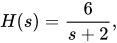
FVTが成立する例 例えば、 伝達関数で記述されるシステムの場合
H
(
s
)
=
6
s
+
2
,
{\displaystyle H(s)={\frac {6}{s+2}},}
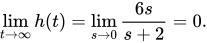
インパルス 応答は 収束する
lim
t
→
∞
h
(
t
)
=
lim
s
→
0
6
s
s
+
2
=
0.
{\displaystyle \lim _{t\to \infty }h(t)=\lim _{s\to 0}{\frac {6s}{s+2}}=0.}
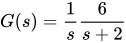
つまり、システムは短いインパルスによって擾乱された後、ゼロに戻る。しかし、 単位ステップ応答 のラプラス変換は
G
(
s
)
=
1
s
6
s
+
2
{\displaystyle G(s)={\frac {1}{s}}{\frac {6}{s+2}}}
そしてステップ応答は次のように収束する。
lim
t
→
∞
g
(
t
)
=
lim
s
→
0
s
s
6
s
+
2
=
6
2
=
3
{\displaystyle \lim _{t\to \infty }g(t)=\lim _{s\to 0}{\frac {s}{s}}{\frac {6}{s+2}}={\frac {6}{2}}=3}
したがって、ゼロ状態のシステムは、最終値 3 まで指数関数的に上昇します。
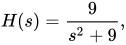
FVTが成立しない例 伝達関数によって記述されるシステムの場合
H
(
s
)
=
9
s
2
+
9
,
{\displaystyle H(s)={\frac {9}{s^{2}+9}},}
最終値定理は、インパルス応答の最終値が0、ステップ応答の最終値が1であると予測するように 見える 。しかし、どちらの時間領域制限も存在しないため、最終値定理の予測は有効ではない。実際には、インパルス応答とステップ応答はどちらも振動しており、(この特殊なケースでは)最終値定理は応答が振動する平均値を記述する。
制御理論 では、最終値定理の有効な結果を確認するための
2 つのチェックが実行されます。
の分母のゼロでない根はすべて、 負の実部を持たなければなりません。
H
(
s
)
{\displaystyle H(s)}
H
(
s
)
{\displaystyle H(s)}
原点に複数の極を持つことはできません。 この例では、分母の根が 以下の通りであるため、ルール1は満たされていない。
0
+
j
3
{\displaystyle 0+j3}
0
−
j
3.
{\displaystyle 0-j3.}
推論する lim k → ∞ f [ k ]
最終値定理 が存在し、 存在する 場合 [4] :101
lim
k
→
∞
f
[
k
]
{\displaystyle \lim _{k\to \infty }f[k]}
lim
z
→
1
(
z
−
1
)
F
(
z
)
{\displaystyle \lim _{z\,\to \,1}{(z-1)F(z)}}
lim
k
→
∞
f
[
k
]
=
lim
z
→
1
(
z
−
1
)
F
(
z
)
.
{\displaystyle \lim _{k\to \infty }f[k]=\lim _{z\,\to \,1}{(z-1)F(z)}.}
線形システムの最終値
連続時間LTIシステム システムの最終価値
x
˙
(
t
)
=
A
x
(
t
)
+
B
u
(
t
)
{\displaystyle {\dot {\mathbf {x} }}(t)=\mathbf {A} \mathbf {x} (t)+\mathbf {B} \mathbf {u} (t)}
y
(
t
)
=
C
x
(
t
)
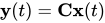
{\displaystyle \mathbf {y} (t)=\mathbf {C} \mathbf {x} (t)}
振幅のある ステップ入力に対する応答は 次のようになります。
u
(
t
)
{\displaystyle \mathbf {u} (t)}
R
{\displaystyle R}
lim
t
→
∞
y
(
t
)
=
−
C
A
−
1
B
R
{\displaystyle \lim _{t\to \infty }\mathbf {y} (t)=-\mathbf {CA} ^{-1}\mathbf {B} R}
サンプルデータシステム 上記の連続時間LTIシステムの非周期的サンプリング時間におけるサンプルデータシステムは 離散時間システムである。
t
i
,
i
=
1
,
2
,
.
.
.
{\displaystyle t_{i},i=1,2,...}
x
(
t
i
+
1
)
=
Φ
(
h
i
)
x
(
t
i
)
+
Γ
(
h
i
)
u
(
t
i
)
{\displaystyle {\mathbf {x} }(t_{i+1})=\mathbf {\Phi } (h_{i})\mathbf {x} (t_{i})+\mathbf {\Gamma } (h_{i})\mathbf {u} (t_{i})}
y
(
t
i
)
=
C
x
(
t
i
)
{\displaystyle \mathbf {y} (t_{i})=\mathbf {C} \mathbf {x} (t_{i})}
どこで そして
h
i
=
t
i
+
1
−
t
i
{\displaystyle h_{i}=t_{i+1}-t_{i}}
Φ
(
h
i
)
=
e
A
h
i
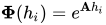
{\displaystyle \mathbf {\Phi } (h_{i})=e^{\mathbf {A} h_{i}}}
、
Γ
(
h
i
)
=
∫
0
h
i
e
A
s
d
s
{\displaystyle \mathbf {\Gamma } (h_{i})=\int _{0}^{h_{i}}e^{\mathbf {A} s}\,\mathrm {d} s}
振幅のある ステップ入力に対するこのシステムの最終値は、 元の連続時間システムの最終値と同じである。 [12]
u
(
t
)
{\displaystyle \mathbf {u} (t)}
R
{\displaystyle R}
参照
注記
^ Wang, Ruye (2010-02-17). 「初期値定理と最終値定理」。2017年12月26日時点のオリジナルよりアーカイブ 。 2011年10月21日 閲覧。 ^ アラン・V・オッペンハイム、アラン・S・ウィルスキー、S・ハミド・ナワブ (1997). Signals & Systems . ニュージャージー州、アメリカ合衆国: プレンティス・ホール. ISBN 0-13-814757-4 。 ^ abc Schiff, Joel L. (1999). 『ラプラス変換:理論と応用 』 ニューヨーク: Springer. ISBN 978-1-4757-7262-3 。 ^ abcd Graf, Urs (2004). 科学者とエンジニアのための応用ラプラス変換とZ変換 . バーゼル: Birkhäuser Verlag. ISBN 3-7643-2427-9 。 ^ abc Chen, Jie; Lundberg, Kent H.; Davison, Daniel E.; Bernstein, Dennis S. (2007年6月). 「最終値定理の再考 - 無限極限と無理関数」. IEEE Control Systems Magazine . 27 (3): 97– 99. doi :10.1109/MCS.2007.365008. ^ 「ラプラス変換の最終値定理」。ProofWiki 。 2020年 4月12日 閲覧 。 ^ abc Ullrich, David C. (2018-05-26). 「タウバーの最終値定理」. Math Stack Exchange . ^ ab Sopasakis, Pantelis (2019-05-18). 「支配収束定理を用いた最終値定理の証明」. Math Stack Exchange . ^ Murthy, Kavi Rama (2019-05-07). 「ラプラス変換における最終値定理の代替版」. Math Stack Exchange . ^ Gluskin, Emanuel (2003年11月1日). 「最終値定理のこの一般化を教えよう」. European Journal of Physics . 24 (6): 591– 597. doi :10.1088/0143-0807/24/6/005. ^ Hew, Patrick (2025-01-06). 「無限大に発散する関数の最終値定理は?」 Math Stack Exchange . ^ Mohajeri, Kamran; Madadi, Ali; Tavassoli, Babak (2021). 「遅延とドロップアウトのあるネットワークにおける非周期的サンプリングによるトラッキング制御」. International Journal of Systems Science . 52 (10): 1987– 2002. doi :10.1080/00207721.2021.1874074.
外部リンク https://web.archive.org/web/20101225034508/http://wikis.controltheorypro.com/index.php?title=最終値定理 http://fourier.eng.hmc.edu/e102/lectures/Laplace_Transform/node17.html 2017年12月26日アーカイブ Wayback Machine : ラプラスの最終値 https://web.archive.org/web/20110719222313/http://www.engr.iupui.edu/~skoskie/ECE595s7/handouts/fvt_proof.pdf: Z変換の最終値の証明 


![{\displaystyle f[k]}](https://wikimedia.org/api/rest_v1/media/math/render/svg/c0c2cac4f7a962e0e8b6e35a6ddb99c8b39763fb)

![{\displaystyle \lim _{k\,\to \,\infty }f[k]=\lim _{z\,\to \,1}{(z-1)F(z)}.}](https://wikimedia.org/api/rest_v1/media/math/render/svg/99e17af23b8f18ac7e030c383a4996c2c63842ab)
![{\displaystyle f(t){\text{ (または }}f[k])}](https://wikimedia.org/api/rest_v1/media/math/render/svg/73802d4af59c32b3791abb6e0e0c8a33b9688cad)


![{\displaystyle {\text{(または}}\lim _{k\to \infty }f[k])}](https://wikimedia.org/api/rest_v1/media/math/render/svg/902dd5ff84f23e22ae19d1437f928aaa5068d807)





























![{\displaystyle s\int _{0}^{\infty }e^{-st}f(t)\,\mathrm {d} t={\Big [}-e^{-st}f(t){\Big ]}_{t=o}^{\infty }+\int _{0}^{\infty }e^{-st}f'(t)\,\mathrm {d} t=\int _{0}^{\infty }e^{-st}h(t)\,\mathrm {d} t.}](https://wikimedia.org/api/rest_v1/media/math/render/svg/1902412d0483ebe75db1e0ca05af285d766313d9)


![{\displaystyle E[X^{n}]=(-1)^{n}\left.{\frac {d^{n}\rho (s)}{ds^{n}}}\right|_{s=0}.}](https://wikimedia.org/api/rest_v1/media/math/render/svg/2edf9220e16e8e0f2fb1cb4d03b905d946cfdb57)







![{\displaystyle E[X^{n}]}](https://wikimedia.org/api/rest_v1/media/math/render/svg/20e9c64670d7e2ee2012bcc89f130e0e96fe7bb9)




![{\displaystyle \lim _{k\to \infty }f[k]}](https://wikimedia.org/api/rest_v1/media/math/render/svg/939d92a4b7eb4101a84900dcb9ede04a340241f7)
![{\displaystyle \lim _{k\to \infty }f[k]=\lim _{z\,\to \,1}{(z-1)F(z)}.}](https://wikimedia.org/api/rest_v1/media/math/render/svg/b05faaa5c64654fb3dda2276b4c43248280349ab)