In mathematics, the Gompertz constant or Euler–Gompertz constant,[1][2] denoted by , appears in integral evaluations and as a value of special functions. It is named after Benjamin Gompertz.

It can be defined via the exponential integral as:[3]

The numerical value of is about
- δ = 0.596347362323194074341078499369... (sequence A073003 in the OEIS).
History
When Euler studied divergent infinite series, he encountered via, for example, the above integral representation. Le Lionnais called the Gompertz constant because of its role in survival analysis.[1]
In 1962, A. B. Shidlovski proved that at least one of the Euler–Mascheroni constant and the Euler–Gompertz constant is irrational.[4] This result was improved in 2012 by Tanguy Rivoal where he proved that at least one of them is transcendental.[2][5][6][7]
Identities involving the Gompertz constant
The most frequent appearance of is in the following integrals:


which follow from the definition of δ by integration of parts and a variable substitution respectively.
Applying the Taylor expansion of we have the series representation

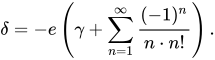
Gompertz's constant is connected to the Gregory coefficients via the 2013 formula of I. Mező:[8]

The Gompertz constant also happens to be the regularized value of the summation of alternating factorials of all natural numbers (1 − 1 + 2 − 6 + 24 − 120 + ⋯), which is defined by Borel summation:[2]

It is also related to several polynomial continued fractions:[1][2]


Notes
- ^ a b c Finch, Steven R. (2003). Mathematical Constants. Cambridge University Press. pp. 425–426.
- ^ a b c d Lagarias, Jeffrey C. (2013-07-19). "Euler's constant: Euler's work and modern developments". Bulletin of the American Mathematical Society. 50 (4): 527–628. arXiv:1303.1856. doi:10.1090/S0273-0979-2013-01423-X. ISSN 0273-0979. S2CID 119612431.
- ^ Weisstein, Eric W. "Gompertz Constant". mathworld.wolfram.com. Retrieved 2024-10-20.
- ^ Aptekarev, A. I. (28 February 2009). "On linear forms containing the Euler constant". arXiv:0902.1768 [math.NT].
- ^ Aptekarev, A. I. (2009-02-28). "On linear forms containing the Euler constant". arXiv:0902.1768 [math.NT].
- ^ Rivoal, Tanguy (2012). "On the arithmetic nature of the values of the gamma function, Euler's constant, and Gompertz's constant". Michigan Mathematical Journal. 61 (2): 239–254. doi:10.1307/mmj/1339011525. ISSN 0026-2285.
- ^ Waldschmidt, Michel (2023). "On Euler's Constant" (PDF). Sorbonne Université, Institut de Mathématiques de Jussieu, Paris.
- ^ Mező, István (2013). "Gompertz constant, Gregory coefficients and a series of the logarithm function" (PDF). Journal of Analysis and Number Theory (7): 1–4.
External links
- Wolfram MathWorld
- OEIS entry
