In mathematical logic, Goodstein's theorem is a statement about the natural numbers, proved by Reuben Goodstein in 1944, which states that every Goodstein sequence (as defined below) eventually terminates at 0. Laurence Kirby and Jeff Paris[1] showed in 1982 that Goodstein's theorem is unprovable in Peano arithmetic (but it can be proven in stronger systems, such as second-order arithmetic or Zermelo–Fraenkel set theory). This was the third example of a true statement about natural numbers that is unprovable in Peano arithmetic, after the examples provided by Gödel's incompleteness theorem and Gerhard Gentzen's 1943 direct proof of the unprovability of ε0-induction in Peano arithmetic. The Paris–Harrington theorem gave another example.
Kirby and Paris also introduced a graph-theoretic hydra game with behavior similar to that of Goodstein sequences: the "Hydra" (named for the mythological multi-headed Hydra of Lerna) is a rooted tree, and a move by "Hercules" consists of cutting off one of its "heads" (a branch of the tree), to which the Hydra responds by growing a finite number of new heads according to certain rules. Kirby and Paris proved that the Hydra will eventually be killed, regardless of the strategy that Hercules uses to chop off its heads, though this may take a very long time. Just like for Goodstein sequences, Kirby and Paris showed that it cannot be proven in Peano arithmetic alone.[1]
Hereditary base-n notation
Goodstein sequences are defined in terms of a concept called "hereditary base-n notation". This notation is very similar to usual base-n positional notation for natural numbers, but the usual notation does not suffice for the purposes of Goodstein's theorem.
To achieve the ordinary base-n notation, where n is a natural number greater than 1, an arbitrary natural number m is written as a sum of multiples of powers of n:

where each coefficient ai satisfies 0 ≤ ai < n, and ak ≠ 0.
For example, the base-3 notation of 100:

Note that the exponents of n themselves are not written in base-n notation, as is seen in the case 34, above.
To convert a base-n notation to a hereditary base-n notation, first rewrite all of the exponents as a sum of powers of n (with the limitation on the coefficients 0 ≤ ai < n). Then rewrite any exponent inside the exponents again in base-n notation (with the same limitation on the coefficients), and continue in this way until every number appearing in the expression (except the bases themselves) is written in base-n notation.
For example, 100 in hereditary base-3 notation is

Goodstein sequences
The Goodstein sequence of a number m is a sequence of natural numbers. The first element in the sequence, written as , is m itself. To get the second, , write m in hereditary base-2 notation, change all the 2s to 3s, and then subtract 1 from the result. In general, the term of the Goodstein sequence of m is computed as follows:


- Take the hereditary base-(n + 1) representation of .
- Replace each occurrence of the base (n + 1) with n + 2.
- Subtract one.

Note that depends both on and on the index n.
Now continue computing further values in the Goodstein sequence, until you reach 0, at which point the sequence terminates.
Early Goodstein sequences terminate quickly. For example, terminates at the 6th step:

| Base | Hereditary notation | Value | Notes |
|---|---|---|---|
| 2 | 3 | Write 3 in hereditary base-2 notation | |
| 3 | 3 | Switch the 2s to 3s, then subtract 1. Write in hereditary base-3 notation. | |
| 4 | 3 | Switch the 3s to a 4s, then subtract 1. Now there are no more 4s left | |
| 5 | 2 | No 4s left to switch to 5s. Just subtract 1 | |
| 6 | 1 | No 5s left to switch to 6s. Just subtract 1 | |
| 7 | 0 | No 6s left to switch to 7s. Just subtract 1 |




Later Goodstein sequences increase for a very large number of steps. For example, OEIS: A056193 starts as follows:

| Base | Hereditary notation | Value |
|---|---|---|
| 2 | 4 | |
| 3 | 26 | |
| 4 | 41 | |
| 5 | 60 | |
| 6 | 83 | |
| 7 | 109 | |
| 11 | 253 | |
| 12 | 299 | |
| 24 | 1151 | |








Elements of continue to increase for a while, but at base , they reach the maximum of , stay there for the next steps, and then begin their descent.

However, even doesn't give a good idea of just how quickly the elements of a Goodstein sequence can increase. increases much more rapidly and starts as follows:

| Hereditary notation | Value |
|---|---|
| 19 | |
| 7625597484990 | |
|
|
|
|
|
|





















In spite of this rapid growth, Goodstein's theorem states that every Goodstein sequence eventually terminates at 0, no matter what the starting value is.
Proof of Goodstein's theorem
Goodstein's theorem can be proved (using techniques outside Peano arithmetic, see below) as follows: Given a Goodstein sequence , we construct a parallel sequence of ordinal numbers in Cantor normal form that is strictly decreasing and terminates. A common misunderstanding of this proof is to believe that goes to because it is dominated by . Actually, the fact that dominates plays no role at all. The important point is: exists if and only if exists (parallelism), and comparison between two members of is preserved when comparing corresponding entries of .[2] Then if terminates, so does . By infinite regress, must reach , which guarantees termination.


We define a function that computes the hereditary base representation of and then replaces each occurrence of the base with the first infinite ordinal number . For example, .



Each term of the sequence is then defined as . For example, and . Addition, multiplication and exponentiation of ordinal numbers are well defined.


We claim that :

Let be after applying the first, base-changing operation in generating the next element of the Goodstein sequence, but before the second minus 1 operation in this generation. Observe that .


Then .[Note 1] Now we apply the minus 1 operation, and , as .[Note 2]


For example, and , so and , which is strictly smaller. Note that in order to calculate , we first need to write in hereditary base notation, as for instance the expression is not an ordinal.


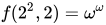



Thus the sequence is strictly decreasing. As the standard order < on ordinals is well-founded, an infinite strictly decreasing sequence cannot exist, or equivalently, every strictly decreasing sequence of ordinals terminates (and cannot be infinite). But is calculated directly from . Hence the sequence must terminate as well, meaning that it must reach .
While this proof of Goodstein's theorem is fairly easy, the Kirby–Paris theorem,[1] which shows that Goodstein's theorem is not a theorem of Peano arithmetic, is technical and considerably more difficult. It makes use of countable nonstandard models of Peano arithmetic.
Extended Goodstein's theorem
The above proof still works if the definition of the Goodstein sequence is changed so that the base-changing operation replaces each occurrence of the base with instead of . More generally, let , , be any non-decreasing sequence of integers with . Then let the st term of the extended Goodstein sequence of be as follows:


- Take the hereditary base representation of .
- Replace each occurrence of the base with .
- Subtract one.


A simple modification of the above proof shows that this sequence still terminates. For example, if and if , then , hence the ordinal is strictly greater than the ordinal



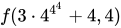

The extended version is in fact the one considered in Goodstein's original paper,[3] where Goodstein proved that it is equivalent to the restricted ordinal theorem (i.e. the claim that transfinite induction below ε0 is valid), and gave a finitist proof for the case where (equivalent to transfinite induction up to ).


The extended Goodstein's theorem without any restriction on the sequence bn is not formalizable in Peano arithmetic (PA), since such an arbitrary infinite sequence cannot be represented in PA. This seems to be what kept Goodstein from claiming back in 1944 that the extended Goodstein's theorem is unprovable in PA due to Gödel's second incompleteness theorem and Gentzen's proof of the consistency of PA using ε0-induction.[4] However, inspection of Gentzen's proof shows that it only needs the fact that there is no primitive recursive strictly decreasing infinite sequence of ordinals, so limiting bn to primitive recursive sequences would have allowed Goodstein to prove an unprovability result.[4] Furthermore, with the relatively elementary technique of the Grzegorczyk hierarchy, it can be shown that every primitive recursive strictly decreasing infinite sequence of ordinals can be "slowed down" so that it can be transformed to a Goodstein sequence where , thus giving an alternative proof to the same result Kirby and Paris proved.[4]

Sequence length as a function of the starting value
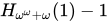
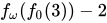
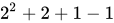
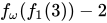
The Goodstein function, , is defined such that is the length of the Goodstein sequence that starts with n. (This is a total function since every Goodstein sequence terminates.) The extremely high growth rate of can be calibrated by relating it to various standard ordinal-indexed hierarchies of functions, such as the functions in the Hardy hierarchy, and the functions in the fast-growing hierarchy of Löb and Wainer:


- Kirby and Paris (1982) proved that
- has approximately the same growth-rate as (which is the same as that of ); more precisely, dominates for every , and dominates
- (For any two functions , is said to dominate if for all sufficiently large .)


- Cichon (1983) showed that
- where is the result of putting n in hereditary base-2 notation and then replacing all 2s with ω (as was done in the proof of Goodstein's theorem).


- Caicedo (2007) showed that if with then


- .

Some examples:
| n | |||||
|---|---|---|---|---|---|
| 1 | 2 | ||||
| 2 | 4 | ||||
| 3 | 6 | ||||
| 4 | 3·2402653211 − 2 ≈ 6.895080803×10121210694 | ||||
| 5 | > A(4,4) > 10101019727 | ||||
| 6 | > A(6,6) | ||||
| 7 | > A(8,8) | ||||
| 8 | > A3(3,3) = A(A(61, 61), A(61, 61)) | ||||
| 12 | > fω+1(64) > Graham's number | ||||
| 19 | |||||


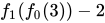


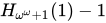






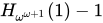



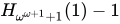





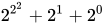



(For Ackermann function and Graham's number bounds see fast-growing hierarchy § Functions in fast-growing hierarchies.)
Application to computable functions
Goodstein's theorem can be used to construct a total computable function that Peano arithmetic cannot prove to be total. The Goodstein sequence of a number can be effectively enumerated by a Turing machine; thus the function that maps n to the number of steps required for the Goodstein sequence of n to terminate is computable by a particular Turing machine. This machine merely enumerates the Goodstein sequence of n and, when the sequence reaches 0, returns the length of the sequence. Because every Goodstein sequence eventually terminates, this function is total. But because Peano arithmetic does not prove that every Goodstein sequence terminates, Peano arithmetic does not prove that this Turing machine computes a total function.
See also
- Non-standard model of arithmetic
- Fast-growing hierarchy
- Paris–Harrington theorem
- Kanamori–McAloon theorem
- Kruskal's tree theorem
Notes
- ^ To calculate the LHS, one replaces all occurrences of to in . To calculate the RHS, one replaces all occurrences of to in to get , then changes all occurrences of in to .
- ^ Note that is strictly increasing in its first argument, as it simply interprets in base as base ; see Cantor normal form.


References
- ^ a b c Kirby & Paris 1982.
- ^ Rathjen 2014, lemma 2.2.
- ^ Goodstein 1944.
- ^ a b c Rathjen 2014.
Bibliography
- Kirby, L.; Paris, J. (1982). "Accessible Independence Results for Peano Arithmetic" (PDF). Bulletin of the London Mathematical Society. 14 (4): 285. CiteSeerX 10.1.1.107.3303. doi:10.1112/blms/14.4.285.
- Rathjen, Michael (2014). "Goodstein revisited". arXiv:1405.4484 [math.LO].
- Goodstein, R. (1944), "On the restricted ordinal theorem", Journal of Symbolic Logic, 9 (2): 33–41, doi:10.2307/2268019, JSTOR 2268019, S2CID 235597.
- Cichon, E. (1983), "A Short Proof of Two Recently Discovered Independence Results Using Recursive Theoretic Methods", Proceedings of the American Mathematical Society, 87 (4): 704–706, doi:10.2307/2043364, JSTOR 2043364.
- Caicedo, A. (2007), "Goodstein's function" (PDF), Revista Colombiana de Matemáticas, 41 (2): 381–391.
External links
- Weisstein, Eric W. "Goodstein Sequence". MathWorld.
- Some elements of a proof that Goodstein's theorem is not a theorem of PA, from an undergraduate thesis by Justin T Miller
- A Classification of non standard models of Peano Arithmetic by Goodstein's theorem - Thesis by Dan Kaplan, Franklan and Marshall College Library
- Definition of Goodstein sequences in Haskell and the lambda calculus
- The Hydra game implemented as a Java applet
- Javascript implementation of a variant of the Hydra game
- Goodstein Sequences: The Power of a Detour via Infinity - good exposition with illustrations of Goodstein Sequences and the hydra game.
- Goodstein Calculator Archived 2017-02-04 at the Wayback Machine
