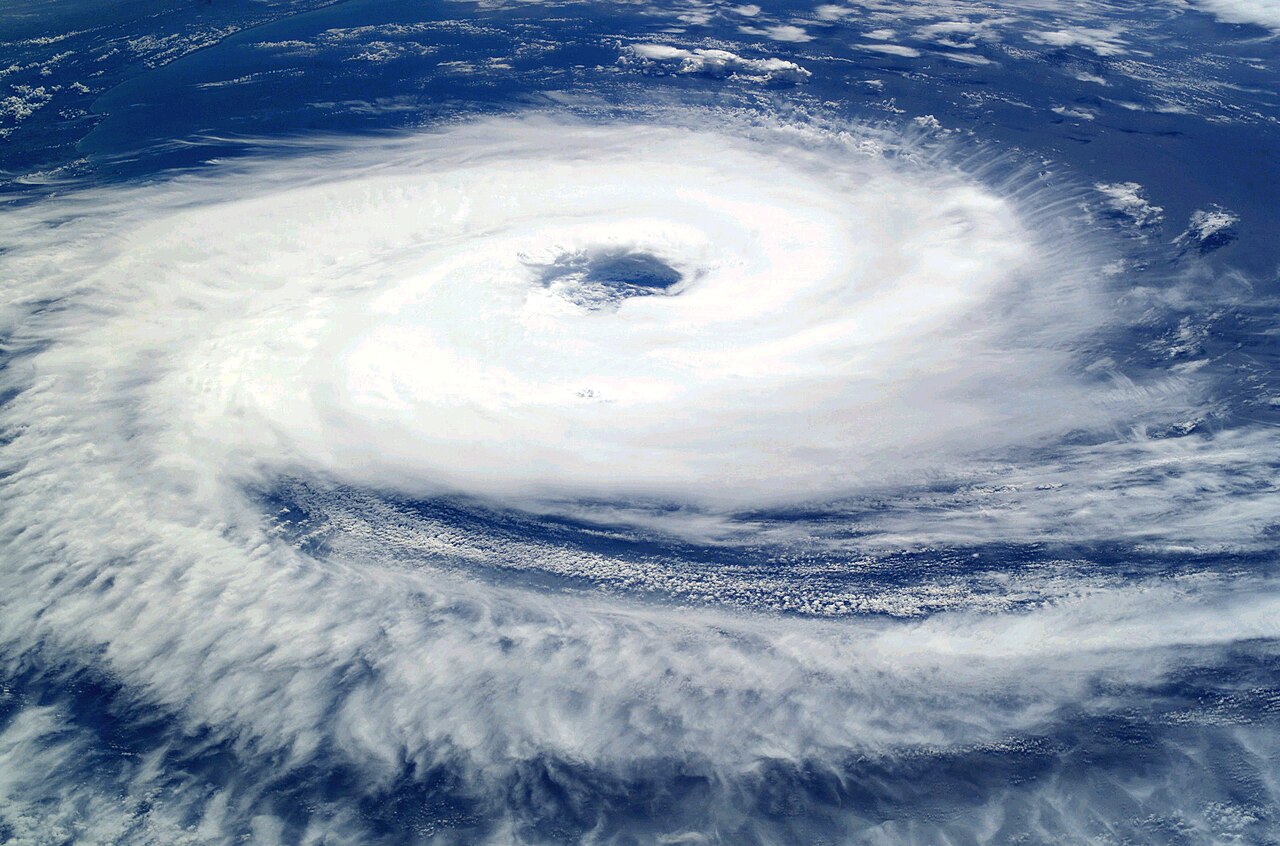
 Typhoon Hato nearing the Pearl River Delta at peak intensity on August 23 | |
| Meteorological history | |
|---|---|
| Formed | August 19, 2017 |
| Dissipated | August 25, 2017 |
| Typhoon | |
| 10-minute sustained (JMA) | |
| Highest winds | 140 km/h (85 mph) |
| Lowest pressure | 965 hPa (mbar); 28.50 inHg |
| Category 3-equivalent typhoon | |
| 1-minute sustained (SSHWS/JTWC) | |
| Highest winds | 185 km/h (115 mph) |
| Lowest pressure | 948 hPa (mbar); 27.99 inHg |
| Overall effects | |
| Fatalities | 24 total |
| Damage | $6.41 billion (2017 USD) |
| Areas affected | |
| IBTrACS | |
Part of the 2017 Pacific typhoon season | |
Typhoon Hato,[nb 1] known in the Philippines as Severe Tropical Storm Isang, was a powerful tropical cyclone that struck South China in late August 2017. The thirteenth named storm and fourth typhoon of the 2017 Pacific typhoon season, Hato developed as a tropical depression east of Luzon on August 19. It strengthened into a tropical storm the next day and emerged over the northern South China Sea on August 21, where it reached typhoon intensity. Undergoing rapid intensification on August 23, Hato became a Category 3-equivalent typhoon before making landfall in Jinwan, Zhuhai. The storm quickly weakened over land and dissipated on August 24.
One of the strongest typhoons to affect Macau and Hong Kong in the past 50 years, Hato caused extensive damage totaling US$6.82 billion along its path. Most of the destruction occurred in mainland China, where the storm produced a powerful storm surge that triggered severe flooding across several provinces along the Pearl River and generated wind gusts up to 240 km/h (150 mph). Both Hong Kong and Macau raised their highest tropical cyclone signals in anticipation of Hato, which caused more than US$1 billion in damage in each territory. While weakening, the storm also brought heavy rain and a tornado to Vietnam. In total, 24 fatalities were reported.
Hato made landfall along the southern coast of Zhuhai with Category 3-equivalent intensity, featuring both one- and two-minute sustained winds of 185 km/h (115 mph), which is strong, though not as powerful as other major typhoons. Three previous typhoons, Wanda (1962), Ruby (1964), and Vicente (2012), followed similar east-southeast to west-northwest tracks, making landfall on slightly different parts of the coast. Hato's forward speed was the fastest among them, reaching 32.5 km/h (20.2 mph), nearly twice that of Wanda.[1]
Meteorological history

Tropical storm (39–73 mph, 63–118 km/h)
Category 1 (74–95 mph, 119–153 km/h)
Category 2 (96–110 mph, 154–177 km/h)
Category 3 (111–129 mph, 178–208 km/h)
Category 4 (130–156 mph, 209–251 km/h)
Category 5 (≥157 mph, ≥252 km/h)
Unknown


 Extratropical cyclone, remnant low, tropical disturbance, or monsoon depression
During the late hours of August 18, the Joint Typhoon Warning Center (JTWC) began monitoring a tropical disturbance that had developed about 1,495 km (929 mi) southeast of Taipei, Taiwan.[2] By August 19, the Japan Meteorological Agency (JMA) classified the area of low pressure as a tropical depression.[3] Around the same time, the JTWC issued a Tropical Cyclone Formation Alert (TCFA),[4] while the JMA began issuing advisories, reporting that the system had 10-minute sustained winds of 55 km/h (35 mph).[5] By 03:00 UTC on August 20, the JTWC began issuing warnings, classifying the system as a tropical depression and designating it as 15W.[6] The Philippine Atmospheric, Geophysical and Astronomical Services Administration (PAGASA) eventually named the system Isang as it entered the Philippine Area of Responsibility.[7] Six hours later, the JMA upgraded it to a tropical storm and assigned the international name Hato.[8]
At 15:00 UTC on August 20, the Joint Typhoon Warning Center (JTWC) upgraded Hato to a tropical storm after the system became better organized.[9] By this time, Hato was located in a favorable environment with low vertical wind shear and sea surface temperatures of about 30 °C (86 °F).[10] The storm failed to intensify through most of August 21 as its low-level circulation center (LLCC) remained partly exposed and the convection appeared sheared.[11] Several hours later, the LLCC broadened as convection redeveloped near the center.[12] By August 22, the sea surface temperature around Hato had warmed to about 31 °C (88 °F),[13] prompting the Japan Meteorological Agency (JMA) to upgrade the system to a severe tropical storm.[14] The storm rapidly consolidated, forming a well-defined 20-nautical-mile-wide (37 km; 23 mi) eye and developing a much-improved convective structure with tightly curved banding feeding into the LLCC.[15] Both the JMA and JTWC upgraded Hato to a typhoon six hours later,[16] although the system’s eye soon became less organized.[17]
Early on August 23, the JTWC upgraded Hato to a Category 2 typhoon as its eye reformed beneath a growing central dense overcast.[18] Hato reached its peak intensity as a Category 3-equivalent typhoon, with Dvorak estimates peaking at T5.5.[2] The JMA assessed maximum 10-minute sustained winds of 150 km/h (95 mph) and a minimum pressure of 960 hPa (28.35 inHg), later revised in post-analysis to 140 km/h (85 mph) and 965 hPa (28.50 inHg).[2][19] However, a minimum pressure of 945 hPa (27.91 inHg) was recorded in Macau, while the China Meteorological Administration (CMA) reported 935 hPa (27.61 inHg), suggesting a higher intensity.[20] Hato made landfall along the southern coast of Zhuhai, Guangdong at 12:50 CST (04:50 UTC).[21] About three hours later, the JTWC issued its final advisory as Hato moved inland.[22] The JMA downgraded Hato to a severe tropical storm six hours later,[23] and then to a tropical storm.[24] The agency continued tracking Hato until 06:00 UTC on August 24.[25]
Impact
| Country/region | Casualties | Damage (2017 USD) |
Ref | |
|---|---|---|---|---|
| Deaths | Injured | |||
| Hong Kong | 0 | 121 | $511 million | [26][27][28] |
| Macau | 10 | 244 | $1.56 billion | [29][30] |
| Mainland China | 11 | 523 | $4.34 billion | [31][32] |
| Vietnam | 1 | 1 | $1.36 million | [33] |
| Totals: | 24 | 845 | $6.41 billion | |
Hong Kong
For the first time in five years, since Typhoon Vicente in 2012, the Hong Kong Observatory issued Hurricane Signal No. 10, the highest level in the tropical cyclone warning system.[34] The HKO recorded a record-high temperature of 36.6 °C (97.9 °F) during the typhoon.[35] The Air Quality Health Index also reached level 8 at several monitoring stations.[36] In response, businesses, government offices, schools, courts, and the stock market were closed. At least 121 injuries were reported as the storm swept through the city.[27] Widespread property damage occurred, including shattered windows, collapsed scaffolding, and more than 690 reports of fallen trees, debris, and broken glass scattered across streets and major roads.[37] Severe flooding was reported in low-lying areas such as Heng Fa Chuen, Lei Yue Mun, and Tai O due to storm surge.[38] More than 450 flights were canceled or delayed at Hong Kong International Airport, and public transport was brought to a standstill.[39] The estimated economic loss was around HK$4 billion (US$511 million).[26]
Macau

The storm was the strongest to have hit Macau in 53 years, according to Macau's Chief Executive Fernando Chui, and it was the first time in 18 years that the Macao Meteorological and Geophysical Bureau hoisted a No. 10 tropical cyclone signal.[40] Maximum hourly mean winds of 132 km/h (82 mph) and gusts of 217 km/h (135 mph) were the highest on record in Macau.[41] Most areas of the territory was hit by major flooding and property damages, with citywide power and water outage lasting for at least 24 hours after the passage of the storm. Overall, 10 deaths and at least 200 injuries were reported.[30] The head of the Macao Meteorological and Geophysical Bureau resigned due to criticisms by the Macanese public that officials failed to predict the ferocity of the storm. The Corruption Agency is investigating The Meteorology Bureau's forecasting procedures and management, including the former director Fong Soi-Kun.[42] The Macau SAR Government also announced 1.3 billion Macanese patacas would be set aside for those affected by the typhoon, with families of victims to get up to 300,000 patacas (US$37 thousand) each.[43] In total, Macau suffered an economic loss of 12.55 billion patacas (US$1.56 billion).[29]
There were shortages of basic supplies locally due to residents buying up remaining stocks in response to the utilities shortages and flooding.[44] At the request of the local government, the Chinese People's Liberation Army Macau Garrison was deployed to assist in disaster relief and cleaning up for the first time in Macau history. About 1,000 troops were called in to help remove debris and clear roads.[45] Macau police arrested two people for using phones to spread unverified information alleging that the authorities had sought to cover up the discovery of bodies in a car park during Typhoon Hato.[46]
A typhoon and storm surge coupling model demonstrated that the maximum storm surge height reached nearly 2.5 m (8.2 ft) along the coast of Macau, while that in Hong Kong was slightly below 2 m (6.6 ft). Furthermore, a field survey of urban flooding revealed evidence of a 2.25-m inundation in downtown Macau and a 0.55-m inundation on Lantau Island, Hong Kong, which were likely exacerbated by a combination of storm surge, heavy rainfall, and surface water runoff over a complex hilly terrain.[1]
China

A storm surge[clarification needed] ranging from 500 to 1,300 mm (20 to 51 in) along the Pearl River inundated parts of Guangdong, Guangxi, Yunnan, Fujian, and Guizhou provinces.[32] Peak winds of 66.9 m/s (241 km/h) were recorded in Guishan Island, Zhuhai, the strongest winds ever observed in the city.[32] A total of 267 people were injured, including 10 who sustained serious injuries.[32] Another 256 residents were stranded and required rescue operations.[32] Overall, 32 people were killed, and total economic losses across mainland China reached CN¥28.91 billion (US$4.34 billion).[47]
Vietnam
Despite passing well to the north of Vietnam, the storm triggered heavy rainfall and a tornado in Lào Cai, Vietnam on August 23. More than 754 houses were damaged in Sa Pa, which injured one person.[48] Strong winds damaged about 40 ha (99 acres) of rice crops which included 37 ha (91 acres) of corn.[48][49] The storm injured one person and total damage reached 7 billion₫ (US$308 thousand).[48] Total damage in Vietnam from the remnants of Hato reached 30 billion₫ (US$1.20 million).[33]
Retirement
Due to the extensive damage and high death toll in South China, the name Hato was officially retired during the 50th annual session of the ESCAP/WMO Typhoon Committee in February 2018. In February 2019, the Typhoon Committee subsequently chose Yamaneko as its replacement name.[50]
See also


Notes
References
- ^ a b Takagi, Hiroshi (2018). "Track analysis and storm surge investigation of 2017 Typhoon Hato: were the warning signals issued in Macau and Hong Kong timed appropriately?". Georisk. 12 (4). Taylor & Francis: 297–307. Bibcode:2018GAMRE..12..297T. doi:10.1080/17499518.2018.1465573. S2CID 116455448.
- ^ a b c "Data". Ftp.emc.ncep.noaa.gov. Archived from the original on April 2, 2021. Retrieved August 31, 2017.
- ^ "GALE WARNING : DEVELOPING LOW 1006 HPA AT 40N 157E FAR OFF EAST OF JAPAN MOVING EAST 20 KNOTS". Webcitation.org. Archived from the original on May 23, 2024. Retrieved August 31, 2017.
- ^ "JOINT TYPHOON WRNCEN PEARL HARBOR HI : SUBJ/TROPICAL CYCLONE FORMATION ALERT". Webcitation.org. Archived from the original on May 23, 2024. Retrieved August 31, 2017.
- ^ "RSMC Tropical Cyclone Advisory TD". Japan Meteorological Agency. August 19, 2017. Archived from the original on May 23, 2024.
- ^ "Tropical Depression 15W (Fifteen) Warning Nr 001". Joint Typhoon Warning Center. August 20, 2017. Archived from the original on May 23, 2024.
- ^ "Signal No. 1 up as 'Isang' develops into tropical depression". Philstar.com. August 20, 2017.
- ^ "RSMC Tropical Cyclone Advisory TS 1713 HATO (1713) UPGRADED FROM TD". Japan Meteorological Agency. August 20, 2017. Archived from the original on May 23, 2024.
- ^ "Tropical Storm 15W (Hato) Warning Nr 003". Joint Typhoon Warning Center. August 20, 2017. Archived from the original on May 23, 2024.
- ^ "Prognostic Reasoning for Tropical Storm 15W (Hato) Warning Nr 03". Joint Typhoon Warning Center. August 20, 2017. Archived from the original on May 23, 2024.
- ^ "Prognostic Reasoning for Tropical Storm 15W (Hato) Warning Nr 05A". Joint Typhoon Warning Center. August 21, 2017. Archived from the original on May 23, 2024.
- ^ "Prognostic Reasoning for Tropical Storm 15W (Hato) Warning Nr 08". Joint Typhoon Warning Center. August 21, 2017. Archived from the original on May 23, 2024.
- ^ "Prognostic Reasoning for Tropical Storm 15W (Hato) Warning Nr 09". Joint Typhoon Warning Center. August 22, 2017. Archived from the original on May 23, 2024.
- ^ "RSMC Tropical Cyclone Advisory STS 1713 HATO (1713) UPGRADED FROM TS". Japan Meteorological Agency. August 22, 2017. Archived from the original on May 23, 2024.
- ^ "Prognostic Reasoning for Tropical Storm 15W (Hato) Warning Nr 10". Joint Typhoon Warning Center. August 22, 2017. Archived from the original on May 23, 2024.
- ^ "RSMC Tropical Cyclone Advisory TY 1713 HATO (1713) UPGRADED FROM STS". Japan Meteorological Agency. August 22, 2017. Archived from the original on May 23, 2024.
- ^ "Prognostic Reasoning for Typhoon 15W (Hato) Warning Nr 11". Joint Typhoon Warning Center. August 22, 2017. Archived from the original on May 23, 2024.
- ^ "Prognostic Reasoning for Typhoon 15W (Hato) Warning Nr 13". Joint Typhoon Warning Center. August 23, 2017. Archived from the original on May 23, 2024.
- ^ "RSMC Tropical Cyclone Advisory TY 1713 HATO (1713)". Japan Meteorological Agency. August 23, 2017. Archived from the original on May 23, 2024.
- ^ "Typhoon Hato (1713)" (PDF). Macau SMG. October 10, 2017.
- ^ Gao, Shuanzhu (August 23, 2017). "台风海洋 >> 台风公报" (in Chinese). National Meteorological Center of CMA. Archived from the original on August 23, 2017. Retrieved August 23, 2017.
- ^ "Typhoon 15W (Hato) Warning Nr 014". Joint Typhoon Warning Center. August 23, 2017. Archived from the original on May 23, 2024.
- ^ "RSMC Tropical Cyclone Advisory STS 1713 HATO (1713) DOWNGRADED FROM TY". Japan Meteorological Agency. August 23, 2017. Archived from the original on May 23, 2024.
- ^ "RSMC Tropical Cyclone Advisory TS 1713 HATO (1713) DOWNGRADED FROM STS". Japan Meteorological Agency. August 23, 2017. Archived from the original on May 23, 2024.
- ^ "RSMC Tropical Cyclone Advisory TD DOWNGRADED FROM TS 1713 HATO (1713)". Japan Meteorological Agency. August 24, 2017. Archived from the original on May 23, 2024.
- ^ a b Nikki Sun (August 23, 2017). "Typhoon Hato could cause HK$8 billion in losses after No 10 signal storm brought Hong Kong to standstill". South China Morning Post.
- ^ a b "五年来最强台风"天鸽"掠过香港 121人受伤". 80视点网. China Press. Archived from the original on June 12, 2018. Retrieved August 23, 2017.
- ^ "五年来最强台风 "天鸽"在港造成至少八死百余伤". 联合早报. China Press. Retrieved August 23, 2017.
- ^ a b "Typhoon Hato losses around MOP12.55 billion". Macau News Agency. February 22, 2018. Retrieved September 7, 2018.
- ^ a b Carvalho, Raquel; Mok, Danny. "Macau observatory chief resigns as government slammed for response to deadly typhoon". South China Morning Post. Retrieved August 27, 2017.
- ^ "Member Report: China" (PDF). CMA. China Meterelogical Agency. Retrieved October 26, 2017.
- ^ a b c d e "台风"天鸽"造成至少500人受伤 目前已抵达广西". 腾讯. China Press. Archived from the original on August 22, 2021. Retrieved August 23, 2017.
- ^ a b Bao Nong Nghiep Viet Nam (August 29, 2017). "Bắc Kạn thiệt hại nặng do mưa bão số 6". Nongnghiep.vn. Retrieved August 31, 2017.
- ^ "Typhoon Hato kills three in Macau and batters Hong Kong". The Guardian. Associated Press. August 23, 2017. ISSN 0261-3077. Retrieved August 23, 2017.
- ^ "The Weather of August 2017". Hong Kong Observatory. Archived from the original on April 5, 2019.
- ^ "Health risk category for Air Quality Health Index may reach "Serious" Level". The Government of the Hong Kong Special Administrative Region. Retrieved August 27, 2017.
- ^ "Flooded homes, shattered windows, a submerged car park and deadly bamboo ... Hato's wrath in Hong Kong". South China Morning Post. Retrieved August 27, 2017.
- ^ Kao, Ernest. "High tide and new moon: Hong Kong meteorologists reveal the secrets behind Typhoon Hato's strength". South China Morning Post. Retrieved August 27, 2017.
- ^ Lee, Danny; Mok, Danny. "Typhoon Hato causes delayed flights and heavy flooding in Hong Kong". South China Morning Post. Retrieved August 27, 2017.
- ^ Leung, Christy (August 24, 2017). "Two bodies found in Macau car park raise Typhoon Hato death toll to 12". South China Morning Post. Retrieved August 27, 2017.
- ^ "Typhoon Hato (1713)" (PDF). Macau SMG. October 10, 2017. Archived from the original (PDF) on July 19, 2018.
- ^ "Macau investigates weather bureau". The Standard. Retrieved September 12, 2017.
- ^ Fraser, Niall. "Cost to casinos may have been key to Macau's late warning on Typhoon Hato". South China Morning Post. Retrieved August 27, 2017.
- ^ Carvalho, Raquel. "No water, rubbish floating in the streets, and another storm on the way: Macau struggles to recover after Typhoon Hato". South China Morning Post. Retrieved August 27, 2017.
- ^ Yeung, Raymond; Carvelho, Raquel. "Up to 10 people feared trapped in flooded underground car parks after Typhoon Hato devastates Macau". South China Morning Post. Retrieved August 27, 2017.
- ^ "typhoon hato aftermath macau arrests two people spreading rumours exobservatory chief investigated". Hong Kong fp. Retrieved September 12, 2017.
- ^ "Member Report: China" (PDF). CMA. China Meteorological Agency. Retrieved October 26, 2017.
- ^ a b c "Thời sự" (in Vietnamese). Vietnamese Traddde Unions. August 24, 2017. Archived from the original on March 19, 2021.
- ^ "Hato batters northern Vietnam". VN Express. August 24, 2017.
- ^ "Replacement Names of TEMBIN, HATO and KAI-TAK in the Tropical Cyclone Name List" (PDF). ESCAP/WMO Typhoon Committee. February 19, 2019.
External links


- JMA General Information of Typhoon Hato (1713) from Digital Typhoon
- 15W.HATO Archived 24 August 2017 at the Wayback Machine from the U.S. Naval Research Laboratory
- South China Morning Post Topic : Typhoon Hato
