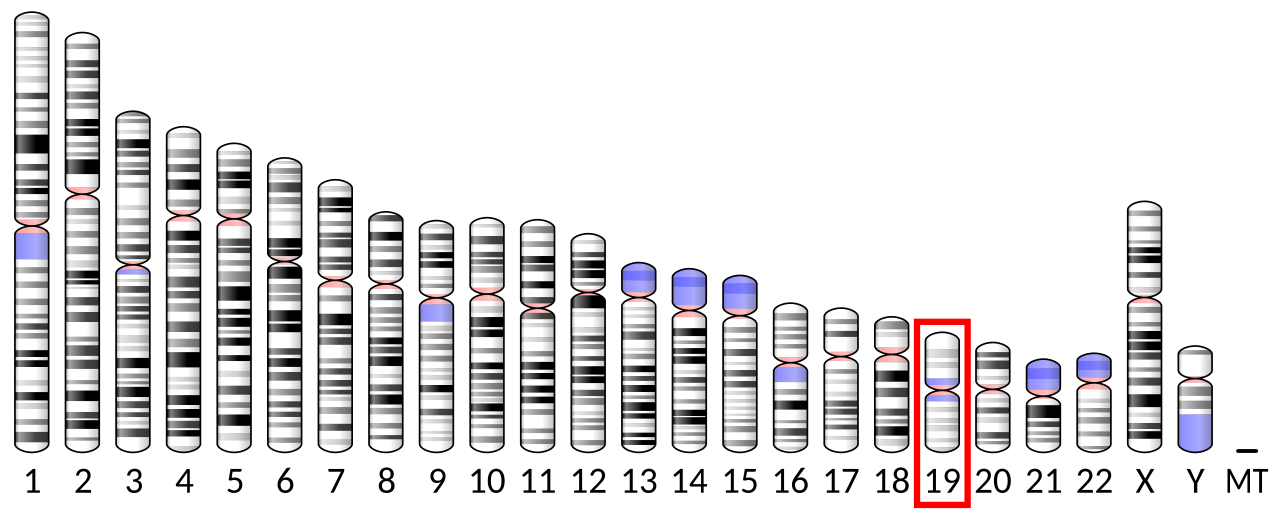
Potassium channel tetramerisation domain containing 15 also known as BTB/POZ domain-containing protein KCTD15 is protein that in humans is encoded by the KCTD15gene.[5]
Clinical significance
Variants of the KCTD15 gene may be associated with obesity.[6][7][8]
^ a b cGRCh38: Ensembl release 89: ENSG00000153885 – Ensembl, May 2017
^ a b cGRCm38: Ensembl release 89: ENSMUSG00000030499 – Ensembl, May 2017
^"Human PubMed Reference:". National Center for Biotechnology Information, U.S. National Library of Medicine.
^"Mouse PubMed Reference:". National Center for Biotechnology Information, U.S. National Library of Medicine.
^Strausberg RL, Feingold EA, Grouse LH, et al. (December 2002). "Generation and initial analysis of more than 15,000 full-length human and mouse cDNA sequences". Proc. Natl. Acad. Sci. U.S.A. 99 (26): 16899–903. Bibcode:2002PNAS...9916899M. doi:10.1073/pnas.242603899. PMC139241. PMID 12477932.
^Thorleifsson G, Walters GB, Gudbjartsson DF, et al. (January 2009). "Genome-wide association yields new sequence variants at seven loci that associate with measures of obesity". Nat. Genet. 41 (1): 18–24. doi:10.1038/ng.274. PMID 19079260. S2CID 764409.
^Willer CJ, Speliotes EK, Loos RJ, et al. (January 2009). "Six new loci associated with body mass index highlight a neuronal influence on body weight regulation". Nat. Genet. 41 (1): 24–34. doi:10.1038/ng.287. PMC2695662. PMID 19079261.
^Zhao J, Bradfield JP, Li M, et al. (May 2009). "The role of obesity-associated loci identified in genome wide association studies in the determination of pediatric BMI". Obesity (Silver Spring). 17 (12): 2254–7. doi:10.1038/oby.2009.159. PMC2860782. PMID 19478790.
Further reading
Stelzl U, Worm U, Lalowski M, et al. (2005). "A human protein-protein interaction network: a resource for annotating the proteome". Cell. 122 (6): 957–68. doi:10.1016/j.cell.2005.08.029. hdl:11858/00-001M-0000-0010-8592-0. PMID 16169070. S2CID 8235923.
Haupt A, Thamer C, Heni M, et al. (2009). "Novel Obesity Risk Loci Do Not Determine Distribution of Body Fat Depots: A Whole-body MRI/MRS study". Obesity (Silver Spring). 18 (6): 1212–7. doi:10.1038/oby.2009.413. PMID 19910938. S2CID 9601431.
Li S, Zhao JH, Luan J, et al. (2010). "Cumulative effects and predictive value of common obesity-susceptibility variants identified by genome-wide association studies". Am. J. Clin. Nutr. 91 (1): 184–90. doi:10.3945/ajcn.2009.28403. PMID 19812171.
Brandys MK, van Elburg AA, Loos RJ, et al. (2010). "Are recently identified genetic variants regulating BMI in the general population associated with anorexia nervosa?". Am. J. Med. Genet. B Neuropsychiatr. Genet. 153B (2): 695–9. doi:10.1002/ajmg.b.31026. PMID 19746409. S2CID 45793585.
Renström F, Payne F, Nordström A, et al. (2009). "Replication and extension of genome-wide association study results for obesity in 4923 adults from northern Sweden". Hum. Mol. Genet. 18 (8): 1489–96. doi:10.1093/hmg/ddp041. PMC2664142. PMID 19164386.
Suzuki Y, Yoshitomo-Nakagawa K, Maruyama K, et al. (1997). "Construction and characterization of a full length-enriched and a 5'-end-enriched cDNA library". Gene. 200 (1–2): 149–56. doi:10.1016/S0378-1119(97)00411-3. PMID 9373149.
Bauer F, Elbers CC, Adan RA, et al. (2009). "Obesity genes identified in genome-wide association studies are associated with adiposity measures and potentially with nutrient-specific food preference". Am. J. Clin. Nutr. 90 (4): 951–9. doi:10.3945/ajcn.2009.27781. PMID 19692490.
Suzuki Y, Yamashita R, Shirota M, et al. (2004). "Sequence Comparison of Human and Mouse Genes Reveals a Homologous Block Structure in the Promoter Regions". Genome Res. 14 (9): 1711–8. doi:10.1101/gr.2435604. PMC515316. PMID 15342556.
Gerhard DS, Wagner L, Feingold EA, et al. (2004). "The Status, Quality, and Expansion of the NIH Full-Length cDNA Project: The Mammalian Gene Collection (MGC)". Genome Res. 14 (10B): 2121–7. doi:10.1101/gr.2596504. PMC528928. PMID 15489334.
Ota T, Suzuki Y, Nishikawa T, et al. (2004). "Complete sequencing and characterization of 21,243 full-length human cDNAs". Nat. Genet. 36 (1): 40–5. doi:10.1038/ng1285. PMID 14702039.
Maruyama K, Sugano S (1994). "Oligo-capping: a simple method to replace the cap structure of eukaryotic mRNAs with oligoribonucleotides". Gene. 138 (1–2): 171–4. doi:10.1016/0378-1119(94)90802-8. PMID 8125298.
Ballif BA, Villén J, Beausoleil SA, et al. (2004). "Phosphoproteomic analysis of the developing mouse brain". Mol. Cell. Proteomics. 3 (11): 1093–101. doi:10.1074/mcp.M400085-MCP200. PMID 15345747.
He M, Cornelis MC, Franks PW, et al. (2010). "Obesity Genotype Score and Cardiovascular Risk in Women with Type 2 Diabetes". Arterioscler. Thromb. Vasc. Biol. 30 (2): 327–32. doi:10.1161/ATVBAHA.109.196196. PMC3061473. PMID 19910641.
Brandenberger R, Wei H, Zhang S, et al. (2004). "Transcriptome characterization elucidates signaling networks that control human ES cell growth and differentiation". Nat. Biotechnol. 22 (6): 707–16. doi:10.1038/nbt971. PMID 15146197. S2CID 27764390.
Hotta K, Nakamura M, Nakamura T, et al. (2009). "Association between obesity and polymorphisms in SEC16B, TMEM18, GNPDA2, BDNF, FAIM2 and MC4R in a Japanese population". J. Hum. Genet. 54 (12): 727–31. doi:10.1038/jhg.2009.106. PMID 19851340.
This article on a gene on human chromosome 19 is a stub. You can help Wikipedia by expanding it.