In number theory, Li's criterion is a particular statement about the positivity of a certain sequence that is equivalent to the Riemann hypothesis. The criterion is named after Xian-Jin Li, who presented it in 1997. In 1999, Enrico Bombieri and Jeffrey C. Lagarias provided a generalization, showing that Li's positivity condition applies to any collection of points that lie on the Re(s) = 1/2 axis.
Definition
The Riemann ξ function is given by

where ζ is the Riemann zeta function. Consider the sequence
![{\displaystyle \lambda _{n}={\frac {1}{(n-1)!}}\left.{\frac {d^{n}}{ds^{n}}}\left[s^{n-1}\log \xi (s)\right]\right|_{s=1}.}](https://wikimedia.org/api/rest_v1/media/math/render/svg/1f5bc55490c2a2324a1626f728db7de58d1261ae)
Li's criterion is then the statement that
- the Riemann hypothesis is equivalent to the statement that for every positive integer .


The numbers (sometimes defined with a slightly different normalization) are called Keiper-Li coefficients or Li coefficients. They may also be expressed in terms of the non-trivial zeros of the Riemann zeta function:

![{\displaystyle \lambda _{n}=\sum _{\rho }\left[1-\left(1-{\frac {1}{\rho }}\right)^{n}\right]}](https://wikimedia.org/api/rest_v1/media/math/render/svg/b19cd8b502ea73beac131750ebad9783c4a82536)
where the sum extends over ρ, the non-trivial zeros of the zeta function. This conditionally convergent sum should be understood in the sense that is usually used in number theory, namely, that
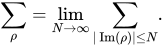
(Re(s) and Im(s) denote the real and imaginary parts of s, respectively.)
The positivity of has been verified up to by direct computation.

Proof
Note that .

Then, starting with an entire function , let .
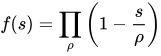
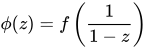
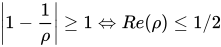
vanishes when . Hence, is holomorphic on the unit disk iff .

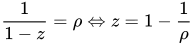


Write the Taylor series . Since
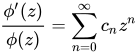

we have
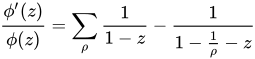
so that
- .

Finally, if each zero comes paired with its complex conjugate , then we may combine terms to get


| . | 1 |
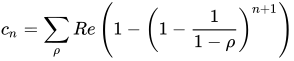
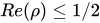
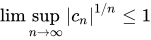
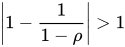
The condition then becomes equivalent to . The right-hand side of (1) is obviously nonnegative when both and . Conversely, ordering the by , we see that the largest term () dominates the sum as , and hence becomes negative sometimes. P. Freitas (2008). "a Li–type criterion for zero–free half-planes of Riemann's zeta function". arXiv:math.MG/0507368.






Generalizations
Bombieri and Lagarias demonstrate that a similar criterion holds for any collection of complex numbers, and is thus not restricted to the Riemann hypothesis. More precisely, let R = {ρ} be any collection of complex numbers ρ, not containing ρ = 1, which satisfies
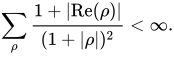
Then one may make several equivalent statements about such a set. One such statement is the following:
- One has for every ρ if and only if
- for all positive integers n.

![{\displaystyle \sum _{\rho }\operatorname {Re} \left[1-\left(1-{\frac {1}{\rho }}\right)^{-n}\right]\geq 0}](https://wikimedia.org/api/rest_v1/media/math/render/svg/555dd225c2bdbebc0cafa997eb99b6943d979eb1)
One may make a more interesting statement, if the set R obeys a certain functional equation under the replacement s ↦ 1 − s. Namely, if, whenever ρ is in R, then both the complex conjugate and are in R, then Li's criterion can be stated as:


- One has Re(ρ) = 1/2 for every ρ if and only if
![{\displaystyle \sum _{\rho }\left[1-\left(1-{\frac {1}{\rho }}\right)^{n}\right]\geq 0}](https://wikimedia.org/api/rest_v1/media/math/render/svg/432e1e2ebab87e7dcc0980f2860582c251142dce)
- for all positive integers n.
Bombieri and Lagarias also show that Li's criterion follows from Weil's criterion for the Riemann hypothesis.
In 2006, P. Freitas proved that all of the zeros of the Riemann zeta function lie inside the region , where if and only if the numbers


![{\displaystyle \sum _{\rho }\left[1-\left({\frac {\rho }{\rho -\tau }}\right)^{n}\right]}](https://wikimedia.org/api/rest_v1/media/math/render/svg/a7bbf7b848563f5188ab9d15aa76348ecec50c0f)
are non-negative for all positive integers . These coefficients are called the -Li coefficients.[1] A. Droll[2] generalized the results to the extended Selberg class, A. Bucur, A.-M. Ernvall-Hytönen, A. Odžak and L. Smajlović[3] investigated the behavior of the coefficients for certain functions violating the Riemann hypothesis, and N. Palojärvi[4] proved explicit conditions between finitely many -Li coefficients and zero-free regions.

References
- ^ Freitas, Pedro (2006). "A Li-type criterion for zero-free half planes of Riemann's zeta function". J. London Math. Soc. 73 (2): 399–414. doi:10.1112/S0024610706022599.
- ^ Droll, Andrew (2012). Variations of Li's criterion for an extension of the Selberg class.
- ^ Bucur, Alina; Ernvall-Hytönen, Anne-Maria; Odžak, Almasa; Smajlović, Lejla (2016). "On a Li-type criterion for zero-free regions of certain Dirichlet series with real coefficients". LMS J. Comput. Math. 19 (1): 259–280. doi:10.1112/S1461157016000115.
- ^ Palojärvi, Neea (2020). "Explicit Zero-Free Regions and a τ -Li-type Criterion". Albanian J. Math. 14 (1): 47–77. arXiv:1807.01506. doi:10.51286/albjm/1608313766.
- Arias de Reyna, Juan (2011). "Asymptotics of Keiper-Li coefficients". Functiones et Approximatio Commentarii Mathematici. 45 (1): 7–21. doi:10.7169/facm/1317045228.
- Bombieri, Enrico; Lagarias, Jeffrey C. (1999). "Complements to Li's criterion for the Riemann hypothesis". Journal of Number Theory. 77 (2): 274–287. doi:10.1006/jnth.1999.2392. MR 1702145.
- Johansson, Fredrik (2015). "Rigorous high-precision computation of the Hurwitz zeta function and its derivatives". Numerical Algorithms. 69 (2): 253–270. arXiv:1309.2877. doi:10.1007/s11075-014-9893-1. S2CID 10344040.
- Keiper, Jerry B (1992). "Power series expansions of Riemann's 𝜉 function". Mathematics of Computation. 58 (198): 765–773. doi:10.2307/2153215. JSTOR 2153215.
- Lagarias, Jeffrey C. (2004). "Li coefficients for automorphic L-functions". Annales de l'Institut Fourier. 57 (2007): 1689–1740. arXiv:math.MG/0404394. Bibcode:2004math......4394L. doi:10.5802/aif.2311. S2CID 16385403.
- Li, Xian-Jin (1997). "The positivity of a sequence of numbers and the Riemann hypothesis". Journal of Number Theory. 65 (2): 325–333. doi:10.1006/jnth.1997.2137. MR 1462847.
