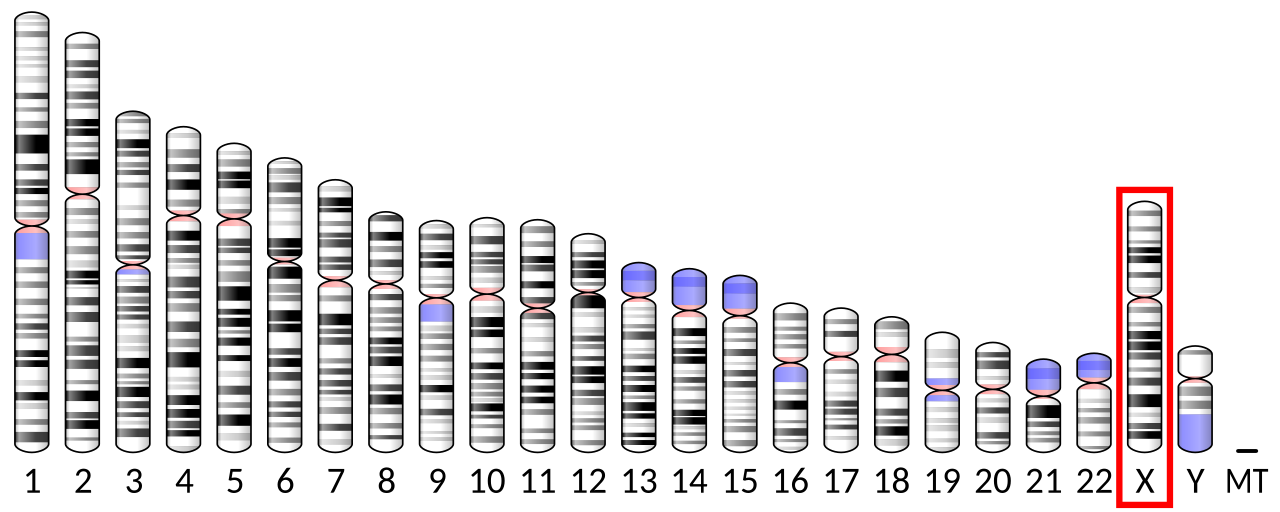
Mortality factor 4-like protein 2 is a protein that in humans is encoded by the MORF4L2gene.[5][6][7]
References
^ a b cGRCh38: Ensembl release 89: ENSG00000123562 – Ensembl, May 2017
^ a b cGRCm38: Ensembl release 89: ENSMUSG00000031422 – Ensembl, May 2017
^"Human PubMed Reference:". National Center for Biotechnology Information, U.S. National Library of Medicine.
^"Mouse PubMed Reference:". National Center for Biotechnology Information, U.S. National Library of Medicine.
^Bertram MJ, Berube NG, Hang-Swanson X, Ran Q, Leung JK, Bryce S, Spurgers K, Bick RJ, Baldini A, Ning Y, Clark LJ, Parkinson EK, Barrett JC, Smith JR, Pereira-Smith OM (Feb 1999). "Identification of a Gene That Reverses the Immortal Phenotype of a Subset of Cells and Is a Member of a Novel Family of Transcription Factor-Like Genes". Mol Cell Biol. 19 (2): 1479–85. doi:10.1128/mcb.19.2.1479. PMC116076. PMID 9891081.
^Nomura N, Miyajima N, Sazuka T, Tanaka A, Kawarabayasi Y, Sato S, Nagase T, Seki N, Ishikawa K, Tabata S (Dec 1995). "Prediction of the coding sequences of unidentified human genes. I. The coding sequences of 40 new genes (KIAA0001-KIAA0040) deduced by analysis of randomly sampled cDNA clones from human immature myeloid cell line KG-1". DNA Res. 1 (1): 27–35. doi:10.1093/dnares/1.1.27. PMID 7584026.
^"Entrez Gene: MORF4L2 mortality factor 4 like 2".
Further reading
Nomura N, Miyajima N, Sazuka T, et al. (1995). "Prediction of the coding sequences of unidentified human genes. I. The coding sequences of 40 new genes (KIAA0001-KIAA0040) deduced by analysis of randomly sampled cDNA clones from human immature myeloid cell line KG-1 (supplement)". DNA Res. 1 (1): 47–56. doi:10.1093/dnares/1.1.47. PMID 7584028.
Maruyama K, Sugano S (1994). "Oligo-capping: a simple method to replace the cap structure of eukaryotic mRNAs with oligoribonucleotides". Gene. 138 (1–2): 171–4. doi:10.1016/0378-1119(94)90802-8. PMID 8125298.
Suzuki Y, Yoshitomo-Nakagawa K, Maruyama K, et al. (1997). "Construction and characterization of a full length-enriched and a 5'-end-enriched cDNA library". Gene. 200 (1–2): 149–56. doi:10.1016/S0378-1119(97)00411-3. PMID 9373149.
Hoja MR, Wahlestedt C, Höög C (2000). "A visual intracellular classification strategy for uncharacterized human proteins". Exp. Cell Res. 259 (1): 239–46. doi:10.1006/excr.2000.4948. PMID 10942595.
Sakai K, Shirakawa T, Li Y, et al. (2002). "Interaction of a paraneoplastic cerebellar degeneration-associated neuronal protein with the nuclear helix-loop-helix leucine zipper protein MRG X". Mol. Cell. Neurosci. 19 (4): 477–84. doi:10.1006/mcne.2001.1059. PMID 11988016. S2CID 26659745.
Yochum GS, Ayer DE (2002). "Role for the Mortality Factors MORF4, MRGX, and MRG15 in Transcriptional Repression via Associations with Pf1, mSin3A, and Transducin-Like Enhancer of Split". Mol. Cell. Biol. 22 (22): 7868–76. doi:10.1128/MCB.22.22.7868-7876.2002. PMC134742. PMID 12391155.
Strausberg RL, Feingold EA, Grouse LH, et al. (2003). "Generation and initial analysis of more than 15,000 full-length human and mouse cDNA sequences". Proc. Natl. Acad. Sci. U.S.A. 99 (26): 16899–903. Bibcode:2002PNAS...9916899M. doi:10.1073/pnas.242603899. PMC139241. PMID 12477932.
Cai Y, Jin J, Tomomori-Sato C, et al. (2003). "Identification of new subunits of the multiprotein mammalian TRRAP/TIP60-containing histone acetyltransferase complex". J. Biol. Chem. 278 (44): 42733–6. doi:10.1074/jbc.C300389200. PMID 12963728.
Tominaga K, Leung JK, Rookard P, et al. (2004). "MRGX is a novel transcriptional regulator that exhibits activation or repression of the B-myb promoter in a cell type-dependent manner". J. Biol. Chem. 278 (49): 49618–24. doi:10.1074/jbc.M309192200. PMID 14506250.
Ota T, Suzuki Y, Nishikawa T, et al. (2004). "Complete sequencing and characterization of 21,243 full-length human cDNAs". Nat. Genet. 36 (1): 40–5. doi:10.1038/ng1285. PMID 14702039.
Gerhard DS, Wagner L, Feingold EA, et al. (2004). "The Status, Quality, and Expansion of the NIH Full-Length cDNA Project: The Mammalian Gene Collection (MGC)". Genome Res. 14 (10B): 2121–7. doi:10.1101/gr.2596504. PMC528928. PMID 15489334.
Cai Y, Jin J, Florens L, et al. (2005). "The mammalian YL1 protein is a shared subunit of the TRRAP/TIP60 histone acetyltransferase and SRCAP complexes". J. Biol. Chem. 280 (14): 13665–70. doi:10.1074/jbc.M500001200. PMID 15647280.
Ross MT, Grafham DV, Coffey AJ, et al. (2005). "The DNA sequence of the human X chromosome". Nature. 434 (7031): 325–37. Bibcode:2005Natur.434..325R. doi:10.1038/nature03440. PMC2665286. PMID 15772651.
Ewing RM, Chu P, Elisma F, et al. (2007). "Large-scale mapping of human protein–protein interactions by mass spectrometry". Mol. Syst. Biol. 3 (1): 89. doi:10.1038/msb4100134. PMC1847948. PMID 17353931.
This article on a gene on the human X chromosome and/or its associated protein is a stub. You can help Wikipedia by expanding it.