マース波形

Complex-valued smooth functions of the upper half plane (harmonic analysis topic)

数学において、マース形式またはマース波形は保型形式理論において研究される。マース形式は上半平面の複素数値滑らかな関数であり、離散部分群 の作用素の下でモジュラー形式と同様に変換される。これらは上半平面上で定義された双曲型ラプラス作用素の固有形式であり、の基本領域の尖点において特定の成長条件を満たす。モジュラー形式とは対照的に、マース形式は必ずしも正則である必要はない。これらは1949年にハンス・マースによって初めて研究された Γ {\displaystyle \Gamma } S L 2 ( R ) {\displaystyle \mathrm {SL} _{2}(\mathbb {R} )} Δ {\displaystyle \Delta } Γ {\displaystyle \Gamma }

一般的なコメント

グループ

G := S L 2 ( R ) = { ( a b c d ) M 2 ( R ) : a d b c = 1 } {\displaystyle G:=\mathrm {SL} _{2}(\mathbb {R} )=\left\{{\begin{pmatrix}a&b\\c&d\\\end{pmatrix}}\in M_{2}(\mathbb {R} ):ad-bc=1\right\}}

上半面上で動作する

H = { z C : Im ( z ) > 0 } {\displaystyle {\mathcal {H}}=\{z\in \mathbb {C} :\operatorname {Im} (z)>0\}}

分数線形変換によって

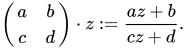
( a b c d ) z := a z + b c z + d . {\displaystyle {\begin{pmatrix}a&b\\c&d\\\end{pmatrix}}\cdot z:={\frac {az+b}{cz+d}}.}

以下を定義することで、操作に拡張できます H { } R {\displaystyle {\mathcal {H}}\cup \{\infty \}\cup \mathbb {\mathbb {R} } }

( a b c d ) z := { a z + b c z + d if  c z + d 0 , if  c z + d = 0 , {\displaystyle {\begin{pmatrix}a&b\\c&d\\\end{pmatrix}}\cdot z:={\begin{cases}{\frac {az+b}{cz+d}}&{\text{if }}cz+d\neq 0,\\\infty &{\text{if }}cz+d=0,\end{cases}}}
( a b c d ) := lim Im ( z ) ( a b c d ) z = { a c if  c 0 if  c = 0 {\displaystyle {\begin{pmatrix}a&b\\c&d\\\end{pmatrix}}\cdot \infty :=\lim _{\operatorname {Im} (z)\to \infty }{\begin{pmatrix}a&b\\c&d\\\end{pmatrix}}\cdot z={\begin{cases}{\frac {a}{c}}&{\text{if }}c\neq 0\\\infty &{\text{if }}c=0\end{cases}}}

ラドン測定

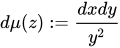
d μ ( z ) := d x d y y 2 {\displaystyle d\mu (z):={\frac {dxdy}{y^{2}}}}

上で定義された はの操作に対して不変です H {\displaystyle {\mathcal {H}}} S L 2 ( R ) {\displaystyle \mathrm {SL} _{2}(\mathbb {R} )}

を の離散部分群とするの基本領域は開集合 であり、代表の系が存在し Γ {\displaystyle \Gamma } G {\displaystyle G} Γ {\displaystyle \Gamma } F H {\displaystyle F\subset {\mathcal {H}}} R {\displaystyle R} Γ H {\displaystyle \Gamma \backslash {\mathcal {H}}}

F R F ¯  and  μ ( F ¯ F ) = 0. {\displaystyle F\subset R\subset {\overline {F}}{\text{ and }}\mu ({\overline {F}}\setminus F)=0.}

モジュラー群の基本領域は次のように与えられる。 Γ ( 1 ) := S L 2 ( Z ) {\displaystyle \Gamma (1):=\mathrm {SL} _{2}(\mathbb {Z} )}

F := { z H | Re ( z ) | < 1 2 , | z | > 1 } {\displaystyle F:=\left\{z\in {\mathcal {H}}\mid \left|\operatorname {Re} (z)\right|<{\frac {1}{2}},|z|>1\right\}}

(モジュラー形式を参照)。

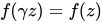
関数 がすべてのおよびすべてのに対して成り立つ場合、その関数は-不変であると呼ばれます f : H C {\displaystyle f:{\mathcal {H}}\to \mathbb {C} } Γ {\displaystyle \Gamma } f ( γ z ) = f ( z ) {\displaystyle f(\gamma z)=f(z)} γ Γ {\displaystyle \gamma \in \Gamma } z H {\displaystyle z\in {\mathcal {H}}}

あらゆる測定可能な不変な関数に対して、方程式 Γ {\displaystyle \Gamma } f : H C {\displaystyle f:{\mathcal {H}}\to \mathbb {C} }

F f ( z ) d μ ( z ) = Γ H f ( z ) d μ ( z ) , {\displaystyle \int _{F}f(z)\,d\mu (z)=\int _{\Gamma \backslash {\mathcal {H}}}f(z)\,d\mu (z),}

が成り立つ。ここで、方程式の右辺の測度は商の誘導測度である。 d μ {\displaystyle d\mu } Γ H . {\displaystyle \Gamma \backslash {\mathcal {H}}.}

古典的なマース形式

双曲型ラプラス演算子の定義

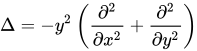
曲型ラプラス作用素はのように定義される。 H {\displaystyle {\mathcal {H}}}

Δ : C ( H ) C ( H ) , {\displaystyle \Delta :C^{\infty }({\mathcal {H}})\to C^{\infty }({\mathcal {H}}),}
Δ = y 2 ( 2 x 2 + 2 y 2 ) {\displaystyle \Delta =-y^{2}\left({\frac {\partial ^{2}}{\partial x^{2}}}+{\frac {\partial ^{2}}{\partial y^{2}}}\right)}

マース形式の定義

マース形式 Γ ( 1 ) := S L 2 ( Z ) {\displaystyle \Gamma (1):=\mathrm {SL} _{2}(\mathbb {Z} )} f {\displaystyle f} H {\displaystyle {\mathcal {H}}}

  1. f ( γ z ) = f ( z )  for all  γ Γ ( 1 ) , z H {\displaystyle f(\gamma z)=f(z){\text{ for all }}\gamma \in \Gamma (1),\qquad z\in {\mathcal {H}}}
  2. there exists  λ C  with  Δ ( f ) = λ f {\displaystyle {\text{there exists }}\lambda \in \mathbb {C} {\text{ with }}\Delta (f)=\lambda f}
  3. there exists  N N  with  f ( x + i y ) = O ( y N )  for  y 1 {\displaystyle {\text{there exists }}N\in \mathbb {N} {\text{ with }}f(x+iy)={\mathcal {O}}(y^{N}){\text{ for }}y\geq 1}

もし

0 1 f ( z + t ) d t = 0  for all  z H {\displaystyle \int _{0}^{1}f(z+t)dt=0{\text{ for all }}z\in {\mathcal {H}}}

これをマースカスプ形式 と呼びます。 f {\displaystyle f}

マース形式とディリクレ級数の関係

をマース形式とする f {\displaystyle f}

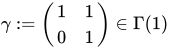
γ := ( 1 1 0 1 ) Γ ( 1 ) {\displaystyle \gamma :={\begin{pmatrix}1&1\\0&1\\\end{pmatrix}}\in \Gamma (1)}

我々は持っています:

z H : f ( z ) = f ( γ z ) = f ( z + 1 ) . {\displaystyle \forall z\in {\mathcal {H}}:\qquad f(z)=f(\gamma z)=f(z+1).}

したがって、フーリエ展開は次のようになる。 f {\displaystyle f}

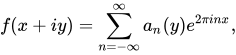
f ( x + i y ) = n = a n ( y ) e 2 π i n x , {\displaystyle f(x+iy)=\sum _{n=-\infty }^{\infty }a_{n}(y)e^{2\pi inx},}

係数関数付き a n , n Z . {\displaystyle a_{n},n\in \mathbb {Z} .}

がマースカスプ形式である場合、かつその場合に限り、 がマースカスプ形式であることを示すのは簡単です f {\displaystyle f} a 0 ( y ) = 0 y > 0 {\displaystyle a_{0}(y)=0\;\;\forall y>0}

係数関数を正確に計算することができます。そのためにはベッセル関数が 必要です。 K v {\displaystyle K_{v}}

定義:ベッセル関数は次のように定義される。 K v {\displaystyle K_{v}}

K s ( y ) := 1 2 0 e y ( t + t 1 ) 2 t s d t t , s C , y > 0. {\displaystyle K_{s}(y):={\frac {1}{2}}\int _{0}^{\infty }e^{-{\frac {y(t+t^{-1})}{2}}}t^{s}{\frac {dt}{t}},\qquad s\in \mathbb {C} ,y>0.}

積分はにおいて絶対的に局所一様収束し、不等式は y > 0 {\displaystyle y>0} s C {\displaystyle s\in \mathbb {C} }

K s ( y ) e y 2 K Re ( s ) ( 2 ) {\displaystyle K_{s}(y)\leq e^{-{\frac {y}{2}}}K_{\operatorname {Re} (s)}(2)}

すべてに当てはまります y > 4 {\displaystyle y>4}

したがって、 はに対して指数的に減少します。さらに、すべての に対してが成り立ちます | K s | {\displaystyle |K_{s}|} y {\displaystyle y\to \infty } K s ( y ) = K s ( y ) {\displaystyle K_{-s}(y)=K_{s}(y)} s C , y > 0 {\displaystyle s\in \mathbb {C} ,y>0}

定理(マース形式のフーリエ係数)を に対応するマース形式の固有値とする。存在し、 は符号を除けば一意であり、 となる。このとき のフーリエ係数 λ C {\displaystyle \lambda \in \mathbb {C} } f {\displaystyle f} Δ . {\displaystyle \Delta .} ν C {\displaystyle \nu \in \mathbb {C} } λ = 1 4 ν 2 {\textstyle \lambda ={\frac {1}{4}}-\nu ^{2}} f {\displaystyle f} a n ( y ) = c n y K ν ( 2 π | n | y ) c n C n 0 a 0 ( y ) = c 0 y 1 2 ν + d 0 y 1 2 + ν c 0 , d 0 C n = 0 {\displaystyle {\begin{aligned}a_{n}(y)&=c_{n}{\sqrt {y}}K_{\nu }(2\pi |n|y)\quad c_{n}\in \mathbb {C} &&n\neq 0\\a_{0}(y)&=c_{0}y^{{\frac {1}{2}}-\nu }+d_{0}y^{{\frac {1}{2}}+\nu }\quad c_{0},d_{0}\in \mathbb {C} &&n=0\end{aligned}}}

証明:我々は

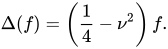
Δ ( f ) = ( 1 4 ν 2 ) f . {\displaystyle \Delta (f)=\left({\frac {1}{4}}-\nu ^{2}\right)f.}

フーリエ係数の定義により、

a n ( y ) = 0 1 f ( x + i y ) e 2 π i n x d x {\displaystyle a_{n}(y)=\int _{0}^{1}f(x+iy)e^{-2\pi inx}dx}

のために n Z . {\displaystyle n\in \mathbb {Z} .}

これらを合わせると、

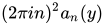
( 1 4 ν 2 ) a n ( y ) = 0 1 ( 1 4 ν 2 ) f ( x + i y ) e 2 π i n x d x = 0 1 ( Δ f ) ( x + i y ) e 2 π i n x d x = y 2 ( 0 1 2 f x 2 ( x + i y ) e 2 π i n x d x + 0 1 2 f y 2 ( x + i y ) e 2 π i n x d x ) = ( 1 ) y 2 ( 2 π i n ) 2 a n ( y ) y 2 2 y 2 0 1 f ( x + i y ) e 2 π i n x d x = y 2 ( 2 π i n ) 2 a n ( y ) y 2 2 y 2 a n ( y ) = 4 π 2 n 2 y 2 a n ( y ) y 2 2 y 2 a n ( y ) {\displaystyle {\begin{aligned}\left({\frac {1}{4}}-\nu ^{2}\right)a_{n}(y)&=\int _{0}^{1}\left({\frac {1}{4}}-\nu ^{2}\right)f(x+iy)e^{-2\pi inx}dx\\[4pt]&=\int _{0}^{1}(\Delta f)(x+iy)e^{-2\pi inx}dx\\[4pt]&=-y^{2}\left(\int _{0}^{1}{\frac {\partial ^{2}f}{\partial x^{2}}}(x+iy)e^{-2\pi inx}dx+\int _{0}^{1}{\frac {\partial ^{2}f}{\partial y^{2}}}(x+iy)e^{-2\pi inx}dx\right)\\[4pt]&{\overset {(1)}{=}}-y^{2}(2\pi in)^{2}a_{n}(y)-y^{2}{\frac {\partial ^{2}}{\partial y^{2}}}\int _{0}^{1}f(x+iy)e^{-2\pi inx}dx\\[4pt]&=-y^{2}(2\pi in)^{2}a_{n}(y)-y^{2}{\frac {\partial ^{2}}{\partial y^{2}}}a_{n}(y)\\[4pt]&=4\pi ^{2}n^{2}y^{2}a_{n}(y)-y^{2}{\frac {\partial ^{2}}{\partial y^{2}}}a_{n}(y)\end{aligned}}}

のために n Z . {\displaystyle n\in \mathbb {Z} .}

(1)では、最初の項のn次のフーリエ係数がであることを用いた。2番目の項では、積分と微分の順序を入れ替えたが、これは f が y に関して滑らかであるため可能である。これにより、 2次線型微分方程式が得られる。 2 f x 2 {\textstyle {\frac {\partial ^{2}f}{\partial x^{2}}}} ( 2 π i n ) 2 a n ( y ) {\displaystyle (2\pi in)^{2}a_{n}(y)}

y 2 2 y 2 a n ( y ) + ( 1 4 ν 2 4 π n 2 y 2 ) a n ( y ) = 0 {\displaystyle y^{2}{\frac {\partial ^{2}}{\partial y^{2}}}a_{n}(y)+\left({\frac {1}{4}}-\nu ^{2}-4\pi n^{2}y^{2}\right)a_{n}(y)=0}

あらゆる解に対して、次のような性質を持つ一意の係数が存在することが示せる。 n = 0 {\displaystyle n=0} f {\displaystyle f} c 0 , d 0 C {\displaystyle c_{0},d_{0}\in \mathbb {C} } a 0 ( y ) = c 0 y 1 2 ν + d 0 y 1 2 + ν . {\displaystyle a_{0}(y)=c_{0}y^{{\frac {1}{2}}-\nu }+d_{0}y^{{\frac {1}{2}}+\nu }.}

あらゆる解は次のような形式の係数を持つ。 n 0 {\displaystyle n\neq 0} f {\displaystyle f}

a n ( y ) = c n y K v ( 2 π | n | y ) + d n y I v ( 2 π | n | y ) {\displaystyle a_{n}(y)=c_{n}{\sqrt {y}}K_{v}(2\pi |n|y)+d_{n}{\sqrt {y}}I_{v}(2\pi |n|y)}

に対して一意です。ここで、 とはベッセル関数です。 c n , d n C {\displaystyle c_{n},d_{n}\in \mathbb {C} } K v ( s ) {\displaystyle K_{v}(s)} I v ( s ) {\displaystyle I_{v}(s)}

ベッセル関数は指数的に増加しますが、ベッセル関数は指数的に減少します。多項式増加条件3)と組み合わせると、また)が唯一の に対して得られます。QED I v {\displaystyle I_{v}} K v {\displaystyle K_{v}} f : a n ( y ) = c n y K v ( 2 π | n | y ) {\displaystyle f:a_{n}(y)=c_{n}{\sqrt {y}}K_{v}(2\pi |n|y)} d n = 0 {\displaystyle d_{n}=0} c n C {\displaystyle c_{n}\in \mathbb {C} }

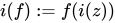
偶マアス形式と奇マアス形式:とする。すると、i はすべての関数に対して となり双曲ラプラシアンと可換となる。 のときマアス形式は偶マアス形式、 のとき奇マアス形式と呼ばれる。 f がマアス形式ならば、 は偶マアス形式かつ奇マアス形式となり、 が成り立つ i ( z ) := z ¯ {\displaystyle i(z):=-{\overline {z}}} f : H C {\displaystyle f:{\mathcal {H}}\to \mathbb {C} } i ( f ) := f ( i ( z ) ) {\displaystyle i(f):=f(i(z))} f {\displaystyle f} i ( f ) = f {\displaystyle i(f)=f} i ( f ) = f {\displaystyle i(f)=-f} 1 2 ( f + i ( f ) ) {\displaystyle {\tfrac {1}{2}}(f+i(f))} 1 2 ( f i ( f ) ) {\displaystyle {\tfrac {1}{2}}(f-i(f))} f = 1 2 ( f + i ( f ) ) + 1 2 ( f i ( f ) ) {\displaystyle f={\tfrac {1}{2}}(f+i(f))+{\tfrac {1}{2}}(f-i(f))}

定理: マース形式のL関数

させて

f ( x + i y ) = n 0 c n y K ν ( 2 π | n | y ) e 2 π i n x {\displaystyle f(x+iy)=\sum _{n\neq 0}c_{n}{\sqrt {y}}K_{\nu }(2\pi |n|y)e^{2\pi inx}}

はマースカスプ形式である。L関数を次のように 定義する。 f {\displaystyle f}

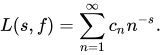
L ( s , f ) = n = 1 c n n s . {\displaystyle L(s,f)=\sum _{n=1}^{\infty }c_{n}n^{-s}.}

すると、級数はについて収束し、 上の関数全体にまで継続できます L ( s , f ) {\displaystyle L(s,f)} ( s ) > 3 2 {\textstyle \Re (s)>{\frac {3}{2}}} C {\displaystyle \mathbb {C} }

が偶数か奇数の 場合は f {\displaystyle f}

Λ ( s , f ) := π s Γ ( s + ε + ν 2 ) Γ ( s + ε ν 2 ) L ( s , f ) . {\displaystyle \Lambda (s,f):=\pi ^{-s}\Gamma \left({\frac {s+\varepsilon +\nu }{2}}\right)\Gamma \left({\frac {s+\varepsilon -\nu }{2}}\right)L(s,f).}

ここでが偶数で、が奇数であれば、関数方程式を満たす 。 ε = 0 {\displaystyle \varepsilon =0} f {\displaystyle f} ε = 1 {\displaystyle \varepsilon =-1} f {\displaystyle f} Λ {\displaystyle \Lambda }

Λ ( s , f ) = ( 1 ) ε Λ ( 1 s , f ) . {\displaystyle \Lambda (s,f)=(-1)^{\varepsilon }\Lambda (1-s,f).}

例: 非正則なアイゼンシュタイン級数 E

非正則アイゼンシュタイン級数は、次のように定義される z = x + i y H {\displaystyle z=x+iy\in {\mathcal {H}}} s C {\displaystyle s\in \mathbb {C} }

E ( z , s ) := π s Γ ( s ) 1 2 ( m , n ) ( 0 , 0 ) y s | m z + n | 2 s {\displaystyle E(z,s):=\pi ^{-s}\Gamma (s){\frac {1}{2}}\sum _{(m,n)\neq (0,0)}{\frac {y^{s}}{|mz+n|^{2s}}}}

ここでガンマ関数です Γ ( s ) {\displaystyle \Gamma (s)}

級数はについて絶対収束し、 について局所一様収束する。これは、級数が z H {\displaystyle z\in {\mathcal {H}}} ( s ) > 1 {\displaystyle \Re (s)>1} H × { ( s ) > 1 } {\displaystyle {\mathcal {H}}\times \{\Re (s)>1\}}

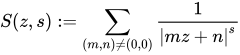
S ( z , s ) := ( m , n ) ( 0 , 0 ) 1 | m z + n | s {\displaystyle S(z,s):=\sum _{(m,n)\neq (0,0)}{\frac {1}{|mz+n|^{s}}}}

は、 のとき、において絶対収束します。より正確には、 は、任意のコンパクト集合および任意の に対して、任意の集合 において一様収束します z H {\displaystyle z\in {\mathcal {H}}} ( s ) > 2 {\displaystyle \Re (s)>2} K × { ( s ) α } {\displaystyle K\times \{\Re (s)\geq \alpha \}} K H {\displaystyle K\subset {\mathcal {H}}} α > 2 {\displaystyle \alpha >2}

Eマース形式

ここでは-不変性と微分方程式のみを示します。滑らかさの証明はDeitmarまたはBumpに示されています。成長条件はアイゼンシュタイン級数のフーリエ展開から従います。 S L 2 ( Z ) {\displaystyle \mathrm {SL} _{2}(\mathbb {Z} )}

まず、-不変性を示します S L 2 ( Z ) {\displaystyle \mathrm {SL} _{2}(\mathbb {Z} )}

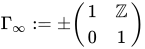
Γ := ± ( 1 Z 0 1 ) {\displaystyle \Gamma _{\infty }:=\pm {\begin{pmatrix}1&\mathbb {Z} \\0&1\\\end{pmatrix}}}

に対する操作に対応する安定群とする {\displaystyle \infty } S L 2 ( Z ) {\displaystyle \mathrm {SL} _{2}(\mathbb {Z} )} H { } {\displaystyle {\mathcal {H}}\cup \{\infty \}}

命題。E -不変である。 Γ ( 1 ) {\displaystyle \Gamma (1)}

証明。定義:

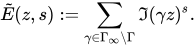
E ~ ( z , s ) := γ Γ Γ ( γ z ) s . {\displaystyle {\tilde {E}}(z,s):=\sum _{\gamma \in \Gamma _{\infty }\backslash \Gamma }\Im (\gamma z)^{s}.}

(a)は絶対収束 E ~ {\displaystyle {\tilde {E}}} z H {\displaystyle z\in {\mathcal {H}}} ( s ) > 1 {\displaystyle \Re (s)>1} E ( z , s ) = π s Γ ( s ) ζ ( 2 s ) E ~ ( z , s ) . {\displaystyle E(z,s)=\pi ^{-s}\Gamma (s)\zeta (2s){\tilde {E}}(z,s).}

以来

γ = ( a b c d ) Γ ( 1 ) ( γ z ) = ( z ) | c z + d | 2 , {\displaystyle \gamma ={\begin{pmatrix}a&b\\c&d\\\end{pmatrix}}\in \Gamma (1)\Longrightarrow \Im (\gamma z)={\frac {\Im (z)}{|cz+d|^{2}}},}

我々は得る

E ~ ( z , s ) = γ Γ Γ ( γ z ) s = ( c , d ) = 1 mod ± 1 y s | c z + d | 2 s . {\displaystyle {\tilde {E}}(z,s)=\sum _{\gamma \in \Gamma _{\infty }\backslash \Gamma }\Im (\gamma z)^{s}=\sum _{(c,d)=1{\bmod {\pm }}1}{\frac {y^{s}}{|cz+d|^{2s}}}.}

これは絶対収束を証明するものである z H {\displaystyle z\in {\mathcal {H}}} Re ( s ) > 1. {\displaystyle \operatorname {Re} (s)>1.}

さらに、

ζ ( 2 s ) E ~ ( z , s ) = n = 1 n s ( c , d ) = 1 mod ± 1 y s | c z + d | 2 s = n = 1 ( c , d ) = 1 mod ± 1 y s | n c z + n d | 2 s = ( m , n ) ( 0 , 0 ) y s | m z + n | 2 s , {\displaystyle \zeta (2s){\tilde {E}}(z,s)=\sum _{n=1}^{\infty }n^{-s}\sum _{(c,d)=1{\bmod {\pm }}1}{\frac {y^{s}}{|cz+d|^{2s}}}=\sum _{n=1}^{\infty }\sum _{(c,d)=1{\bmod {\pm }}1}{\frac {y^{s}}{|ncz+nd|^{2s}}}=\sum _{(m,n)\neq (0,0)}{\frac {y^{s}}{|mz+n|^{2s}}},}

地図から

{ N × { ( x , y ) Z 2 { ( 0 , 0 ) } : ( x , y ) = 1 } Z 2 { ( 0 , 0 ) } ( n , ( x , y ) ) ( n x , n y ) {\displaystyle {\begin{cases}\mathbb {N} \times \{(x,y)\in \mathbb {Z} ^{2}-\{(0,0)\}:(x,y)=1\}\to \mathbb {Z} ^{2}-\{(0,0)\}\\(n,(x,y))\mapsto (nx,ny)\end{cases}}}

は一対一である (a) が成り立つ。

(b)すべての に対してが成り立ちます E ( γ z , s ) = E ( z , s ) {\displaystyle E(\gamma z,s)=E(z,s)} γ Γ ( 1 ) {\displaystyle \gamma \in \Gamma (1)}

なぜなら私たちは γ ~ Γ ( 1 ) {\displaystyle {\tilde {\gamma }}\in \Gamma (1)}

E ~ ( γ ~ z , s ) = γ Γ Γ ( γ ~ γ z ) s = γ Γ Γ ( γ z ) s = E ~ ( z , s ) . {\displaystyle {\tilde {E}}({\tilde {\gamma }}z,s)=\sum _{\gamma \in \Gamma _{\infty }\backslash \Gamma }\Im ({\tilde {\gamma }}\gamma z)^{s}=\sum _{\gamma \in \Gamma _{\infty }\backslash \Gamma }\Im (\gamma z)^{s}={\tilde {E}}(z,s).}

(a) と共に、も に対して不変である。QED E {\displaystyle E} Γ ( 1 ) {\displaystyle \Gamma (1)}

命題。E は双曲型ラプラス作用素の固有形である

次の補題が必要です。

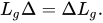
補題: は上の の作用素と可換である。より正確には、すべての に対して、以下の関係が成り立つ Δ {\displaystyle \Delta } G {\displaystyle G} C ( H ) {\displaystyle C^{\infty }({\mathcal {H}})} g G {\displaystyle g\in G} L g Δ = Δ L g . {\displaystyle L_{g}\Delta =\Delta L_{g}.}

証明:グループはフォームの要素によって生成される S L 2 ( R ) {\displaystyle \mathrm {SL} _{2}(\mathbb {R} )}

( a 0 0 1 a ) , a R × ; ( 1 x 0 1 ) , x R ; S = ( 0 1 1 0 ) . {\displaystyle {\begin{pmatrix}a&0\\0&{\frac {1}{a}}\\\end{pmatrix}},a\in \mathbb {R} ^{\times };\quad {\begin{pmatrix}1&x\\0&1\\\end{pmatrix}},x\in \mathbb {R} ;\quad S={\begin{pmatrix}0&-1\\1&0\\\end{pmatrix}}.}

これらのジェネレータの要求を計算し、すべてのジェネレータの要求を取得します。QED g S L 2 ( R ) {\displaystyle g\in \mathrm {SL} _{2}(\mathbb {R} )}

の微分方程式を示すだけで十分であるので、次式を得ます。 E ( z , s ) = π s Γ ( s ) ζ ( 2 s ) E ~ ( z , s ) {\displaystyle E(z,s)=\pi ^{-s}\Gamma (s)\zeta (2s){\tilde {E}}(z,s)} E ~ {\displaystyle {\tilde {E}}}

Δ E ~ ( z , s ) := Δ γ Γ Γ ( γ z ) s = γ Γ Γ Δ ( ( γ z ) s ) {\displaystyle \Delta {\tilde {E}}(z,s):=\Delta \sum _{\gamma \in \Gamma _{\infty }\backslash \Gamma }\Im (\gamma z)^{s}=\sum _{\gamma \in \Gamma _{\infty }\backslash \Gamma }\Delta \left(\Im (\gamma z)^{s}\right)}

さらに、

Δ ( ( z ) s ) = Δ ( y s ) = y 2 ( 2 y s x 2 + 2 y s y 2 ) = s ( 1 s ) y s . {\displaystyle \Delta \left(\Im (z)^{s}\right)=\Delta (y^{s})=-y^{2}\left({\frac {\partial ^{2}y^{s}}{\partial x^{2}}}+{\frac {\partial ^{2}y^{s}}{\partial y^{2}}}\right)=s(1-s)y^{s}.}

ラプラス演算子は の演算子と交換するので Γ ( 1 ) {\displaystyle \Gamma (1)}

γ Γ ( 1 ) : Δ ( ( γ z ) s ) = s ( 1 s ) ( γ z ) s {\displaystyle \forall \gamma \in \Gamma (1):\quad \Delta \left(\Im (\gamma z)^{s}\right)=s(1-s)\Im (\gamma z)^{s}}

など

Δ E ~ ( z , s ) = s ( 1 s ) E ~ ( z , s ) . {\displaystyle \Delta {\tilde {E}}(z,s)=s(1-s){\tilde {E}}(z,s).}

したがって、微分方程式はにおいてEに対して成立する。すべての に対してこの主張を得るには、関数 を考える。この関数のフーリエ展開を明示的に計算することにより、この関数が有理型 であることがわかる。この関数は に対して 0 となるため、恒等定理より零関数でなければならない ( s ) > 3 {\displaystyle \Re (s)>3} s C {\displaystyle s\in \mathbb {C} } Δ E ( z , s ) s ( 1 s ) E ( z , s ) {\displaystyle \Delta E(z,s)-s(1-s)E(z,s)} ( s ) > 3 {\displaystyle \Re (s)>3}

フーリエ展開E

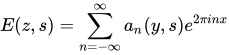
非正則アイゼンシュタイン級数はフーリエ展開を持つ

E ( z , s ) = n = a n ( y , s ) e 2 π i n x {\displaystyle E(z,s)=\sum _{n=-\infty }^{\infty }a_{n}(y,s)e^{2\pi inx}}

どこ

a 0 ( y , s ) = π s Γ ( s ) ζ ( 2 s ) y s + π s 1 Γ ( 1 s ) ζ ( 2 ( 1 s ) ) y 1 s a n ( y , s ) = 2 | n | s 1 2 σ 1 2 s ( | n | ) y K s 1 2 ( 2 π | n | y ) n 0 {\displaystyle {\begin{aligned}a_{0}(y,s)&=\pi ^{-s}\Gamma (s)\zeta (2s)y^{s}+\pi ^{s-1}\Gamma (1-s)\zeta (2(1-s))y^{1-s}\\a_{n}(y,s)&=2|n|^{s-{\frac {1}{2}}}\sigma _{1-2s}(|n|){\sqrt {y}}K_{s-{\frac {1}{2}}}(2\pi |n|y)&&n\neq 0\end{aligned}}}

ならばは に有理型接続を持つ。 は、 における単純極を除いて正則である。 z H {\displaystyle z\in {\mathcal {H}}} E ( z , s ) {\displaystyle E(z,s)} C {\displaystyle \mathbb {C} } s = 0 , 1. {\displaystyle s=0,1.}

アイゼンシュタイン級数は関数方程式を満たす

E ( z , s ) = E ( z , 1 s ) {\displaystyle E(z,s)=E(z,1-s)}

すべてのために z H {\displaystyle z\in {\mathcal {H}}}

成長条件 において局所的に均一 x R {\displaystyle x\in \mathbb {R} }

E ( x + i y , s ) = 0 ( y σ ) {\displaystyle E(x+iy,s)={\mathcal {0}}(y^{\sigma })}

保持され、 σ = max ( Re ( s ) , 1 Re ( s ) ) . {\displaystyle \sigma =\max(\operatorname {Re} (s),1-\operatorname {Re} (s)).}

Eの有理型接続は、双曲型ラプラス演算子のスペクトル理論において非常に重要です。

重量のマス形態

合同部分群

を正準射影の核と する N N {\displaystyle N\in \mathbb {N} } Γ ( N ) {\displaystyle \Gamma (N)}

S L 2 ( Z ) S L 2 ( Z / N Z ) . {\displaystyle \mathrm {SL} _{2}(\mathbb {Z} )\to \mathrm {SL} _{2}(\mathbb {Z} /N\mathbb {Z} ).}

レベルの合同部分群を と呼ぶ。が存在し、 となるとき、部分群は合同部分群と呼ばれる。すべての合同部分群は離散的である。 Γ ( N ) {\displaystyle \Gamma (N)} N {\displaystyle N} Γ S L 2 ( Z ) {\displaystyle \Gamma \subseteq \mathrm {SL} _{2}(\mathbb {Z} )} N N {\displaystyle N\in \mathbb {N} } Γ ( N ) Γ {\displaystyle \Gamma (N)\subseteq \Gamma }

させて

Γ ( 1 ) ¯ := Γ ( 1 ) / { ± 1 } . {\displaystyle {\overline {\Gamma (1)}}:=\Gamma (1)/\{\pm 1\}.}

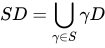
合同部分群について、を におけるの像とする。S代表の系であるとき Γ , {\displaystyle \Gamma ,} Γ ¯ {\displaystyle {\overline {\Gamma }}} Γ {\displaystyle \Gamma } Γ ( 1 ) ¯ {\displaystyle {\overline {\Gamma (1)}}} Γ ¯ Γ ( 1 ) ¯ {\displaystyle {\overline {\Gamma }}\backslash {\overline {\Gamma (1)}}}

S D = γ S γ D {\displaystyle SD=\bigcup _{\gamma \in S}\gamma D}

は の基本領域である。集合は基本領域 によって一意に決定される。さらに、は有限である。 Γ {\displaystyle \Gamma } S {\displaystyle S} S D {\displaystyle SD} S {\displaystyle S}

点は基本領域 の尖点と呼ばれます。これらは の部分集合です γ {\displaystyle \gamma \infty } γ S {\displaystyle \gamma \in S} S D {\displaystyle SD} Q { } {\displaystyle \mathbb {Q} \cup \{\infty \}}

すべてのカスプには が存在します c {\displaystyle c} σ Γ ( 1 ) {\displaystyle \sigma \in \Gamma (1)} σ = c {\displaystyle \sigma \infty =c}

重量のマス形態

を合同部分群とし Γ {\displaystyle \Gamma } k Z . {\displaystyle k\in \mathbb {Z} .}

重みの双曲型ラプラス演算子を次のように 定義する。 Δ k {\displaystyle \Delta _{k}} k {\displaystyle k}

Δ k : C ( H ) C ( H ) , {\displaystyle \Delta _{k}:C^{\infty }({\mathcal {H}})\to C^{\infty }({\mathcal {H}}),}
Δ k = y 2 ( 2 x 2 + 2 y 2 ) + i k y x . {\displaystyle \Delta _{k}=-y^{2}\left({\frac {\partial ^{2}}{\partial x^{2}}}+{\frac {\partial ^{2}}{\partial y^{2}}}\right)+iky{\frac {\partial }{\partial x}}.}

これは双曲型ラプラス演算子の一般化です Δ 0 = Δ {\displaystyle \Delta _{0}=\Delta }

の演算を次のように定義する S L 2 ( R ) {\displaystyle \mathrm {SL} _{2}(\mathbb {R} )} C ( H ) {\displaystyle C^{\infty }({\mathcal {H}})}

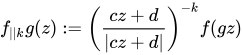
f | | k g ( z ) := ( c z + d | c z + d | ) k f ( g z ) {\displaystyle f_{||k}g(z):=\left({\frac {cz+d}{|cz+d|}}\right)^{-k}f(gz)}

どこ

z H , g = ( c d ) S L 2 ( R ) , f C ( H ) . {\displaystyle z\in {\mathcal {H}},g={\begin{pmatrix}\ast &\ast \\c&d\\\end{pmatrix}}\in \mathrm {SL} _{2}(\mathbb {R} ),f\in C^{\infty }({\mathcal {H}}).}

次のようなことが証明できる。

( Δ k f ) | | k g = Δ k ( f | | k g ) {\displaystyle (\Delta _{k}f)_{||k}g=\Delta _{k}(f_{||k}g)}

すべておよびあらゆるに当てはまります f C ( H ) , k Z {\displaystyle f\in C^{\infty }({\mathcal {H}}),k\in \mathbb {Z} } g S L 2 ( R ) {\displaystyle g\in \mathrm {SL} _{2}(\mathbb {R} )}

したがって、ベクトル空間上で動作する Δ k {\displaystyle \Delta _{k}}

C ( Γ H , k ) := { f C ( H ) : f | | k γ = f γ Γ } {\displaystyle C^{\infty }(\Gamma \backslash {\mathcal {H}},k):=\{f\in C^{\infty }({\mathcal {H}}):f_{||k}\gamma =f\forall \gamma \in \Gamma \}}

定義。重みのマース形式は、 の固有関数であり、カスプで中程度の増加を示す 関数です。 k Z {\displaystyle k\in \mathbb {Z} } Γ {\displaystyle \Gamma } f C ( Γ H , k ) {\displaystyle f\in C^{\infty }(\Gamma \backslash {\mathcal {H}},k)} Δ k {\displaystyle \Delta _{k}}

「カスプにおける中程度の増加」という用語については、明確にする必要があります。関数が で中程度の増加を示す場合、無限大はカスプです。関数 がy多項式 で と有界となる場合、関数 はカスプです。関数 を別のカスプとします。すると、 が存在することになります。 とします。するとは合同部分群です。関数 が で中程度の増加を示す場合、関数 はカスプで中程度の増加を示すと言えます Γ , {\displaystyle \Gamma ,} f C ( Γ H , k ) {\displaystyle f\in C^{\infty }(\Gamma \backslash {\mathcal {H}},k)} {\displaystyle \infty } f ( x + i y ) {\displaystyle f(x+iy)} y {\displaystyle y\to \infty } c Q {\displaystyle c\in \mathbb {Q} } θ S L 2 ( Z ) {\displaystyle \theta \in \mathrm {SL} _{2}(\mathbb {Z} )} θ ( ) = c {\displaystyle \theta (\infty )=c} f := f | | k θ {\displaystyle f':=f_{||k}\theta } f C ( Γ H , k ) {\displaystyle f'\in C^{\infty }(\Gamma '\backslash {\mathcal {H}},k)} Γ {\displaystyle \Gamma '} θ 1 Γ θ {\displaystyle \theta ^{-1}\Gamma \theta } f {\displaystyle f} c {\displaystyle c} f {\displaystyle f'} {\displaystyle \infty }

定義:がレベルの主合同部分群を含む場合、 は無限遠点において 尖っているという。 Γ {\displaystyle \Gamma } N {\displaystyle N} f {\displaystyle f}

z H : 0 N f ( z + u ) d u = 0. {\displaystyle \forall z\in {\mathcal {H}}:\quad \int _{0}^{N}f(z+u)du=0.}

が無限遠点において尖っている場合、は尖点で尖っていると言います。 がすべての尖点で尖っている場合、尖点形式と呼びます f {\displaystyle f} c {\displaystyle c} f {\displaystyle f'} f {\displaystyle f} f {\displaystyle f}

モジュラー群の 重みのマース形式の簡単な例を示します。 k > 1 {\displaystyle k>1}

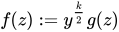
例:を の偶数重みのモジュラー形式とすると、 は群 の重みのマース形式になります g : H C {\displaystyle g:{\mathcal {H}}\to \mathbb {C} } k {\displaystyle k} Γ ( 1 ) . {\displaystyle \Gamma (1).} f ( z ) := y k 2 g ( z ) {\displaystyle f(z):=y^{\frac {k}{2}}g(z)} k {\displaystyle k} Γ ( 1 ) {\displaystyle \Gamma (1)}

スペクトルの問題

を の合同部分群としを満たす すべて測定可能な関数のベクトル空間とする。 Γ {\displaystyle \Gamma } S L 2 ( R ) {\displaystyle \mathrm {SL} _{2}(\mathbb {R} )} L 2 ( Γ H , k ) {\displaystyle L^{2}(\Gamma \backslash {\mathcal {H}},k)} f : H C {\displaystyle f:{\mathcal {H}}\to \mathbb {C} } f | | k γ = f {\displaystyle f_{||k}\gamma =f} γ Γ {\displaystyle \gamma \in \Gamma }

f 2 := Γ H | f ( z ) | 2 d μ ( z ) < {\displaystyle \|f\|^{2}:=\int _{\Gamma \backslash {\mathcal {H}}}|f(z)|^{2}d\mu (z)<\infty }

を法とする関数は-不変ので、積分は明確に定義される。これは内積を持つヒルベルト空間である。 f = 0. {\displaystyle \|f\|=0.} | f ( z ) | 2 {\displaystyle |f(z)|^{2}} Γ {\displaystyle \Gamma }

f , g = Γ H f ( z ) g ( z ) ¯ d μ ( z ) . {\displaystyle \langle f,g\rangle =\int _{\Gamma \backslash {\mathcal {H}}}f(z){\overline {g(z)}}d\mu (z).}

作用素はに稠密なベクトル空間で定義できる半正定値対称作用素が存在する。 に自己随伴接続が一意に存在することが示される。 Δ k {\displaystyle \Delta _{k}} B L 2 ( Γ H , k ) C ( Γ H , k ) {\displaystyle B\subset L^{2}(\Gamma \backslash {\mathcal {H}},k)\cap C^{\infty }(\Gamma \backslash {\mathcal {H}},k)} L 2 ( Γ H , k ) {\displaystyle L^{2}(\Gamma \backslash {\mathcal {H}},k)} Δ k {\displaystyle \Delta _{k}} L 2 ( Γ H , k ) . {\displaystyle L^{2}(\Gamma \backslash {\mathcal {H}},k).}

をすべてのカスプ形式の成す空間として定義する。すると、は に作用し、離散スペクトルを持つ。直交補空間に属するスペクトルは連続部分を持ち、(修正された)非正則アイゼンシュタイン級数、それらの有理型接続、およびそれらの留数を用いて記述できる。(Bump または Iwaniec を参照)。 C ( Γ H , k ) {\displaystyle C(\Gamma \backslash {\mathcal {H}},k)} L 2 ( Γ H , k ) C ( Γ H , k ) . {\displaystyle L^{2}(\Gamma \backslash {\mathcal {H}},k)\cap C^{\infty }(\Gamma \backslash {\mathcal {H}},k).} Δ k {\displaystyle \Delta _{k}} C ( Γ H , k ) {\displaystyle C(\Gamma \backslash {\mathcal {H}},k)}

が の離散的(ねじれのない)部分群で、商がコンパクトである場合、スペクトル問題は単純化されます。これは、離散ココンパクト部分群には尖点が存在しないからです。ここで、空間全体は固有空間の和です。 Γ {\displaystyle \Gamma } S L 2 ( R ) {\displaystyle \mathrm {SL} _{2}(\mathbb {R} )} Γ H {\displaystyle \Gamma \backslash {\mathcal {H}}} L 2 ( Γ H , k ) {\displaystyle L^{2}(\Gamma \backslash {\mathcal {H}},k)}

空間への埋め込みL2(Γ \G

G = S L 2 ( R ) {\displaystyle G=\mathrm {SL} _{2}(\mathbb {R} )} 局所コンパクト ユニモジュラ群で、位相は である。 を合同部分群とする。は において離散的であるため、 においても閉じている。 群はユニモジュラであり、計数測度は離散群 上のハール測度であるため、もユニモジュラである。商積分公式により、局所コンパクト空間 上には-右不変のラドン測度が存在するを対応する-空間とする。この空間はヒルベルト空間の直和に分解される。 R 4 . {\displaystyle \mathbb {R} ^{4}.} Γ {\displaystyle \Gamma } Γ {\displaystyle \Gamma } G {\displaystyle G} G {\displaystyle G} G {\displaystyle G} Γ {\displaystyle \Gamma } Γ {\displaystyle \Gamma } G {\displaystyle G} d x {\displaystyle dx} Γ G {\displaystyle \Gamma \backslash G} L 2 ( Γ G ) {\displaystyle L^{2}(\Gamma \backslash G)} L 2 {\displaystyle L^{2}}

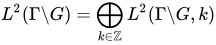
L 2 ( Γ G ) = k Z L 2 ( Γ G , k ) {\displaystyle L^{2}(\Gamma \backslash G)=\bigoplus _{k\in \mathbb {Z} }L^{2}(\Gamma \backslash G,k)}

どこ

L 2 ( Γ G , k ) := { ϕ L 2 ( Γ G ) ϕ ( x k θ ) = e i k θ F ( x ) x Γ G θ R } {\displaystyle L^{2}(\Gamma \backslash G,k):=\left\{\phi \in L^{2}(\Gamma \backslash G)\mid \phi (xk_{\theta })=e^{ik\theta }F(x)\forall x\in \Gamma \backslash G\forall \theta \in \mathbb {R} \right\}}

そして

k θ = ( cos ( θ ) sin ( θ ) sin ( θ ) cos ( θ ) ) S O ( 2 ) , θ R . {\displaystyle k_{\theta }={\begin{pmatrix}\cos(\theta )&-\sin(\theta )\\\sin(\theta )&\cos(\theta )\\\end{pmatrix}}\in SO(2),\theta \in \mathbb {R} .}

ヒルベルト空間はヒルベルト空間に等長的に埋め込むことができる。等長写像は L 2 ( Γ H , k ) {\displaystyle L^{2}(\Gamma \backslash {\mathcal {H}},k)} L 2 ( Γ G , k ) {\displaystyle L^{2}(\Gamma \backslash G,k)}

{ ψ k : L 2 ( Γ H , k ) L 2 ( Γ G , k ) ψ k ( f ) ( g ) := f | | k γ ( i ) {\displaystyle {\begin{cases}\psi _{k}:L^{2}(\Gamma \backslash {\mathcal {H}},k)\to L^{2}(\Gamma \backslash G,k)\\\psi _{k}(f)(g):=f_{||k}\gamma (i)\end{cases}}}

したがって、合同群のすべてのマースカスプ形式はの要素として考えることができます Γ {\displaystyle \Gamma } L 2 ( Γ G ) {\displaystyle L^{2}(\Gamma \backslash G)}

L 2 ( Γ G ) {\displaystyle L^{2}(\Gamma \backslash G)} は、群の演算、いわゆる右正則表現を伴うヒルベルト空間である。 G {\displaystyle G}

R g ϕ := ϕ ( x g ) ,  where  x Γ G  and  ϕ L 2 ( Γ G ) . {\displaystyle R_{g}\phi :=\phi (xg),{\text{ where }}x\in \Gamma \backslash G{\text{ and }}\phi \in L^{2}(\Gamma \backslash G).}

がヒルベルト空間 上のユニタリ表現であることは容易に示せます。ここで関心のあるのは、既約部分表現への分解です。これはがココンパクトである場合にのみ可能です。そうでない場合は、連続ヒルベルト積分部分も存在します。興味深いのは、この問題の解がマース形式のスペクトル問題も解くことです。(Bump, C. 2.3 を参照) R {\displaystyle R} G {\displaystyle G} L 2 ( Γ G ) {\displaystyle L^{2}(\Gamma \backslash G)} Γ {\displaystyle \Gamma }

マースカスプフォーム

マースカスプ形式はマース形式の部分集合であり、上半平面上の関数で、モジュラー形式のように変換されるが、必ずしも正則である必要はない。これはハンス・マースによってMaass (1949)で初めて研究された

意味

kを整数s を複素数、Γ をSL 2 ( R )離散部分群とする。ラプラス固有値sを持つ Γ の重みkのマース形式は、上半平面から複素数への 滑らかな関数であり、以下の条件を満たす。

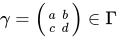
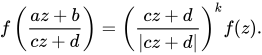
  • 誰にとって、私たちは γ = ( a b c d ) Γ {\displaystyle \gamma =\left({\begin{smallmatrix}a&b\\c&d\end{smallmatrix}}\right)\in \Gamma } z H {\displaystyle z\in {\mathcal {H}}} f ( a z + b c z + d ) = ( c z + d | c z + d | ) k f ( z ) . {\displaystyle f\left({\frac {az+b}{cz+d}}\right)=\left({\frac {cz+d}{|cz+d|}}\right)^{k}f(z).}
  • となる。ここで重みkは双曲ラプラシアンで、次のように定義される。 Δ k f = s f {\displaystyle \Delta _{k}f=sf} Δ k {\displaystyle \Delta _{k}} Δ k = y 2 ( 2 x 2 + 2 y 2 ) + i k y x . {\displaystyle \Delta _{k}=-y^{2}\left({\frac {\partial ^{2}}{\partial x^{2}}}+{\frac {\partial ^{2}}{\partial y^{2}}}\right)+iky{\frac {\partial }{\partial x}}.}
  • この関数は、尖点において最大で多項式増加します f {\displaystyle f}

マース形式も同様に定義されますが、3番目の条件が「関数はカスプにおいて最大でも線形指数関数的増加を示す」に置き換えられます。さらに、ラプラシアン作用素によって消滅する場合、調和関数であると言われます f {\displaystyle f} f {\displaystyle f}

主な成果

を重み0のマースカスプ形式とする。素数pにおけるその正規化フーリエ係数は、p 7/64 + p −7/64有界となる。この定理はヘンリー・キムとピーター・サーナックによるものである。これはラマヌジャン=ペーターソン予想への近似である f {\displaystyle f}

高次元

マース・カスプ形式はGL(2)上の保型形式とみなせる。GL( n )上のマース・カスプ形式を有理数体上 のGL( n )上の球面保型形式として定義するのは自然である。その存在はミラー、ミュラー等によって証明されている。

アデール群の保型表現

グループGL2(あ)

を単位元を持つ可換環とし、の要素と可逆行列式を持つ行列群とするを有理数アデール環、を有限(有理)アデール環とし、素数に対してをp進数の体とするさらに、をp 進整数環とする(アデール環 を参照)。 を定義する。 と はそれぞれの部分空間位相を持つ場合、局所コンパクトユニモジュラ群となる。すると、 R {\displaystyle R} G R := G L 2 ( R ) {\displaystyle G_{R}:=\mathrm {GL} _{2}(R)} 2 × 2 {\displaystyle 2\times 2} R {\displaystyle R} A = A Q {\displaystyle \mathbb {A} =\mathbb {A} _{\mathbb {Q} }} A fin {\displaystyle \mathbb {A} _{\text{fin}}} p N {\displaystyle p\in \mathbb {N} } Q p {\displaystyle \mathbb {Q} _{p}} Z p {\displaystyle \mathbb {Z} _{p}} G p := G Q p {\displaystyle G_{p}:=G_{\mathbb {Q} _{p}}} G p {\displaystyle G_{p}} G R {\displaystyle G_{\mathbb {R} }} Q p 4 {\displaystyle \mathbb {Q} _{p}^{4}} R 4 {\displaystyle \mathbb {R} ^{4}}

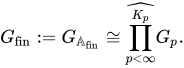
G fin := G A fin p < K p ^ G p . {\displaystyle G_{\text{fin}}:=G_{\mathbb {A} _{\text{fin}}}\cong {\widehat {\prod _{p<\infty }^{K_{p}}}}G_{p}.}

右辺は、のコンパクト開部分群に関する制限積である制限積位相を付与すれば、局所コンパクト群となる。 K p := G Z p {\displaystyle K_{p}:=G_{\mathbb {Z} _{p}}} G p {\displaystyle G_{p}} G fin {\displaystyle G_{\text{fin}}}

この群 G A {\displaystyle G_{\mathbb {A} }}

G fin × G R {\displaystyle G_{\text{fin}}\times G_{\mathbb {R} }}

と は両方とも局所コンパクトであるため、積位相を持つ局所コンパクト群です G fin {\displaystyle G_{\text{fin}}} G R {\displaystyle G_{\mathbb {R} }}

させて

Z ^ = p < Z p . {\displaystyle {\widehat {\mathbb {Z} }}=\prod _{p<\infty }\mathbb {Z} _{p}.}

サブグループ

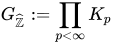
G Z ^ := p < K p {\displaystyle G_{\widehat {\mathbb {Z} }}:=\prod _{p<\infty }K_{p}}

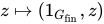
は の最大コンパクト開部分群であり、の埋め込みを考えると、の部分群と考えることができます G fin {\displaystyle G_{\text{fin}}} G A {\displaystyle G_{\mathbb {A} }} x fin ( x fin , 1 ) {\displaystyle x_{\text{fin}}\mapsto (x_{\text{fin}},1_{\infty })}

を の中心として定義します。つまり、 は(ここで )の形式をとるすべての対角行列の群です。を で埋め込むことができるため、は のサブグループであると考えられます Z R {\displaystyle Z_{\mathbb {R} }} G {\displaystyle G_{\infty }} Z R {\displaystyle Z_{\mathbb {R} }} ( λ λ ) {\displaystyle {\begin{pmatrix}\lambda &\\&\lambda \\\end{pmatrix}}} λ R × {\displaystyle \lambda \in \mathbb {R} ^{\times }} Z R {\displaystyle Z_{\mathbb {R} }} G A {\displaystyle G_{\mathbb {A} }} z ( 1 G fin , z ) {\displaystyle z\mapsto (1_{G_{\text{fin}}},z)}

群はに対角的に埋め込まれますが、これは の 4 つの要素すべてが有限個の素因数しか持てないため、有限個以外のすべての素数 に対して となるため可能です G Q {\displaystyle G_{\mathbb {Q} }} G A {\displaystyle G_{\mathbb {A} }} x G Q {\displaystyle x\in G_{\mathbb {Q} }} x K p {\displaystyle x\in K_{p}} p N {\displaystyle p\in \mathbb {N} }

を を満たすすべての の群とします(イデル環の絶対値の定義についてはアデル環を参照してください。)が の部分群であることは簡単に計算できます G A 1 {\displaystyle G_{\mathbb {A} }^{1}} x G A {\displaystyle x\in G_{\mathbb {A} }} | det ( x ) | = 1 {\displaystyle |\det(x)|=1} G Q {\displaystyle G_{\mathbb {Q} }} G A 1 {\displaystyle G_{\mathbb {A} }^{1}}

1対1のマップを使用すると、グループ互いを識別できます。 G A 1 G A {\displaystyle G_{\mathbb {A} }^{1}\hookrightarrow G_{\mathbb {A} }} G Q G A 1 {\displaystyle G_{\mathbb {Q} }\backslash G_{\mathbb {A} }^{1}} G Q Z R G A {\displaystyle G_{\mathbb {Q} }Z_{\mathbb {R} }\backslash G_{\mathbb {A} }}

群はでは稠密であり、 では離散的である。商はコンパクトではないが、有限ハール測度を持つ。 G Q {\displaystyle G_{\mathbb {Q} }} G fin {\displaystyle G_{\text{fin}}} G A {\displaystyle G_{\mathbb {A} }} G Q Z R G A = G Q G A 1 {\displaystyle G_{\mathbb {Q} }Z_{\mathbb {R} }\backslash G_{\mathbb {A} }=G_{\mathbb {Q} }\backslash G_{\mathbb {A} }^{1}}

したがって、はモジュラー群およびの古典的な場合と同様に、の格子となる。調和解析により、がユニモジュラーであることも分かる。 G Q {\displaystyle G_{\mathbb {Q} }} G A 1 , {\displaystyle G_{\mathbb {A} }^{1},} S L 2 ( R ) {\displaystyle \mathrm {SL} _{2}(\mathbb {R} )} G A 1 {\displaystyle G_{\mathbb {A} }^{1}}

尖頭骨のアデル化

ここで、重み0のモジュラー群の古典的なマースカスプ形式を に埋め込むことを考えます。これは「強近似定理」によって達成でき、これは写像 Z R G Q G A {\displaystyle Z_{\mathbb {R} }G_{\mathbb {Q} }\backslash G_{\mathbb {A} }}

ψ : G Z x G Q ( 1 , x ) G Z ^ {\displaystyle \psi :G_{\mathbb {Z} }x_{\infty }\mapsto G_{\mathbb {Q} }(1,x_{\infty })G_{\widehat {\mathbb {Z} }}}

は -同変同相写像である。したがって、 G R {\displaystyle G_{\mathbb {R} }}

G Z G R G Q G A / G Z ^ {\displaystyle G_{\mathbb {Z} }\backslash G_{\mathbb {R} }{\overset {\sim }{\to }}G_{\mathbb {Q} }\backslash G_{\mathbb {A} }/G_{\widehat {\mathbb {Z} }}}

さらに

G Z Z R G R G Q Z R G A / G Z ^ . {\displaystyle G_{\mathbb {Z} }Z_{\mathbb {R} }\backslash G_{\mathbb {R} }{\overset {\sim }{\to }}G_{\mathbb {Q} }Z_{\mathbb {R} }\backslash G_{\mathbb {A} }/G_{\widehat {\mathbb {Z} }}.}

モジュラー群の重み0のマース尖形は、

L 2 ( S L 2 ( Z ) S L 2 ( R ) ) L 2 ( G L 2 ( Z ) Z R G L 2 ( R ) ) . {\displaystyle L^{2}(\mathrm {SL} _{2}(\mathbb {Z} )\backslash \mathrm {SL} _{2}(\mathbb {R} ))\cong L^{2}(\mathrm {GL} _{2}(\mathbb {Z} )Z_{\mathbb {R} }\backslash \mathrm {GL} _{2}(\mathbb {R} )).}

強近似定理により、この空間は

L 2 ( G Q Z R G A / G Z ^ ) L 2 ( G Q Z R G A ) G Z ^ {\displaystyle L^{2}(G_{\mathbb {Q} }Z_{\mathbb {R} }\backslash G_{\mathbb {A} }/G_{\widehat {\mathbb {Z} }})\cong L^{2}(G_{\mathbb {Q} }Z_{\mathbb {R} }\backslash G_{\mathbb {A} })^{G_{\widehat {\mathbb {Z} }}}}

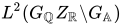
これは L 2 ( G Q Z R G A ) . {\displaystyle L^{2}(G_{\mathbb {Q} }Z_{\mathbb {R} }\backslash G_{\mathbb {A} }).}

同様に、古典的な正則カスプ形式を埋め込むことができます。近似定理を少し一般化することで、任意の合同部分群に対して、任意の重みを持つすべてのマースカスプ形式(および正則カスプ形式)を埋め込むことができます Γ {\displaystyle \Gamma } L 2 ( G Q Z R G A ) {\displaystyle L^{2}(G_{\mathbb {Q} }Z_{\mathbb {R} }\backslash G_{\mathbb {A} })}

保型形式の空間をアデール群と 呼びます。 L 2 ( G Q Z R G A ) {\displaystyle L^{2}(G_{\mathbb {Q} }Z_{\mathbb {R} }\backslash G_{\mathbb {A} })}

アデール群のカスプ形式

を環とし、 となるを とする。この群はRの加法群と同型である R {\displaystyle R} N R {\displaystyle N_{R}} ( 1 r 1 ) , {\displaystyle {\begin{pmatrix}1&r\\&1\\\end{pmatrix}},} r R {\displaystyle r\in R}

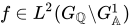
関数をカスプ形式と呼ぶのは、 f L 2 ( G Q G A 1 ) {\displaystyle f\in L^{2}(G_{\mathbb {Q} }\backslash G_{\mathbb {A} }^{1})}

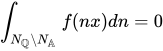
N Q N A f ( n x ) d n = 0 {\displaystyle \int _{N_{\mathbb {Q} }\backslash N_{\mathbb {A} }}f(nx)dn=0}

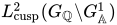
はほぼすべての に対して成り立つ(または単に)をこれらのカスプ形式のベクトル空間とする。は の閉部分空間であり、 の右正規表現に対して不変である。 x G Q G A 1 {\displaystyle x\in G_{\mathbb {Q} }\backslash G_{\mathbb {A} }^{1}} L cusp 2 ( G Q G A 1 ) {\displaystyle L_{\text{cusp}}^{2}(G_{\mathbb {Q} }\backslash G_{\mathbb {A} }^{1})} L cusp 2 {\displaystyle L_{\text{cusp}}^{2}} L cusp 2 {\displaystyle L_{\text{cusp}}^{2}} L 2 ( G Q Z R G A ) {\displaystyle L^{2}(G_{\mathbb {Q} }Z_{\mathbb {R} }\backslash G_{\mathbb {A} })} G A 1 . {\displaystyle G_{\mathbb {A} }^{1}.}

ここで再び興味があるのは、 を既約な閉部分空間に分解することです L cusp 2 {\displaystyle L_{\text{cusp}}^{2}}

次の定理が成り立ちます。

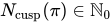
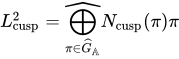
この空間は有限重複度を持つ既約ヒルベルト空間の直和に分解される L cusp 2 {\displaystyle L_{\text{cusp}}^{2}} N cusp ( π ) N 0 {\displaystyle N_{\text{cusp}}(\pi )\in \mathbb {N} _{0}}

L cusp 2 = π G ^ A ^ N cusp ( π ) π {\displaystyle L_{\text{cusp}}^{2}={\widehat {\bigoplus _{\pi \in {\widehat {G}}_{\mathbb {A} }}}}N_{\text{cusp}}(\pi )\pi }

これらの重複度の計算は、保型形式の理論において最も重要かつ最も難しい問題の 1 つです。 N cusp ( π ) {\displaystyle N_{\text{cusp}}(\pi )}

アデール群の尖頭表現

群の既約表現は、それが の部分表現と同型である場合、尖端的であると呼ばれます π {\displaystyle \pi } G A {\displaystyle G_{\mathbb {A} }} L cusp 2 {\displaystyle L_{\text{cusp}}^{2}}

群の既約表現は、コンパクト部分群が存在しすべての に対してとなる場合、許容表現と呼ばれます π {\displaystyle \pi } G A {\displaystyle G_{\mathbb {A} }} K {\displaystyle K} K G A {\displaystyle K\subset G_{\mathbb {A} }} dim K ( V π , V τ ) < {\displaystyle \dim _{K}(V_{\pi },V_{\tau })<\infty } τ G ^ A {\displaystyle \tau \in {\widehat {G}}_{\mathbb {A} }}

あらゆる尖頭表現が許容されることを示すことができます。

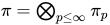
許容性は、いわゆるテンソル積定理の証明に必要であり、これは、群のすべての既約、ユニタリ、許容表現が無限テンソル積と同型である というものである。 G A {\displaystyle G_{\mathbb {A} }}

p π p . {\displaystyle \bigotimes _{p\leq \infty }\pi _{p}.}

群の既約表現である。それらのほとんどは非分岐化する必要がある。 π p {\displaystyle \pi _{p}} G p {\displaystyle G_{p}}

(群の表現はベクトル空間が π p {\displaystyle \pi _{p}} G p {\displaystyle G_{p}} ( p < ) {\displaystyle (p<\infty )}

V π p K p = { v V π p π p ( k ) v = v k K p } {\displaystyle V_{\pi _{p}}^{K_{p}}=\left\{v\in V_{\pi _{p}}\mid \pi _{p}(k)v=v\forall k\in K_{p}\right\}}

ゼロ空間ではありません。

無限テンソル積の構築については、Deitmar,C.7 を参照してください。

保型L関数

を の既約かつ許容可能なユニタリ表現とするテンソル積定理により、は次のような形をとる(アデール群の尖頭表現を参照)。 π {\displaystyle \pi } G A {\displaystyle G_{\mathbb {A} }} π {\displaystyle \pi } π = p π p {\textstyle \pi =\bigotimes _{p\leq \infty }\pi _{p}}

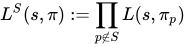
を、すべての分岐点を含む有限集合とするの大域ヘッケ関数を次のように 定義する。 S {\displaystyle S} {\displaystyle \infty } π {\displaystyle \pi }

L S ( s , π ) := p S L ( s , π p ) {\displaystyle L^{S}(s,\pi ):=\prod _{p\notin S}L(s,\pi _{p})}

ここでは局所表現 のいわゆる局所L関数である。局所L関数の構築法はDeitmar C. 8.2に記載されている。 L ( s , π p ) {\displaystyle L(s,\pi _{p})} π p {\displaystyle \pi _{p}}

が尖点表現である場合、L関数は上で有理型接続を持ちます。これは、 が特定の関数方程式を満たす ため可能です。 π {\displaystyle \pi } L S ( s , π ) {\displaystyle L^{S}(s,\pi )} C {\displaystyle \mathbb {C} } L S ( s , π ) {\displaystyle L^{S}(s,\pi )}

参照

参考文献

  • キャサリン・ブリングマン; Folsom、Amanda (2014)、「ほぼ調和的な Maass 形式と Kac–Wakimoto キャラクター」、Journal für die Reine und Angewandte Mathematik2014 (694): 179–202arXiv : 1112.4726doi :10.1515/crelle-2012-0102、MR  3259042、S2CID  54896147
  • バンプ、ダニエル(1997)、保型形式と表現、ケンブリッジ高等数学研究、第55巻、ケンブリッジ大学出版局doi:10.1017/CBO9780511609572、ISBN 978-0-521-55098-7MR  1431508
  • アントン・ダイトマール:オートモーフ・フォルメン。 Springer、ベルリン/ハイデルベルク、2010 年、ISBN 978-3-642-12389-4
  • デューク、W. ;フリードレンダー, JB ; iwaniec, H. (2002)、「Artin L関数の部分凸問題」、Inventiones Mathematicae149 (3): 489–577Bibcode :2002InMat.149..489D、doi :10.1007/s002220200223、MR  1923476、S2CID  121720199
  • ヘンリク・イワニエツ 著『保型形式のスペクトル法(数学大学院研究)アメリカ数学会刊行物、第2巻(2002年11月)、ISBN 978-0821831601
  • マース、ハンス(1949)、「Über eine neue Art von nichtanalytischen automorphen Funktionen und die Bestimmung Dirichletscher Reihen durch Funktionalgleichungen」、Mathematische Annalen121 : 141–183doi :10.1007/BF01329622、MR  0031519、S2CID  119494842
Retrieved from "https://en.wikipedia.org/w/index.php?title=Maass_wave_form&oldid=1315046114#Maass_cusp_form"