Santiago Metropolitan Region
Región Metropolitana de Santiago | |
|---|---|
.png/1280px-Montaje_de_la_Regi%C3%B3n_Metropolitana_de_Santiago_(202011260).png) Skyline of Santiago Metropolitan Region | |
 Map of Santiago Metropolitan Region | |
| Coordinates: 33°26′16″S 70°39′01″W / 33.43778°S 70.65028°W / -33.43778; -70.65028 | |
| Country |  Chile Chile |
| Capital | Santiago |
| Provinces | Santiago, Chacabuco, Cordillera, Maipo, Melipilla, Talagante |
| Government | |
| • Regional governor | Claudio Orrego |
| • Presidencial Regional Delegate | Gonzalo Andrés Durán Baronti |
| Area [1] | |
• Total | 15,403.2 km2 (5,947.2 sq mi) |
| • Rank | 15 |
| Highest elevation | 6,570 m (21,560 ft) |
| Population (2024)[2] | |
• Total | 7,400,741 |
| • Rank | 1st in Chile |
| • Density | 480.468/km2 (1,244.41/sq mi) |
| GDP (PPP) [3] | |
| • Total | $175.108 billion (2014) |
| • Per capita | $39,000 (2024) |
| ISO 3166 code | CL-RM |
| HDI (2023) | 0.908[4] very high |
| Website | (in Spanish) Gobierno Regional Metropolitano de Santiago |


Santiago Metropolitan Region (Spanish: Región Metropolitana de Santiago) is one of Chile's 16 first-order administrative divisions. It is the country's only landlocked administrative region and contains the nation's capital, Santiago. Most commercial and administrative centers are located in the region, including Chile's main international airport, Arturo Merino Benítez International Airport.
With an area of 15,403.2 km2 (5,947 sq mi) and population over seven million, it is Chile's most populated and most densely populated region. It is also the most developed subdivision in all of South America with a very high HDI of 0.908.[5]
History
The region's history of European influence started in 1542,[1] a few days after Santiago was founded. When the Santiago cabildo was built, its function was to supervise the entire territory. Later, with the creation of the cities of La Serena and Concepción and the creation of their respective cabildos, its territorial reach was reduced.
On 30 August 1826, 8 provinces were created, with the Santiago Province being one of them, but it wasn't until 1980 that the Metropolitan Region was created.
Geography
This section needs additional citations for verification. (July 2023) |

Metropolitana is Chile's only landlocked region and lies in the Intermediate Depression valley between the Chilean Coast Range and the Andes Mountains. Cerro San Cristóbal dominates the sprawling Santiago cityscape at a height of 880 m (2,887 ft) above sea level with city suburbs steadily climbing the foothills of the Andes to the east. The Tupungato stratovolcano, measures 6,570 m (21,555 ft) on the Argentine border, is one of South America's highest peaks.
The dominant drainage basin feeds into the Maipo River; its main tributaries are the Mapocho, Yeso and Colorado rivers.[1]
Most of the region is made up of an extremely fertile, level prairie that the locals call la Depresión intermedia (Intermediate Depression). The terrain is known for its low elevation in relation to sea level and for being surrounded by hills, as well as emergent so-called island hills, such as Santa Lucía (an ancient extinct volcano), Blanco, and Renca, present today in the city of Santiago.
There is some occurrence of the endangered Chilean Wine Palm, Jubaea chilensis within the Santiago Province;[6] this iconic tree of central Chile had a much larger range prehistorically, before the decimation of much of its habitat by the expanding human population.
The region mountainous parts of the region host various deposits of copper ore. To the north the mine of Los Bronces straddle the border with Valparaíso Region in the high Andes. Also in the high Andes but to the south along the border with O'Higgins Region lies the unexploited copper ore prospect of Catedral.[7] To the west of the region at the foot of the Chilean Coastal Cordillera lies the mine Lo Aguirre which closed in 2000.[8]
Climate
The climate of the Metropolitan Region is temperate Mediterranean cold, of the kind called continental. Precipitation is concentrated in the winter months, generally as snow over 900 m above sea level and, in colder years, over the city of Santiago. Winter tends to be cold with frequent frosts during which temperature drops below 0 °C (32 °F). The summer months are usually dry and hot. The Cordillera de la Costa acts as a climate screen and reduces marine influence, which makes the climate more continental. This situation becomes apparent when comparing precipitation from a coastal location such as Valparaíso (460 mm) with that of Santiago de Chile (360 mm).
The annual median precipitation reaches 367 mm on average. The annual median temperature comes out to 13.5 °C (56 °F), with a median high of 21 °C (70 °F) and a median low of 6 °C (43 °F) in urban areas. Rural areas tend to be colder, as temperature reaches −10 °C (14 °F) in the coldest months (July, August)
Government
The region is divided into 6 provinces, which are themselves divided into 52 communes. Since 2021 the region is governed by the governor, who is elected by popular vote. The current governor is Claudio Orrego Larraín (Independent).
Demographics
| Year | Pop. | ±% p.a. |
|---|---|---|
| 1970 | 3,153,775 | — |
| 1982 | 4,318,097 | +2.65% |
| 1992 | 5,257,937 | +1.99% |
| 2002 | 6,061,185 | +1.43% |
| 2017 | 7,112,808 | +1.07% |
| 2024 | 7,400,741 | +0.57% |
| Source: INE[9][2], Memoria Chilena[10] | ||
As of the 2024 census, the region has a population of 7,400,741, of which 48.4% are male and 51.6% are female, compared to the nationwide average of 48.5% and 51.5% respectively. People under 15 years old make up 17.3% of the population, and people over 65 years old make up 13.2%, compared to the nationwide average of 17.7% and 14.0% respectively. 96.2% of the population is urban and 3.8% is rural.[2]
Economy
The region's principal industries include manufacturing, services, retail, and financial services. The capital of Santiago serves as the country's administrative, industrial, commercial, financial and cultural center, producing 41.5% of Chile's gross domestic product, according to central bank estimates.
Notable places
The Plaza de Armas, the central square in downtown Santiago, hosts the city's cathedral and city hall. Eight city blocks around the presidential palace, La Moneda, are where most ministries, services and commercial banks can be found. Vitacura and El Golf host most of the city's high-rise buildings and are also home to the Latin American headquarters of several United Nations organizations.[1] Though Santiago's expansion has caused newer vineyards to move to more rural locations, many of the country's oldest wineries, built in the 19th century, have preserved cellars in the valley.[1]
References
- ^ a b c d e "Santiago Metropolitan Region". Government of Chile Foreign Investment Committee. Retrieved 13 March 2010.[permanent dead link]
- ^ a b c d "Resultados – Censo 2024" [Results – 2024 Census] (in Spanish). INE.
- ^ Regions and Cities > Regional Statistics > Regional Economy > Regional GDP per Capita, OECD.Stats.
- ^ "Subnational HDI (v9.0)". Global Data Lab. Institute for Management Research. Retrieved 6 November 2025.
- ^ "Subnational HDI of Chile".
- ^ C. Michael Hogan (2008) Chilean Wine Palm: Jubaea chilensis, GlobalTwitcher.com, ed. Nicklas Stromberg Archived 17 October 2012 at the Wayback Machine
- ^ Catedral (PDF) (Report) (in Spanish). ENAMI. 2019. Retrieved 12 December 2025.
- ^ Saric, Nicolas; Kreft, Carlos; Huete, Carlos (2003). "Geología del yacimiento Lo Aguirre, Chile" [Geology of Lo Aguirre copper deposit, Chile]. Revista Geológica de Chile (in Spanish). 30 (2): 317–331. doi:10.4067/S0716-02082003000200010.
- ^ "Censo de Población y Vivienda" [Census of Population and Housing] (in Spanish). INE.
- ^ "Censos de 1970-1982" [1970-1982 Censuses] (PDF) (in Spanish). Memoria Chilena.
Gallery
-
Metropolitan communes by Human Development Index
-
Santiago de Chile
-
View of Palacio de La Moneda
-
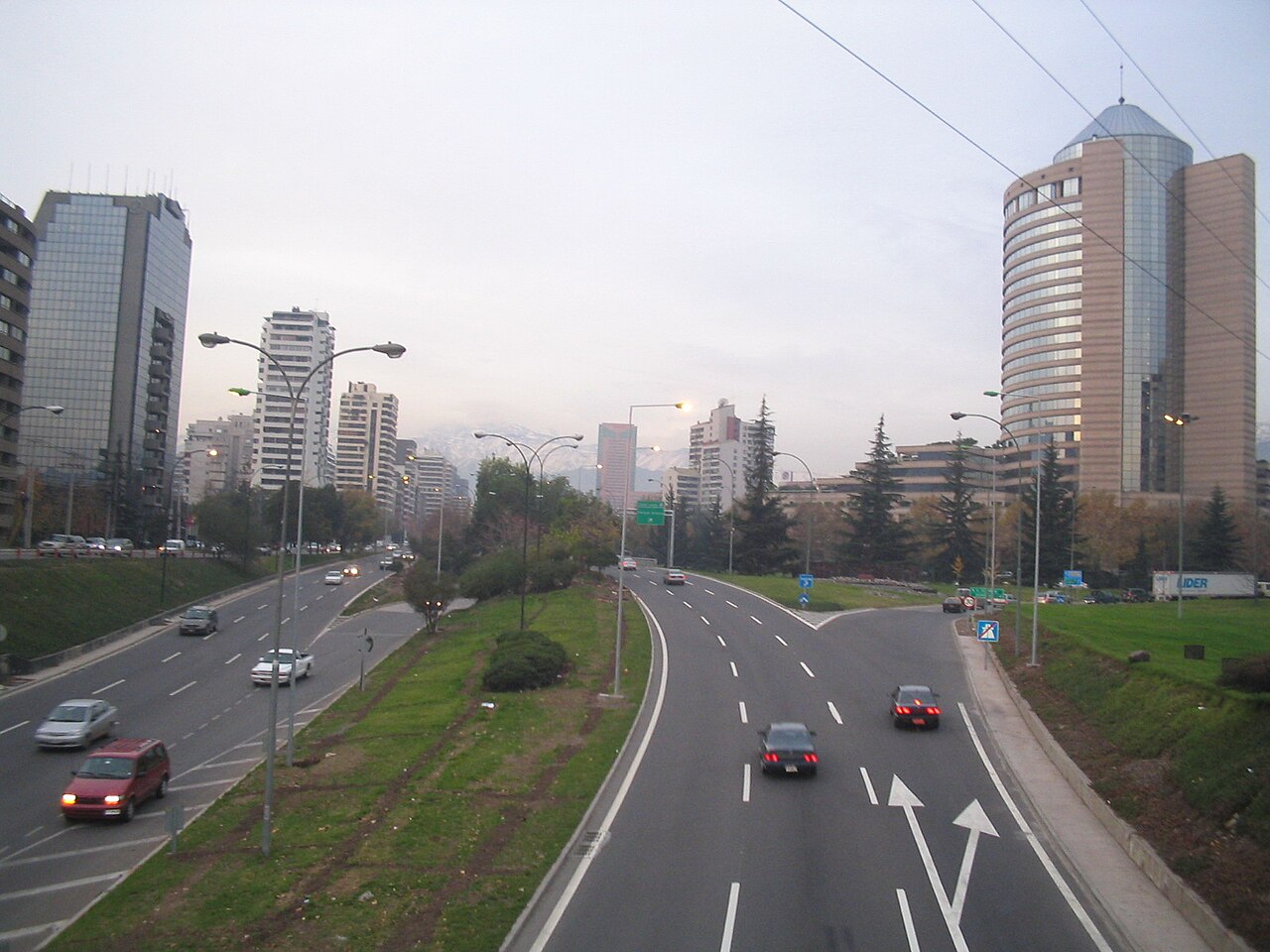
Kennedy Avenue, East Santiago with the Hyatt at the far right.
-
Isidora Goyenechea Avenue, Santiago financial district.
-
Typical middle-class neighbourhood
-
Santiago at night
-
One of the region's ski centers
-
Sanhattan, Santiago's financial district with the Great Tower of Santiago.
-
Santiago's Financial District with the Great Tower on the right and the Titanium on the left.
-
Apoquindo Avenue, the main avenue leading to the financial district.
-
House in one of the region's ski centers.




.png)


