Nitra Region
Nitriansky kraj | |
|---|---|
From the top to bottom-left; Panoramic view of Nitra, Štúrovo - Bridge of Mária Valéria, Hrušov Castle, Topoľčianky chateau, Topoľčany Castle, Komárno city centre, Levice Castle and Dražovce church | |
 Nitra Region | |
| Country |  Slovakia Slovakia |
| Capital | Nitra |
| Government | |
| • Body | County Council of Nitra Region |
| • Governor | Branislav Becík (Voice) |
| Area [1] | |
• Total | 6,343.73 km2 (2,449.33 sq mi) |
| Highest elevation | 943 m (3,094 ft) |
| Population (2024)[2] | |
• Total | 665,600 |
| GDP [3] | |
| • Total | €8.801 billion (2016) |
| • Per capita | €12,925 (2016) |
| Time zone | UTC+1 (CET) |
| • Summer (DST) | UTC+2 (CEST) |
| ISO 3166 code | SK-NI |
| Website | www.unsk.sk |


.jpg/1280px-Topo%C4%BE%C4%8Diansky_hrad_(2016).jpg)


The Nitra Region (Slovak: Nitriansky kraj, pronounced [ˈɲitrɪɐnski ˈkraj]; Hungarian: Nyitrai kerület) is one of the administrative regions of Slovakia. It was first established in 1923 and from 1996 exists in its present borders. It consists of seven districts (okres) and 354 municipalities, of which 16 have a town status. The economy of the region focuses more on agriculture, than in other Slovak regions. Nitra is its seat, largest city, and cultural and economic center.
Geography
This region with a long history is situated in the southwest of Slovakia, mostly in the eastern part of the Danubian Lowland. It is divided into two sub-units: the Danubian Flat in the south-west, with eastern part of the Žitný ostrov island, and the Danubian Hills in the north, centre and east. Mountain ranges reaching into the region are: Považský Inovec in the north-west, where the region's highest point, Veľký Inovec, is located, Tribeč in the north from Nitra, Pohronský Inovec in the north-east and Štiavnické vrchy in the east. Major rivers are the Danube in the south, Váh in the south-west, Nitra in the western-central part, Hron in the east and Ipeľ in the south-east. As for administrative divisions, the region borders Trenčín Region in the north, Banská Bystrica Region in the east, Hungarian Pest in the south-east, Komárom-Esztergom in the south, and Győr-Moson-Sopron county in the south-west and Trnava Region in the west.
Population
| Year | Pop. | ±% |
|---|---|---|
| 1970 | 678,733 | — |
| 1980 | 708,634 | +4.4% |
| 1991 | 716,846 | +1.2% |
| 2001 | 713,422 | −0.5% |
| 2011 | 689,867 | −3.3% |
| 2021 | 677,900 | −1.7% |
| Source: Censuses[4][5] | ||
| Year | 1994 | 2004 | 2014 | 2024 |
|---|---|---|---|---|
| Count | 718,358 | 709,350 | 684,922 | 665,600 |
| Difference | −1.25% | −3.44% | −2.82% |
| Year | 2023 | 2024 |
|---|---|---|
| Count | 668,301 | 665,600 |
| Difference | −0.40% |
It has a population of 665,600 people (31 December 2024).[7] The population density in the region is 104.92/km2 (271.7/sq mi) (2024),[8][9] which is very similar to the country's average (110 per km2). The largest towns are Nitra, Komárno, Nové Zámky and Levice.
Ethnicity
| Ethnicity | Number | Fraction |
|---|---|---|
| Slovak | 484,494 | 71.46% |
| Hungarian | 160,584 | 23.68% |
| Not found out | 44,853 | 6.61% |
| Total | 677,900 |
In year 2021 was 677,900 people by ethnicity 484,494 as Slovak, 160,584 as Hungarian, 44,853 as Not found out, 5478 as Romani, 4290 as Czech, 1971 as Other, 904 as Russian, 583 as Ukrainian, 524 as German, 481 as Polish, 440 as Rusyn, 386 as Vietnamese, 315 as Italian, 268 as Romanian, 170 as Chinese, 169 as English, 166 as Jewish, 164 as Moravian, 156 as Serbian, 153 as Croatian, 147 as Bulgarian, 120 as Turkish, 115 as Austrian, 114 as Albanian, 77 as Greek, 64 as French, 56 as Canadian, 53 as Irish, 18 as Korean, 16 as Silesian and 7 as Iranian.
Note on population The difference between the population numbers above and in the census (here and below) is that the population numbers above are mostly made up of permanent residents, etc.; and the census should indicate the place where people actually mainly live.
For example, a student is a citizen of a village because he has permanent residence there (he lived there as a child and has parents), but most of the time he studies at a university in the city.
Religion
| Religion | Number | Fraction |
|---|---|---|
| Roman Catholic Church | 413,458 | 60.99% |
| None | 155,832 | 22.99% |
| Not found out | 47,485 | 7% |
| Calvinist Church | 24,210 | 3.57% |
| Evangelical Church | 17,825 | 2.63% |
| Total | 677,900 |
In year 2021 was 677,900 people by religion 413,458 from Roman Catholic Church, 155,832 from None, 47,485 from Not found out, 24,210 from Calvinist Church, 17,825 from Evangelical Church, 4204 from Greek Catholic Church, 2763 from Christian Congregations in Slovakia, 1817 from Ad hoc movements, 1657 from Other, 1522 from Jehovah's Witnesses, 1117 from Other and not ascertained christian church, 975 from Eastern Orthodox Church, 759 from Buddhism, 684 from Baptists Church, 676 from Church of the Brethren, 638 from Apostolic Church, 497 from Paganism and natural spirituality, 462 from Islam, 412 from Old Catholic Church, 309 from United Methodist Church, 181 from Jewish community, 175 from Seventh-day Adventist Church, 112 from Hinduism, 52 from Church of Jesus Christ of Latter-day Saints, 50 from Czechoslovak Hussite Church, 22 from Bahá'i Community and 6 from New Apostolic Church.
Economy and climate
The city of Nitra is also the centre of whole region. The region—which is the warmest in Slovakia—reaches a high production of wheat, rye and vegetables. Significant industries are: the food industry, with breweries in Topoľčany, Nitra and Hurbanovo, are machinery (fridges in Zlaté Moravce, shipyards in Komárno) and energy (Mochovce Nuclear Power Plant).
Politics
Current governor of Banská Bystrica region is Milan Belica (Smer-SD). He won with 34,1 %. In election 2017 was elected also regional parliament:
Nitra Region is known to be a strong hold of Hungarian Parties such as SMK/MKP.
County Council of Nitra region | |
|---|---|
 | |
| Type | |
| Type | |
| Houses | County Council |
| Leadership | |
Governor | Branislav Becík, Voice |
| Structure | |
| Seats | 54 |
 | |
Political groups |
|
| Elections | |
Last election | 29 October 2022 |
| Meeting place | |
| Nitra | |
| Website | |
| Council of Nitra region | |
2017 elections
In governor's elections won Milan Belica (Smer–SD) over many another candidates.
 | |||||
| Political party | Seats won | +/- | Percentage | Electoral leader [14] | |
|---|---|---|---|---|---|
| Coalition led by Smer–SD[15] | 17 |  4 4
|
31,48 % | Jozef Dvonč | |
| Independents | 15 |  11 11
|
27,77 % | Peter Oremus | |
| SMK-MKP | 11 | 3
|
20,37 % | Miklós Viola | |
| Centre-right coalition[16] | 10 | 4
|
18,51 % | Ján Greššo | |
| ĽSNS | 1 | 1
|
1,85 % | Milan Uhrík | |
2013 elections
In governor's elections won Milan Belica (Smer–SD) over centre-right candidate Tomáš Galbavý (SDKÚ–DS), who was supported by SaS, OKS, NOVA, Most–Híd, SMK-MKP.
 | |||||
| Parties and coalitions | % | Seats | +/- | ||
|---|---|---|---|---|---|
| Social Democrats | 35.19 | 19 | 4
| ||
| Christian Democrats | 24.07 | 13 | 6
| ||
| Smer–SD, KDH | 59.26 | 32 | 10
| ||
| SMK–MKP | 25.93 | 14 | 1
| ||
| SMK–MKP | 25.93 | 14 | 1
| ||
| Independents | 7.41 | 4 | 1
| ||
| Independents | 7.41 | 4 | 1
| ||
| SDKÚ–DS | 1.85 | 1 | 8
| ||
| Most–Híd | 1.85 | 1 | 1
| ||
| NOVA | 1.85 | 1 | 1
| ||
| SDKÚ–DS, OKS, SaS, NOVA, Most–Híd | 5.55 | 3 | 6
| ||
| Nationalists | 1.85 | 1 | 1
| ||
| SNS | 1.85 | 1 | 1
| ||
2009 elections
In governor's elections won Milan Belica (Smer–SD), who was supported by SDKÚ–DS and KDH.
2009.svg/1280px-NITRA(new)2009.svg.png) | |||||
| Political party | Seats won | +/- | Percentage | Electoral leader | |
|---|---|---|---|---|---|
| Smer–SD[17] | 15 | 4
|
27,78 % | Jozef Dvonč | |
| SMK-MKP | 13 | 4
|
24,07 % | Arpád Horváth | |
| SDKÚ–DS[18] | 9 | 4
|
16,67 % | Tibor Tóth | |
| KDH[19] | 7 |  0 0
|
12,96 % | Ján Vančo | |
| ĽS–HZDS[20] | 7 | 3
|
12,96 % | Lýdia Forrová | |
| Independents | 3 | 3
|
5,56 % | Anton Marek | |
2005 elections
In governor's elections won Milan Belica, who was supported by ASV, KSS, ĽB, ĽS–HZDS, PSNS, ZSNS. His rival in second round of elections was Ján Greššo (DS, SDKÚ).
 | |||||
| Political party | Seats won | +/- | Percentage | Electoral leader | |
|---|---|---|---|---|---|
| SMK-MKP | 17 | 14
|
32,69 % | László Fekete | |
| Smer–SD[21] | 11 | 9
|
21,15 % | Juraj Horváth | |
| ĽS–HZDS[22] | 10 | 10
|
19,23 % | Jozef Hasilla | |
| KDH[23] | 7 | 7
|
13,46 % | Ján Vančo | |
| SDKÚ[24] | 5 | 5
|
9,62 % | Tibor Tóth | |
| SNS[25] | 1 | 1
|
1,92 % | Igor Varga | |
| HZD | 1 | 1
|
1,92 % | Albert Hačko | |
2001 elections
In governor's elections won Milan Belica, who was supported by HZDS, SOP, SDĽ and Centre party. His rival in second round of elections was Miklós Fehér (SMK-MKP).
 | ||||
| Political party | Seats won | Percentage | Electoral leader | |
|---|---|---|---|---|
| SMK-MKP | 31 | 59,62 % | Tibor Bastrnák | |
| Centre-left coalition[26] | 20 | 38,46 % | Jozef Dvonč | |
| SNS | 1 | 1,92 % | Peter Lisý | |
Administrative divisions
The Nitra Region consists of 7 districts. There are 354 municipalities, of which 16 are towns.
| District | Area [km2][27] | Population[28] |
|---|---|---|
| Komárno | 1100.13 | 98,829 |
| Levice | 1551.12 | 107,992 |
| Nitra | 870.71 | 164,577 |
| Nové Zámky | 1347.03 | 134,231 |
| Šaľa | 355.90 | 49,971 |
| Topoľčany | 597.63 | 69,278 |
| Zlaté Moravce | 521.17 | 40,722 |
- Population and area values are current for year 2024.
Places of interest
- Nitra with Nitra Castle and Saint Emmeram's Cathedral, Nitra Synagogue, Dražovce church, etc.
- Medieval churches in Kostoľany pod Tribečom and Nitrianska Blatnica
- Chateau and European bison sanctuary in Topoľčianky (Topoľčianska zubria zvernica)
- Šaľa - town with a castle
- The water mill and bridge in Kolárovo
- Komárno with its fortification system, fortress, Elisabeth bridge, etc.
- Iža - Roman military camp Celemantia - UNESCO World Heritage Site
- Štúrovo - Bridge of Mária Valéria
- Levice with Levice Castle, Saint Michael's Church, Levice Town Hall etc.
- Arboretum in Tesárske Mlyňany
- Dunajské luhy Protected Landscape Area
- Ponitrie Protected Landscape Area
Photo gallery
-
Topoľčany Castle
-
Nitrianska Blatnica church
-
Kostoľany pod Tribečom church
-
Topoľčianky chateau
-
European bison in Topoľčianska zubria zvernica
-
Šaľa castle
-
Water mill in Kolárovo
-
Levice Castle, Levice
-
Levice Town Hall, Levice
-
Church of Saint Michael, Levice
-
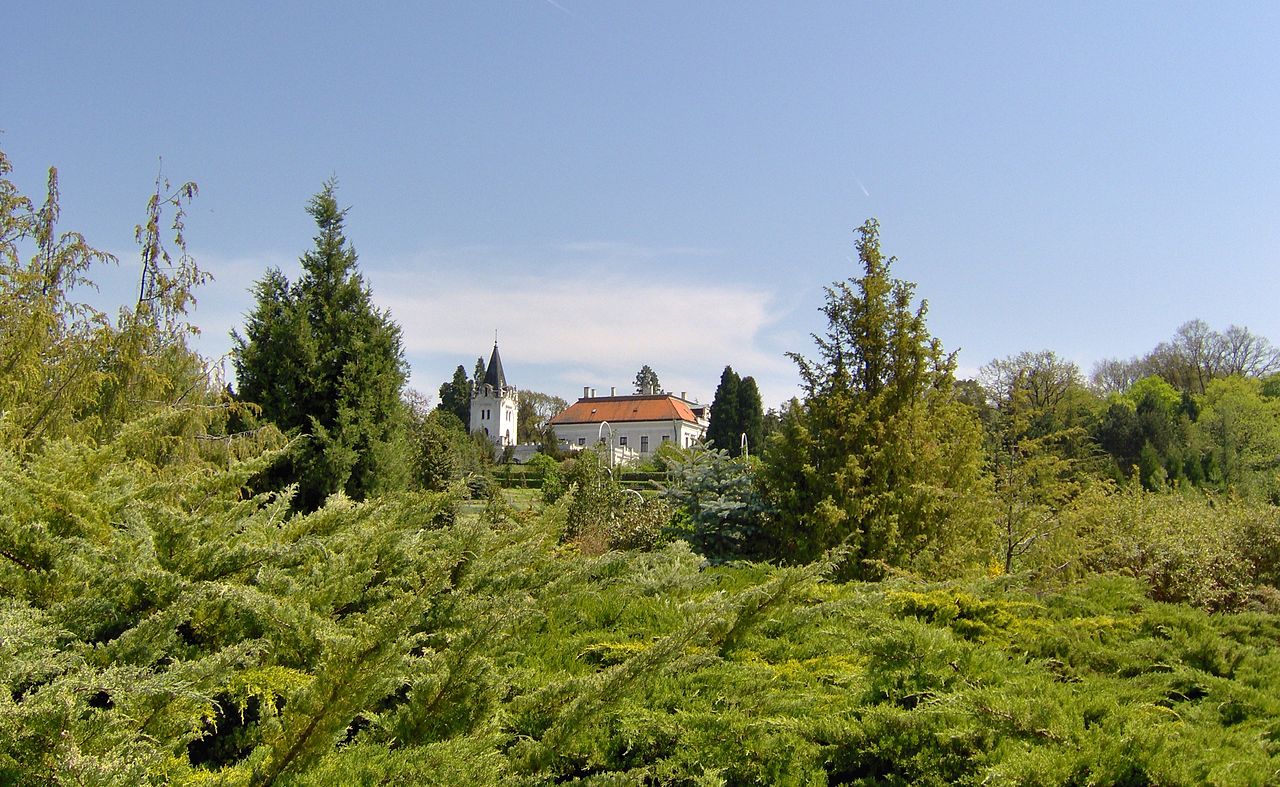
Arboretum Tesárske Mlyňany


_02.jpg/1280px-Vodn%C3%BD_mlyn_Kol%C3%A1rovo_(G%C3%BAtai_Vizimalom)_02.jpg)


.jpg/1280px-Hrad_Levice_(L%C3%A9va_v%C3%A1ra).jpg)




.jpg)


2009.svg)


_02.jpg)


.jpg)


See also
- Nyitra County of the Kingdom of Hungary
References
- ^ "Hustota obyvateľstva - obce [om7015rr_obc=AREAS_SK, v_om7015rr_ukaz=Rozloha (Štvorcový meter)]". Statistical Office of the Slovak Republic. 2025-03-31. Retrieved 2025-03-31.
- ^ "Počet obyvateľov podľa pohlavia - obce (ročne) [om7102rr_obce=AREAS_SK]". Statistical Office of the Slovak Republic. 2025-03-31. Retrieved 2025-03-31.
- ^ Regions and Cities > Regional Statistics > Regional Economy > Regional GDP per Capita, OECD.Stats. Accessed on 16 November 2018.
- ^ "Statistical lexikon of municipalities 1970-2011" (PDF) (in Slovak).
- ^ "Census 2021 - Population - Basic results". Statistical Office of the Slovak Republic. 2021-01-01.
- ^ a b "Počet obyvateľov podľa pohlavia - obce (ročne) [om7102rr_obce=AREAS_SK]". Statistical Office of the Slovak Republic. 2025-03-31. Retrieved 2025-03-31.
- ^ "Počet obyvateľov podľa pohlavia - obce (ročne) [om7102rr_obce=AREAS_SK]". Statistical Office of the Slovak Republic. 2025-03-31. Retrieved 2025-03-31.
- ^ "Počet obyvateľov podľa pohlavia - obce (ročne) [om7102rr_obce=AREAS_SK]". Statistical Office of the Slovak Republic. 2025-03-31. Retrieved 2025-03-31.
- ^ "Hustota obyvateľstva - obce [om7015rr_obc=AREAS_SK, v_om7015rr_ukaz=Rozloha (Štvorcový meter)]". Statistical Office of the Slovak Republic. 2025-03-31. Retrieved 2025-03-31.
- ^ "Population - Basic results". www.scitanie.sk. Statistical Office of the Slovak republic. Retrieved 2025-11-03.
- ^ "Population - Basic results". www.scitanie.sk. Statistical Office of the Slovak republic. Retrieved 2025-11-03.
- ^ "Population - Basic results". www.scitanie.sk. Statistical Office of the Slovak republic. Retrieved 2025-11-03.
- ^ SaS, Democrats, Chance, ODS, DS, KDH, OKS, ZĽ, TKN
- ^ The highest number of votes in preferential voting.
- ^ Smer–SD, SNS, Most–Híd
- ^ SaS, OKS, OĽaNO, NOVA, KDH, Šanca, ZZ–DÚ
- ^ Candidated as coalition with KDH, SDKÚ–DS, ĽS–HZDS.
- ^ Candidated as coalition with KDH, Smer–SD, ĽS–HZDS.
- ^ Candidated as coalition with Smer–SD, SDKÚ–DS, ĽS–HZDS.
- ^ Candidated as coalition with KDH, Smer–SD, SDKÚ–DS.
- ^ Candidated as coalition with KDH, SDKÚ, ĽS–HZDS, SNS.
- ^ Candidated as coalition with KDH, Smer–SD, SDKÚ, SNS.
- ^ Candidated as coalition with Smer–SD, SDKÚ, ĽS–HZDS, SNS.
- ^ Candidated as coalition with KDH, Smer–SD, ĽS–HZDS, SNS.
- ^ Candidated as coalition with KDH, SDKÚ, ĽS–HZDS.
- ^ HZDS, SOP, SDĽ, Smer–SD, Centre party
- ^ "Hustota obyvateľstva - obce [om7015rr_obc=AREAS_SK, v_om7015rr_ukaz=Rozloha (Štvorcový meter)]". Statistical Office of the Slovak Republic. 2025-03-31. Retrieved 2025-03-31.
- ^ "Počet obyvateľov podľa pohlavia - obce (ročne) [om7102rr_obce=AREAS_SK]". Statistical Office of the Slovak Republic. 2025-03-31. Retrieved 2025-03-31.
- Kopa, Ľudovít; et al. (2006). The Encyclopaedia of Slovakia and the Slovaks. Bratislava, Slovakia: Encyclopaedic Institute of the Slovak Academy of Sciences. ISBN 80-224-0925-1.
External links
- Nitriansky samosprávny kraj Official website
