- See Ricci calculus and Van der Waerden notation for the notation.
| Quantum field theory |
|---|
 |
| History |
In quantum field theory, the nonlinear Dirac equation is a model of self-interacting Dirac fermions. This model is widely considered in quantum physics as a toy model of self-interacting electrons.[1][2][3][4][5]
The nonlinear Dirac equation appears in the Einstein–Cartan–Sciama–Kibble theory of gravity, which extends general relativity to matter with intrinsic angular momentum (spin).[6][7] This theory removes a constraint of the symmetry of the affine connection and treats its antisymmetric part, the torsion tensor, as a variable in varying the action. In the resulting field equations, the torsion tensor is a homogeneous, linear function of the spin tensor. The minimal coupling between torsion and Dirac spinors thus generates an axial-axial, spin–spin interaction in fermionic matter, which becomes significant only at extremely high densities. Consequently, the Dirac equation becomes nonlinear (cubic) in the spinor field,[8][9] which causes fermions to be spatially extended and may remove the ultraviolet divergence in quantum field theory.[10]
Models
Two common examples are the massive Thirring model and the Soler model.
Thirring model
The Thirring model[11] was originally formulated as a model in (1 + 1) space-time dimensions and is characterized by the Lagrangian density

where ψ ∈ C2 is the spinor field, ψ = ψ*γ0 is the Dirac adjoint spinor,

(Feynman slash notation is used), g is the coupling constant, m is the mass, and γμ are the two-dimensional gamma matrices, finally μ = 0, 1 is an index.
Soler model
The Soler model[12] was originally formulated in (3 + 1) space-time dimensions. It is characterized by the Lagrangian density

using the same notations above, except
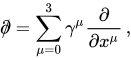
is now the four-gradient operator contracted with the four-dimensional Dirac gamma matrices γμ, so therein μ = 0, 1, 2, 3.
Einstein–Cartan theory
In Einstein–Cartan theory the Lagrangian density for a Dirac spinor field is given by ()


where
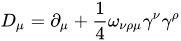
is the Fock–Ivanenko covariant derivative of a spinor with respect to the affine connection, is the spin connection, is the determinant of the metric tensor , and the Dirac matrices satisfy



The Einstein–Cartan field equations for the spin connection yield an algebraic constraint between the spin connection and the spinor field rather than a partial differential equation, which allows the spin connection to be explicitly eliminated from the theory. The final result is a nonlinear Dirac equation containing an effective "spin-spin" self-interaction,

where is the general-relativistic covariant derivative of a spinor, and is the Einstein gravitational constant, . The cubic term in this equation becomes significant at densities on the order of .


In a more general theory in which torsion is propagating, when torsion is taken in the effective approximation, the non-linearity in the Dirac equation will have the same structure, but with the constant replaced in terms of the constant where X is the spinor-torsion coupling constant and M the mass of torsion: in this theory, then, the self-interaction is repulsive, exactly like in the Nambu--Jona-Lasinio model, and with non-linearities manifested at the energy scale given by the torsion mass. [13]


See also
References
- ^ Д.Д. Иваненко (1938). "Замечание к теории взаимодействия через частицы" [translated in: D.D. Ivanenko, Notes to the theory of interaction via particles, Sov. Phys. JETP 13 (1938), 141)] (PDF). ЖЭТФ. 8: 260–266.
- ^ R. Finkelstein; R. LeLevier & M. Ruderman (1951). "Nonlinear spinor fields". Phys. Rev. 83 (2): 326–332. Bibcode:1951PhRv...83..326F. doi:10.1103/PhysRev.83.326.
- ^ R. Finkelstein; C. Fronsdal & P. Kaus (1956). "Nonlinear Spinor Field". Phys. Rev. 103 (5): 1571–1579. Bibcode:1956PhRv..103.1571F. doi:10.1103/PhysRev.103.1571.
- ^ W. Heisenberg (1957). "Quantum Theory of Fields and Elementary Particles". Rev. Mod. Phys. 29 (3): 269–278. Bibcode:1957RvMP...29..269H. doi:10.1103/RevModPhys.29.269.
- ^ Gross, David J. and Neveu, André (1974). "Dynamical symmetry breaking in asymptotically free field theories". Phys. Rev. D. 10 (10): 3235–3253. Bibcode:1974PhRvD..10.3235G. doi:10.1103/PhysRevD.10.3235.
{{cite journal}}: CS1 maint: multiple names: authors list (link) - ^ Dennis W. Sciama, "The physical structure of general relativity". Rev. Mod. Phys. 36, 463-469 (1964).
- ^ Tom W. B. Kibble, "Lorentz invariance and the gravitational field". J. Math. Phys. 2, 212-221 (1961).
- ^ F. W. Hehl & B. K. Datta (1971). "Nonlinear spinor equation and asymmetric connection in general relativity". J. Math. Phys. 12 (7): 1334–1339. Bibcode:1971JMP....12.1334H. doi:10.1063/1.1665738.
- ^ Friedrich W. Hehl; Paul von der Heyde; G. David Kerlick & James M. Nester (1976). "General relativity with spin and torsion: Foundations and prospects". Rev. Mod. Phys. 48 (3): 393–416. Bibcode:1976RvMP...48..393H. doi:10.1103/RevModPhys.48.393.
- ^ Nikodem J. Popławski (2010). "Nonsingular Dirac particles in spacetime with torsion". Phys. Lett. B. 690 (1): 73–77. arXiv:0910.1181. Bibcode:2010PhLB..690...73P. doi:10.1016/j.physletb.2010.04.073.
- ^ Walter Thirring (1958). "A soluble relativistic field theory". Annals of Physics. 3 (1): 91–112. Bibcode:1958AnPhy...3...91T. doi:10.1016/0003-4916(58)90015-0.
- ^ Mario Soler (1970). "Classical, Stable, Nonlinear Spinor Field with Positive Rest Energy". Phys. Rev. D. 1 (10): 2766–2769. Bibcode:1970PhRvD...1.2766S. doi:10.1103/PhysRevD.1.2766.
- ^ Luca Fabbri (2023). "Torsionally-Induced Stability in Spinors". Universe. 9: 73. arXiv:2303.12085. doi:10.3390/universe9020073.
