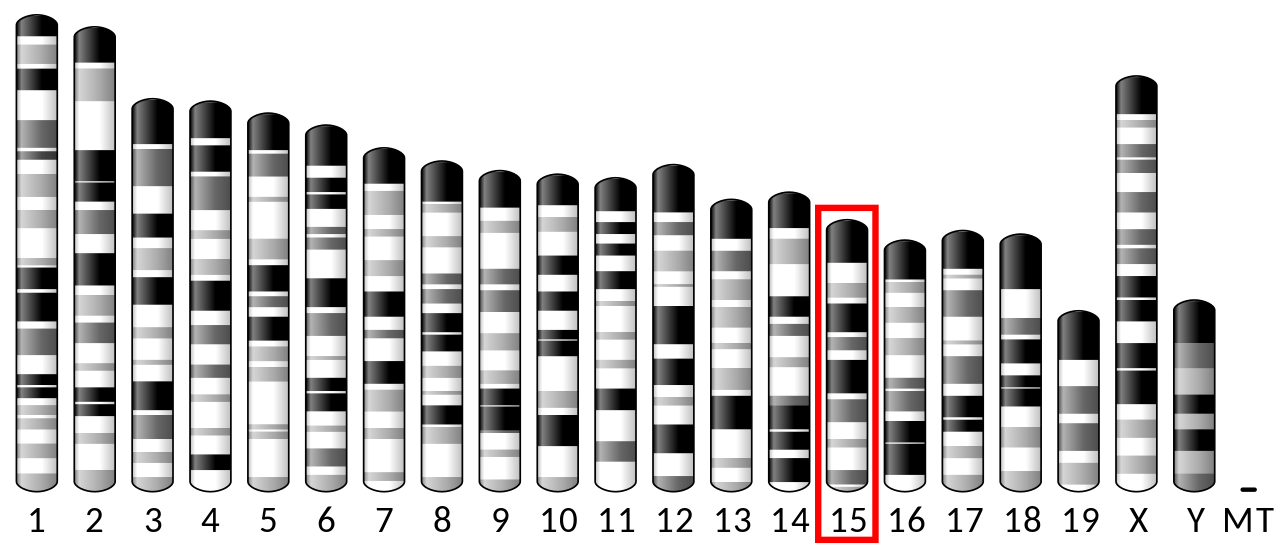
Calcium/calmodulin-dependent 3',5'-cyclic nucleotide phosphodiesterase 1B is an enzyme that in humans is encoded by the PDE1Bgene.[5][6][7]
References
^ a b cGRCh38: Ensembl release 89: ENSG00000123360 – Ensembl, May 2017
^ a b cGRCm38: Ensembl release 89: ENSMUSG00000022489 – Ensembl, May 2017
^"Human PubMed Reference:". National Center for Biotechnology Information, U.S. National Library of Medicine.
^"Mouse PubMed Reference:". National Center for Biotechnology Information, U.S. National Library of Medicine.
^Jiang X, Li J, Paskind M, Epstein PM (Nov 1996). "Inhibition of calmodulin-dependent phosphodiesterase induces apoptosis in human leukemic cells". Proc Natl Acad Sci U S A. 93 (20): 11236–41. Bibcode:1996PNAS...9311236J. doi:10.1073/pnas.93.20.11236. PMC1074519. PMID 8855339.
^Yu J, Wolda SL, Frazier AL, Florio VA, Martins TJ, Snyder PB, Harris EA, McCaw KN, Farrell CA, Steiner B, Bentley JK, Beavo JA, Ferguson K, Gelinas R (Feb 1998). "Identification and characterisation of a human calmodulin-stimulated phosphodiesterase PDE1B1". Cell Signal. 9 (7): 519–29. doi:10.1016/S0898-6568(97)00046-6. PMID 9419816.
Repaske DR, Swinnen JV, Jin SL, et al. (1992). "A polymerase chain reaction strategy to identify and clone cyclic nucleotide phosphodiesterase cDNAs. Molecular cloning of the cDNA encoding the 63-kDa calmodulin-dependent phosphodiesterase". J. Biol. Chem. 267 (26): 18683–8. doi:10.1016/S0021-9258(19)37015-2. PMID 1326532.
Spence S, Rena G, Sullivan M, et al. (1997). "Receptor-mediated stimulation of lipid signalling pathways in CHO cells elicits the rapid transient induction of the PDE1B isoform of Ca2+/calmodulin-stimulated cAMP phosphodiesterase". Biochem. J. 321 ( Pt 1) (Pt 1): 157–63. doi:10.1042/bj3210157. PMC1218050. PMID 9003415.
Zauli G, Milani D, Mirandola P, et al. (2001). "HIV-1 Tat protein down-regulates CREB transcription factor expression in PC12 neuronal cells through a phosphatidylinositol 3-kinase/AKT/cyclic nucleoside phosphodiesterase pathway". FASEB J. 15 (2): 483–91. doi:10.1096/fj.00-0354com. PMID 11156964. S2CID 26315564.
Fidock M, Miller M, Lanfear J (2002). "Isolation and differential tissue distribution of two human cDNAs encoding PDE1 splice variants". Cell. Signal. 14 (1): 53–60. doi:10.1016/S0898-6568(01)00207-8. PMID 11747989.
Strausberg RL, Feingold EA, Grouse LH, et al. (2003). "Generation and initial analysis of more than 15,000 full-length human and mouse cDNA sequences". Proc. Natl. Acad. Sci. U.S.A. 99 (26): 16899–903. Bibcode:2002PNAS...9916899M. doi:10.1073/pnas.242603899. PMC139241. PMID 12477932.
Ballif BA, Villén J, Beausoleil SA, et al. (2005). "Phosphoproteomic analysis of the developing mouse brain". Mol. Cell. Proteomics. 3 (11): 1093–101. doi:10.1074/mcp.M400085-MCP200. PMID 15345747.
Gerhard DS, Wagner L, Feingold EA, et al. (2004). "The Status, Quality, and Expansion of the NIH Full-Length cDNA Project: The Mammalian Gene Collection (MGC)". Genome Res. 14 (10B): 2121–7. doi:10.1101/gr.2596504. PMC528928. PMID 15489334.
Bender AT, Ostenson CL, Wang EH, Beavo JA (2005). "Selective up-regulation of PDE1B2 upon monocyte-to-macrophage differentiation". Proc. Natl. Acad. Sci. U.S.A. 102 (2): 497–502. Bibcode:2005PNAS..102..497B. doi:10.1073/pnas.0408535102. PMC544304. PMID 15625104.
Bender AT, Beavo JA (2006). "PDE1B2 regulates cGMP and a subset of the phenotypic characteristics acquired upon macrophage differentiation from a monocyte". Proc. Natl. Acad. Sci. U.S.A. 103 (2): 460–5. Bibcode:2006PNAS..103..460B. doi:10.1073/pnas.0509972102. PMC1326187. PMID 16407168.
This article on a gene on human chromosome 12 is a stub. You can help Wikipedia by expanding it.