Qテンソル

配向秩序パラメータ

物理学において、-テンソルは一軸性および二軸性ネマティック液晶を記述する配向秩序パラメータであり、等方性液体相では消失する。[1] このテンソルは2次のトレースレス対称テンソルであり、 [2] [3] [4]によって定義される。 質問 {\displaystyle \mathbf {Q} } 質問 {\displaystyle \mathbf {Q} }

質問 S n n 1 3 + R メートル メートル 1 3 {\displaystyle \mathbf {Q} =S\left(\mathbf {n} \otimes \mathbf {n} -{\tfrac {1}{3}}\mathbf {I} \right)+R\left(\mathbf {m} \otimes \mathbf {m} -{\tfrac {1}{3}}\mathbf {I} \right)}

ここで、およびはスカラー秩序パラメータ、はネマティック相の2つのダイレクタ、は温度である。一軸性液晶では、テンソルの成分は S S T {\displaystyle S=S(T)} R R T {\displaystyle R=R(T)} n メートル {\displaystyle (\mathbf {n} ,\mathbf {m} )} T {\displaystyle T} R 0 {\displaystyle R=0}

質問 j S n n j 1 3 δ j + R メートル メートル j 1 3 δ j {\displaystyle Q_{ij}=S\left(n_{i}n_{j}-{\tfrac {1}{3}}\delta _{ij}\right)+R\left(m_{i}m_{j}-{\tfrac {1}{3}}\delta _{ij}\right)}

ディレクターと を持つ状態物理的に同等であり、同様に、ディレクターと を持つ状態物理的に同等です。 n {\displaystyle \mathbf {n} } n {\displaystyle -\mathbf {n} } メートル {\displaystyle \mathbf {m} } メートル {\displaystyle -\mathbf {m} }

-テンソルは常に対角化することができ、 質問 {\displaystyle \mathbf {Q} }

質問 1 3 [ 2 S R 0 0 0 2 R S 0 0 0 S R ] {\displaystyle \mathbf {Q} ={\frac {1}{3}}{\begin{bmatrix}2S-R&0&0\\0&2R-S&0\\0&0&-SR\\\end{bmatrix}}}

以下はテンソルの2つの不変量である。 質問 {\displaystyle \mathbf {Q} }

t r 質問 2 質問 j 質問 j 2 3 S 2 S R + R 2 t r 質問 3 質問 j 質問 j 質問 1 9 [ 2 S 3 + R 3 3 S R S + R ] ; {\displaystyle \mathrm {tr} \,\mathbf {Q} ^{2}=Q_{ij}Q_{ji}={\frac {2}{3}}(S^{2}-SR+R^{2}),\quad \mathrm {tr} \,\mathbf {Q} ^{3}=Q_{ij}Q_{jk}Q_{ki}={\frac {1}{9}}[2(S^{3}+R^{3})-3SR(S+R)];}

一次不変量はここでは自明である。液晶の二軸性の尺度は、一般的にパラメータ t r 質問 質問 0 {\displaystyle \mathrm {tr} \,\mathbf {Q} =Q_{ii}=0} t r 質問 2 3 6 t r 質問 3 2 {\displaystyle (\mathrm {tr} \,\mathbf {Q} ^{2})^{3}\geq 6(\mathrm {tr} \,\mathbf {Q} ^{3})^{2}.}

β 1 6 t r 質問 3 2 t r 質問 2 3 27 S 2 R 2 S R 2 4 S 2 S R + R 2 3 {\displaystyle \beta =1-6{\frac {(\mathrm {tr} \,\mathbf {Q} ^{3})^{2}}{(\mathrm {tr} \,\mathbf {Q} ^{2})^{3}}}={\frac {27S^{2}R^{2}(SR)^{2}}{4(S^{2}-SR+R^{2})^{3}}}。

一軸ネマティック

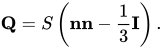
一軸性ネマティック液晶では、 -テンソルは次のように減少する。 R 0 {\displaystyle R=0} 質問 {\displaystyle \mathbf {Q} }

質問 S n n 1 3 {\displaystyle \mathbf {Q} =S\left(\mathbf {n} \mathbf {n} -{\frac {1}{3}}\mathbf {I} \right).}

スカラー秩序パラメータは以下のように定義される。ネマティック分子の軸と配向軸の間の角度を とすると、[2] θ メートル o l {\displaystyle \theta _{\mathrm {mol} }} n {\displaystyle \mathbf {n} }

S P 2 コス θ メートル o l 1 2 3 コス 2 θ メートル o l 1 1 2 3 コス 2 θ メートル o l 1 f θ メートル o l d Ω {\displaystyle S=\langle P_{2}(\cos \theta _{\mathrm {mol} })\rangle ={\frac {1}{2}}\langle 3\cos ^{2}\theta _{\mathrm {mol} }-1\rangle ={\frac {1}{2}}\int (3\cos ^{2}\theta _{\mathrm {mol} }-1)f(\theta _{\mathrm {mol} })d\Omega }

ここで、 は分布関数 に関して計算された配向角のアンサンブル平均を表し、は立体角です。配向子とは物理的に等価であるため、分布関数は必ず条件を満たさなければなりません {\displaystyle \langle \cdot \rangle } f θ メートル o l {\displaystyle f(\theta _{\mathrm {mol} })} d Ω θ メートル o l d θ メートル o l d ϕ メートル o l {\displaystyle d\Omega =\sin \theta _{\mathrm {mol} }d\theta _{\mathrm {mol} }d\phi _{\mathrm {mol} }} f θ メートル o l + π f θ メートル o l {\displaystyle f(\theta _{\mathrm {mol} }+\pi )=f(\theta _{\mathrm {mol} })} n {\displaystyle \mathbf {n} } n {\displaystyle -\mathbf {n} }

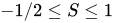
の範囲は で与えられはすべての分子がディレクターに沿って完全に整列していることを表し、 はすべての分子がディレクターに対して完全にランダムに整列していること(等方性)を表します。 は、すべての分子がディレクターの軸に対して垂直に整列していることを示しますが、このようなネマティックはまれであるか合成が困難です。 S {\displaystyle S} 1 / 2 S 1 {\displaystyle -1/2\leq S\leq 1} S 1 {\displaystyle S=1} S 0 {\displaystyle S=0} S 1 / 2 {\displaystyle S=-1/2}

参照

参考文献

  1. ^ De Gennes, PG (1969). ネマティック物質の等方相における短距離秩序効果の現象論. Physics Letters A, 30 (8), 454-455.
  2. ^ ab De Gennes, PG, & Prost, J. (1993). 液晶の物理学 (第83号). オックスフォード大学出版局.
  3. ^ Mottram, NJ, & Newton, CJ (2014). Qテンソル理論入門. arXivプレプリント arXiv:1409.3542.
  4. ^ Kleman, M., Lavrentovich, OD (編). (2003). ソフトマター物理学入門. ニューヨーク: Springer New York.
「https://en.wikipedia.org/w/index.php?title=Q-テンソル&oldid=1323375001」から取得