In mathematics and statistics, the quasi-arithmetic mean or generalised f-mean or Kolmogorov-Nagumo-de Finetti mean[1] is one generalisation of the more familiar means such as the arithmetic mean and the geometric mean, using a function . It is also called Kolmogorov mean after Soviet mathematician Andrey Kolmogorov. It is a broader generalization than the regular generalized mean.

Definition
If is a function that maps some continuous interval of the real line to some other continuous subset of the real numbers, and is both continuous, and injective (one-to-one).


- (We require to be injective on in order for an inverse function to exist. We require and to both be continuous intervals in order to ensure that an average of any finite (or infinite) subset of values within will always correspond to a value in .)


Subject to those requirements, the f mean of numbers is defined to be


or equivalently

A consequence of being defined over some selected interval, mapping to yet another interval, is that must also lie within And because is the domain of so in turn must produce a value inside the same domain the values originally came from,


Because is injective and continuous, it necessarily follows that is a strictly monotonic function, and therefore that the f mean is neither larger than the largest number of the tuple nor smaller than the smallest number contained in hence contained somewhere among the values of the original sample.


Examples
- If the real line, and (or indeed any linear function for otherwise any and any ) then the f mean corresponds to the arithmetic mean.


- If the strictly positive real numbers, and then the f mean corresponds to the geometric mean. (The result is the same for any logarithm; it does not depend on the base of the logarithm, as long as that base is strictly positive but not 1.)


- If and then the f mean corresponds to the harmonic mean.


- If and then the f mean corresponds to the power mean with exponent (e.g., for one gets the root mean square (RMS).)


- If and then the f mean is the mean in the log semiring, which is a constant-shifted version of the LogSumExp (LSE) function (which is the logarithmic sum), (The in the expression corresponds to dividing by n, since logarithmic division is linear subtraction.) The LogSumExp function is a smooth maximum: It is a smooth approximation to the maximum function.


Properties
The following properties hold for for any single function :

Symmetry: The value of is unchanged if its arguments are permuted.
Idempotency: for all the repeated average


Monotonicity: is monotonic in each of its arguments (since is monotonic).
Continuity: is continuous in each of its arguments (since is continuous).
Replacement: Subsets of elements can be averaged a priori, without altering the mean, given that the multiplicity of elements is maintained. With it holds:


Partitioning: The computation of the mean can be split into computations of equal sized sub-blocks:

Self-distributivity: For any quasi-arithmetic (q.a.) mean of two variables:


Mediality: For any quasi-arithmetic mean of two variables:


Balancing: For any quasi-arithmetic mean of two variables:

Scale-invariance: The quasi-arithmetic mean is invariant with respect to offsets and non-trivial scaling of quasi-arithmetic For any with and constants, and a quasi-aritmetic function, and are always the same. In mathematical notation:


- Given quasi-aritmetic, and

Central limit theorem : Under certain regularity conditions, and for a sufficiently large sample,
![{\displaystyle \ z~\equiv ~{\sqrt {n\ }}\ {\biggl [}\;M_{f}(\ X_{1},\ \ldots \ ,\ X_{n}\ )\;-\;\operatorname {\mathbb {E} } _{X}\!{\Bigl (}\ M_{f}(\ X_{1},\ \ldots \ ,\ X_{n}\ )\ {\Bigr )}\;{\biggr ]}\ }](https://wikimedia.org/api/rest_v1/media/math/render/svg/44bd12dfffd97db0acbecc25a3af682800bdec41)
is approximately normally distributed.[2] A similar result is available for Bajraktarević means and deviation means, which are generalizations of quasi-arithmetic means.[3][4]
Characterization
There are several different sets of properties that characterize the quasi-arithmetic mean (i.e., each function that satisfies these properties is an f-mean for some function f).
- Mediality is essentially sufficient to characterize quasi-arithmetic means.[5]: chapter 17
- Self-distributivity is essentially sufficient to characterize quasi-arithmetic means.[5]: chapter 17
- Replacement: Kolmogorov proved that the five properties of symmetry, fixed-point, monotonicity, continuity, and replacement fully characterize the quasi-arithmetic means.[6]
- Continuity is superfluous in the characterization of two variables quasi-arithmetic means. See [10] for the details.
- Balancing: An interesting problem is whether this condition (together with symmetry, fixed-point, monotonicity and continuity properties) implies that the mean is quasi-arithmetic. Georg Aumann showed in the 1930s that the answer is no in general,[7] but that if one additionally assumes to be an analytic function then the answer is positive.[8]

Homogeneity
Means are usually homogeneous, but for most functions , the f-mean is not. Indeed, the only homogeneous quasi-arithmetic means are the power means (including the geometric mean); see Hardy–Littlewood–Pólya, page 68.
The homogeneity property can be achieved by normalizing the input values by some (homogeneous) mean .

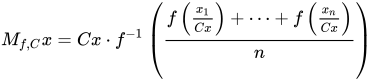
However this modification may violate monotonicity and the partitioning property of the mean.
Generalizations
Consider a Legendre-type strictly convex function . Then the gradient map is globally invertible and the weighted multivariate quasi-arithmetic mean[9] is defined by , where is a normalized weight vector ( by default for a balanced average). From the convex duality, we get a dual quasi-arithmetic mean associated to the quasi-arithmetic mean . For example, take for a symmetric positive-definite matrix. The pair of matrix quasi-arithmetic means yields the matrix harmonic mean:








See also
References
- Andrey Kolmogorov (1930) "On the Notion of Mean", in "Mathematics and Mechanics" (Kluwer 1991) — pp. 144–146.
- Andrey Kolmogorov (1930) Sur la notion de la moyenne. Atti Accad. Naz. Lincei 12, pp. 388–391.
- John Bibby (1974) "Axiomatisations of the average and a further generalisation of monotonic sequences," Glasgow Mathematical Journal, vol. 15, pp. 63–65.
- Hardy, G. H.; Littlewood, J. E.; Pólya, G. (1952) Inequalities. 2nd ed. Cambridge Univ. Press, Cambridge, 1952.
- B. De Finetti, "Sul concetto di media", vol. 3, p. 36996, 1931, istituto italiano degli attuari.
- ^ Nielsen, Frank; Nock, Richard (June 2017). "Generalizing skew Jensen divergences and Bregman divergences with comparative convexity". IEEE Signal Processing Letters. 24 (8): 2. arXiv:1702.04877. Bibcode:2017ISPL...24.1123N. doi:10.1109/LSP.2017.2712195. S2CID 31899023.
- ^ de Carvalho, Miguel (2016). "Mean, what do you mean?". The American Statistician. 70 (3): 764‒776. doi:10.1080/00031305.2016.1148632. hdl:20.500.11820/fd7a8991-69a4-4fe5-876f-abcd2957a88c. S2CID 219595024 – via zenodo.org.
- ^ Barczy, Mátyás; Burai, Pál (April 2022). "Limit theorems for Bajraktarević and Cauchy quotient means of independent identically distributed random variables". Aequationes Mathematicae. 96 (2): 279–305. arXiv:1909.02968. doi:10.1007/s00010-021-00813-x. ISSN 1420-8903 – via Springer.com.
- ^ Barczy, Mátyás; Páles, Zsolt (September 2023). "Limit theorems for deviation means of independent and identically distributed random variables". Journal of Theoretical Probability. 36 (3): 1626–1666. arXiv:2112.05183. doi:10.1007/s10959-022-01225-6. ISSN 1572-9230 – via Springer.com.
- ^ a b Aczél, J.; Dhombres, J. G. (1989). Functional equations in several variables. With applications to mathematics, information theory and to the natural and social sciences. Encyclopedia of Mathematics and its Applications, 31. Cambridge: Cambridge Univ. Press.
- ^ Grudkin, Anton (2019). "Characterization of the quasi-arithmetic mean". Math stackexchange.
- ^ Aumann, Georg (1937). "Vollkommene Funktionalmittel und gewisse Kegelschnitteigenschaften". Journal für die reine und angewandte Mathematik. 1937 (176): 49–55. doi:10.1515/crll.1937.176.49. S2CID 115392661.
- ^ Aumann, Georg (1934). "Grundlegung der Theorie der analytischen Analytische Mittelwerte". Sitzungsberichte der Bayerischen Akademie der Wissenschaften: 45–81.
- ^ Nielsen, Frank (2023). "Beyond scalar quasi-arithmetic means: Quasi-arithmetic averages and quasi-arithmetic mixtures in information geometry". arXiv:2301.10980 [cs.IT].
