
Rugby football is the collective name for the team sports of rugby union and rugby league.
Rugby football started at Rugby School in Rugby, Warwickshire, England,[1] where the rules were first codified in 1845.[2] Forms of football in which the ball was carried and tossed date to the Middle Ages (see medieval football).[3] Rugby football spread to other English public schools in the 19th century and across the British Empire as former pupils continued to play it.
Rugby football split into two codes in 1895, when twenty-one clubs from the North of England left the Rugby Football Union to form the Northern Rugby Football Union (renamed the Rugby Football League in 1922) at the George Hotel, Huddersfield, over payments to players who took time off work to play ("broken-time payments"), thus making rugby league the first football code to turn professional and pay players.[4] Rugby union allowed professional players one hundred years later, in 1995.[5] The world governing bodies are World Rugby (rugby union) and the International Rugby League (rugby league).[6]
Canadian football and American football were once considered forms of rugby football but, after significant rules changes, are not now. The governing body of Canadian football, Football Canada, was known as the Canadian Rugby Union as late as 1967, more than fifty years after the sport parted ways with rugby rules.[7][8][9]
Forms

Following the 1895 split in rugby football, the two forms rugby league and rugby union differed in administration only. Soon the desire among the northern clubs to make the rules simpler and more attractive to paying spectators meant that the rules of rugby league were modified, including reducing teams from 15 to 13 players, removing the line-out and replacing the ruck with the play-the-ball, resulting in two distinct sports.
The form of rugby played at the Olympic Games is rugby sevens, based on rugby union, and organised by World Rugby. Each team has seven players on the field at one time, playing seven-minute halves. The rules and pitch size are the same as rugby union.[10] Rugby league sevens and nines are similar short forms of rugby league.
History

Establishment of modern rugby
In 1871, English clubs met to form the Rugby Football Union (RFU). In 1892, after charges of professionalism (compensation of team members) were made against some clubs for paying players for missing work, the Northern Rugby Football Union, usually called the Northern Union (NU), was formed.[11] The existing rugby union authorities responded by issuing sanctions against the clubs, players, and officials involved in the new organization. After the schism, the separate clubs were named "rugby league" and "rugby union".[12]
- Early forms of rugby
-
Depiction of a "football" game in London, 1868. Illustration by Godefroy Durand.
-
Scotland first rugby team (wearing brown[13]) for the 1st international, v. England in Edinburgh, 1871
-
The England team in the 1st international, v. Scotland in Edinburgh, 1871
-
Rochdale Hornets team of 1875


![Scotland first rugby team (wearing brown[13]) for the 1st international, v. England in Edinburgh, 1871](http://upload.wikimedia.org/wikipedia/commons/thumb/7/7b/Scotland_rugbyteam_1871.jpg/1280px-Scotland_rugbyteam_1871.jpg)


Global status of rugby codes
Rugby union

Rugby union is both a professional and amateur game, and is dominated by the first tier unions: England, New Zealand, Ireland, Wales, South Africa, Australia, Argentina, Scotland, Italy, France and Japan. Second and third tier unions include Belgium, Brazil, Canada, Chile, Fiji, Georgia, Germany, Hong Kong, Kenya, Namibia, the Netherlands, Portugal, Romania, Russia, Samoa, Spain, Tonga, the United States, Uruguay and Zimbabwe. Rugby Union is administered by World Rugby (WR), whose headquarters are located in Dublin, Ireland. It is the national sport in New Zealand, Fiji, Samoa, Tonga, Georgia, Wales and Madagascar, and is the most popular form of rugby globally.[14] The Olympic Games have admitted the seven-a-side version of the game, known as Rugby sevens, into the programme from Rio de Janeiro in 2016 onwards.[15]
The premier international competition is the Rugby World Cup. There are major domestic professional leagues in several countries.
Rugby league
Rugby league is also both a professional and amateur game, administered on a global level by the Rugby League International Federation. In addition to amateur and semi-professional competitions in the United States, Russia, Lebanon, Serbia, Europe and Australasia, there are two major professional competitions—the Australasian National Rugby League and the Super League. International Rugby League is dominated by Australia, England and New Zealand, though Tonga and Samoa have threatened this hegemony regularly since 2017. In Papua New Guinea, it is the national sport.[16][17][18] Other nations from the South Pacific and Europe also play in the Pacific Cup and European Cup respectively.
The premier international competition is the Rugby League World Cup, which is contested quadrennially. The premier international club competition is the World Club Challenge, which is contested annually in February. Currently there are two major domestic professional leagues globally:
- National Rugby League:
 Australia (16 teams)
- New Zealand (1 team)
- Super League:
- England (12 teams)
- France (2 team)
- Wales (currently no teams, part of system)
.svg/1280px-Flag_of_Australia_(converted).svg.png)



Rules

Both major codes of rugby—rugby league and rugby union—share several distinctive characteristics that set them apart from other types of football. One of the most notable features is the use of an oval-shaped ball, which influences the style and flow of gameplay. Another defining rule in both codes is the strict prohibition of forward passing. This means that players are not allowed to throw the ball ahead to a teammate; instead, they must either pass the ball laterally or backward. As a result, teams can only advance toward the opponent’s try line by running with the ball in hand or by kicking it strategically. Additionally, in contrast to American and Canadian football, athletes in both rugby union and rugby league do not wear protective gear or armor such as helmets or heavy padding. The physicality of the sport is managed through technique, rules, and discipline, rather than through the use of extensive protective equipment.
The two rugby codes differ as the result of changes made to the rules of rugby league. League implemented these changes with the aim of making a faster-paced and more try-oriented game than rugby union.
The main differences between the two games, besides league having teams of 13 players and union of 15, involve the tackle and its aftermath:
- Union players contest possession following the tackle: depending on the situation, either a ruck or a maul can occur. League players may not contest possession after making a tackle: play is continued with a play-the-ball.
- In league, if the team in possession fails to score before a set of six tackles, it surrenders possession. Union has no six-tackle rule; a team can keep the ball for an unlimited number of tackles before scoring as long as it maintains possession and does not commit an offence.
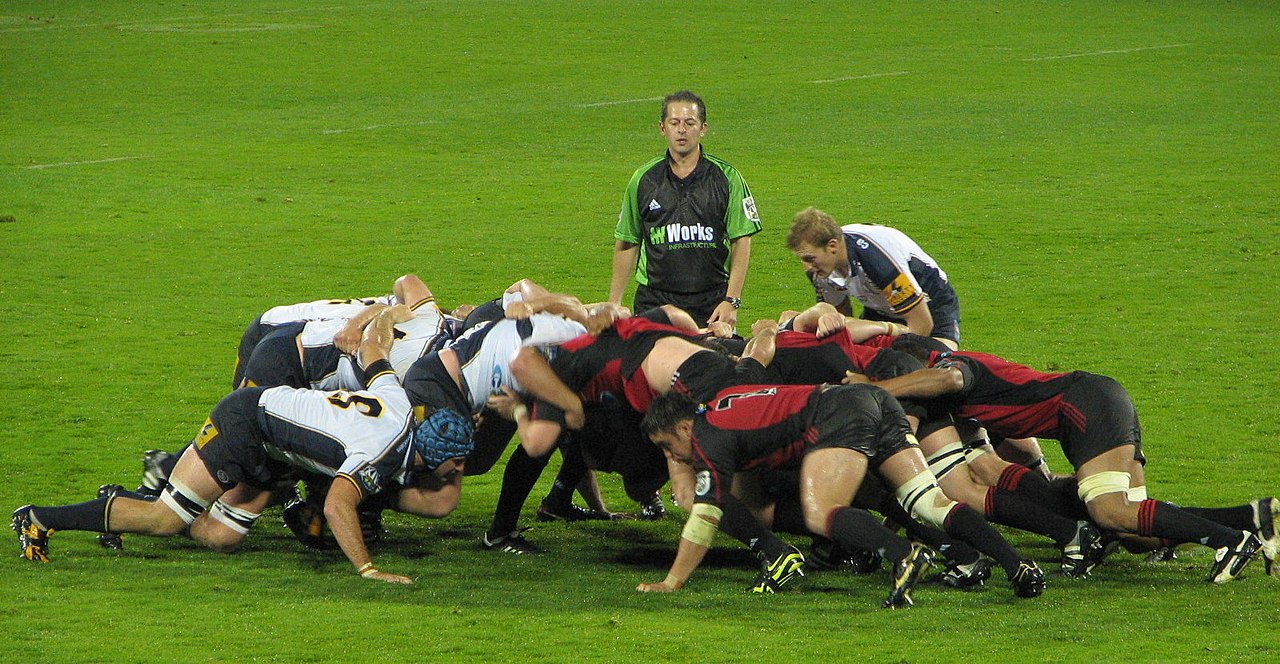
Set pieces of the union code include the scrum and the line-out. The scrum occurs after a minor infringement of the rules (most often a knock-on, when a player knocks the ball forward). After an infringement, packs of opposing players "scrum" or push against each other for possession. In a line-out, parallel lines of players from each team, arranged perpendicular to the touch-line, attempt to catch the ball thrown from touch. A rule has been added to line-outs which allows the jumper to be pulled down once a players' feet are on the ground.
In the league code, the scrum still exists albeit with greatly reduced importance. In league, the scrum involves fewer players and is rarely contested. Set pieces are generally started from the play-the-ball situation.
Many of the rugby league positions have names and requirements similar to rugby union positions. Notably, however, there are no flankers in rugby league.
Culture
In England, rugby union is widely regarded as an "establishment" sport, played mostly by members of the upper and middle classes. For example, many pupils at public schools and grammar schools play rugby union, although the game (which had a long history of being played at state schools until the 1980s) is becoming increasingly popular in comprehensive schools.[19] In contrast, rugby league has traditionally been seen as a working-class pursuit. Another exception to rugby union's upper-class stereotype is in Wales, where it has been traditionally associated with small village teams made up of coal miners and other industrial workers who played on their days off.[20]
In Australia, support for both codes is concentrated in New South Wales, Queensland and the Australian Capital Territory (55% of the population), though rugby league is far more popular. The same perceived class barrier as exists between the two games in England also occurs in these states, fostered by rugby union's prominence and support at private schools.[21]
Exceptions to the above include New Zealand, Wales, France (except Paris), Cornwall, Gloucestershire, Somerset, Scottish Borders, County Limerick (see Munster Rugby) and the Pacific Islands, where rugby union is popular in working class communities. Nevertheless, rugby league is perceived as the game of the working-class people in northern England[22] and in the Australian states of New South Wales and Queensland.[21]
In the United Kingdom, rugby union fans sometimes used the term "rugger" as an alternative name for the sport (see Oxford '-er'), although this archaic expression has not had currency since the 1950s or earlier.[23] New Zealanders refer to rugby union simply as either "rugby" or "union", or even simply "football", and to rugby league as "rugby league" or "league".[24]
Injuries
About a quarter of rugby players are injured in each season.[25]
Being a high contact sport, rugby union has the highest announced rates of concussions[26] and outside England also has the highest number of catastrophic injuries[27] among team sports.[28][29] A 2014 study found that during match play concussion was reported at a higher level, and during training at a lower level, but still at a higher level than most players of any other sport receive.[29]
Rugby ball
In rugby union, World Rugby regulates the size and shape of the ball under Law 2 (also known as Law E.R.B); an official rugby union ball is oval and made of four panels, has a length in-line of 280–300 millimetres, a circumference (end to end) of 740–770 millimetres, and a circumference (in width) of 580–620 millimetres. It is made of leather or suitable synthetic material and may be treated to make it water resistant and easier to grip. The rugby ball may not weigh more than 460 grams or less than 410 and has an air pressure of 65.71–68.75 kilopascals, or 0.67–0.70 kilograms per square centimetre, or 9.5–10.0 lbs per square inch.[30] Spare balls are allowed under the condition that players or teams do not seek an advantage by changing the ball. Smaller sized balls may also be used in games between younger players.
World Cups
The Rugby League World Cup was the first World Cup of either of the Rugby codes and was first held in France in 1954, and as of 2013 occurs on a four-year cycle. It is an international tournament that is organized by the International Rugby League. The event is played in the league format and features the top 16 teams from around the world with three different winners recorded so far. Australia won the 2017 Rugby League World Cup, played in Australia, New Zealand and Papua New Guinea. The Kangaroos backed this up by winning the 2021 tournament also. The women's version of the Rugby League World Cup which is known as the Women's Rugby League World Cup, first held in 2000 and New Zealand won the inaugural tournament. There is the third Rugby League World Cup competition, which is known as the Wheelchair Rugby League World Cup. First held in 2008, it is played with wheelchair-using teams and England won the inaugural tournament.
In rugby union, the Rugby World Cup, which was first held in New Zealand and Australia in 1987, occurs every four years. It is an international tournament organized by World Rugby. South Africa won the 2023 Rugby World Cup, which was played in France. The Women's Rugby World Cup was first held in 1991 and the United States won the inaugural tournament.
See also

References
- ^ "200th Anniversary – Rugby School". rugbyschool.co.uk. Retrieved 8 September 2023.
- ^ Trueman, Nigel. "History of the Laws of Rugby Football". rugbyfootballhistory.com. Retrieved 8 September 2023.
- ^ "Rugby Football History". rugbyfootballhistory.com. Archived from the original on 15 April 2020. Retrieved 19 June 2013.
- ^ "Rugby Football History". rugbyfootballhistory.com. Archived from the original on 1 December 2014. Retrieved 30 November 2018.
- ^ "27 August 1995:Rugby Union turns professional". MoneyWeek. 27 August 2015. Archived from the original on 14 April 2019. Retrieved 14 April 2019.
- ^ Williams, Richard (15 January 2019). "Jonathan Davies: 30 years on from the day he switched to Rugby league". BBC Sport.
- ^ "The Rugby World Cup: Second Only to the Soccer World Cup in Attendance [Infographic]". Forbes. 18 September 2015. Archived from the original on 14 April 2019. Retrieved 14 April 2019.
- ^ "Rugby League World Cup:Will World Cup joy finally come for Sam Burgess?". BBC Sport. 30 November 2017. Archived from the original on 14 April 2019. Retrieved 14 April 2019.
- ^ "The Other (and Less Popular) Rugby World Cup Gets Underway". The New York Times. 27 October 2017. Archived from the original on 14 April 2019. Retrieved 14 April 2019.
- ^ "A Beginners's Guide to Rugby Union : Rugby Sevens – The Olympic dream". passport.worldrugby.org. Archived from the original on 19 January 2019. Retrieved 17 January 2019.
- ^ Baker, Andrew (20 August 1995). "100 years of rugby league: From the great divide to the Super era". The Independent. Archived from the original on 18 February 2020. Retrieved 25 September 2009.
- ^ Tony Collins (2006). "Schism 1893–1895". Rugby's great split: class, culture and the origins of rugby league football (2nd ed.). Routlage. pp. 87–120. ISBN 0-415-39616-6.
- ^ Glasgow Herald (Glasgow, Scotland), Tuesday, 28 March 1871; Issue 9746
- ^ Kemp, Stuart; Szalai, Georg (24 August 2007). "Rugby World Cup gaining wide popularity". Reuters. Archived from the original on 3 October 2020. Retrieved 30 May 2011.
- ^ "Olympics: Sevens heaven for Rugby". International Rugby Board. 31 December 2009. Archived from the original on 3 January 2010. Retrieved 30 May 2011.
- ^ "PNG vow to upset World Cup odds". BBC Sport Rugby League. 15 October 2008. Archived from the original on 15 May 2019. Retrieved 3 July 2009.
But it would still be one of the biggest shocks in World Cup history if Papua New Guinea – the only country to have rugby league as its national sport – were to qualify for the last four.
- ^ "PNG seal 2010 Four Nations place". BBC. 1 November 2009. Archived from the original on 3 October 2020. Retrieved 21 October 2015.
- ^ Falcous, Mark (2007). "Rugby League in the National Imaginary of New Zealand Aotearoa". Sport in History. 27 (3): 423–446. doi:10.1080/17460260701591684. S2CID 143871555.
1907–2007 Centenary of International Rugby
- ^ Phillips, Buchler. Appendices to the Minutes of Evidence to Select Committee on Culture, Media and Sport Archived 20 August 2017 at the Wayback Machine
- ^ Sommerville, D. (1997). The Encyclopedia of Rugby Union. Aurum Press, UK. ISBN 1-85410-481-0.
- ^ a b Collins, T. (2005). "Australian Nationalism and Working-Class Britishness: The Case of Rugby League Football." History Compass, Vol. 3, No. 1.
- ^ Collins, T. (1998). Rugby's Great Split: Class, Culture and the Origins of Rugby League Football (London).
- ^ Rugger:
- OED: Rugger "Slang or colloquial alteration of RUGBY (in the sense of 'Rugby football'). Freq. attrib. rugger-tackle".
- Tony Collins, "Football, rugby, rugger?" (Archived 30 April 2017 at the Wayback Machine), BBC sound recording with written transcript, and a comment in prose by Jonnie Robinson, Curator, English accents and dialects, British Library Sound Archive.
- ^ The New Zealand Pocket Oxford Dictionary. ISBN 0-19-558379-5.
- ^ "Common Rugby Injuries". Archived from the original on 7 May 2019. Retrieved 8 May 2019.
- ^ Bradley, Susan (2 May 2019). "High school rugby cancelled across Nova Scotia due to safety concerns". CBC News. Archived from the original on 1 October 2020. Retrieved 19 July 2020.
- ^ Hull, Jeff. "Rugby Player Welfare, Part 2: 'Rugby Is Not the NFL'...Not Yet, Anyway". Bleacher Report. Archived from the original on 19 July 2020. Retrieved 19 July 2020.
- ^ "What Sport Has The Most Concussions? | Concussion Rate". Complete Concussion Management Inc. 6 December 2018. Archived from the original on 19 July 2020. Retrieved 19 July 2020.
- ^ a b Gardner, Andrew J; Iverson, Grant L; Williams, W. Huw; Baker, Stephanie; Stanwell, Peter (2014). "A Systematic Review and Meta-Analysis of Concussion in Rugby Union". Sports Medicine. 44 (12): 1717–1731. doi:10.1007/s40279-014-0233-3. PMID 25138311. S2CID 23808676.
- ^ International rugby board. "Rugby ball laws" 22 February 2010.
External links


- Rugby's Most Unfortunate Faces (Archived 16 March 2011 at the Wayback Machine)—slideshow by Life magazine
- Video on the Basics of Rugby Union
- Full Guide of the Rugby World Cup 2019 in Japan