Zech logarithms are used to implement addition in finite fields when elements are represented as powers of a generator .

Zech logarithms are named after Julius Zech,[1][2][3][4] and are also called Jacobi logarithms,[5] after Carl G. J. Jacobi who used them for number theoretic investigations.[6]
Definition
Given a primitive element of a finite field, the Zech logarithm relative to the base is defined by the equation which is often rewritten as The choice of base is usually dropped from the notation when it is clear from the context.


To be more precise, is a function on the integers modulo the multiplicative order of , and takes values in the same set. In order to describe every element, it is convenient to formally add a new symbol , along with the definitions where is an integer satisfying , that is for a field of characteristic 2, and for a field of odd characteristic with elements.



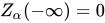
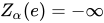


Using the Zech logarithm, finite field arithmetic can be done in the exponential representation: These formulas remain true with our conventions with the symbol , with the caveat that subtraction of is undefined. In particular, the addition and subtraction formulas need to treat as a special case.




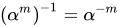


This can be extended to arithmetic of the projective line by introducing another symbol satisfying and other rules as appropriate.


For fields of characteristic 2,

Uses
For sufficiently small finite fields, a table of Zech logarithms allows an especially efficient implementation of all finite field arithmetic in terms of a small number of integer addition/subtractions and table look-ups.
The utility of this method diminishes for large fields where one cannot efficiently store the table. This method is also inefficient when doing very few operations in the finite field, because one spends more time computing the table than one does in actual calculation.
Examples
Let be a root of the primitive polynomial . The traditional representation of elements of this field is as polynomials in of degree or less.


Here is a table of Zech logarithms for this field.


The multiplicative order of is , so the exponential representation works with integers modulo .

Since is a root of then that means , or if we recall that since all coefficients are in , subtraction is the same as addition, we obtain .


The conversion from exponential to polynomial representations is given by (as shown above)



Using Zech logarithms to compute : or, more efficiently, and verifying it in the polynomial representation:




Visualization
Given a prime power and a primitive element of , one can visualize the Zech logarithm by plotting all elements of in a directed graph, :


- Place the element at the center.
- Arrange the non-zero elements sequentially as equally spaced nodes around a circle, with at the top.
- Draw a directed edge for every in .


The edges in correspond to the mappings in the Zech logarithm function: since , an edge connecting node to effectively connects the exponent to the exponent .


Here is , where is a root of , and the powers of are placed in counterclockwise order:




If one draws an edge instead of for every in , where is any fixed element, one obtains a graph . The standard graph corresponds to . The graph consists of self-loops. For any , the graph appears identical to , except that all edges are rotated by around the center node.


Here is , which differs from by a rotation of :


Each graph visualizes the permutation . The set of these permutations forms an Elementary abelian group of order (isomorphic to the additive group of the field). The rotational symmetry of the graphs for elegantly captures the algebraic indistinguishability of the non-zero elements in an elementary abelian group.


If and are both primitive elements of , then the graphs and are identical if and only if and are roots of the same primitive polynomial in . Therefore, the number of distinct graphs equals , where is Euler's totient function. Equivalently, there exist distinct Zech logarithm tables for a given field size.


![{\displaystyle \mathrm {GF} (p)[X]}](https://wikimedia.org/api/rest_v1/media/math/render/svg/6d261049065497b38d7d18f92481109a4b5c1d1b)


If and are multiplicative inverses of each other, then and are reflections of each other.
When is odd, contains a "diagonal" edge that connects the node to (where denotes the multiplicative inverse of ).


Here are the graphs for all such that the graph remains invariant (up to reflection) across all primitive elements :


See also
- Gaussian logarithm
- Irish logarithm, a similar technique derived empirically by Percy Ludgate
- Finite field arithmetic
- Logarithm table
References
- ^ Zech, Julius August Christoph (1849). Tafeln der Additions- und Subtractions-Logarithmen für sieben Stellen (in German) (Specially reprinted (from Vega–Hülße collection) 1st ed.). Leipzig: Weidmann'sche Buchhandlung. Archived from the original on 2018-07-14. Retrieved 2018-07-14. Also part of: Freiherr von Vega, Georg (1849). Hülße, Julius Ambrosius [in German]; Zech, Julius August Christoph (eds.). Sammlung mathematischer Tafeln (in German) (Completely reworked ed.). Leipzig: Weidmann'sche Buchhandlung. Bibcode:1849smt..book.....V. Archived from the original on 2018-07-14. Retrieved 2018-07-14.
- ^ Zech, Julius August Christoph (1863) [1849]. Tafeln der Additions- und Subtractions-Logarithmen für sieben Stellen (in German) (Specially reprinted (from Vega–Hülße collection) 2nd ed.). Berlin: Weidmann'sche Buchhandlung. Archived from the original on 2018-07-14. Retrieved 2018-07-13.
- ^ Zech, Julius August Christoph (1892) [1849]. Tafeln der Additions- und Subtractions-Logarithmen für sieben Stellen (in German) (Specially reprinted (from Vega–Hülße collection) 3rd ed.). Berlin: Weidmann'sche Buchhandlung. Archived from the original on 2018-07-14. Retrieved 2018-07-13.
- ^ Zech, Julius August Christoph (1910) [1849]. Tafeln der Additions- und Subtractions-Logarithmen für sieben Stellen (in German) (Specially reprinted (from Vega–Hülße collection) 4th ed.). Berlin: Weidmann'sche Buchhandlung. Archived from the original on 2018-07-14. Retrieved 2018-07-13.
- ^ Lidl, Rudolf; Niederreiter, Harald (1997). Finite Fields (2nd ed.). Cambridge University Press. ISBN 978-0-521-39231-0.
- ^ Jacoby, Carl Gustav Jacob (1846). "Über die Kreistheilung und ihre Anwendung auf die Zahlentheorie". Journal für die reine und angewandte Mathematik (in German). 1846 (30): 166–182. doi:10.1515/crll.1846.30.166. ISSN 0075-4102. S2CID 120615565. (NB. Also part of "Gesammelte Werke", Volume 6, pages 254–274.)
Further reading
- Fletcher, Alan; Miller, Jeffrey Charles Percy; Rosenhead, Louis (1946) [1943]. An Index of Mathematical Tables (1 ed.). Blackwell Scientific Publications Ltd., Oxford / McGraw-Hill, New York.
- Conway, John Horton (1968). Churchhouse, Robert F.; Herz, J.-C. (eds.). "A tabulation of some information concerning finite fields". Computers in Mathematical Research. Amsterdam: North-Holland Publishing Company: 37–50. MR 0237467.
- Lam, Clement Wing Hong; McKay, John K. S. (1973-11-01). "Algorithm 469: Arithmetic over a finite field [A1]". Communications of the ACM. Collected Algorithms of the ACM (CALGO). 16 (11). Association for Computing Machinery (ACM): 699. doi:10.1145/355611.362544. ISSN 0001-0782. S2CID 62794130. toms/469. [1] [2] [3]
- Kühn, Klaus (2008). "C. F. Gauß und die Logarithmen" (PDF) (in German). Alling-Biburg, Germany. Archived (PDF) from the original on 2018-07-14. Retrieved 2018-07-14.
