| Bettongs[1] | |
|---|---|
| |
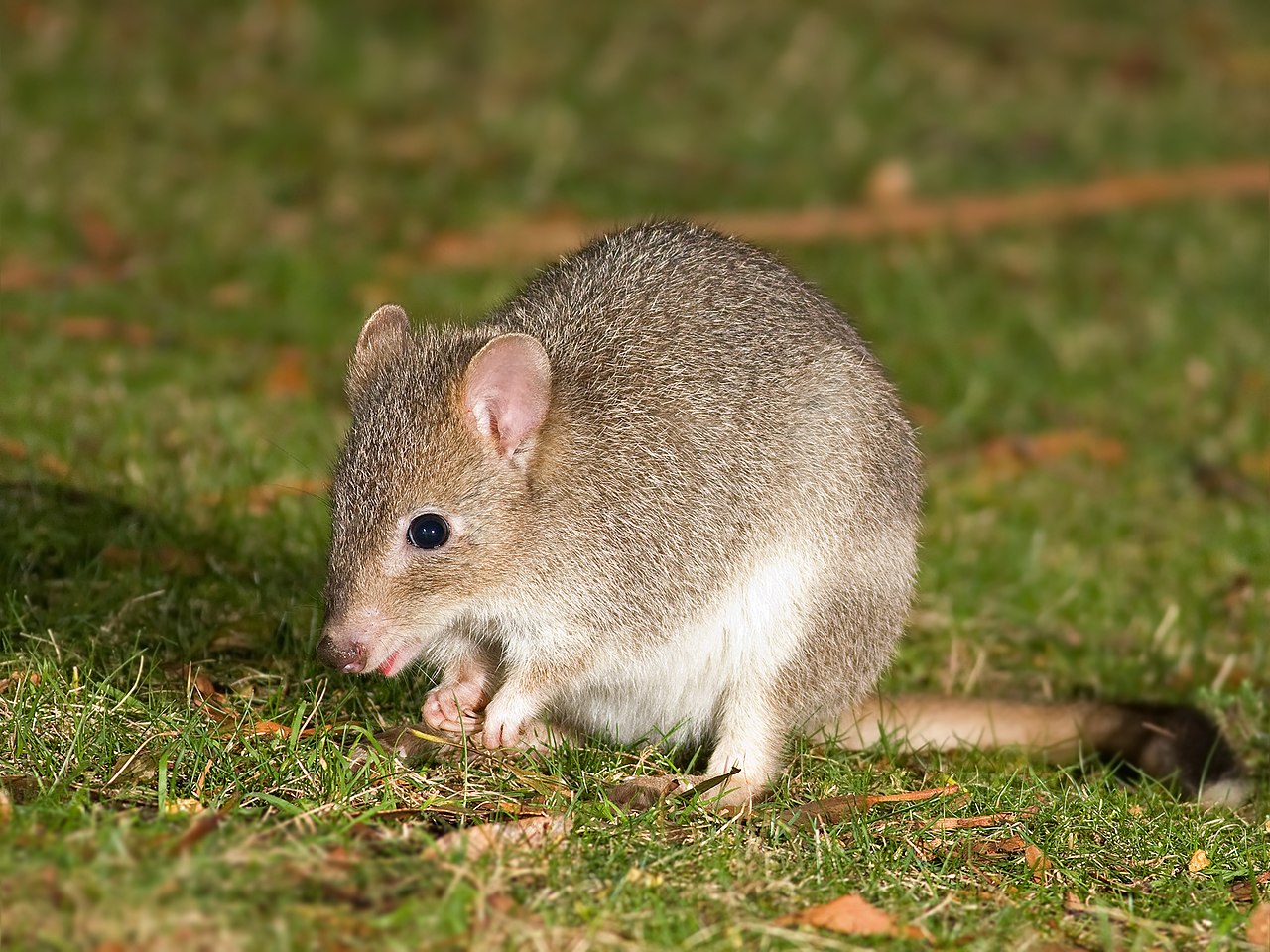
| Eastern bettong | |
Scientific classification 
| |
| Kingdom: | Animalia |
| Phylum: | Chordata |
| Class: | Mammalia |
| Infraclass: | Marsupialia |
| Order: | Diprotodontia |
| Family: | Potoroidae |
| Subfamily: | Potoroinae |
| Tribe: | Bettongini |
| Genus: | Bettongia J. E. Gray, 1837 |
| Type species | |
| Bettongia setosa | |
| Species | |

Bettongs, species of the genus Bettongia, are potoroine marsupials once common in Australia. They are important ecosystem engineers displaced during the colonisation of the continent, and are vulnerable to threatening factors such as altered fire regimes, land clearing, pastoralism and introduced predatory species such as the fox and cat.
Conservation status
All species of the genus have been severely affected by ecological changes since the European colonisation of Australia. Those that have not become extinct became largely confined to islands and protected reserves and are dependent on re-population programs. The diversity of the genus was poorly understood before their extirpation from the mainland, and new taxa have been identified in specimens newly discovered and already held in museum collections.[2] In August 2021, 40 bettongs were released in different parts of South Australia after being raised in captivity to increase their numbers.[3]
Taxonomy
Four extant species are recognised in the work Mammal Species of the World (2005):[1]
- Eastern bettong (B. gaimardi)
- Boodie (B. lesueur)
- Woylie (B. penicillata)
- Northern bettong (B. tropica)[4]
The recently extinct species are:
- Desert bettong (B. anhydra). Only known from one specimen collected in the Tanami in 1933 and subfossil material from the Nullarbor. The causes of extinction are presumed to be predation by feral cats and foxes, and changes to the fire regime.[5]
- Nullarbor dwarf bettong (B. pusilla). Known only from subfossil remains but considered to have survived until European settlement.[6]
The fossil species is:
- Bettongia moyesi, Middle Miocene bettong from Riversleigh[7]
The phylogeny of the genus has seen a grouping of 'brush-tailed' taxa allied within the genus Bettongia, and this includes the extant species Bettongia gaimardi, B. tropica and B. penicillata.[2]
A conservative arrangement of modern and fossil taxa of Bettongia may be summarised as[8]
- family Potoroidae:
- subfamily †Bulungamayinae
- subfamily †Palaeopotoroinae
- subfamily Potoroinae
- genus Aepyprymnus
- genus Bettongia
- species †Bettongia anhydra
- species Bettongia gaimardi
- species Bettongia lesueur
- species †Bettongia moyesi
- species Bettongia penicillata
- species †Bettongia pusilla
- species Bettongia tropica
- genus †Milliyowi
- genus †Caloprymnus
- genus Potorous
- genus †Purtia
- genus †Wakiewakie
- genus †Gumardee
The species Aepyprymnus rufescens is referred to as the rufous bettong,[9] despite not being a member of the genus Bettongia.
See also
- Kangaroo rat – a heteromyid rodent of North America
References
- ^ a b Groves, C. P. (2005). Wilson, D. E.; Reeder, D. M. (eds.). Mammal Species of the World: A Taxonomic and Geographic Reference (3rd ed.). Baltimore: Johns Hopkins University Press. pp. 57–58. ISBN 0-801-88221-4. OCLC 62265494.
- ^ a b Prideaux, G.J.; Baynes, A.; Bunce, M.; Aplin, K.P.; Haouchar, D.; McDowell, M.C. (25 April 2015). "Morphological and molecular evidence supports specific recognition of the recently extinct Bettongia anhydra (Marsupialia: Macropodidae)". Journal of Mammalogy. 96 (2): 287–296. doi:10.1093/jmammal/gyv006. hdl:20.500.11937/10145. ISSN 0022-2372.
- ^ "Endangered bettongs return to SA after more than a century".
- ^ Wakefield, N.A. (1967). "Some taxonomie revision in the Australian marsupial genus Bettongia (Macropodidae), with description of a new species". The Victorian Naturalist. 84: 8–22.
- ^ Burbidge, A.A. & Zichy-Woinarski, J. (2016). "Bettongia anhydra". IUCN Red List of Threatened Species. 2016 e.T71510353A71510399. doi:10.2305/IUCN.UK.2016-2.RLTS.T71510353A71510399.en. Retrieved 2 June 2024.
- ^ Burbidge, A.A.; Woinarski, J. (2016). "Bettongia pusilla". IUCN Red List of Threatened Species. 2016 e.T136805A21960843. doi:10.2305/IUCN.UK.2016-2.RLTS.T136805A21960843.en. Retrieved 26 April 2022.
- ^ Flannery, T.F. and Archer, M, 1987. Bettongia moyesi, a new and plesiomorphic kangaroo (Marsupialia: Potoridae) from Miocene sediments of northwestern Queensland. 'Possums and Opossums: Studies in Evolution', Pp.759–67. ed. M. Archer. Surrey Beatty & Sons and the Royal Zoological Society of New South Wales, Sydney pdf
- ^ Claridge, A.W.; Seebeck, J.H.; Rose, R. (2007). Bettongs, potoroos, and the musky rat-kangaroo. Collingwood, Victoria: CSIRO Pub. p. 25. ISBN 978-0-643-09341-6.
- ^ Menkhorst, P.W.; Knight, F. (2011). A field guide to the mammals of Australia (3rd ed.). Melbourne: Oxford University Press. p. 106. ISBN 978-0-19-557395-4.
