| Rhododendron groenlandicum | |
|---|---|

| |
Scientific classification 
| |
| Kingdom: | Plantae |
| Clade: | Tracheophytes |
| Clade: | Angiosperms |
| Clade: | Eudicots |
| Clade: | Asterids |
| Order: | Ericales |
| Family: | Ericaceae |
| Genus: | Rhododendron |
| Subgenus: | Rhododendron subg. Rhododendron |
| Section: | Rhododendron sect. Rhododendron |
| Subsection: | R. subsect. Ledum |
| Species: | R. groenlandicum
|
| Binomial name | |
| Rhododendron groenlandicum | |

| |
| Distribution of Rhododendrom groenlandicum | |
| Synonyms[1] | |
| |
Rhododendron groenlandicum (formerly Ledum groenlandicum or Ledum latifolium[2]), known by the common names bog Labrador tea, muskeg tea, swamp tea, or in northern Canada, Hudson's Bay tea,[3] is a species of flowering shrub in the family Ericaceae. Found in northern parts of North America and Greenland,[4] R. groenlandicum grows primarily in bogs and other wetlands, which tend to be also in cold, acidic, and nutrient-poor environments. It has traditionally been used to make medicinal herbal teas among the Dene, Athabaskan, and Inuit, and other indigenous cultures of North America peoples.
Description
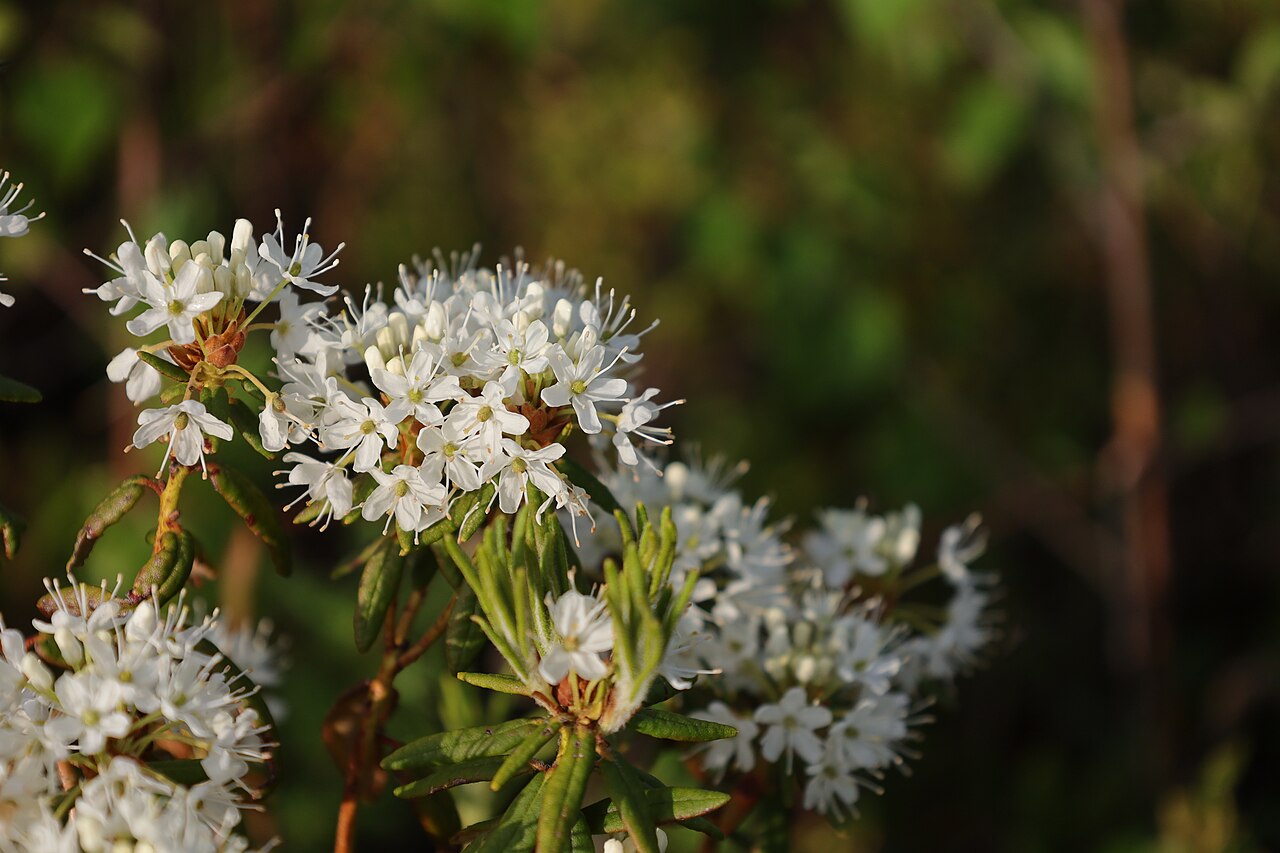
It is a low shrub growing to 50 cm (20 in) tall – rarely up to 2 m (6 ft 7 in) – with evergreen leaves 2–6 cm (3⁄4–2+3⁄8 in) long and 3–15 mm (1⁄8–5⁄8 in) broad. The leaves are wrinkled on top with a thick waxy cuticle and have a leathery texture. The underside is covered in dense white hair that turns red-brown with age. The flowers of R. groenlandicum are small, white, and perfect (bisexual).[5] Their hemispherical clusters have up to 35 flowers with petals approximately 1 cm long. With 5 oval shaped petals it produces a sweet aroma and sticky nectar to attract pollinators.[5]
R. groenlandicum is self-compatible; however, self-fertilization results in a lower fruit set and fewer seeds per fruit “than cross-pollination”. Pollination is primarily performed by bees; however, butterflies and beetles can also act as pollinators.[6]
-
Illustration by William Miller
-
Specimen in Newfoundland and Labrador
-
Dry leaves
-
Underside of leaves
-
Leaves and buds
-
Close-up of flowers

_-_Port_Rexton,_Newfoundland_2019-08-14.jpg/1280px-Labrador_Tea_(Rhododendron_groenlandicum)_-_Port_Rexton,_Newfoundland_2019-08-14.jpg)

.jpg/1280px-Ledum_groenlandicum_1-eheep_(5097488087).jpg)

.jpg/1280px-Bog_Labrador_Tea_(3816426668).jpg)
Distribution and habitat
It is reported from Greenland, as well as from every province and territory in Canada and in the northern United States including the Northeast (New England, New York, Pennsylvania), the Northwest (Oregon, Washington, Idaho, Alaska), and parts of the Upper Midwest (Michigan, Wisconsin, Minnesota).[7] It grows in bogs, muskegs, and open tundra, as well as occasionally on wet shores and rocky alpine slopes.[8][9]
Toxicity
The plant contains toxic alkaloids which are poisonous to livestock and may be toxic to humans in concentrated doses.[9]
Harvesting
Due to the plant’s slow growth, tea leaves are collected only from multiple plants in the spring by taking one. Labrador tea is slow-growing, so only a single new leaf is collected from a plant every other year to avoid damaging the plants.[citation needed]
Uses
The leaves are regularly used to make beverages and medicines—most commonly a fragrant tea—by many Native American tribes such as the Quinault and Makah, the Potawatomi, the Anishinaabe, the Iroquois, and First Nations tribes in Canada.[9] Antioxidant, anti-inflammatory and anticancer activity has been found.[10] When European explorers arrived, they soon adopted these uses as well, dubbing it "Indian plant tea".[9] During the American Revolutionary War, it was used as a substitute for tea.[9] It was used as ale flavoring in Europe prior to hops becoming the main flavor/preservative ingredient[11][12]
Rhododendron groenlandicum is sometimes grown as an ornamental shrub.[9] Its essential oil is also popular in aromatherapy.[9]
See also
- Rhododendron (disambiguation)
- List of Rhododendron species
- List of rhododendron diseases
- List of Award of Garden Merit rhododendrons
- Ceanothus herbaceus, known as Jersey tea
References
- ^ "Rhododendron groenlandicum". Plants of the World Online. Royal Botanic Gardens, Kew. Retrieved 27 March 2022.
- ^ Kron, Kathleen Anne; Judd (1990). "Phylogenetic Relationships within the Rhodoreae (Ericaceae) with Specific Comments on the Placement of Ledum". Systematic Botany. 15 (1): 67. Bibcode:1990SysBo..15...57K. doi:10.2307/2419016. JSTOR 2419016.
- ^ Niering, William A.; Olmstead, Nancy C. (1985) [1979]. The Audubon Society Field Guide to North American Wildflowers, Eastern Region. Knopf. p. 502. ISBN 0-394-50432-1.
- ^ Perry, Anne; Levine, Carol (1997). "A Guide to Wildflowers in Winter: Herbaceous Plants of Northeastern North America". Northeastern Naturalist. 4 (2): 115. doi:10.2307/3858412. ISSN 1092-6194. JSTOR 3858412.
- ^ a b Hébert, François; Thiffault, Nelson (July 2011). "The Biology of Canadian Weeds. 146.Rhododendron groenlandicum(Oeder) Kron and Judd". Canadian Journal of Plant Science. 91 (4): 725–738. Bibcode:2011CJPlS..91..725H. doi:10.4141/cjps2010-012. ISSN 0008-4220.
- ^ Kew, Royal Botanic Gardens of. Oxford Art Online. Oxford University Press. 2003. doi:10.1093/gao/9781884446054.article.t046369.
- ^ "Rhododendron groenlandicum". Plants of the World Online. Royal Botanic Gardens, Kew. Retrieved 27 March 2022.
- ^ Kron, Kathleen A.; Judd, Walter S. (1990). "Rhododendron groenlandicum". Systematic Botany. 15 (1). Flora of North America: 57–68. Bibcode:1990SysBo..15...57K. doi:10.2307/2419016. JSTOR 2419016.
- ^ a b c d e f g Anderson, M. (2011). Plant Guide for bog Labrador tea (Ledum groenlandicum) (PDF). Greensboro, NC.: USDA-Natural Resources Conservation Service, National Plant Data Team.
- ^ Dufour, Dominic; Pichette, André; Mshvildadze, Vakhtang; Bradette-Hébert, Marie-Eve; Lavoie, Serge; Longtin, Angélique; Laprise, Catherine; Legault, Jean (April 2007). "Antioxidant, anti-inflammatory and anticancer activities of methanolic extracts from Ledum groenlandicum Retzius". Journal of Ethnopharmacology. 111 (1): 22–28. doi:10.1016/j.jep.2006.10.021. PMID 17156957.
- ^ Susan Verberg,The Rise and Fall of Gruit,Copyright © Susan Verberg, 2018.
- ^ Richard W. Unger, Beer in the Middle Ages and the Renaissance,2004 University of Pennsylvania Press, p31-2
External links


_-_Port_Rexton,_Newfoundland_2019-08-14.jpg)

.jpg)

.jpg)


- USDA PLANTS database: Ledum groenlandicum
- Description of Rhododendron groenlandicum at the American Rhododendron Society
- Photograph of Rhododendron groenlandicum plus description at the Washington Native Plant Society
- Rhododendron groenlandicum Archived 2015-05-19 at the Wayback Machine at the Connecticut Botanical Society
