
In mathematics, the interior extremum theorem, also known as Fermat's theorem, is a theorem which states that at the local extrema of a differentiable function, its derivative is always zero. It belongs to the mathematical field of real analysis and is named after French mathematician Pierre de Fermat.
By using the interior extremum theorem, the potential extrema of a function , with derivative , can found by solving an equation involving . The interior extremum theorem gives only a necessary condition for extreme function values, as some stationary points are inflection points (not a maximum or minimum). The function's second derivative, if it exists, can sometimes be used to determine whether a stationary point is a maximum or minimum.


History
Pierre de Fermat proposed in a collection of treatises titled Maxima et minima a method to find maximum or minimum, similar to the modern interior extremum theorem using an approach he called adequality.[1]: 456–457 [2]: 2 [3] After Marin Mersenne passed the treatises onto René Descartes, Descartes was doubtful, remarking "if [...] he speaks of wanting to send you still more papers, I beg of you to ask him to think them out more carefully than those preceding".[2]: 3 Descartes later agreed that the method was valid.[2]: 8
Statement
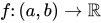
One way to state the interior extremum theorem is that, if a function has a local extremum at some point and is differentiable there, then the function's derivative at that point must be zero. In precise mathematical language:
- Let be a function from an open interval to , and suppose that is a point where has a local extremum. If is differentiable at , then .[4]: 377


Another way to understand the theorem is via the contrapositive statement: if the derivative of a function at any point is not zero, then there is not a local extremum at that point. Formally:
- If is differentiable at , and , then is not a local extremum of .

Corollary
The global extrema of a function f on a domain A occur only at boundaries, non-differentiable points, and stationary points. If is a global extremum of f, then one of the following is true:[2]: 1
- boundary: is in the boundary of A
- non-differentiable: f is not differentiable at
- stationary point: is a stationary point of f
Extension
A similar statement holds for the partial derivatives of multivariate functions. Suppose that some real-valued function of the real numbers has an extremum at a point , defined by . If is differentiable at , then:where .[5]: 16



The statement can also be extended to differentiable manifolds. If is a differentiable function on a manifold , then its local extrema must be critical points of , in particular points where the exterior derivative is zero.[6][better source needed]


Applications
The interior extremum theorem is central for determining maxima and minima of piecewise differentiable functions of one variable: an extremum is either a stationary point (that is, a zero of the derivative), a non-differentiable point (that is a point where the function is not differentiable), or a boundary point of the domain of the function. Since the number of these points is typically finite, the computation of the values of the function at these points provide the maximum and the minimun, simply by comparing the obtained values.[7]: 25 [2]: 1
Proof
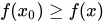
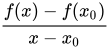
Suppose that is a local maximum. (A similar argument applies if is a local minimum.) Then there is some neighbourhood around such that for all within that neighborhood. If , then the difference quotient is non-positive for in this neighborhood. This implies Similarly, if , then the difference quotient is non-negative, and so Since is differentiable, the above limits must both be equal to . This is only possible if both limits are equal to 0, so .[8]: 182




See also
References
- ^ Fikhtengol'ts, G.M. (1965). The Fundamentals of Mathematical Analysis. Pergamon Press. doi:10.1016/C2013-0-02242-6. ISBN 978-0-08-013473-4.
- ^ a b c d e Monks, Kenneth M (February 20, 2023). "Fermat's Method for Finding Maxima and Minima" (PDF). MAA Convergence.
- ^ Breger, Herbert (2013). "Fermat's Analysis of Extreme Values and Tangents". Studia Leibnitiana. 45 (1): 20–41. ISSN 0039-3185.
- ^ Bronshtein, I. N.; Semendyayev, K. A. (1972). A Guide Book to Mathematics. Springer. doi:10.1007/978-1-4684-6288-3. ISBN 978-1-4684-6290-6.
- ^ Bhattacharya, Bhargab B. (2009). Algorithms, Architectures and Information Systems Security. World Scientific. ISBN 978-981-283-624-3.
- ^ "Is Fermat's theorem about local extrema true for smooth manifolds?". Stack Exchange. August 11, 2015. Retrieved 21 April 2017.
- ^ Brinkhuis, Jan; Tikhomirov, Vladimir (2005). Optimization: Insights and Applications. Princeton University Press. ISBN 978-0-691-10287-0.
- ^ Canuto, Claudio; Tabacco, Anita (2015). Mathematical Analysis I (2nd ed.). Springer. doi:10.1007/978-3-319-12772-9. ISBN 978-3-319-12771-2.
External links
- "Fermat's Theorem (stationary points)". PlanetMath.
- "Proof of Fermat's Theorem (stationary points)". PlanetMath.
