ローカルシステム

数学において、位相空間X上の局所系(または局所係数系)は、代数位相幾何学における手法の一つであり、固定されたアーベル群A内の係数を持つコホモロジーと、点ごとに係数が変化する一般層コホモロジーとの間を補間する。局所係数系は1943年にノーマン・スティーンロッドによって導入された。[ 1 ]

ローカル システムは、構築可能層パーバース層などのより一般的なツールの構成要素です。

意味

X を位相空間とする。X上局所系アーベル群加群…)は、 X上の局所定数層(アーベル群/加群…)である。言い換えれば、層が局所系であるとは、すべての点が開近傍を持ち、その制限層が何らかの定数前層の層化と同型であることを意味する。 L{\displaystyle {\mathcal {L}}}あなた{\displaystyle U}L|あなた{\displaystyle {\mathcal {L}}|_{U}}

同等の定義

パス接続空間

Xが経路連結である場合、アーベル群の局所系はどの点においても同一の茎を持つ。Xの局所系と群準同型写像 の間には全単射対応が存在する。L{\displaystyle {\mathcal {L}}}L{\displaystyle L}

ρ:π1X×自動L{\displaystyle \rho :\pi _{1}(X,x)\to {\text{Aut}}(L)}

加群の局所系についても同様に成り立つ。局所系を与える写像はのモノドロミー表現と呼ばれる。 π1X×自動L{\displaystyle \pi _{1}(X,x)\to {\text{Aut}}(L)}L{\displaystyle {\mathcal {L}}}L{\displaystyle {\mathcal {L}}}

同等性の証明

局所系とxにおけるループを考える。 上の任意の局所系が定数であることは簡単に証明できる。例えば、は定数である。これは同型、すなわちと 自身との間の同型を与える。逆に、準同型 が与えられた場合、Xの普遍被覆上の定数層を考える。 のデッキ変換不変セクションはX上の局所系を与える。同様に、デッキ変換ρ同変セクションはX上の別の局所系を与える。十分に小さい開集合Uに対して、これは次のように定義される。 L{\displaystyle {\mathcal {L}}}γ{\displaystyle \gamma }[0,1]{\displaystyle [0,1]}γL{\displaystyle \gamma ^{*}{\mathcal {L}}}(γL)0Γ([0,1],L)(γL)1{\displaystyle (\gamma ^{*}{\mathcal {L}})_{0}\simeq \Gamma ([0,1],{\mathcal {L}})\simeq (\gamma ^{*}{\mathcal {L}})_{1}}L{\displaystyle L}ρ:π1(X,x)Aut(L){\displaystyle \rho :\pi _{1}(X,x)\to {\text{Aut}}(L)}L_{\displaystyle {\underline {L}}}X~{\displaystyle {\widetilde {X}}}L_{\displaystyle {\underline {L}}}

L(ρ)U = {sections sL_π1(U) with θs=ρ(θ)s for all θ Deck(X~/X)=π1(X,x)}{\displaystyle {\mathcal {L}}(\rho )_{U}\ =\ \left\{{\text{sections }}s\in {\underline {L}}_{\pi ^{-1}(U)}{\text{ with }}\theta \circ s=\rho (\theta )s{\text{ for all }}\theta \in {\text{ Deck}}({\widetilde {X}}/X)=\pi _{1}(X,x)\right\}}

普遍的なカバーは どこにありますか。π:X~X{\displaystyle \pi :{\widetilde {X}}\to X}

これは、(X がパス接続されている場合に)ローカル システムが、X普遍被覆への引き戻しが定数層である層とまったく同じであることを示しています。

この対応は、 X上のアーベル群の局所系のカテゴリーと(同値な、 -加群)の作用を与えられたアーベル群のカテゴリーとの間のカテゴリーの同値性にまで昇格することができる。[ 2 ]π1(X,x){\displaystyle \pi _{1}(X,x)}Z[π1(X,x)]{\displaystyle \mathbb {Z} [\pi _{1}(X,x)]}

非接続空間のより強力な定義

非連結Xに対して機能するより強い非同値な定義は次の通りである:局所システムは共変関数である

L:Π1(X)Mod(R){\displaystyle {\mathcal {L}}\colon \Pi _{1}(X)\to {\textbf {Mod}}(R)}

の基本群から可換環上の加群の圏への変換。ここで典型的には。これは、加群の各点への割り当てのデータと、基底点の変更と基本群上の誘導写像とが両立するような群表現と同義である。 X{\displaystyle X}R{\displaystyle R}R=Q,R,C{\displaystyle R=\mathbb {Q} ,\mathbb {R} ,\mathbb {C} }xX{\displaystyle x\in X}M{\displaystyle M}ρx:π1(X,x)AutR(M){\displaystyle \rho _{x}:\pi _{1}(X,x)\to {\text{Aut}}_{R}(M)}ρx{\displaystyle \rho _{x}}xy{\displaystyle x\to y}π1(X,x)π1(X,y){\displaystyle \pi _{1}(X,x)\to \pi _{1}(X,y)}

  • のような定数層。これはコホモロジーを計算するのに便利なツールです。なぜなら、状況によっては層コホモロジーと特異コホモロジーの間に同型性が存在するからです。Q_X{\displaystyle {\underline {\mathbb {Q} }}_{X}}

Hk(X,Q_X)Hsingk(X,Q){\displaystyle H^{k}(X,{\underline {\mathbb {Q} }}_{X})\cong H_{\text{sing}}^{k}(X,\mathbb {Q} )}

  • とする。 なので、写像に対応するX上の局所系の族が存在する:X=R2{(0,0)}{\displaystyle X=\mathbb {R} ^{2}\setminus \{(0,0)\}}π1(R2{(0,0)})=Z{\displaystyle \pi _{1}(\mathbb {R} ^{2}\setminus \{(0,0)\})=\mathbb {Z} }S1{\displaystyle S^{1}}neinθ{\displaystyle n\mapsto e^{in\theta }}

ρθ:π1(X;x0)ZAutC(C){\displaystyle \rho _{\theta }:\pi _{1}(X;x_{0})\cong \mathbb {Z} \to {\text{Aut}}_{\mathbb {C} }(\mathbb {C} )}

  • 平坦接続を持つベクトル束の水平切断。 が平坦接続を持つベクトル束である場合、 によって与えられる局所系が存在する。 例えば、と を自明な束とする。Eの切断はX上の関数のn組であるため、E上の平坦接続を定義する。これはX上の任意の 1 形式行列の場合も同様である。水平切断は次のように定義される。EX{\displaystyle E\to X}{\displaystyle \nabla }EU={sections sΓ(U,E) which are horizontal: s=0}{\displaystyle E_{U}^{\nabla }=\left\{{\text{sections }}s\in \Gamma (U,E){\text{ which are horizontal: }}\nabla s=0\right\}}X=C0{\displaystyle X=\mathbb {C} \setminus 0}E=X×Cn{\displaystyle E=X\times \mathbb {C} ^{n}}0(f1,,fn)=(df1,,dfn){\displaystyle \nabla _{0}(f_{1},\dots ,f_{n})=(df_{1},\dots ,df_{n})}(f1,,fn)=(df1,,dfn)Θ(x)(f1,,fn)t{\displaystyle \nabla (f_{1},\dots ,f_{n})=(df_{1},\dots ,df_{n})-\Theta (x)(f_{1},\dots ,f_{n})^{t}}Θ{\displaystyle \Theta }

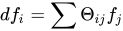
    EU={(f1,,fn)EU:(df1,,dfn)=Θ(f1,,fn)t}{\displaystyle E_{U}^{\nabla }=\left\{(f_{1},\dots ,f_{n})\in E_{U}:(df_{1},\dots ,df_{n})=\Theta (f_{1},\dots ,f_{n})^{t}\right\}}つまり、線形微分方程式の解です。dfi=Θijfj{\displaystyle df_{i}=\sum \Theta _{ij}f_{j}}

    が 上の 1 形式に拡張される場合、上の局所系も定義されます。したがって、 は なので自明です。興味深い例として、0に極を持つものを選んでみましょう。Θ{\displaystyle \Theta }C{\displaystyle \mathbb {C} }C{\displaystyle \mathbb {C} }π1(C)=0{\displaystyle \pi _{1}(\mathbb {C} )=0}

    Θ=(0dx/xdxexdx){\displaystyle \Theta ={\begin{pmatrix}0&dx/x\\dx&e^{x}dx\end{pmatrix}}}この場合、=d+Θ{\displaystyle \nabla =d+\Theta }EU={f1,f2:UC   with f1=f2/x  f2=f1+exf2}{\displaystyle E_{U}^{\nabla }=\left\{f_{1},f_{2}:U\to \mathbb {C} \ \ {\text{ with }}f'_{1}=f_{2}/x\ \ f_{2}'=f_{1}+e^{x}f_{2}\right\}}
  • nシート被覆写像は、集合 によって与えられるファイバーを持つ局所系である。同様に、離散ファイバーを持つファイバー束も局所系である。なぜなら各パスは、その基点から与えられたリフトまで一意にリフトするからである。(定義は、集合値を持つ局所系を当然のことながら含むように調整されている。)XY{\displaystyle X\to Y}{1,,n}{\displaystyle \{1,\dots ,n\}}
  • X上のkベクトル空間の局所系は、のk線型表現と同等です。π1(X,x){\displaystyle \pi _{1}(X,x)}
  • 接続が平坦でない場合(つまり、曲率がゼロでない場合)、x _0を基点とする収縮可能なループの周りをファイバーF_xがx上で平行移動すると、 F_xの非自明な自己同型が得られる可能性があるため、平坦でない接続に対して局所的に定数な層を必ずしも定義できるとは限りません。

コホモロジー

局所システムのコホモロジーを定義する方法はいくつかあり、局所係数を持つコホモロジーと呼ばれ、 Xに関する弱い仮定の下では同値になります。

  • X上のアーベル群の局所定数層が与えられると、に係数を持つ層コホモロジー群が得られます。L{\displaystyle {\mathcal {L}}}Hj(X,L){\displaystyle H^{j}(X,{\mathcal {L}})}L{\displaystyle {\mathcal {L}}}
  • X上のアーベル群の局所定数層が与えられたとき、各特異n単体を逆像層の大域切断に写す関数f全体の成す群を とする。これらの群は、通常の特異コホモロジーと同様に微分が構成されるコチェーン複体とすることができる。この複体のコホモロジーを と定義する。L{\displaystyle {\mathcal {L}}}Cn(X;L){\displaystyle C^{n}(X;{\mathcal {L}})}σ:ΔnX{\displaystyle \sigma \colon \Delta ^{n}\to X}f(σ){\displaystyle f(\sigma )}σ1L{\displaystyle \sigma ^{-1}{\mathcal {L}}}Hsingj(X;L){\displaystyle H_{\mathrm {sing} }^{j}(X;{\mathcal {L}})}
  • Xの普遍被覆上の特異n鎖群は、デッキ変換によっての作用を持つ。明示的に、デッキ変換は特異n単体を に取る。すると、の作用を備えたアーベル群Lが与えられれば、上記のように -同変準同型群からコチェーン複体を形成することができる。 をこの複体のコホモロジーと定義する。Cn(X~){\displaystyle C_{n}({\widetilde {X}})}π1(X,x){\displaystyle \pi _{1}(X,x)}γ:X~X~{\displaystyle \gamma \colon {\widetilde {X}}\to {\widetilde {X}}}σ:ΔnX~{\displaystyle \sigma \colon \Delta ^{n}\to {\widetilde {X}}}γσ{\displaystyle \gamma \circ \sigma }π1(X,x){\displaystyle \pi _{1}(X,x)}Homπ1(X,x)(Cn(X~),L){\displaystyle \operatorname {Hom} _{\pi _{1}(X,x)}(C_{n}({\widetilde {X}}),L)}π1(X,x){\displaystyle \pi _{1}(X,x)}Hsingj(X;L){\displaystyle H_{\mathrm {sing} }^{j}(X;L)}

Xパラコンパクトかつ局所的に縮約可能な場合、 となる。[ 3 ]がLに対応する局所システムである場合、微分と互換性のある同一視が存在する。 [ 4 ]したがって となる。 Hj(X,L)Hsingj(X;L){\displaystyle H^{j}(X,{\mathcal {L}})\cong H_{\mathrm {sing} }^{j}(X;{\mathcal {L}})}L{\displaystyle {\mathcal {L}}}Cn(X;L)Homπ1(X,x)(Cn(X~),L){\displaystyle C^{n}(X;{\mathcal {L}})\cong \operatorname {Hom} _{\pi _{1}(X,x)}(C_{n}({\widetilde {X}}),L)}Hsingj(X;L)Hsingj(X;L){\displaystyle H_{\mathrm {sing} }^{j}(X;{\mathcal {L}})\cong H_{\mathrm {sing} }^{j}(X;L)}

一般化

局所システムは構成可能層への緩やかな一般化を持つ。局所的にパス連結な位相空間上の構成可能層とは、次のような層が存在する 層である。X{\displaystyle X}L{\displaystyle {\mathcal {L}}}

X=Xλ{\displaystyle X=\coprod X_{\lambda }}

ここでは局所系である。これらは典型的には、導出されたプッシュフォワードのコホモロジーをある連続写像に対して取ることによって求められる。例えば、射の複素点を見ると、 L|Xλ{\displaystyle {\mathcal {L}}|_{X_{\lambda }}}f:XY{\displaystyle f:X\to Y}

f:X=Proj(C[s,t][x,y,z](sth(x,y,z)))Spec(C[s,t]){\displaystyle f:X={\text{Proj}}\left({\frac {\mathbb {C} [s,t][x,y,z]}{(st\cdot h(x,y,z))}}\right)\to {\text{Spec}}(\mathbb {C} [s,t])}

そして繊維が

As,t2V(st){\displaystyle \mathbb {A} _{s,t}^{2}-\mathbb {V} (st)}

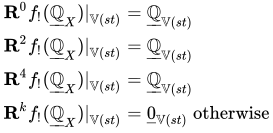
は で与えられる平面曲線であるが、 上のファイバーはである。導出されたプッシュフォワードを取ると、構成可能な層が得られる。 上においては、局所系 h{\displaystyle h}V=V(st){\displaystyle \mathbb {V} =\mathbb {V} (st)}P2{\displaystyle \mathbb {P} ^{2}}Rf!(Q_X){\displaystyle \mathbf {R} f_{!}({\underline {\mathbb {Q} }}_{X})}V{\displaystyle \mathbb {V} }

R0f!(Q_X)|V(st)=Q_V(st)R2f!(Q_X)|V(st)=Q_V(st)R4f!(Q_X)|V(st)=Q_V(st)Rkf!(Q_X)|V(st)=0_V(st) otherwise{\displaystyle {\begin{aligned}\mathbf {R} ^{0}f_{!}({\underline {\mathbb {Q} }}_{X})|_{\mathbb {V} (st)}&={\underline {\mathbb {Q} }}_{\mathbb {V} (st)}\\\mathbf {R} ^{2}f_{!}({\underline {\mathbb {Q} }}_{X})|_{\mathbb {V} (st)}&={\underline {\mathbb {Q} }}_{\mathbb {V} (st)}\\\mathbf {R} ^{4}f_{!}({\underline {\mathbb {Q} }}_{X})|_{\mathbb {V} (st)}&={\underline {\mathbb {Q} }}_{\mathbb {V} (st)}\\\mathbf {R} ^{k}f_{!}({\underline {\mathbb {Q} }}_{X})|_{\mathbb {V} (st)}&={\underline {0}}_{\mathbb {V} (st)}{\text{ otherwise}}\end{aligned}}}

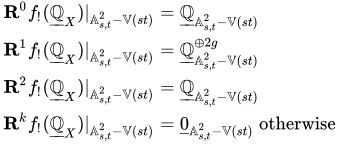
ローカルシステムについて はAs,t2V(st){\displaystyle \mathbb {A} _{s,t}^{2}-\mathbb {V} (st)}

R0f!(Q_X)|As,t2V(st)=Q_As,t2V(st)R1f!(Q_X)|As,t2V(st)=Q_As,t2V(st)2gR2f!(Q_X)|As,t2V(st)=Q_As,t2V(st)Rkf!(Q_X)|As,t2V(st)=0_As,t2V(st) otherwise{\displaystyle {\begin{aligned}\mathbf {R} ^{0}f_{!}({\underline {\mathbb {Q} }}_{X})|_{\mathbb {A} _{s,t}^{2}-\mathbb {V} (st)}&={\underline {\mathbb {Q} }}_{\mathbb {A} _{s,t}^{2}-\mathbb {V} (st)}\\\mathbf {R} ^{1}f_{!}({\underline {\mathbb {Q} }}_{X})|_{\mathbb {A} _{s,t}^{2}-\mathbb {V} (st)}&={\underline {\mathbb {Q} }}_{\mathbb {A} _{s,t}^{2}-\mathbb {V} (st)}^{\oplus 2g}\\\mathbf {R} ^{2}f_{!}({\underline {\mathbb {Q} }}_{X})|_{\mathbb {A} _{s,t}^{2}-\mathbb {V} (st)}&={\underline {\mathbb {Q} }}_{\mathbb {A} _{s,t}^{2}-\mathbb {V} (st)}\\\mathbf {R} ^{k}f_{!}({\underline {\mathbb {Q} }}_{X})|_{\mathbb {A} _{s,t}^{2}-\mathbb {V} (st)}&={\underline {0}}_{\mathbb {A} _{s,t}^{2}-\mathbb {V} (st)}{\text{ otherwise}}\end{aligned}}}

ここで、 は平面曲線の種数()です。 g{\displaystyle g}g=(deg(f)1)(deg(f)2)/2{\displaystyle g=(\deg(f)-1)(\deg(f)-2)/2}

アプリケーション

向き被覆に対応するモジュール内の局所係数を持つコホモロジーは、向き付け不可能な多様体のポアンカレ双対性を定式化するために使用できます。ツイスト ポアンカレ双対性を参照してください。

参照

参考文献

  1. ^スティーンロッド, ノーマン E. (1943). 「局所係数を持つホモロジー」Annals of Mathematics . 44 (4): 610– 627. doi : 10.2307/1969099 . JSTOR  1969099 . MR  0009114 .
  2. ^ミルン、ジェームズ・S. (2017).志村多様体入門. 命題14.7.
  3. ^ Bredon, Glen E. (1997).層理論, 第2版, Graduate Texts in Mathematics, vol. 25, Springer-Verlag . 第3章, 定理1.1.
  4. ^ハッチャー、アレン(2001).代数的位相幾何学,ケンブリッジ大学出版局. 第3節H.