This article relies largely or entirely on a single source. (April 2016) |

In number theory, two positive integers a and b are said to be multiplicatively independent[1] if their only common integer power is 1. That is, for integers n and m, implies . Two integers which are not multiplicatively independent are said to be multiplicatively dependent.


As examples, 36 and 216 are multiplicatively dependent since , whereas 2 and 3 are multiplicatively independent.

Properties
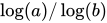
Being multiplicatively independent admits some other characterizations. a and b are multiplicatively independent if and only if is irrational. This property holds independently of the base of the logarithm.
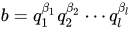
Let and be the canonical representations of a and b. The integers a and b are multiplicatively dependent if and only if k = l, and for all i and j.



Applications
Büchi arithmetic in base a and b define the same sets if and only if a and b are multiplicatively dependent.
Let a and b be multiplicatively dependent integers, that is, there exists n,m>1 such that . The integers c such that the length of its expansion in base a is at most m are exactly the integers such that the length of their expansion in base b is at most n. It implies that computing the base b expansion of a number, given its base a expansion, can be done by transforming consecutive sequences of m base a digits into consecutive sequence of n base b digits.
References
[2]
- ^ Bès, Alexis. "A survey of Arithmetical Definability". Archived from the original on 28 November 2012. Retrieved 27 June 2012.
- ^ Bruyère, Véronique; Hansel, Georges; Michaux, Christian; Villemaire, Roger (1994). "Logic and p-recognizable sets of integers" (PDF). Bull. Belg. Math. Soc. 1: 191--238.
