In mathematics, in the area of combinatorics and quantum calculus, the q-derivative, or Jackson derivative, is a q-analog of the ordinary derivative, introduced by Frank Hilton Jackson. It is the inverse of Jackson's q-integration. For other forms of q-derivative, see Chung et al. (1994).
Definition
The q-derivative of a function f(x) is defined as[1][2][3]
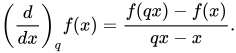
It is also often written as . The q-derivative is also known as the Jackson derivative.

Formally, in terms of Lagrange's shift operator in logarithmic variables, it amounts to the operator
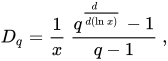
which goes to the plain derivative, as .


It is manifestly linear,

It has a product rule analogous to the ordinary derivative product rule, with two equivalent forms

Similarly, it satisfies a quotient rule,

There is also a rule similar to the chain rule for ordinary derivatives. Let . Then


The eigenfunction of the q-derivative is the q-exponential eq(x).
Relationship to ordinary derivatives
Q-differentiation resembles ordinary differentiation, with curious differences. For example, the q-derivative of the monomial is:[2]
![{\displaystyle \left({\frac {d}{dz}}\right)_{q}z^{n}={\frac {1-q^{n}}{1-q}}z^{n-1}=[n]_{q}z^{n-1}}](https://wikimedia.org/api/rest_v1/media/math/render/svg/64a0fdcac5de2e43d295dde69328b13b64d51c6c)
where is the q-bracket of n. Note that so the ordinary derivative is regained in this limit.
![{\displaystyle [n]_{q}}](https://wikimedia.org/api/rest_v1/media/math/render/svg/3dfd22063139d4a06ae9dfcaf79a85a2b2f751fc)
![{\displaystyle \lim _{q\to 1}[n]_{q}=n}](https://wikimedia.org/api/rest_v1/media/math/render/svg/a110bfe1445444b82c53754fa3f08361f4715aba)
The n-th q-derivative of a function may be given as:[3]
![{\displaystyle (D_{q}^{n}f)(0)={\frac {f^{(n)}(0)}{n!}}{\frac {(q;q)_{n}}{(1-q)^{n}}}={\frac {f^{(n)}(0)}{n!}}[n]!_{q}}](https://wikimedia.org/api/rest_v1/media/math/render/svg/1e8afafc343a4bcbeaf4ad40cb2bc9488826b39f)
provided that the ordinary n-th derivative of f exists at x = 0. Here, is the q-Pochhammer symbol, and is the q-factorial. If is analytic we can apply the Taylor formula to the definition of to get

![{\displaystyle [n]!_{q}}](https://wikimedia.org/api/rest_v1/media/math/render/svg/b9908fef01f897a1326dac11c8c37a95c82e2c5f)



A q-analog of the Taylor expansion of a function about zero follows:[2]
![{\displaystyle f(z)=\sum _{n=0}^{\infty }f^{(n)}(0)\,{\frac {z^{n}}{n!}}=\sum _{n=0}^{\infty }(D_{q}^{n}f)(0)\,{\frac {z^{n}}{[n]!_{q}}}.}](https://wikimedia.org/api/rest_v1/media/math/render/svg/324658e15855d983442d8ad7083c667767b3bd4f)
Higher order q-derivatives
The following representation for higher order -derivatives is known:[4][5]


is the -binomial coefficient. By changing the order of summation as , we obtain the next formula:[4][6]



Higher order -derivatives are used to -Taylor formula and the -Rodrigues' formula (the formula used to construct -orthogonal polynomials[4]).
Generalizations
Post Quantum Calculus
Post quantum calculus is a generalization of the theory of quantum calculus, and it uses the following operator:[7][8]

Hahn difference
Wolfgang Hahn introduced the following operator (Hahn difference):[9][10]

When this operator reduces to -derivative, and when it reduces to forward difference. This is a successful tool for constructing families of orthogonal polynomials and investigating some approximation problems.[11][12][13]

β-derivative
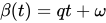
-derivative is an operator defined as follows:[14][15]


In the definition, is a given interval, and is any continuous function that strictly monotonically increases (i.e. ). When then this operator is -derivative, and when this operator is Hahn difference.




Applications
The q-calculus has been used in machine learning for designing stochastic activation functions.[16]
See also
- Derivative (generalizations)
- Jackson integral
- Q-exponential
- Q-difference polynomials
- Quantum calculus
- Tsallis entropy
Citations
- ^ Jackson 1908, pp. 253–281.
- ^ a b c Kac & Pokman Cheung 2002.
- ^ a b Ernst 2012.
- ^ a b c Koepf 2014.
- ^ Koepf, Rajković & Marinković 2007, pp. 621–638.
- ^ Annaby & Mansour 2008, pp. 472–483.
- ^ Gupta V., Rassias T.M., Agrawal P.N., Acu A.M. (2018) Basics of Post-Quantum Calculus. In: Recent Advances in Constructive Approximation Theory. SpringerOptimization and Its Applications, vol 138. Springer.
- ^ Duran 2016.
- ^ Hahn, W. (1949). Math. Nachr. 2: 4-34.
- ^ Hahn, W. (1983) Monatshefte Math. 95: 19-24.
- ^ Foupouagnigni 1998.
- ^ Kwon, K.; Lee, D.; Park, S.; Yoo, B.: Kyungpook Math. J. 38, 259-281 (1998).
- ^ Alvarez-Nodarse, R.: J. Comput. Appl. Math. 196, 320-337 (2006).
- ^ Auch, T. (2013): Development and Application of Difference and Fractional Calculus on Discrete Time Scales. PhD thesis, University of Nebraska-Lincoln.
- ^ Hamza et al. 2015, p. 182.
- ^ Nielsen & Sun 2021, pp. 2782–2789.
Bibliography
- Annaby, M. H.; Mansour, Z. S. (2008). "q-Taylor and interpolation-difference operators". Journal of Mathematical Analysis and Applications. 344 (1): 472–483. doi:10.1016/j.jmaa.2008.02.033.
- Chung, K. S.; Chung, W. S.; Nam, S. T.; Kang, H. J. (1994). "New q-derivative and q-logarithm". International Journal of Theoretical Physics. 33 (10): 2019–2029. Bibcode:1994IJTP...33.2019C. doi:10.1007/BF00675167. S2CID 117685233.
- Duran, U. (2016). Post Quantum Calculus (M.Sc. thesis). Department of Mathematics, University of Gaziantep Graduate School of Natural & Applied Sciences. Retrieved 9 March 2022 – via ResearchGate.
- Ernst, T. (2012). A comprehensive treatment of q-calculus. Springer Science & Business Media. ISBN 978-303480430-1.
- Ernst, Thomas (2001). "The History of q-Calculus and a new method" (PDF). Archived from the original (PDF) on 28 November 2009. Retrieved 9 March 2022.
- Exton, H. (1983). q-Hypergeometric Functions and Applications. New York: Halstead Press. ISBN 978-047027453-8.
- Foupouagnigni, M. (1998). Laguerre-Hahn orthogonal polynomials with respect to the Hahn operator: fourth-order difference equation for the rth associated and the Laguerre-Freud equations for the recurrence coefficients (Ph.D. thesis). Université Nationale du Bénin.
- Hamza, A.; Sarhan, A.; Shehata, E.; Aldwoah, K. (2015). "A General Quantum Difference Calculus". Advances in Difference Equations. 1 182. doi:10.1186/s13662-015-0518-3. S2CID 54790288.
- Jackson, F. H. (1908). "On q-functions and a certain difference operator". Trans. R. Soc. Edinb. 46 (2): 253–281. doi:10.1017/S0080456800002751. S2CID 123927312.
- Kac, Victor; Pokman Cheung (2002). Quantum Calculus. Springer-Verlag. ISBN 0-387-95341-8.
- Koekoek, J.; Koekoek, R. (1999). "A note on the q-derivative operator". J. Math. Anal. Appl. 176 (2): 627–634. arXiv:math/9908140. doi:10.1006/jmaa.1993.1237. S2CID 329394.
- Koepf, W.; Rajković, P. M.; Marinković, S. D. (July 2007). "Properties of q-holonomic functions". Journal of Difference Equations and Applications. 13 (7): 621–638. CiteSeerX 10.1.1.298.4595. doi:10.1080/10236190701264925. S2CID 123079843.
- Koepf, Wolfram (2014). Hypergeometric Summation. An Algorithmic Approach to Summation and Special Function Identities. Springer. ISBN 978-1-4471-6464-7.
- Nielsen, Frank; Sun, Ke (2021). "q-Neurons: Neuron Activations Based on Stochastic Jackson's Derivative Operators". IEEE Trans. Neural Netw. Learn. Syst. 32 (6): 2782–2789. arXiv:1806.00149. Bibcode:2021ITNNL..32.2782N. doi:10.1109/TNNLS.2020.3005167. PMID 32886614. S2CID 44143912.
