.jpg/1280px-Quebrada_de_Cafayate,_Salta_(Argentina).jpg)

In geology and related fields, a stratum (pl.: strata) is a layer of rock or sediment characterized by certain lithologic properties or attributes that distinguish it from adjacent layers from which it is separated by visible surfaces known as either bedding surfaces or bedding planes.[1] Prior to the publication of the International Stratigraphic Guide,[1] older publications have defined a stratum as being either equivalent to a single bed or composed of a number of beds; as a layer greater than 1 cm in thickness and constituting a part of a bed; or a general term that includes both bed and lamina.[2] Related terms are substrate and substratum (pl.substrata), a stratum underlying another stratum.
Characteristics
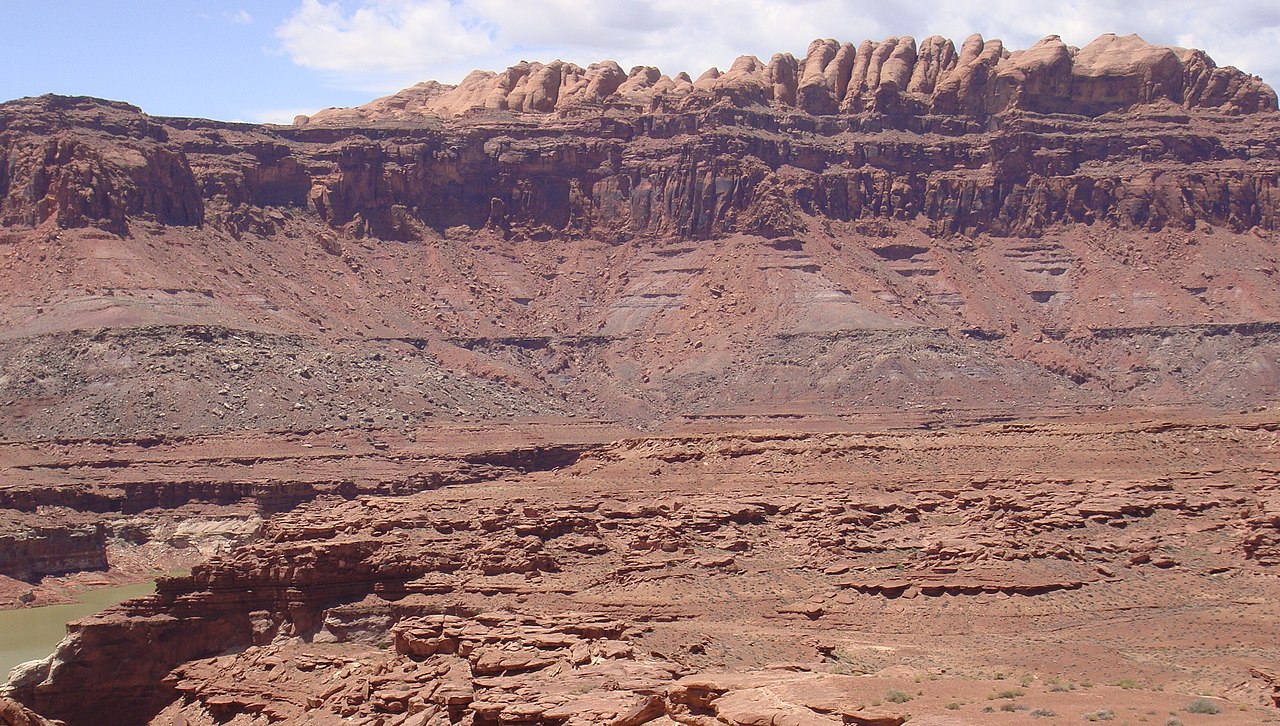
通常、地層は多数の平行な層のうちの 1 つであり、これらの層が互いに重なり合って非常に厚い地層を形成します。[1]地層を分ける層理面 (層理面) は、周期的な侵食、堆積の停止、またはその 2 つの組み合わせに伴う、堆積の断続的な中断を表します。[3] [4]個々の地層は、他の地層と一緒に積み重なって、地球の表面の何十万平方キロメートルにも及ぶ複合地層単位を形成できます。個々の地層は、同様に広い領域を覆うことができます。地層は通常、崖、道路の切土、採石場、川岸に露出した異なる色または異なる構造の物質の帯として見られます。個々の帯の厚さは、数ミリメートルから数メートル以上まで異なる場合があります。帯は、川のシルト、浜辺の砂、石炭湿地、砂丘、溶岩床などの 特定の堆積モードを表す場合があります。
種類
岩石や堆積物の地層の研究では、地質学者は、ベッド、フロー、バンド、キーベッドなど、さまざまな種類の地層を認識しています。[1] [5]ベッドは、上下の他の層と岩相的に区別できる単一の地層です。堆積性岩相層序単位の分類階層では、ベッドが最小の正式な単位です。ただし、地層の相関関係や地質図の作成に有用なほど特徴的なベッドのみが、通常、正式な名前を与えられ、正式な岩相層序単位と見なされます。ベッドの火山版であるフローは、テクスチャ、組成、またはその他の客観的基準で区別できる個別の噴出火山地層または体です。ベッドの場合と同様に、フローは、特徴的で広範囲に広がり、地層の相関関係に有用な場合にのみ、正式な岩相層序単位として指定および命名されるべきです。バンドとは、特徴的な岩相や色によって区別できる薄い地層であり、地層の相関関係を明らかにするのに役立ちます。最後に、キーベッド(マーカーベッドとも呼ばれます)とは、明確に定義され、容易に識別できる地層または地層群であり、岩相や化石含有量など、地質調査や地下地図作成の際に認識・相関関係を明らかにするのに十分な特徴を有しています。[1] [5]
ギャラリー
-
フランスアルプスの山腹の地層
-
Rock strata at Depot Beach, New South Wales
-
Rainbow Basin Syncline in the Barstow Formation near Barstow, California. Folded strata.
-
Outcrop of Upper Ordovician limestone and minor shale, central Tennessee
-
Chalk Layers in Cyprus showing classic layered structure
-
Heavy minerals (dark) as thin strata in a quartz beach sand (Chennai, India)
-
Stratified Island near La Paz, Baja California Sur, Mexico


See also
- Archaeological horizon
- Bed (geology)
- Geological formation
- Geologic unit
- Lamination (geology)
- Law of superposition
References
- ^ a b c d e Salvador, A. ed., 1994. International stratigraphic guide: a guide to stratigraphic classification, terminology, and procedure. 2nd ed. Boulder, Colorado, The Geological Society of America, Inc., 215 pp. ISBN 978-0-8137-5216-7.
- ^ Neuendorf, K.K.E., Mehl, Jr., J.P., and Jackson, J.A. , eds., 2005. Glossary of Geology 5th ed. Alexandria, Virginia, American Geological Institute. 779 pp. ISBN 0-922152-76-4.
- ^ Davies, N.S.; Shillito, A.P. (2021). "True substrates: The exceptional resolution and unexceptional preservation of deep time snapshots on bedding surfaces". Sedimentology. 68 (7): 3307–3356. Bibcode:2021Sedim..68.3307D. doi:10.1111/sed.12900.
- ^ Davies, S.S.; Shillito, A.P. (2018). "Incomplete but intricately detailed: The inevitable preservation of true substrates in a time-deficient stratigraphic record". Geology. 46 (8): 679–682. Bibcode:2018Geo....46..679D. doi:10.1130/G45206.1.
- ^ a b Murphy, M.A.; Salvador, A. (1999). "International Stratigraphic Guide — An abridged version". Episodes. 22 (4): 255–271. doi:10.18814/epiiugs/1999/v22i4/002.
External links

.jpg)


- GeoWhen Database
