
組合せ 数学において、乱れとは、集合の要素の順列のうち、どの要素も元の位置には現れない順列のことである。言い換えれば、乱れとは不動点を持たない順列のことである。
大きさnの集合の乱れの数は、nの階乗、n 次の乱れ数、またはn 次のド・モンモール数(ピエール・レモン・ド・モンモールにちなんで)として知られています。一般的に用いられる階乗の表記法には、! n、Dn 、 dn 、またはn¡ などがあります。[ a] [1] [2]
n > 0の場合、階乗! nは最も近い整数に等しくなります。 n !/e、ここでn !はnの階乗を表し、 e ≈ 2.718281828...はオイラー数です。 [3]
乱れの数を数える問題は、1708年にピエール・レイモン・ド・モンモールによって「危険の分析に関するエッセイ」[4]で初めて考察されました。彼は1713年に、ニコラ・ベルヌーイもほぼ同時期にこの問題を解決しました。
例

教授が4人の学生(A、B、C、D)にテストを与え、お互いのテストを採点させたいとします。教授が学生にテストを返却し、どの学生も自分のテストを受け取らないようにするには、何通りの方法がありますか?テストを返却する24通りの順列(4通り!)のうち、
ABCD、 AB DC、 A CB D、 A CDB、 A DBC、 A D C B、 BA CD、 BADC、 BCA D、 BCDA、 BDAC、 BD CA、 CAB D、 CADB、 C B A D、 C B DA、 CDAB、 CDBA、 DABC、 DA C B、 D B AC、 D BC A、 DCAB、 DCBA、
並び替えは9つだけです(上記に青い斜体で示されています)。この4つの要素セットの他のすべての順列では、少なくとも1人の生徒に独自のテストが返却されます(赤の太字で示されています)。
問題の別のバージョンは、それぞれ異なる宛先に宛てられたn通の手紙を、宛先が書かれた n個の封筒に入れ、正しく宛名が書かれた封筒に手紙が1通も入らないようにする方法の数を求めるときに生じます。
乱れの数を数える
集合の乱れの数を数えることは、帽子チェック問題に相当します。これは、n個の帽子( h 1からh nと呼ぶ)をn人の人(P 1からP nと呼ぶ)に返却し、持ち主に帽子が戻らないようにする方法の数を考える問題です。[5]
各人は、自分のものではないn − 1個の帽子のいずれかを受け取る可能性があります。P 1 が受け取る帽子 をh iとし、h iの所有者を考えます。P i はP 1の帽子、h 1 、または他の帽子を受け取ります。したがって、問題は2つのケースに分かれます
- P i receives a hat other than h 1 . This case is equivalent to solving the problem with n − 1 people and n − 1 hats because for each of the n − 1 people besides P 1 there is exactly one hat from among the remaining n − 1 hats that they may not receive (for any P j besides P i , the unreceivable hat is h j , while for P i it is h 1 ). Another way to see this is to rename h 1 to h i , where the derangement is more explicit: for any j from 2 to n , P j cannot receive h j .
- P i receives h 1 . In this case the problem reduces to n − 2 people and n − 2 hats, because P 1 received h i ' s hat and P i received h 1 's hat, effectively putting both out of further consideration.
P 1 が受け取る可能性のあるn − 1個のハットのそれぞれについて、 P 2、…、 P n がすべてハットを受け取る可能性のある方法の数は、2つのケースのカウントの合計です。
これにより、ハットチェック問題の解が得られます。代数的に述べると、n要素集合 の乱れの数は、に対して! nです。ここで、および[6]


小さな長さの乱れの数は、下の表に示されています。
| n | 0 | 1 | 2 | 3 | 4 | 5 | 6 | 7 | 8 | 9 | 10 | 11 | 12 | 13 |
|---|---|---|---|---|---|---|---|---|---|---|---|---|---|---|
| ! n | 1 | 0 | 1 | 2 | 9 | 44 | 265 | 1,854 | 14,833 | 133,496 | 1,334,961 | 14,684,570 | 176,214,841 | 2,290,792,932 |
上記の式に相当する、 ! nの様々な表現があります。これらには、 およびが 含まれます。


- の場合
![{\displaystyle !n=\left[{\frac {n!}{e}}\right]=\left\lfloor {\frac {n!}{e}}+{\frac {1}{2}}\right\rfloor }](https://wikimedia.org/api/rest_v1/media/math/render/svg/d522701b28d640964b2e50f781b9e10c385898f5)

ここで、は最も近い整数関数であり、は床関数です。[3] [6]
![{\displaystyle \left[x\right]}](https://wikimedia.org/api/rest_v1/media/math/render/svg/bee30b48da3d61e9dfa898ca4d209afdcc6503dc)

その他の関連する式には、 [3] [7] および
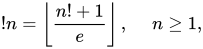


次の再帰性も成り立ちます。[6]

包含排他原理による導出
n集合の乱れの数についても、非再帰的な式を導くことができます。k 番目のオブジェクトを固定するn個のオブジェクトの順列の集合を と定義します。これらの集合のi個の集合の任意の交差は、 i個のオブジェクトの特定の集合を固定し、したがって順列を含みます。そのような集合が存在するため、包含排他原理により、となり 、乱れはn 個のオブジェクトのいずれも固定しない順列であるため、これは次のことを意味します


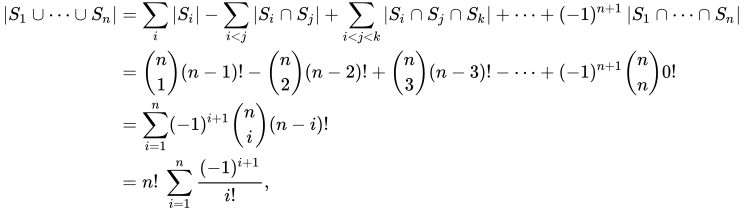

一方、定義により、要素をそれぞれの場所に配置して、他のi個の要素をちょうど! i通りの方法で乱すことができるため、 [8]


乱れの数の増加n∞に近づくにつれて
とを代入することで、 すぐ に次の式が得られます。 これは、多数のオブジェクトのランダムに選択された順列が乱れである確率 の極限です。確率はnが増加するにつれて非常に速くこの極限に収束します。そのため、! nはn !/ eに最も近い整数です。上記の片対数グラフは、乱れのグラフが順列のグラフよりほぼ一定の値だけ遅れていることを示しています。



この計算と上記の極限に関する詳細は、ランダム順列の統計に関する記事をご覧ください 。
ベル数による漸近展開
ベル数による乱れの数の漸近展開は次のとおりです。 ここで、は任意の固定された正の整数であり、は番目のベル数を表します。さらに、大きなO項によって暗示される定数はを超えません。[9]



一般化
問題「出会い」は、サイズnの集合の順列のうち、正確にk個の固定点 を持つものがいくつあるかを問うものです
乱れは、制約付き順列のより広い分野の一例です。例えば、メネジャージュ問題は、 n組の異性のカップルがテーブルの周りに男性-女性-男性-女性…と座っている場合、誰もパートナーの隣に座らないように座るには、何通りの座り方ができるかを問うものです。
より正式には、集合AとS 、および射影A → Sの集合UとVが与えられたとき、 fがUに含まれ、gがVに含まれる関数 ( f , g )のペアの数を知りたいことがよくあります。そして、 Aのすべてのaに対して、f ( a ) ≠ g ( a ) となります。言い換えれば、各fとgに対して、 f ( a ) = φ( g ( a ) )となるようなSの乱れ φ が存在します。
別の一般化は次の問題です
- 特定の単語の固定文字を含まないアナグラムはいくつありますか?
For instance, for a word made of only two different letters, say n letters A and m letters B, the answer is, of course, 1 or 0 according to whether n = m or not, for the only way to form an anagram without fixed letters is to exchange all the A with B, which is possible if and only if n = m. In the general case, for a word with n1 letters X1, n2 letters X2, ..., nr letters Xr, it turns out (after a proper use of the inclusion-exclusion formula) that the answer has the form for a certain sequence of polynomials Pn, where Pn has degree n. But the above answer for the case r = 2 gives an orthogonality relation, whence the Pn's are the Laguerre polynomials (up to a sign that is easily decided).[10]


In particular, for the classical derangements, one has that where is the upper incomplete gamma function.


Computational complexity
It is NP-complete to determine whether a given permutation group (described by a given set of permutations that generate it) contains any derangements.[11][12]
Table of factorial and derangement values Permutations, Derangements, 0 1 =1×100
1 =1×100
= 1 1 1 =1×100
0 = 0 2 2 =2×100
1 =1×100
= 0.5 3 6 =6×100
2 =2×100
≈0.33333 33333 4 24 =2.4×101
9 =9×100
= 0.375 5 120 =1.20×10²
44 =4.4×101
≈0.36666 66667 6 720 =7.20×10²
265 =2.65×10²
≈0.36805 55556 7 5,040 =5.04×10³
1,854 ≈1.85×10³
≈0.36785,71429 8 40,320 ≈4.03×10⁴
14,833 ≈1.48×10⁴
≈0.36788 19444 9 362,880 ≈3.63×10⁵
133,496 ≈1.33×10⁵
≈0.36787 91887 10 3,628,800 ≈3.63×10⁶
1,334,961 ≈1.33×10⁶
≈0.36787 94643 11 39,916,800 ≈3.99×10⁷
14,684,570 ≈1.47×10⁷
≈0.36787 94392 12 479,001,600 ≈4.79×10⁸
176,214,841 ≈1.76×10⁸
≈0.36787 94413 13 6,227,020,800 ≈6.23×10⁹
2,290,792,932 ≈2.29×10⁹
≈0.36787 94412 14 87,178,291,200 ≈8.72×10¹⁰
32,071,101,049 ≈3.21×10¹⁰
≈0.36787 94412 15 1,307,674,368,000 ≈1.31×10¹²
481,066,515,734 ≈4.81×10¹¹
≈0.36787 94412 16 20,922,789,888,000 ≈2.09×10¹³
7,697,064,251,745 ≈7.70×10¹²
≈0.36787 94412 17 355,687,428,096,000 ≈3.56×10¹⁴
130,850,092,279,664 ≈1.31×10¹⁴
≈0.36787 94412 18 6,402,373,705,728,000 ≈6.40×10¹⁵
2,355,301,661,033,953 ≈2.36×10¹⁵
≈0.36787 94412 19 121,645,100,408,832,000 ≈1.22×10¹⁷
44,750,731,559,645,106 ≈4.48×10¹⁶
≈0.36787 94412 20 2,432,902,008,176,640,000 ≈2.43×10¹⁸
895,014,631,192,902,121 ≈8.95×10¹⁷
≈0.36787 94412 21 51,090,942,171,709,440,000 ≈5.11×10¹⁹
18,795,307,255,050,944,540 ≈1.88×10¹⁹
≈0.36787 94412 22 1,124,000,727,777,607,680,000 ≈1.12×10²¹
413,496,759,611,120,779,881 ≈4.13×10²⁰
≈0.36787 94412 23 25,852,016,738,884,976,640,000 ≈2.59×10²²
9,510,425,471,055,777,937,262 ≈9.51×10²¹
≈0.36787 94412 24 620,448,401,733,239,439,360,000 ≈6.20×10²³
228,250,211,305,338,670,494,289 ≈2.28×10²³
≈0.36787 94412 25 15,511,210,043,330,985,984,000,000 ≈1.55×1025
5,706,255,282,633,466,762,357,224 ≈5.71×1024
≈0.36787 94412 26 403,291,461,126,605,635,584,000,000 ≈4.03×1026
148,362,637,348,470,135,821,287,825 ≈1.48×1026
≈0.36787 94412 27 10,888,869,450,418,352,160,768,000,000 ≈1.09×1028
4,005,791,208,408,693,667,174,771,274 ≈4.01×1027
≈0.36787 94412 28 304,888,344,611,713,860,501,504,000,000 ≈3.05×1029
112,162,153,835,443,422,680,893,595,673 ≈1.12×1029
≈0.36787 94412 29 8,841,761,993,739,701,954,543,616,000,000 ≈8.84×1030
3,252,702,461,227,859,257,745,914,274,516 ≈3.25×1030
≈0.36787 94412 30 265,252,859,812,191,058,636,308,480,000,000 ≈2.65×1032
97,581,073,836,835,777,732,377,428,235,481 ≈9.76×1031
≈0.36787 94412


Footnotes
- ^ The name "subfactorial" originates with William Allen Whitworth.[1]
References
- ^ a b Cajori, Florian (2011). A History of Mathematical Notations: Two volumes in one. Cosimo, Inc. p. 77. ISBN 9781616405717 – via Google.
- ^ Graham, Ronald L.; Knuth, Donald E.; Patashnik, Oren (1994). Concrete Mathematics. Reading, MA: Addison–Wesley. ISBN 0-201-55802-5.
- ^ a b c Hassani, Mehdi (2003). "Derangements and applications". Journal of Integer Sequences. 6 (1). Article 03.1.2. Bibcode:2003JIntS...6...12H – via cs.uwaterloo.ca.
- ^ de Montmort, PR (1713) [1708]. Essay d'analyse sur les jeux de hazard (フランス語) (Revue & augmentée de plusieurs Lettres, seconde ed.). Paris, FR: Jacque Quillau (1708) / Jacque Quillau (1713).
- ^ Scoville, Richard (1966). "The Hat-Check Problem". American Mathematical Monthly . 73 (3): 262– 265. doi :10.2307/2315337. JSTOR 2315337.
- ^ abc Stanley, Richard (2012). Enumerative Combinatorics, volume 1 (2 ed.). Cambridge University Press. Example 2.2.1. ISBN 978-1-107-60262-5.
- ^ Weisstein, Eric W.「Subfactorial」. MathWorld .
- ^ Bizley, MTL (1967年5月). 「A note on derangements」. Math. Gaz . 51 (376): 118–120 . doi :10.2307/3614384. JSTOR 3614384.
- ^ Hassani, Mehdi (2020). 「Derangements and Alternating Sum of Permutations by Integration」. Journal of Integer Sequences . 23. Article 20.7.8
- ^ Even, S.; Gillis, J. (1976). 「Derangements and Laguerre polynomials」 . Mathematical Proceedings of the Cambridge Philosophical Society . 79 (1): 135– 143. Bibcode :1976MPCPS..79..135E. doi :10.1017/S0305004100052154. S2CID 122311800. 2011年12月27日閲覧.
- ^ Lubiw, Anna (1981). 「グラフ同型性に類似したNP完全問題のいくつか」. SIAM Journal on Computing . 10 (1): 11– 21. doi :10.1137/0210002. MR 0605600
- ^ Babai, László (1995). 「自己同型群、同型、再構成」. 組合せ論ハンドブック(PDF) . 第1巻、第2巻. アムステルダム、オランダ: Elsevier. 第27章、1447~1540ページ. MR 1373683 – cs.uchicago.edu経由.
外部リンク


- Baez, John (2003). 「Let's get deranged!」(PDF) – math.ucr.edu経由
- ボガート、ケネス・P.;ドイル、ピーター・G. (1985). 「メネジェ問題の非性差別的解」 – math.dartmouth.edu経由
- ワイススタイン、EW「錯乱」 MathWorld / Wolfram Research – mathworld.wolfram.com経由
