重み付けパターン

Pattern in control theory

線形動的システム重み付けパターンは、入力と出力の関係を記述する u {\displaystyle u} y {\displaystyle y}

x ˙ ( t ) = A ( t ) x ( t ) + B ( t ) u ( t ) {\displaystyle {\dot {x}}(t)=A(t)x(t)+B(t)u(t)}
y ( t ) = C ( t ) x ( t ) {\displaystyle y(t)=C(t)x(t)} ,

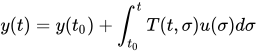
出力は次のように表すことができます

y ( t ) = y ( t 0 ) + t 0 t T ( t , σ ) u ( σ ) d σ {\displaystyle y(t)=y(t_{0})+\int _{t_{0}}^{t}T(t,\sigma )u(\sigma )d\sigma } ,

ここではシステムの重みパターンですこのようなシステムでは、重みパターンはが状態遷移行列となるようなものになります T ( , ) {\displaystyle T(\cdot ,\cdot )} T ( t , σ ) = C ( t ) ϕ ( t , σ ) B ( σ ) {\displaystyle T(t,\sigma )=C(t)\phi (t,\sigma )B(\sigma )} ϕ {\displaystyle \phi }

重み付けパターンによってシステムが決定されますが、この重み付けパターンの実現例が存在する場合、それを実現するシステムは数多く存在します。[1]

線形時不変システム

LTI システムは重み付けパターンは次のようになります。

連続
T ( t , σ ) = C e A ( t σ ) B {\displaystyle T(t,\sigma )=Ce^{A(t-\sigma )}B}

ここで行列は指数関数です e A ( t σ ) {\displaystyle e^{A(t-\sigma )}}

離散
T ( k , l ) = C A k l 1 B {\displaystyle T(k,l)=CA^{k-l-1}B}

参照

参考文献

  1. ^ Brockett, Roger W. (1970).有限次元線形システム. John Wiley & Sons. ISBN 978-0-471-10585-5
Retrieved from "https://en.wikipedia.org/w/index.php?title=Weighting_pattern&oldid=1280193227"