
計算化学では、水モデルは、水クラスター、液体の水、および明示的な溶媒を含む水溶液のシミュレーションと熱力学的計算に使用され、多くの場合、分子動力学法またはモンテカルロ法が使用されます。モデルは水分子間の分子間力を記述し、量子力学、分子力学、実験結果、およびこれらの組み合わせから決定されます。分子間力の特定の性質を模倣するために、多くの種類のモデルが開発されています。一般に、これらは次の3つの特性によって分類できます。(i)相互作用点またはサイトの数、(ii)モデルが剛性か柔軟か、(iii)モデルに分極効果が含まれているかどうか。
明示的な水モデルの代わりに、暗黙的な溶媒和モデル(連続体モデルとも呼ばれる)を使用する方法があります。この種のモデルの例としては、 COSMO溶媒和モデル、分極連続体モデル(PCM)、ハイブリッド溶媒和モデルなどがあります。[1]
シンプルな水モデル
剛体モデルは最も単純な水モデルと考えられており、非結合相互作用に依存している。これらのモデルでは、結合相互作用はホロノミック制約によって暗黙的に扱われる。静電相互作用はクーロンの法則を用いて、分散力と斥力はレナード・ジョーンズポテンシャルを用いてモデル化される。[2] [3] TIP3P(3点転移型分子間ポテンシャル)やTIP4Pなどのモデルのポテンシャルは次のように表される。
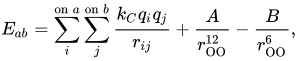
ここで、静電定数k C は、分子モデリングで一般的に用いられる単位では332.1 Å·kcal/(mol· e ²) である[要出典]。[4] [5] [6] q iとq jは電子の電荷に対する部分電荷、 r ijは2つの原子または荷電サイト間の距離、AとBはレナード・ジョーンズ・パラメータである。荷電サイトは原子上にある場合もあれば、ダミーサイト(孤立電子対など)上にある場合もある。ほとんどの水モデルでは、レナード・ジョーンズ項は酸素原子間の相互作用にのみ適用される。
下の図は、3~6サイト水モデルの一般的な形状を示しています。正確な幾何学的パラメータ(OH距離とHOH角)はモデルによって異なります。

2サイト
よく知られている3サイトSPCモデル(下記参照)に基づく水の2サイトモデルは、サイト再正規化分子流体理論を用いて水の誘電特性を予測できることが示されている。[7]
3サイト
3サイトモデルは、水分子の3つの原子に対応する3つの相互作用点を持ちます。各サイトは点電荷を持ち、酸素原子に対応するサイトはレナード・ジョーンズパラメータも持ちます。3サイトモデルは高い計算効率を実現するため、分子動力学シミュレーションの多くの用途で広く用いられています。ほとんどのモデルは、実際の水分子に一致する剛体形状を採用しています。例外として、SPCモデルは、観測された角度104.5°ではなく、理想的な四面体形状(HOH角109.47°)を仮定します。
以下の表には、いくつかの 3 サイト モデルのパラメータがリストされています。
SPC/E モデルは、ポテンシャル エネルギー関数に平均分極補正を追加します。

ここで、μは有効分極した水分子の電気双極子モーメント( SPC/Eモデルでは2.35 D )、μ 0は孤立した水分子の双極子モーメント(実験では1.85 D)、α iは等方性分極率定数で、1.608 × 10 −40 F ·m 2。モデル内の電荷は一定であるため、この補正により全エネルギーに1.25 kcal/mol(5.22 kJ/mol)が追加されるだけです。SPC/Eモデルは、SPCモデルよりも優れた密度と拡散定数をもたらします。
CHARMM力場に実装されたTIP3Pモデルは、オリジナルのモデルを若干改変したものです。違いはレナード・ジョーンズ・パラメータにあります。TIP3Pとは異なり、CHARMM版のモデルでは、酸素原子に加えて水素原子にもレナード・ジョーンズ・パラメータを適用します。電荷は変更されません。[12] 3サイトモデル(TIP3P)は、比熱計算においてより優れた性能を発揮します。[13]
柔軟なSPC水モデル

柔軟な単純点電荷水モデル(または柔軟なSPC水モデル)は、3中心SPC水モデルの再パラメータ化である。[14] [15] SPCモデルは剛性であるのに対し、柔軟なSPCモデルは柔軟性がある。ToukanとRahmanのモデルでは、O–H伸縮が非調和化されているため、動的挙動がよく記述される。これは、分極を考慮しない最も正確な3中心水モデルの一つである。分子動力学シミュレーションでは、水の正確な密度と誘電率を与える。[16]
柔軟な SPC は、プログラムMDynaMixおよびAbaloneに実装されています。
その他のモデル
- ファーガソン(フレキシブルSPC)[17]
- CVFF(フレキシブル)
- MG(柔軟で解離性)[18]
- KKYポテンシャル(柔軟なモデル)[19]
- BLXL(スミア帯電電位)[20]
4サイト
4 サイトモデルは、3 サイトモデルの HOH 角の二等分線に沿って酸素の近くにダミー原子を 1 つ追加することにより、4 つの相互作用点を持ちます (図のMで示されています)。ダミー原子は負の電荷のみを持ちます。このモデルは、水分子の周りの静電分布を改善します。このアプローチを使用した最初のモデルは、1933 年に発表された Bernal–Fowler モデルであり、[21]これは最も初期の水モデルでもある可能性があります。ただし、BF モデルは密度や蒸発熱などの水のバルク特性をうまく再現しないため、歴史的な関心の対象にすぎません。これはパラメーター化の方法による結果です。現代のコンピューターが利用可能になった後に開発された新しいモデルは、メトロポリスモンテカルロまたは分子動力学シミュレーションを実行し、バルク特性が十分に再現されるまでパラメーターを調整することによってパラメーター化されました。
1983年に初めて公開されたTIP4Pモデルは、計算化学ソフトウェアパッケージに広く実装されており、生体分子システムのシミュレーションによく使用されています。その後、TIP4Pモデルは特定の用途向けに再パラメータ化されてきました。エワルド和法で使用するためのTIP4P-Ewモデル、固体氷のシミュレーションのためのTIP4P/Ice、凝縮水の状態図全体をシミュレーションするための汎用パラメータ化であるTIP4P/2005、そして量子効果がシミュレーションに組み込まれた場合の固体水と液体水の特性を正確に記述するように設計された類似モデルであるTIP4PQ/2005です。[22]
4サイト水モデルのほとんどは、自由水分子のOH距離とHOH角と一致する値を使用しています。唯一の例外はOPCモデルで、水分子の基本的なC 2v 分子対称性以外には幾何学的制約は課されません。その代わりに、点電荷とその位置は、水分子の静電特性を最もよく記述するように最適化されます。OPCは、一般的に使用されているいくつかのnサイト剛体水モデルよりも、包括的なバルク特性をより正確に再現します。OPCモデルはAMBER力場内に実装されています。
その他:
- q-TIP4P/F(フレキシブル)[29]
- TIP4P/2005f(フレキシブル)[30]
5サイト
The 5-site models place the negative charge on dummy atoms (labelled L) representing the lone pairs of the oxygen atom, with a tetrahedral-like geometry. An early model of these types was the BNS model of Ben-Naim and Stillinger, proposed in 1971,[citation needed] soon succeeded by the ST2 model of Stillinger and Rahman in 1974.[31] Mainly due to their higher computational cost, five-site models were not developed much until 2000, when the TIP5P model of Mahoney and Jorgensen was published.[32] When compared with earlier models, the TIP5P model results in improvements in the geometry for the water dimer, a more "tetrahedral" water structure that better reproduces the experimental radial distribution functions from neutron diffraction, and the temperature of maximal density of water. The TIP5P-E model is a reparameterization of TIP5P for use with Ewald sums.
Note, however, that the BNS and ST2 models do not use Coulomb's law directly for the electrostatic terms, but a modified version that is scaled down at short distances by multiplying it by the switching function S(r):
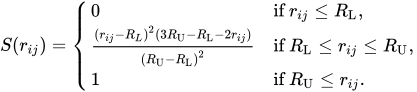


Thus, the RL and RU parameters only apply to BNS and ST2.
6-site
Originally designed to study water/ice systems, a 6-site model that combines all the sites of the 4- and 5-site models was developed by Nada and van der Eerden.[34] Since it had a very high melting temperature[35] when employed under periodic electrostatic conditions (Ewald summation), a modified version was published later[36] optimized by using the Ewald method for estimating the Coulomb interaction.
Other
- 生体分子シミュレーションにおける溶質挙動への明示的な溶質モデルの影響についても、広範囲に研究されている。明示的な水モデルは、折り畳まれていないペプチドの特異的な溶媒和とダイナミクスに影響を与える一方で、折り畳まれたペプチドのコンフォメーション挙動と柔軟性は損なわれないことが示された。[37]
- MBモデル。メルセデス・ベンツのロゴに似た、より抽象的なモデルで、2次元システムにおける水の特徴を再現する。「現実の」(つまり3次元の)システムのシミュレーションには直接的には用いられないが、定性研究や教育目的には有用である。[38]
- 粗視化モデル。水の1サイトモデルと2サイトモデルも開発されている。[39]粗視化モデルでは、各サイトは複数の水分子を表すことができる。
- 多体モデル。トレーニングセット構成を用いて構築された水モデルを量子力学的に解き、機械学習プロトコルを用いてポテンシャルエネルギー面を抽出します。これらのポテンシャルエネルギー面をMDシミュレーションに入力することで、凝縮相系の物理的特性をこれまでにない精度で計算できます。[40]
- 多体モデルのもう一つの分類法[41]は、基礎となる静電気の展開に基づくものであり、例えばSCME(単一中心多極展開)モデル[42]などがある。
計算コスト
水シミュレーションの計算コストは、水モデル内の相互作用サイトの数に応じて増加します。CPU時間は、計算に必要な原子間距離の数にほぼ比例します。3サイトモデルの場合、水分子の各ペアに対して9つの距離(一方の分子のすべての原子ともう一方の分子のすべての原子、つまり3 × 3)が必要です。4サイトモデルの場合、10の距離(すべての荷電サイトとすべての荷電サイト、さらにO-O相互作用、つまり3 × 3 + 1)が必要です。5サイトモデルの場合、17の距離(4 × 4 + 1)が必要です。最後に、6サイトモデルの場合、26の距離(5 × 5 + 1)が必要です。
分子動力学で剛体水モデルを使用する場合、制約アルゴリズムを使用して構造を制約された状態に保つことに関連する追加コストが発生します(ただし、結合長が制約されている場合、時間ステップを増やすことは多くの場合可能です)。
参照
参考文献
- ^ Skyner RE, McDonagh JL, Groom CR, van Mourik T, Mitchell JB (2015年3月). 「溶液自由エネルギーの計算方法と溶液中のシステムのモデリングに関するレビュー」(PDF) . Physical Chemistry Chemical Physics . 17 (9): 6174–91 . Bibcode :2015PCCP...17.6174S. doi : 10.1039/C5CP00288E . PMID 25660403.
- ^ Allen MP, Tildesley DJ (1989).液体のコンピュータシミュレーション. Clarendon Press. ISBN 978-0-19-855645-9。
- ^ Kirby BJ. マイクロ・ナノスケール流体力学:マイクロ流体デバイスにおける輸送. 2019年4月28日時点のオリジナルよりアーカイブ。2010年9月4日閲覧。
- ^ Swails JM, Roitberg AE (2013). 「prmtopファイル of {A}mber」(PDF) .
- ^ Swails JM (2013). 一定pHにおける複雑な生物システムの自由エネルギーシミュレーション(PDF) . フロリダ大学.書誌コード:2013PhDT......588S.
- ^ Case DA、Walker RC、Cheatham III TE、Simmerling CL、Roitberg A、Merz KM、他。 (2019年4月)。 「Amber 2019 リファレンス マニュアル (Amber18 および AmberTools19 をカバー)」(PDF)。
- ^ Dyer KM, Perkyns JS, Stell G, Pettitt BM (2009). 「サイト再正規化分子流体理論:水の2サイトモデルの有用性について」.分子物理学. 107 ( 4–6 ): 423– 431. Bibcode :2009MolPh.107..423D. doi :10.1080/00268970902845313. PMC 2777734. PMID 19920881 .
- ^ Jorgensen, William L. (1981). 「液体の量子力学および統計力学的研究. 10. 水、アルコール、エーテルの可搬性分子間ポテンシャル関数. 液体水への応用」.アメリカ化学会誌. 103 (2). アメリカ化学会誌 (ACS): 335– 340. Bibcode :1981JAChS.103..335J. doi :10.1021/ja00392a016. ISSN 0002-7863.
- ^ HJC Berendsen、JPM Postma、WF van Gunsteren、および J. Hermans、「分子間力」、B. Pullman 編集 (ライデル、ドルドレヒト、 1981 年)、p. 331.
- ^ ab Jorgensen WL, Chandrasekhar J, Madura JD, Impey RW, Klein ML (1983). 「液体の水のシミュレーションにおける単純ポテンシャル関数の比較」. The Journal of Chemical Physics . 79 (2): 926– 935. Bibcode :1983JChPh..79..926J. doi :10.1063/1.445869.
- ^ ベレンセン HJ、グリゲラ JR、ストラツマ TP (1987)。 「有効ペアポテンシャルの欠落項」。物理化学ジャーナル。91 (24): 6269–6271。土井:10.1021/j100308a038。
- ^ MacKerell AD, Bashford D, Bellott M, Dunbrack RL, Evanseck JD, Field MJ, et al. (1998年4月). 「タンパク質の分子モデリングとダイナミクス研究のための全原子経験的ポテンシャル」. The Journal of Physical Chemistry B. 102 ( 18): 3586– 616. doi :10.1021/jp973084f. PMID 24889800.
- ^ Mao Y, Zhang Y (2012). 「剛体水モデルの熱伝導率、せん断粘度、比熱」. Chemical Physics Letters . 542 : 37– 41. Bibcode :2012CPL...542...37M. doi :10.1016/j.cplett.2012.05.044.
- ^ Toukan K, Rahman A (1985年3月). 「水中の原子運動の分子動力学研究」. Physical Review B. 31 ( 5): 2643– 2648. Bibcode :1985PhRvB..31.2643T. doi :10.1103/PhysRevB.31.2643. PMID 9936106.
- ^ ベレンセン HJ、グリゲラ JR、ストラツマ TP (1987)。 「有効ペアポテンシャルの欠落項」。物理化学ジャーナル。91 (24): 6269–6271。土井:10.1021/j100308a038。
- ^ Praprotnik M, Janezic D, Mavri J (2004). 「水の振動スペクトルの温度依存性:分子動力学シミュレーション研究」. Journal of Physical Chemistry A. 108 ( 50): 11056– 11062. Bibcode :2004JPCA..10811056P. doi :10.1021/jp046158d.
- ^ Ferguson, David M. (1995年4月). 「柔軟な水モデルのパラメータ化と評価」 . Journal of Computational Chemistry . 16 (4): 501– 511. doi :10.1002/jcc.540160413. S2CID 206038409. 2021年7月28日閲覧。
- ^ MGモデル Archived 2016-03-04 at the Wayback Machine .
- ^ 熊谷 暢・河村 健・横川 剛 (1994). 「H2Oの原子間ポテンシャルモデル:水と氷の多形への応用」.分子シミュレーション. 12 ( 3–6 ). Informa UK Limited: 177–186 . doi :10.1080/08927029408023028. ISSN 0892-7022.
- ^ Burnham CJ, Li J, Xantheas SS, Leslie M (1999). 「第一原理によるThole型全原子分極水モデルのパラメータ化と水クラスター(n=2–21)および氷Ihのフォノンスペクトルの研究への応用」. The Journal of Chemical Physics . 110 (9): 4566– 4581. Bibcode :1999JChPh.110.4566B. doi :10.1063/1.478797.
- ^ ab Bernal JD, Fowler RH (1933). 「水とイオン溶液の理論、特に水素イオンと水酸化イオンについて」. The Journal of Chemical Physics . 1 (8): 515. Bibcode :1933JChPh...1..515B. doi :10.1063/1.1749327.
- ^ McBride, C.; Vega, C.; Noya, EG; Ramirez, R.; Sese', LM (2009). 「氷相における量子寄与:水の新しい経験的モデルへの道—TIP4PQ/2005」. J. Chem. Phys . 131 (2): 024506. arXiv : 0906.3967 . Bibcode :2009JChPh.131b4506M. doi :10.1063/1.3175694. PMID: 19604003. S2CID: 15505037.
- ^ Jorgensen (1982). 「液体の水と水溶液のシミュレーションのための改訂版TIPS」. The Journal of Chemical Physics . 77 (8): 4156– 4163. Bibcode :1982JChPh..77.4156J. doi : 10.1063/1.444325 .
- ^ Horn HW, Swope WC, Pitera JW, Madura JD, Dick TJ, Hura GL, Head-Gordon T (2004年5月). 「生体分子シミュレーションのための改良型4サイト水モデルの開発:TIP4P-Ew」. The Journal of Chemical Physics . 120 (20): 9665–78 . Bibcode :2004JChPh.120.9665H. doi :10.1063/1.1683075. PMID : 15267980. S2CID : 39545298.
- ^ Abascal JL, Sanz E, García Fernández R, Vega C (2005年6月). 「氷とアモルファス水の研究のための潜在的モデル:TIP4P/Ice」. The Journal of Chemical Physics . 122 (23): 234511. Bibcode :2005JChPh.122w4511A. doi :10.1063/1.1931662. PMID: 16008466. S2CID : 8382245.
- ^ Abascal JL, Vega C (2005年12月). 「水の凝縮相の汎用モデル:TIP4P/2005」. The Journal of Chemical Physics . 123 (23): 234505. Bibcode :2005JChPh.123w4505A. doi :10.1063/1.2121687. PMID: 16392929. S2CID : 9757894.
- ^ Izadi S, Anandakrishnan R, Onufriev AV (2014年11月). 「水モデルの構築:新たなアプローチ」. The Journal of Physical Chemistry Letters . 5 (21): 3863– 3871. arXiv : 1408.1679 . Bibcode :2014arXiv1408.1679I. doi :10.1021/jz501780a. PMC 4226301. PMID 25400877 .
- ^ Piana S, Donchev AG, Robustelli P, Shaw DE (2015年4月). 「水分散相互作用は、無秩序なタンパク質状態のシミュレーションによる構造特性に強く影響する」. The Journal of Physical Chemistry B. 119 ( 16): 5113–23 . doi : 10.1021/jp508971m . PMID 25764013.
- ^ Habershon, S.; Markland, TE; Manolopoulos, DE (2009). 「柔軟な水モデルのダイナミクスにおける競合する量子効果」. J. Chem. Phys . 131 (2): 024501. arXiv : 1011.1047 . Bibcode :2009JChPh.131b4501H. doi :10.1063/1.3167790. PMID: 19603998. S2CID : 9095938.
- ^ Gonzalez, MA; Abascal, JJF (2011). 「TIP4P/2005に基づく水の柔軟なモデル」. J. Chem. Phys . 135 (22): 224516. Bibcode :2011JChPh.135v4516G. doi :10.1063/1.3663219. PMID 22168712.
- ^ abc Stillinger FH, Rahman A (1974). 「分子動力学による液体の水の改良シミュレーション」. The Journal of Chemical Physics . 60 (4): 1545– 1557. Bibcode :1974JChPh..60.1545S. doi :10.1063/1.1681229. S2CID 96035805.
- ^ a b Mahoney MW, Jorgensen WL (2000). "A five-site model for liquid water and the reproduction of the density anomaly by rigid, nonpolarizable potential functions". The Journal of Chemical Physics. 112 (20): 8910–8922. Bibcode:2000JChPh.112.8910M. doi:10.1063/1.481505. S2CID 16367148.
- ^ Rick SW (April 2004). "A reoptimization of the five-site water potential (TIP5P) for use with Ewald sums". The Journal of Chemical Physics. 120 (13): 6085–93. Bibcode:2004JChPh.120.6085R. doi:10.1063/1.1652434. PMID 15267492.
- ^ Nada, H. (2003). "An intermolecular potential model for the simulation of ice and water near the melting point: A six-site model of H2O". The Journal of Chemical Physics. 118 (16): 7401. Bibcode:2003JChPh.118.7401N. doi:10.1063/1.1562610.
- ^ Abascal JL, Fernández RG, Vega C, Carignano MA (October 2006). "The melting temperature of the six site potential model of water". The Journal of Chemical Physics. 125 (16): 166101. Bibcode:2006JChPh.125p6101A. doi:10.1063/1.2360276. PMID 17092145. S2CID 33883071.
- ^ Nada H (December 2016). "2O and a molecular dynamics simulation". The Journal of Chemical Physics. 145 (24): 244706. Bibcode:2016JChPh.145x4706N. doi:10.1063/1.4973000. PMID 28049310.
- ^ Florová P, Sklenovský P, Banáš P, Otyepka M (November 2010). "Explicit Water Models Affect the Specific Solvation and Dynamics of Unfolded Peptides While the Conformational Behavior and Flexibility of Folded Peptides Remain Intact". Journal of Chemical Theory and Computation. 6 (11): 3569–79. doi:10.1021/ct1003687. PMID 26617103.
- ^ Silverstein KA, Haymet AD, Dill KA (1998). "A Simple Model of Water and the Hydrophobic Effect". Journal of the American Chemical Society. 120 (13): 3166–3175. Bibcode:1998JAChS.120.3166S. doi:10.1021/ja973029k.
- ^ Izvekov S, Voth GA (2005年10月). 「液体状態のシステムのマルチスケール粗視化」. The Journal of Chemical Physics . 123 (13). AIP Publishing: 134105. Bibcode :2005JChPh.123m4105I. doi :10.1063/1.2038787. PMID 16223273.
- ^ Medders GR, Paesani F (2015年3月). 「第一原理多体分子動力学による液体水の赤外分光およびラマン分光法」. Journal of Chemical Theory and Computation . 11 (3): 1145–54 . doi :10.1021/ct501131j. PMID 26579763.
- ^ Cisneros GA、Wikfeldt KT、Ojamäe L、Lu J、Xu Y、Torabifard H、他。 (2016年7月)。 「水中の分子相互作用のモデリング: ペアワイズから多体のポテンシャル エネルギー関数まで」。化学レビュー。116 (13): 7501–28 .土井:10.1021/acs.chemrev.5b00644。PMC 5450669。PMID 27186804。
- ^ Wikfeldt KT, Batista ER, Vila FD, Jónsson H (2013年10月). 「単一中心多極展開に基づく転送可能なH2O相互作用ポテンシャル:SCME」. Physical Chemistry Chemical Physics . 15 (39): 16542–56 . arXiv : 1306.0327 . Bibcode :2013PCCP...1516542W. doi :10.1039/c3cp52097h. PMID: 23949215. S2CID : 15215071.