Solar eclipse of July 2, 2019
| Total eclipse | |
 Totality viewed from La Serena, Chile | |
 Map | |
| Gamma | −0.6466 |
|---|---|
| Magnitude | 1.0459 |
| Maximum eclipse | |
| Duration | 273 s (4 min 33 s) |
| Coordinates | 17°24′S109°00′W / 17.4°S 109°W / -17.4; -109 |
| Max. width of band | 201 km (125 mi) |
| Times (UTC) | |
| Greatest eclipse | 19:24:08 |
| References | |
| Saros | 127 (58 of 82) |
| Catalog # (SE5000) | 9551 |
A total solar eclipse occurred at the Moon's ascending node of orbit on Tuesday, July 2, 2019,[1][2][3][4][5] with a magnitude of 1.0459. A total solar eclipse occurs when the Moon's apparent diameter is larger than the Sun's and the apparent path of the Sun and Moon intersect, blocking all direct sunlight and turning daylight into darkness; the Sun appears to be black with a halo around it. Totality occurs in a narrow path across Earth's surface, with the partial solar eclipse visible over a surrounding region thousands of kilometres wide. Occurring about 2.4 days before perigee (on July 5, 2019, at 6:00 UTC), the Moon's apparent diameter was larger.[6]
Totality was visible from the southern Pacific Ocean east of New Zealand to the Pitcairn Islands and the Tuamotu Archipelago and finally reaching the Coquimbo Region in Chile and central Argentina near sunset, with the maximum of 4 minutes 33 seconds visible from the Pacific Ocean. A partial eclipse was visible for parts of eastern Oceania, South America, and southern Central America. A total solar eclipse crossed a similar region of the Earth about a year and a half later on December 14, 2020.
Visibility


Following the North Americansolar eclipse of August 21, 2017, Astronomers Without Borders collected eclipse glasses for redistribution to Latin America and Asia for the 2019 eclipses.[7]
Totality travelled over areas with low levels of humidity and light pollution, allowing for very good observations. Several major observatories experienced totality, including the European Southern Observatory.[8][9]
Oeno Island
The first land surface and the only Pacific island from which totality was visible is Oeno Island, an uninhabited atoll in the Pitcairn Islands.[9]
Chile
Totality was visible in a large portion of Coquimbo Region and small parts of Atacama Region. Cities in the path included La Serena and La Higuera. Approximately 300,000 people visited La Serena to view the event.[8] Tickets to view the eclipse from the European Southern Observatory were sold for US$2000 each.[9]
Argentina
Totality was visible in the provinces of San Juan, La Rioja, San Luis, Córdoba, Santa Fe, and Buenos Aires. Cities in the path included San Juan and Río Cuarto.[9] The path of totality finished at the Samborombon Bay, where the eclipsed sunset was observed from San Clemente del Tuyu.
Eclipse timing
Places experiencing total eclipse
| Country or territory | City or place | Start of partial eclipse | Start of total eclipse | Maximum eclipse | End of total eclipse | End of partial eclipse | Duration of totality (min:s) | Duration of eclipse (hr:min) | Maximum magnitude |
|---|---|---|---|---|---|---|---|---|---|
 Chile Chile | La Serena | 15:22:26 | 16:38:08 | 16:39:15 | 16:40:23 | 17:46:32 | 2:15 | 2:24 | 1.0094 |
 Argentina Argentina | San Juan | 16:25:51 | 17:40:21 | 17:40:29 | 17:40:37 | 18:42:09 (sunset) | 0:16 | 2:16 | 1.0004 |
| Argentina | Bella Vista | 16:25:26 | 17:39:28 | 17:40:43 | 17:41:58 | 18:46:50 | 2:30 | 2:22 | 1.0179 |
| Argentina | San José de Jáchal | 16:26:21 | 17:40:20 | 17:41:18 | 17:42:16 | 18:46:03 (sunset) | 1:56 | 2:20 | 1.0072 |
| Argentina | Bragado | 16:33:40 | 17:42:16 | 17:42:50 | 17:43:24 | 18:01:09 (sunset) | 1:08 | 1:27 | 1.0028 |
| Argentina | Junín | 16:33:36 | 17:42:04 | 17:43:04 | 17:44:04 | 18:04:19 (sunset) | 2:00 | 1:31 | 1.0105 |
| References: [1] | |||||||||
Places experiencing partial eclipse
| Country or territory | City or place | Start of partial eclipse | Maximum eclipse | End of partial eclipse | Duration of eclipse (hr:min) | Maximum coverage | |||
|---|---|---|---|---|---|---|---|---|---|
 Tokelau Tokelau | Fakaofo[a] | 06:41:18 (sunrise) | 06:47:46 | 07:11:43 | 0:30 | 2.95% | |||
 American Samoa American Samoa | Pago Pago | 06:47:59 (sunrise) | 06:50:20 | 07:27:06 | 0:39 | 13.52% | |||
 Cook Islands Cook Islands | Rarotonga | 07:17:16 (sunrise) | 07:52:06 | 08:53:09 | 1:36 | 49.22% | |||
 Samoa Samoa | Apia[a] | 06:51:27 (sunrise) | 06:54:54 | 07:24:37 | 0:33 | 10.70% | |||
 Niue Niue | Alofi | 06:53:39 (sunrise) | 06:56:04 | 07:37:30 | 0:44 | 26.60% | |||
 French Polynesia French Polynesia | Papeete | 06:56:47 | 07:57:49 | 09:07:21 | 2:11 | 53.20% | |||
| French Polynesia | Gambier Islands | 08:01:39 | 09:17:27 | 10:45:06 | 2:43 | 96.22% | |||
 Tonga Tonga | Nuku'alofa[a] | 07:18:47 (sunrise) | 07:21:14 | 07:35:52 | 0:17 | 8.85% | |||
 Pitcairn Islands Pitcairn Islands | Adamstown | 09:07:20 | 10:26:55 | 11:58:02 | 2:51 | 97.73% | |||
 Clipperton Island Clipperton Island | Clipperton Island | 10:25:50 | 11:24:31 | 12:23:06 | 1:57 | 11.13% | |||
 Falkland Islands Falkland Islands | Stanley | 16:21:17 | 16:47:56 | 16:52:15 (sunset) | 0:31 | 24.89% | |||
 Ecuador Ecuador | Galápagos Islands | 12:57:00 | 14:15:36 | 15:25:07 | 2:28 | 34.22% | |||
 Nicaragua Nicaragua | Managua | 14:03:26 | 14:16:01 | 14:28:21 | 0:25 | 0.14% | |||
 Brazil Brazil | Rio de Janeiro | 17:03:45 | 17:16:17 | 17:19:19 (sunset) | 0:16 | 8.36% | |||
 Costa Rica Costa Rica | San José | 13:53:24 | 14:21:10 | 14:47:38 | 0:54 | 1.55% | |||
| Brazil | São Paulo | 17:00:05 | 17:28:21 | 17:31:56 (sunset) | 0:32 | 26.10% | |||
| Brazil | Porto Alegre | 16:47:53 | 17:33:42 | 17:36:26 (sunset) | 0:49 | 58.48% | |||
| Ecuador | Quito | 14:36:13 | 15:35:08 | 16:27:46 | 1:52 | 18.53% | |||
| Chile | Santiago | 15:21:24 | 16:36:59 | 17:43:40 | 2:25 | 92.17% | |||
 Colombia Colombia | Bogotá | 15:06:57 | 15:38:50 | 16:08:45 | 1:02 | 3.18% | |||
 Peru Peru | Lima | 14:22:34 | 15:39:22 | 16:45:44 | 2:23 | 53.83% | |||
 Uruguay Uruguay | Montevideo | 16:38:15 | 17:41:34 | 17:44:29 (sunset) | 1:06 | 94.51% | |||
| Argentina | Buenos Aires | 16:36:22 | 17:44:19 | 17:54:01 (sunset) | 1:18 | 99.73% | |||
| Colombia | Leticia | 14:53:04 | 15:46:40 | 16:34:50 | 1:42 | 18.67% | |||
 Bolivia Bolivia | La Paz | 15:38:57 | 16:48:28 | 17:49:19 | 2:10 | 54.69% | |||
| Brazil | Uruguaiana | 16:42:23 | 17:48:48 | 18:00:28 (sunset) | 1:18 | 82.54% | |||
| Brazil | Brasília | 17:11:24 | 17:49:22 | 17:51:47 (sunset) | 0:40 | 21.80% | |||
| Bolivia | Sucre | 15:41:42 | 16:50:01 | 17:50:04 | 2:08 | 58.71% | |||
 Paraguay Paraguay | Asunción | 15:46:26 | 16:51:26 | 17:12:25 (sunset) | 1:26 | 68.09% | |||
| Brazil | Foz do Iguaçu | 16:49:43 | 17:52:21 | 17:59:40 (sunset) | 1:10 | 64.29% | |||
| References: [1] | |||||||||
Gallery
- Eclipse progression from Huechuraba, Chile
.jpg/1280px-Secuencia_eclipse_(48183876321).jpg)
- Totality over La Silla Observatory, Chile
- Partial from Temuco, Chile, 19:42 UTC
- Partial from Buenos Aires, Argentina, 20:10 UTC
- Totality as seen from La Silla Observatory, 20:39 UTC
- From Ñuñoa, Chile, 20:41 UTC, near greatest eclipse
- Time-lapse image from Marcos Juárez, Argentina
- The total solar eclipse diamond ring from ESO's La Silla Observatory on July 2, 2019 at the moment when most of its face is occulted by the Moon. Image was taken by Mahdi Zamani by the NTT telescope viewpoint.

.jpg/1280px-Eclipse_parcial_de_sol_julio_2_de_2019_-_Temuco,_Chile._(48182824772).jpg)
.jpg/1280px-Eclipse_Solar_Total_del_02.07.2019_-_RN_N%C2%B02_-_Km._140_-_Prov._Buenos_Aires_(Argentina).jpg)

.jpg/1280px-Solar_Eclipse_(48185068557).jpg)
_(48199449761).jpg/1280px-Solar_Eclipse_2019_(Alejo_Ledesma,_Cordoba)_(48199449761).jpg)
_(processed).jpg/1280px-Total_Solar_eclipse,_July_2,_2019,_Chile_(La_Silla_Observatory)_(processed).jpg)


.jpg)

.jpg)
.jpg)

.jpg)
_(48199449761).jpg)
_(processed).jpg)

Eclipse details
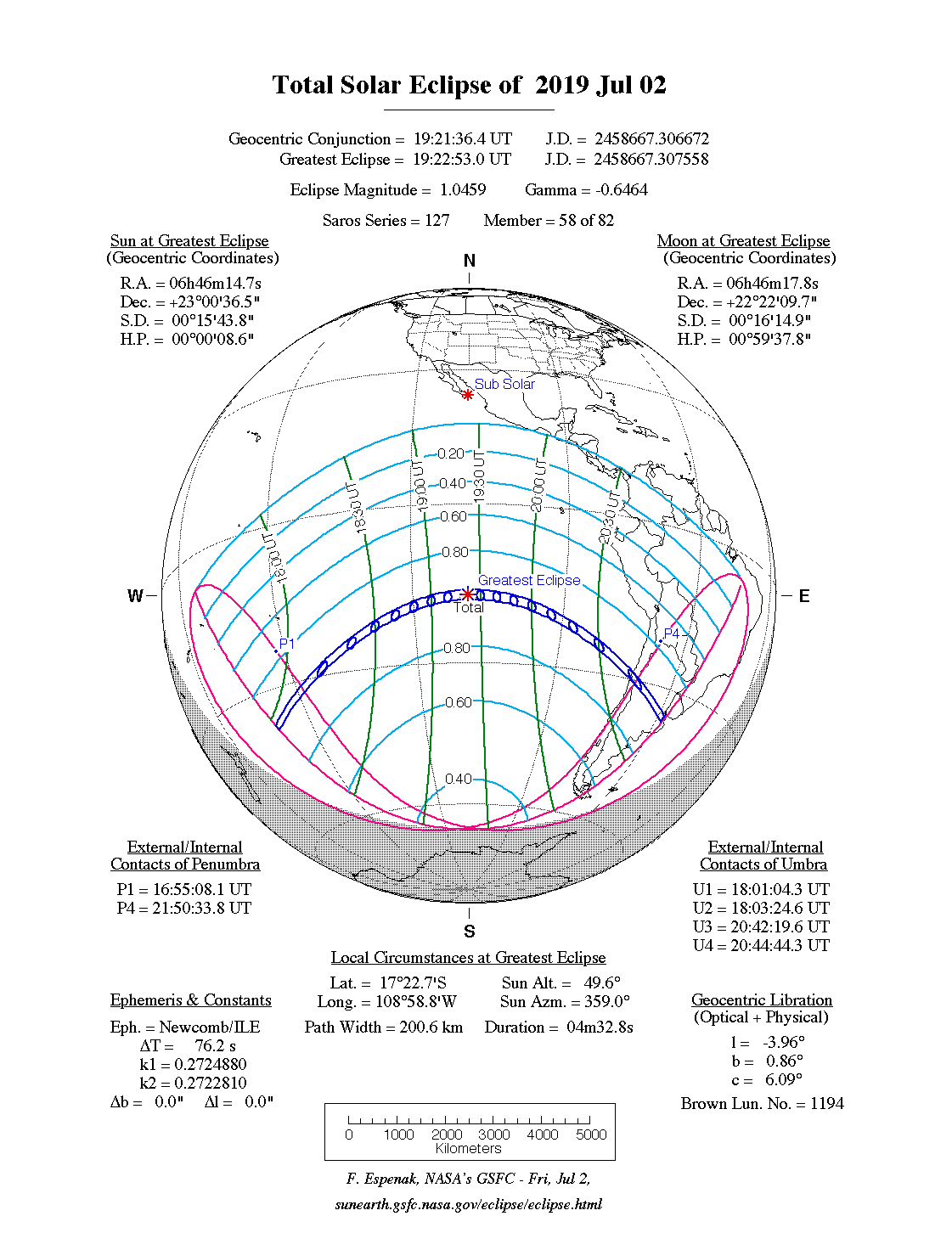
Shown below are two tables displaying details about this particular solar eclipse. The first table outlines times at which the Moon's penumbra or umbra attains the specific parameter, and the second table describes various other parameters pertaining to this eclipse.[10]
| Event | Time (UTC) |
|---|---|
| First Penumbral External Contact | 2019 July 2 at 16:56:22.9 UTC |
| First Umbral External Contact | 2019 July 2 at 18:02:19.5 UTC |
| First Central Line | 2019 July 2 at 18:03:29.5 UTC |
| First Umbral Internal Contact | 2019 July 2 at 18:04:39.8 UTC |
| Ecliptic Conjunction | 2019 July 2 at 19:17:21.9 UTC |
| Equatorial Conjunction | 2019 July 2 at 19:22:51.0 UTC |
| Greatest Eclipse | 2019 July 2 at 19:24:07.5 UTC |
| Greatest Duration | 2019 July 2 at 19:25:18.8 UTC |
| Last Umbral Internal Contact | 2019 July 2 at 20:43:33.5 UTC |
| Last Central Line | 2019 July 2 at 20:44:46.0 UTC |
| Last Umbral External Contact | 2019 July 2 at 20:45:58.2 UTC |
| Last Penumbral External Contact | 2019 July 2 at 21:51:48.1 UTC |
| Parameter | Value |
|---|---|
| Eclipse Magnitude | 1.04593 |
| Eclipse Obscuration | 1.09398 |
| Gamma | −0.64656 |
| Sun Right Ascension | 06h46m14.8s |
| Sun Declination | +23°00'36.4" |
| Sun Semi-Diameter | 15'43.8" |
| Sun Equatorial Horizontal Parallax | 08.6" |
| Moon Right Ascension | 06h46m17.9s |
| Moon Declination | +22°22'09.2" |
| Moon Semi-Diameter | 16'14.9" |
| Moon Equatorial Horizontal Parallax | 0°59'37.8" |
| ΔT | 69.6 s |
Eclipse season
This eclipse is part of an eclipse season, a period, roughly every six months, when eclipses occur. Only two (or occasionally three) eclipse seasons occur each year, and each season lasts about 35 days and repeats just short of six months (173 days) later; thus two full eclipse seasons always occur each year. Either two or three eclipses happen each eclipse season. In the sequence below, each eclipse is separated by a fortnight.
| July 2Ascending node (new moon) | July 16Descending node (full moon) |
|---|---|
|  |
| Total solar eclipseSolar Saros 127 | Partial lunar eclipseLunar Saros 139 |
Related eclipses
Eclipses in 2019
- A partial solar eclipse on January 6.
- A total lunar eclipse on January 21.
- A total solar eclipse on July 2.
- A partial lunar eclipse on July 16.
- An annular solar eclipse on December 26.
Metonic
- Preceded by: Solar eclipse of September 13, 2015
- Followed by: Solar eclipse of April 20, 2023
Tzolkinex
- Preceded by: Solar eclipse of May 20, 2012
- Followed by: Solar eclipse of August 12, 2026
Half-Saros
- Preceded by: Lunar eclipse of June 26, 2010
- Followed by: Lunar eclipse of July 6, 2028
Tritos
- Preceded by: Solar eclipse of August 1, 2008
- Followed by: Solar eclipse of June 1, 2030
Solar Saros 127
- Preceded by: Solar eclipse of June 21, 2001
- Followed by: Solar eclipse of July 13, 2037
Inex
- Preceded by: Solar eclipse of July 22, 1990
- Followed by: Solar eclipse of June 11, 2048
Triad
- Preceded by: Solar eclipse of August 31, 1932
- Followed by: Solar eclipse of May 3, 2106
Solar eclipses of 2018–2021
This eclipse is a member of a semester series. An eclipse in a semester series of solar eclipses repeats approximately every 177 days and 4 hours (a semester) at alternating nodes of the Moon's orbit.[11]
The partial solar eclipses on February 15, 2018 and August 11, 2018 occur in the previous lunar year eclipse set.
| Solar eclipse series sets from 2018 to 2021 | ||||||
|---|---|---|---|---|---|---|
| Ascending node | Descending node | |||||
| Saros | Map | Gamma | Saros | Map | Gamma | |
117.jpg/1280px-Eclipse_(41629136430).jpg) Partial in Melbourne, Australia Partial in Melbourne, Australia | July 13, 2018 Partial Partial | −1.35423 | 122 Partial in Nakhodka, Russia Partial in Nakhodka, Russia | January 6, 2019 Partial Partial | 1.14174 | |
| 127Totality in La Serena, Chile | July 2, 2019Total | −0.64656 | 132 .jpg/1280px-Annular_Solar_Eclipse_in_Jaffna_-_26_December_2019_(1).jpg) Annularity in Jaffna, Sri Lanka Annularity in Jaffna, Sri Lanka | December 26, 2019 Annular Annular | 0.41351 | |
137 Annularity in Beigang, Yunlin, Taiwan Annularity in Beigang, Yunlin, Taiwan | June 21, 2020 Annular Annular | 0.12090 | 142 Totality in Gorbea, Chile Totality in Gorbea, Chile | December 14, 2020 Total Total | −0.29394 | |
147_(cropped).jpg/1280px-Partial_Solar_Eclipse,_10_June_2021_(51237879346)_(cropped).jpg) Partial in Halifax, Canada Partial in Halifax, Canada | June 10, 2021 Annular Annular | 0.91516 | 152.jpg/1280px-Royal_Navy_sailors_observed_2021_partial_solar_eclipse_off_South_Georgia_(cropped).jpg) From HMS Protector off South Georgia From HMS Protector off South Georgia | December 4, 2021 Total Total | −0.95261 | |
.jpg)

.jpg)


_(cropped).jpg)
.jpg)
Saros 127
This eclipse is a part of Saros series 127, repeating every 18 years, 11 days, and containing 82 events. The series started with a partial solar eclipse on October 10, 991 AD. It contains total eclipses from May 14, 1352 through August 15, 2091. There are no annular or hybrid eclipses in this set. The series ends at member 82 as a partial eclipse on March 21, 2452. Its eclipses are tabulated in three columns; every third eclipse in the same column is one exeligmos apart, so they all cast shadows over approximately the same parts of the Earth.
The longest duration of totality was produced by member 31 at 5 minutes, 40 seconds on August 30, 1532. All eclipses in this series occur at the Moon’s ascending node of orbit.[12]
| Series members 46–68 occur between 1801 and 2200: | ||
|---|---|---|
| 46 | 47 | 48 |
 February 21, 1803 February 21, 1803 |  March 4, 1821 March 4, 1821 |  March 15, 1839 March 15, 1839 |
| 49 | 50 | 51 |
 March 25, 1857 March 25, 1857 |  April 6, 1875 April 6, 1875 |  April 16, 1893 April 16, 1893 |
| 52 | 53 | 54 |
 April 28, 1911 April 28, 1911 |  May 9, 1929 May 9, 1929 |  May 20, 1947 May 20, 1947 |
| 55 | 56 | 57 |
 May 30, 1965 May 30, 1965 |  June 11, 1983 June 11, 1983 |  June 21, 2001 June 21, 2001 |
| 58 | 59 | 60 |
| July 2, 2019 |  July 13, 2037 July 13, 2037 |  July 24, 2055 July 24, 2055 |
| 61 | 62 | 63 |
 August 3, 2073 August 3, 2073 |  August 15, 2091 August 15, 2091 |  August 26, 2109 August 26, 2109 |
| 64 | 65 | 66 |
 September 6, 2127 September 6, 2127 |  September 16, 2145 September 16, 2145 |  September 28, 2163 September 28, 2163 |
| 67 | 68 | |
 October 8, 2181 October 8, 2181 |  October 19, 2199 October 19, 2199 | |


Metonic series
The metonic series repeats eclipses every 19 years (6939.69 days), lasting about 5 cycles. Eclipses occur in nearly the same calendar date. In addition, the octon subseries repeats 1/5 of that or every 3.8 years (1387.94 days). All eclipses in this table occur at the Moon's ascending node.
| 21 eclipse events between July 1, 2000 and July 1, 2076 | ||||
|---|---|---|---|---|
| July 1–2 | April 19–20 | February 5–7 | November 24–25 | September 12–13 |
| 117 | 119 | 121 | 123 | 125 |
 July 1, 2000 July 1, 2000 |  April 19, 2004 April 19, 2004 |  February 7, 2008 February 7, 2008 |  November 25, 2011 November 25, 2011 |  September 13, 2015 September 13, 2015 |
| 127 | 129 | 131 | 133 | 135 |
| July 2, 2019 |  April 20, 2023 April 20, 2023 |  February 6, 2027 February 6, 2027 |  November 25, 2030 November 25, 2030 |  September 12, 2034 September 12, 2034 |
| 137 | 139 | 141 | 143 | 145 |
 July 2, 2038 July 2, 2038 |  April 20, 2042 April 20, 2042 |  February 5, 2046 February 5, 2046 |  November 25, 2049 November 25, 2049 |  September 12, 2053 September 12, 2053 |
| 147 | 149 | 151 | 153 | 155 |
 July 1, 2057 July 1, 2057 |  April 20, 2061 April 20, 2061 |  February 5, 2065 February 5, 2065 |  November 24, 2068 November 24, 2068 |  September 12, 2072 September 12, 2072 |
| 157 | ||||
 July 1, 2076 July 1, 2076 | ||||
Tritos series
This eclipse is a part of a tritos cycle, repeating at alternating nodes every 135 synodic months (≈ 3986.63 days, or 11 years minus 1 month). Their appearance and longitude are irregular due to a lack of synchronization with the anomalistic month (period of perigee), but groupings of 3 tritos cycles (≈ 33 years minus 3 months) come close (≈ 434.044 anomalistic months), so eclipses are similar in these groupings.
| Series members between 1801 and 2200 | ||||
|---|---|---|---|---|
 March 14, 1801(Saros 107) March 14, 1801(Saros 107) |  February 12, 1812(Saros 108) February 12, 1812(Saros 108) |  January 12, 1823(Saros 109) January 12, 1823(Saros 109) |  November 10, 1844(Saros 111) November 10, 1844(Saros 111) | |
 August 9, 1877(Saros 114) August 9, 1877(Saros 114) |  July 9, 1888(Saros 115) July 9, 1888(Saros 115) |  June 8, 1899(Saros 116) June 8, 1899(Saros 116) | ||
 May 9, 1910(Saros 117) May 9, 1910(Saros 117) |  April 8, 1921(Saros 118) April 8, 1921(Saros 118) |  March 7, 1932(Saros 119) March 7, 1932(Saros 119) |  February 4, 1943(Saros 120) February 4, 1943(Saros 120) |  January 5, 1954(Saros 121) January 5, 1954(Saros 121) |
 December 4, 1964(Saros 122) December 4, 1964(Saros 122) |  November 3, 1975(Saros 123) November 3, 1975(Saros 123) |  October 3, 1986(Saros 124) October 3, 1986(Saros 124) |  September 2, 1997(Saros 125) September 2, 1997(Saros 125) |  August 1, 2008(Saros 126) August 1, 2008(Saros 126) |
| July 2, 2019(Saros 127) |  June 1, 2030(Saros 128) June 1, 2030(Saros 128) |  April 30, 2041(Saros 129) April 30, 2041(Saros 129) |  March 30, 2052(Saros 130) March 30, 2052(Saros 130) |  February 28, 2063(Saros 131) February 28, 2063(Saros 131) |
 January 27, 2074(Saros 132) January 27, 2074(Saros 132) |  December 27, 2084(Saros 133) December 27, 2084(Saros 133) |  November 27, 2095(Saros 134) November 27, 2095(Saros 134) |  October 26, 2106(Saros 135) October 26, 2106(Saros 135) |  September 26, 2117(Saros 136) September 26, 2117(Saros 136) |
 August 25, 2128(Saros 137) August 25, 2128(Saros 137) |  July 25, 2139(Saros 138) July 25, 2139(Saros 138) |  June 25, 2150(Saros 139) June 25, 2150(Saros 139) |  May 25, 2161(Saros 140) May 25, 2161(Saros 140) |  April 23, 2172(Saros 141) April 23, 2172(Saros 141) |
 March 23, 2183(Saros 142) March 23, 2183(Saros 142) |  February 21, 2194(Saros 143) February 21, 2194(Saros 143) | |||
Inex series
This eclipse is a part of the long period inex cycle, repeating at alternating nodes, every 358 synodic months (≈ 10,571.95 days, or 29 years minus 20 days). Their appearance and longitude are irregular due to a lack of synchronization with the anomalistic month (period of perigee). However, groupings of 3 inex cycles (≈ 87 years minus 2 months) comes close (≈ 1,151.02 anomalistic months), so eclipses are similar in these groupings.
| Series members between 1801 and 2200 | ||
|---|---|---|
 November 19, 1816(Saros 120) November 19, 1816(Saros 120) |  October 30, 1845(Saros 121) October 30, 1845(Saros 121) |  October 10, 1874(Saros 122) October 10, 1874(Saros 122) |
 September 21, 1903(Saros 123) September 21, 1903(Saros 123) |  August 31, 1932(Saros 124) August 31, 1932(Saros 124) |  August 11, 1961(Saros 125) August 11, 1961(Saros 125) |
 July 22, 1990(Saros 126) July 22, 1990(Saros 126) | July 2, 2019(Saros 127) |  June 11, 2048(Saros 128) June 11, 2048(Saros 128) |
 May 22, 2077(Saros 129) May 22, 2077(Saros 129) |  May 3, 2106(Saros 130) May 3, 2106(Saros 130) |  April 13, 2135(Saros 131) April 13, 2135(Saros 131) |
 March 23, 2164(Saros 132) March 23, 2164(Saros 132) |  March 3, 2193(Saros 133) March 3, 2193(Saros 133) | |
Notes
References
- ^ abc"July 2, 2019 Total Solar Eclipse". timeanddate. Retrieved 12 August 2024.
- ^"Chileans, Argentines see total solar eclipse". Albany Democrat-Herald. 2019-07-03. p. B7. Retrieved 2023-10-27 – via Newspapers.com.
- ^McFall-Johnsen, Morgan. "A NASA satellite caught yesterday's solar eclipse and a Category 4 hurricane at the same time — here's the video". Business Insider.
- ^Waters, Michael. "Photos Capture the Great South American Eclipse". Smithsonian Magazine.
- ^Strickland, Ashley; Picheta, Rob (July 2, 2019). "Stunning photos of the solar eclipse over South America". CNN.
- ^"Moon Distances for London, United Kingdom, England". timeanddate. Retrieved 12 August 2024.
- ^Cooper, Gael (2017-08-22). "Wait! Dig those eclipse glasses out of the garbage Here comes the sun. Astronomers Without Borders will be collecting the protective eyewear for use in future eclipses worldwide". Retrieved 2017-08-27.
- ^ ab"Total solar eclipse: thousands in Chile and Argentina marvel at 'something supreme'". The Guardian. 2019-07-02. ISSN 0261-3077. Retrieved 2019-07-02.
- ^ abcd"Total solar eclipse hits South America". BBC News. 2019-07-02. Retrieved 2019-07-02.
- ^"Total Solar Eclipse of 2019 Jul 02". EclipseWise.com. Retrieved 12 August 2024.
- ^van Gent, R.H. "Solar- and Lunar-Eclipse Predictions from Antiquity to the Present". A Catalogue of Eclipse Cycles. Utrecht University. Retrieved 6 October 2018.
- ^"NASA - Catalog of Solar Eclipses of Saros 127". eclipse.gsfc.nasa.gov.
Additional sources
- Earth visibility chart and eclipse statistics Eclipse Predictions by Fred Espenak, NASA/GSFC
External links

- solar-eclipse.de: The total solar eclipse of 07/02/2019
- eclipseportal.com: Total Solar Eclipse July, 02, 2019
- JulyEclipse.com has free educational materials aimed at teaching children about the July 2019 Solar Eclipse. They are available in English, Spanish, and Portuguese.
