Spherium
 | This article includes a list of general references, but it lacks sufficient corresponding inline citations.(April 2021) |
The "spherium" model consists of two electrons trapped on the surface of a sphere of radius . It has been used by Berry and collaborators [1] to understand both weakly and strongly correlated systems and to suggest an "alternating" version of Hund's rule. Seidl studies this system in the context of density functional theory (DFT) to develop new correlation functionals within the adiabatic connection.[2]

Definition and solution
The electronic Hamiltonian in atomic units is
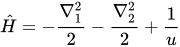
where is the interelectronic distance. For the singlet S states, it can be then shown[3] that the wave function satisfies the Schrödinger equation



By introducing the dimensionless variable , this becomes a Heun equation with singular points at . Based on the known solutions of the Heun equation, we seek wave functions of the form


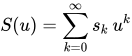
and substitution into the previous equation yields the recurrence relation
![{\displaystyle s_{k+2}={\frac {s_{k+1}+\left[k(k+2){\frac {1}{4R^{2}}}-E\right]s_{k}}{(k+2)^{2}}}}](https://wikimedia.org/api/rest_v1/media/math/render/svg/28d74b6be41f54e2b4dce1a59ddb37c31e2df891)
with the starting values . Thus, the Kato cusp condition is

- .

The wave function reduces to the polynomial
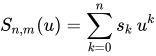
(where the number of roots between and ) if, and only if, . Thus, the energy is a root of the polynomial equation (where ) and the corresponding radius is found from the previous equation which yields








is the exact wave function of the -th excited state of singlet S symmetry for the radius .

We know from the work of Loos and Gill [3] that the HF energy of the lowest singlet S state is . It follows that the exact correlation energy for is which is much larger than the limiting correlation energies of the helium-like ions () or Hooke's atoms (). This confirms the view that electron correlation on the surface of a sphere is qualitatively different from that in three-dimensional physical space.





Spherium on a 3-sphere
LoosとGill [ 4 ]は、クーロン反発する3次元球に閉じ込められた2つの電子の場合を考察した。彼らは基底状態エネルギーを( )と報告している。

参照
参考文献
- ^エズラ, GS; ベリー, RS (1982)、「球面上の2粒子の相関」、Physical Review A、25 (3): 1513– 1527、Bibcode : 1982PhRvA..25.1513E、doi : 10.1103/PhysRevA.25.1513
- ^ Seidl, M. (2007)、「密度汎関数理論における断熱接続:球面上の2つの電子」、Physical Review A、75 (6) 062506、Bibcode:2007PhRvA..75a2506P、doi:10.1103/PhysRevA.75.062506
- ^ a b Loos, P.-F.; Gill, PMW (2009)、「球面上の2つの電子の基底状態」、Physical Review A、79 (6) 062517、arXiv : 1002.3398、Bibcode : 2009PhRvA..79f2517L、doi : 10.1103/PhysRevA.79.062517、S2CID 59364477
- ^ Loos, P.-F.; Gill, PMW (2010), 「球状体の励起状態」, Molecular Physics , 108 ( 19– 20): 2527– 2532, arXiv : 1004.3641 , Bibcode : 2010MolPh.108.2527L , doi : 10.1080/00268976.2010.508472 , S2CID 43949268
さらに読む
- Loos, P.-F.; Gill, PMW (2009)、「超球面上の2つの電子:準正確に解けるモデル」、Physical Review Letters、103 (12) 123008、arXiv : 1002.3400、Bibcode : 2009PhRvL.103l3008L、doi : 10.1103/physrevlett.103.123008、PMID 19792435、S2CID 11611242
