In algebra, a triple system (or ternar) is a vector space V over a field F together with a F-trilinear map

The most important examples are Lie triple systems and Jordan triple systems. They were introduced by Nathan Jacobson in 1949. In particular, any Lie algebra defines a Lie triple system and any Jordan algebra defines a Jordan triple system. They are important in the theories of symmetric spaces, particularly Hermitian symmetric spaces and their generalizations (symmetric R-spaces and their noncompact duals).
Lie triple systems
A triple system is said to be a Lie triple system if the trilinear map, denoted , satisfies the following identities:
![{\displaystyle [\cdot ,\cdot ,\cdot ]}](https://wikimedia.org/api/rest_v1/media/math/render/svg/d28fe776c6d24967c92205f772c4a8c1d3c0d743)
![{\displaystyle [u,v,w]=-[v,u,w]}](https://wikimedia.org/api/rest_v1/media/math/render/svg/0be58e98d8e2e64b3463f3c5586719872b76f1cb)
![{\displaystyle [u,v,w]+[w,u,v]+[v,w,u]=0}](https://wikimedia.org/api/rest_v1/media/math/render/svg/26c8017d3ac7945cba3cd00eabe8f666f1d5bbf1)
![{\displaystyle [u,v,[w,x,y]]=[[u,v,w],x,y]+[w,[u,v,x],y]+[w,x,[u,v,y]].}](https://wikimedia.org/api/rest_v1/media/math/render/svg/bc65657f2497c024f80b4001d478680521508abf)
The first two identities abstract the skew symmetry and Jacobi identity for the triple commutator, while the third identity means that the linear map Lu,v: V → V, defined by Lu,v(w) = [u, v, w], is a derivation of the triple product. The identity also shows that the space of linear operators = span {Lu,v : u, v ∈ V} is closed under commutator bracket, hence a Lie algebra.

It follows that
- V

is a -graded Lie algebra with of grade 0 and V of grade 1, and bracket

![{\displaystyle [(L,u),(M,v)]=([L,M]+L_{u,v},L(v)-M(u)).}](https://wikimedia.org/api/rest_v1/media/math/render/svg/8f89d2c413d17562056d2946fae97fb8a31a0407)
This is called the standard embedding of the Lie triple system V into a -graded Lie algebra. Conversely, given any -graded Lie algebra, the triple bracket [[u, v], w] makes the space of degree-1 elements into a Lie triple system.
However, these methods of converting a Lie triple system into a -graded Lie algebra and vice versa are not inverses: more precisely, they do not define an equivalence of categories. For example, if we start with any abelian -graded Lie algebra, the round trip process produces one where the grade-0 space is zero-dimensional, since we obtain = span {Lu,v : u, v ∈ V} = {0}.
Given any Lie triple system V, and letting V be the corresponding -graded Lie algebra, this decomposition of obeys the algebraic definition of a symmetric space, so if G is any connected Lie group with Lie algebra and H is a subgroup with Lie algebra , then G/H is a symmetric space. Conversely, the tangent space of any point in any symmetric space is naturally a Lie triple system.


We can also obtain Lie triple systems from associative algebras. Given an associative algebra A and defining the commutator by , any subspace of A closed under the operation
![{\displaystyle [a,b]=ab-ba}](https://wikimedia.org/api/rest_v1/media/math/render/svg/23bf78c808a8f58515d59d520bdfac43cf80114f)
![{\displaystyle [a,b,c]=[[a,b],c]}](https://wikimedia.org/api/rest_v1/media/math/render/svg/2a7c9be15914f0e4777c47714c19931de8598aee)
becomes a Lie triple system with this operation.
Jordan triple systems
A triple system V is said to be a Jordan triple system if the trilinear map, denoted , satisfies the following identities:



The second identity means that if Lu,v:V→V is defined by Lu,v(y) = {u, v, y} then
![{\displaystyle [L_{u,v},L_{w,x}]:=L_{u,v}\circ L_{w,x}-L_{w,x}\circ L_{u,v}=L_{w,\{u,v,x\}}-L_{\{v,u,w\},x}}](https://wikimedia.org/api/rest_v1/media/math/render/svg/75e8d5ef11a7cae6bca6179fcb18859e8f5af769)
so that the space of linear maps span {Lu,v:u,v ∈ V} is closed under commutator bracket, and hence is a Lie algebra .

A Jordan triple system is said to be positive definite (resp. nondegenerate) if the bilinear form on V defined by the trace of Lu,v is positive definite (resp. nondegenerate). In either case, there is an identification of V with its dual space, and a corresponding involution on . They induce an involution of
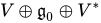
which in the positive definite case is a Cartan involution. The corresponding symmetric space is a symmetric R-space. It has a noncompact dual given by replacing the Cartan involution by its composite with the involution equal to +1 on and −1 on V and V*. A special case of this construction arises when preserves a complex structure on V. In this case we obtain dual Hermitian symmetric spaces of compact and noncompact type (the latter being bounded symmetric domains).
Any Jordan triple system is a Lie triple system with respect to the operation
![{\displaystyle [u,v,w]=\{u,v,w\}-\{v,u,w\}.}](https://wikimedia.org/api/rest_v1/media/math/render/svg/cf8be89d63d4decdb93b3998ae6d40333d6f71a2)
Jordan pairs
A Jordan pair is a generalization of a Jordan triple system involving two vector spaces V+ and V−. The trilinear map is then replaced by a pair of trilinear maps
- .


The other Jordan axiom (apart from symmetry) is likewise replaced by two axioms, one being

and the other being the analogue with + and − subscripts exchanged. The trilinear maps are often viewed as quadratic maps


As in the case of Jordan triple systems, one can define, for u in V− and v in V+, a linear map

and similarly L−. The Jordan axioms (apart from symmetry) may then be written
![{\displaystyle [L_{u,v}^{\pm },L_{w,x}^{\pm }]=L_{w,\{u,v,x\}_{\pm }}^{\pm }-L_{\{v,u,w\}_{\mp },x}^{\pm }}](https://wikimedia.org/api/rest_v1/media/math/render/svg/469730b0c18656e661938c48665de68b19dc4448)
which imply that the images of L+ and L− are closed under commutator brackets in End(V+) and End(V−). Together they determine a linear map

whose image is a Lie subalgebra , and the Jordan identities become Jacobi identities for a graded Lie bracket on

making this space into a -graded Lie algebra with only grades 1, 0, and -1 being nontrivial, often called a 3-graded Lie algebra. Conversely, given any 3-graded Lie algebra


then the pair is a Jordan pair, with brackets

![{\displaystyle \{X_{\mp },Y_{\pm },Z_{\pm }\}_{\pm }:=[[X_{\mp },Y_{\pm }],Z_{\pm }].}](https://wikimedia.org/api/rest_v1/media/math/render/svg/deb3e00ef22cd927a7fc89c0492d5de1341a4b8f)
Jordan triple systems are Jordan pairs with V+ = V− and equal trilinear maps. Another important case occurs when V+ and V− are dual to one another, with dual trilinear maps determined by an element of

These arise in particular when above is semisimple, when the Killing form provides a duality between and .


For a simple example of a Jordan pair, let be a finite-dimensional vector space and the dual of that vector space, with the quadratic maps


given by


where .

See also
References
- Bertram, Wolfgang (2000), The geometry of Jordan and Lie structures, Lecture Notes in Mathematics, vol. 1754, Springer, ISBN 978-3-540-41426-1
- Helgason, Sigurdur (2001) [1978], Differential geometry, Lie groups, and symmetric spaces, Graduate Studies in Mathematics, vol. 34, American Mathematical Society, ISBN 978-0-8218-2848-9
- Jacobson, Nathan (1949), "Lie and Jordan triple systems", American Journal of Mathematics, 71 (1): 149–170, doi:10.2307/2372102, JSTOR 2372102
- Kamiya, Noriaki (2001) [1994], "Lie triple system", Encyclopedia of Mathematics, EMS Press.
- Kamiya, Noriaki (2001) [1994], "Jordan triple system", Encyclopedia of Mathematics, EMS Press.
- Koecher, M. (1969), An elementary approach to bounded symmetric domains, Lecture Notes, Rice University
- Loos, Ottmar (1969), General Theory, Symmetric spaces, vol. 1, W. A. Benjamin, OCLC 681278693
- Loos, Ottmar (1969), Compact Spaces and Classification, Symmetric spaces, vol. 2, W. A. Benjamin
- Loos, Ottmar (1971), "Jordan triple systems, R-spaces, and bounded symmetric domains", Bulletin of the American Mathematical Society, 77 (4): 558–561, doi:10.1090/s0002-9904-1971-12753-2
- Loos, Ottmar (2006) [1975], Jordan pairs, Lecture Notes in Mathematics, vol. 460, Springer, ISBN 978-3-540-37499-2
- Loos, Ottmar (1977), Bounded symmetric domains and Jordan pairs (PDF), Mathematical lectures, University of California, Irvine, archived from the original (PDF) on 2016-03-03
- Meyberg, K. (1972), Lectures on algebras and triple systems (PDF), University of Virginia
- Rosenfeld, Boris (1997), Geometry of Lie groups, Mathematics and its Applications, vol. 393, Kluwer, p. 92, ISBN 978-0792343905, Zbl 0867.53002
- Tevelev, E. (2002), "Moore-Penrose inverse, parabolic subgroups, and Jordan pairs", Journal of Lie Theory, 12: 461–481, arXiv:math/0101107, Bibcode:2001math......1107T
