Landau kernel

The Landau kernel is named after the German number theorist Edmund Landau. The kernel is a summability kernel defined as:[1]

L n ( t ) = { ( 1 t 2 ) n c n if  1 t 1 0 otherwise {\displaystyle L_{n}(t)={\begin{cases}{\frac {(1-t^{2})^{n}}{c_{n}}}&{\text{if }}{-1}\leq t\leq 1\\0&{\text{otherwise}}\end{cases}}} where the coefficients c n {\displaystyle c_{n}} are defined as follows:

c n = 1 1 ( 1 t 2 ) n d t . {\displaystyle c_{n}=\int _{-1}^{1}(1-t^{2})^{n}\,dt.}

Visualisation

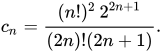
Using integration by parts, one can show that:[2] c n = ( n ! ) 2 2 2 n + 1 ( 2 n ) ! ( 2 n + 1 ) . {\displaystyle c_{n}={\frac {(n!)^{2}\,2^{2n+1}}{(2n)!(2n+1)}}.} Hence, this implies that the Landau kernel can be defined as follows: L n ( t ) = { ( 1 t 2 ) n ( 2 n ) ! ( 2 n + 1 ) ( n ! ) 2 2 2 n + 1 for  t [ 1 , 1 ] 0 elsewhere {\displaystyle L_{n}(t)={\begin{cases}(1-t^{2})^{n}{\frac {(2n)!(2n+1)}{(n!)^{2}\,2^{2n+1}}}&{\text{for }}t\in [-1,1]\\0&{\text{elsewhere}}\end{cases}}}

Plotting this function for different values of n reveals that as n goes to infinity, L n ( t ) {\displaystyle L_{n}(t)} approaches the Dirac delta function, as seen in the image,[1] where the following functions are plotted.

Properties

Some general properties of the Landau kernel is that it is nonnegative and continuous on R {\displaystyle \mathbb {R} } . These properties are made more concrete in the following section.

Dirac sequences

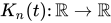
Definition: Dirac sequenceA Dirac sequence is a sequence { K n ( t ) } {\displaystyle \{K_{n}(t)\}} of functions K n ( t ) : R R {\displaystyle K_{n}(t)\colon \mathbb {R} \to \mathbb {R} } that satisfies the following properities:

  • K n ( t ) 0 , t R  and  n Z {\displaystyle K_{n}(t)\geq 0,\,\,\forall t\in \mathbb {R} {\text{ and }}\forall n\in \mathbb {Z} }
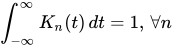
  • K n ( t ) d t = 1 , n {\displaystyle \int _{-\infty }^{\infty }K_{n}(t)\,dt=1,\,\forall n}
  • ε > 0 δ > 0 N Z + n N : {\displaystyle \forall \varepsilon >0\,\forall \delta >0\,\exists N\in \mathbb {Z} _{+}\,\forall n\geq N:}
    R [ δ , δ ] K n ( t ) d t = δ K n ( t ) d t + δ K n ( t ) d t < ε {\displaystyle {}\quad \int _{\mathbb {R} \smallsetminus [-\delta ,\delta ]}K_{n}(t)\,dt=\int _{-\infty }^{-\delta }K_{n}(t)\,dt+\int _{\delta }^{\infty }K_{n}(t)\,dt<\varepsilon }

The third bullet point means that the area under the graph of the function y = K n ( t ) {\displaystyle y=K_{n}(t)} becomes increasingly concentrated close to the origin as n approaches infinity. This definition lends us to the following theorem.

TheoremThe sequence of Landau kernels is a Dirac sequence

Proof: We prove the third property only. In order to do so, we introduce the following lemma:

LemmaThe coefficients satsify the following relationship, c n 2 n + 1 {\displaystyle c_{n}\geq {\frac {2}{n+1}}}

Proof of the Lemma:

Using the definition of the coefficients above, we find that the integrand is even, we may write c n 2 = 0 1 ( 1 t 2 ) n d t = 0 1 ( 1 t ) n ( 1 + t ) n d t 0 1 ( 1 t ) n d t = 1 1 + n {\displaystyle {\frac {c_{n}}{2}}=\int _{0}^{1}(1-t^{2})^{n}\,dt=\int _{0}^{1}(1-t)^{n}(1+t)^{n}\,dt\geq \int _{0}^{1}(1-t)^{n}\,dt={\frac {1}{1+n}}} completing the proof of the lemma. A corollary of this lemma is the following:

CorollaryFor all positive, real δ : {\displaystyle \delta :} R [ δ , δ ] K n ( t ) d t 2 c n δ 1 ( 1 t 2 ) n d t ( n + 1 ) ( 1 r 2 ) n {\displaystyle \int _{\mathbb {R} \smallsetminus [-\delta ,\delta ]}K_{n}(t)\,dt\leq {\frac {2}{c_{n}}}\int _{\delta }^{1}(1-t^{2})^{n}\,dt\leq (n+1)(1-r^{2})^{n}}

See also

References

  1. ^ a b Terras, Audrey (May 25, 2009). "Lecture 8. Dirac and Weierstrass" (PDF).
  2. ^ Hilber, Courant. Methods of Mathematical Physics, Vol. I. p. 84.
Retrieved from "https://en.wikipedia.org/w/index.php?title=Landau_kernel&oldid=1264899425"