Special mathematical function
In mathematics , the Lerch transcendent , is a special function that generalizes the Hurwitz zeta function and the polylogarithm . It is named after Czech mathematician Mathias Lerch , who published a paper about a similar function in 1887.[1] The Lerch transcendent, is given by:
Φ
(
z
,
s
,
α
)
=
∑
n
=
0
∞
z
n
(
n
+
α
)
s
{\displaystyle \Phi (z,s,\alpha )=\sum _{n=0}^{\infty }{\frac {z^{n}}{(n+\alpha )^{s}}}}
It only converges for any real number
α
>
0
{\displaystyle \alpha >0}
|
z
|
<
1
{\displaystyle |z|<1}
R
(
s
)
>
1
{\displaystyle {\mathfrak {R}}(s)>1}
|
z
|
=
1
{\displaystyle |z|=1}
Special cases
The Lerch transcendent is related to and generalizes various special functions.
The Lerch zeta function is given by:
L
(
λ
,
s
,
α
)
=
∑
n
=
0
∞
e
2
π
i
λ
n
(
n
+
α
)
s
=
Φ
(
e
2
π
i
λ
,
s
,
α
)
{\displaystyle L(\lambda ,s,\alpha )=\sum _{n=0}^{\infty }{\frac {e^{2\pi i\lambda n}}{(n+\alpha )^{s}}}=\Phi (e^{2\pi i\lambda },s,\alpha )}
The Hurwitz zeta function is the special case[3]
ζ
(
s
,
α
)
=
∑
n
=
0
∞
1
(
n
+
α
)
s
=
Φ
(
1
,
s
,
α
)
{\displaystyle \zeta (s,\alpha )=\sum _{n=0}^{\infty }{\frac {1}{(n+\alpha )^{s}}}=\Phi (1,s,\alpha )}
The polylogarithm is another special case:[3]
Li
s
(
z
)
=
∑
n
=
1
∞
z
n
n
s
=
z
Φ
(
z
,
s
,
1
)
{\displaystyle {\textrm {Li}}_{s}(z)=\sum _{n=1}^{\infty }{\frac {z^{n}}{n^{s}}}=z\Phi (z,s,1)}
The Riemann zeta function is a special case of both of the above:[3]
ζ
(
s
)
=
∑
n
=
1
∞
1
n
s
=
Φ
(
1
,
s
,
1
)
{\displaystyle \zeta (s)=\sum _{n=1}^{\infty }{\frac {1}{n^{s}}}=\Phi (1,s,1)}
The Dirichlet eta function :[3]
η
(
s
)
=
∑
n
=
1
∞
(
−
1
)
n
−
1
n
s
=
Φ
(
−
1
,
s
,
1
)
{\displaystyle \eta (s)=\sum _{n=1}^{\infty }{\frac {(-1)^{n-1}}{n^{s}}}=\Phi (-1,s,1)}
The Dirichlet beta function :[3]
β
(
s
)
=
∑
k
=
0
∞
(
−
1
)
k
(
2
k
+
1
)
s
=
2
−
s
Φ
(
−
1
,
s
,
1
2
)
{\displaystyle \beta (s)=\sum _{k=0}^{\infty }{\frac {(-1)^{k}}{(2k+1)^{s}}}=2^{-s}\Phi (-1,s,{\tfrac {1}{2}})}
The Legendre chi function :[3]
χ
s
(
z
)
=
∑
k
=
0
∞
z
2
k
+
1
(
2
k
+
1
)
s
=
z
2
s
Φ
(
z
2
,
s
,
1
2
)
{\displaystyle \chi _{s}(z)=\sum _{k=0}^{\infty }{\frac {z^{2k+1}}{(2k+1)^{s}}}={\frac {z}{2^{s}}}\Phi (z^{2},s,{\tfrac {1}{2}})}
The inverse tangent integral :[4]
Ti
s
(
z
)
=
∑
k
=
0
∞
(
−
1
)
k
z
2
k
+
1
(
2
k
+
1
)
s
=
z
2
s
Φ
(
−
z
2
,
s
,
1
2
)
{\displaystyle {\textrm {Ti}}_{s}(z)=\sum _{k=0}^{\infty }{\frac {(-1)^{k}z^{2k+1}}{(2k+1)^{s}}}={\frac {z}{2^{s}}}\Phi (-z^{2},s,{\tfrac {1}{2}})}
The polygamma functions for positive integers n :[5] [6]
ψ
(
n
)
(
α
)
=
(
−
1
)
n
+
1
n
!
Φ
(
1
,
n
+
1
,
α
)
{\displaystyle \psi ^{(n)}(\alpha )=(-1)^{n+1}n!\Phi (1,n+1,\alpha )}
The Clausen function :[7]
Cl
2
(
z
)
=
i
e
−
i
z
2
Φ
(
e
−
i
z
,
2
,
1
)
−
i
e
i
z
2
Φ
(
e
i
z
,
2
,
1
)
{\displaystyle {\text{Cl}}_{2}(z)={\frac {ie^{-iz}}{2}}\Phi (e^{-iz},2,1)-{\frac {ie^{iz}}{2}}\Phi (e^{iz},2,1)}
Integral representations
The Lerch transcendent has an integral representation:
Φ
(
z
,
s
,
a
)
=
1
Γ
(
s
)
∫
0
∞
t
s
−
1
e
−
a
t
1
−
z
e
−
t
d
t
{\displaystyle \Phi (z,s,a)={\frac {1}{\Gamma (s)}}\int _{0}^{\infty }{\frac {t^{s-1}e^{-at}}{1-ze^{-t}}}\,dt}
The proof is based on using the integral definition of the gamma function to write
Φ
(
z
,
s
,
a
)
Γ
(
s
)
=
∑
n
=
0
∞
z
n
(
n
+
a
)
s
∫
0
∞
x
s
e
−
x
d
x
x
=
∑
n
=
0
∞
∫
0
∞
t
s
z
n
e
−
(
n
+
a
)
t
d
t
t
{\displaystyle \Phi (z,s,a)\Gamma (s)=\sum _{n=0}^{\infty }{\frac {z^{n}}{(n+a)^{s}}}\int _{0}^{\infty }x^{s}e^{-x}{\frac {dx}{x}}=\sum _{n=0}^{\infty }\int _{0}^{\infty }t^{s}z^{n}e^{-(n+a)t}{\frac {dt}{t}}}
and then interchanging the sum and integral. The resulting integral representation converges for
z
∈
C
∖
[
1
,
∞
)
,
{\displaystyle z\in \mathbb {C} \setminus [1,\infty ),}
s ) > 0, and Re(a ) > 0. This analytically continues
Φ
(
z
,
s
,
a
)
{\displaystyle \Phi (z,s,a)}
z outside the unit disk . The integral formula also holds if z = 1, Re(s ) > 1, and Re(a ) > 0; see Hurwitz zeta function .[8] [9]
A contour integral representation is given by
Φ
(
z
,
s
,
a
)
=
−
Γ
(
1
−
s
)
2
π
i
∫
C
(
−
t
)
s
−
1
e
−
a
t
1
−
z
e
−
t
d
t
{\displaystyle \Phi (z,s,a)=-{\frac {\Gamma (1-s)}{2\pi i}}\int _{C}{\frac {(-t)^{s-1}e^{-at}}{1-ze^{-t}}}\,dt}
where C is a Hankel contour counterclockwise around the positive real axis, not enclosing any of the points
t
=
log
(
z
)
+
2
k
π
i
{\displaystyle t=\log(z)+2k\pi i}
k ) which are poles of the integrand. The integral assumes Re(a ) > 0.[10]
Other integral representations
A Hermite-like integral representation is given by
Φ
(
z
,
s
,
a
)
=
1
2
a
s
+
∫
0
∞
z
t
(
a
+
t
)
s
d
t
+
2
a
s
−
1
∫
0
∞
sin
(
s
arctan
(
t
)
−
t
a
log
(
z
)
)
(
1
+
t
2
)
s
/
2
(
e
2
π
a
t
−
1
)
d
t
{\displaystyle \Phi (z,s,a)={\frac {1}{2a^{s}}}+\int _{0}^{\infty }{\frac {z^{t}}{(a+t)^{s}}}\,dt+{\frac {2}{a^{s-1}}}\int _{0}^{\infty }{\frac {\sin(s\arctan(t)-ta\log(z))}{(1+t^{2})^{s/2}(e^{2\pi at}-1)}}\,dt}
for
ℜ
(
a
)
>
0
∧
|
z
|
<
1
{\displaystyle \Re (a)>0\wedge |z|<1}
and
Φ
(
z
,
s
,
a
)
=
1
2
a
s
+
log
s
−
1
(
1
/
z
)
z
a
Γ
(
1
−
s
,
a
log
(
1
/
z
)
)
+
2
a
s
−
1
∫
0
∞
sin
(
s
arctan
(
t
)
−
t
a
log
(
z
)
)
(
1
+
t
2
)
s
/
2
(
e
2
π
a
t
−
1
)
d
t
{\displaystyle \Phi (z,s,a)={\frac {1}{2a^{s}}}+{\frac {\log ^{s-1}(1/z)}{z^{a}}}\Gamma (1-s,a\log(1/z))+{\frac {2}{a^{s-1}}}\int _{0}^{\infty }{\frac {\sin(s\arctan(t)-ta\log(z))}{(1+t^{2})^{s/2}(e^{2\pi at}-1)}}\,dt}
for
ℜ
(
a
)
>
0.
{\displaystyle \Re (a)>0.}
Similar representations include
Φ
(
z
,
s
,
a
)
=
1
2
a
s
+
∫
0
∞
cos
(
t
log
z
)
sin
(
s
arctan
t
a
)
−
sin
(
t
log
z
)
cos
(
s
arctan
t
a
)
(
a
2
+
t
2
)
s
2
tanh
π
t
d
t
,
{\displaystyle \Phi (z,s,a)={\frac {1}{2a^{s}}}+\int _{0}^{\infty }{\frac {\cos(t\log z)\sin {\Big (}s\arctan {\tfrac {t}{a}}{\Big )}-\sin(t\log z)\cos {\Big (}s\arctan {\tfrac {t}{a}}{\Big )}}{{\big (}a^{2}+t^{2}{\big )}^{\frac {s}{2}}\tanh \pi t}}\,dt,}
and
Φ
(
−
z
,
s
,
a
)
=
1
2
a
s
+
∫
0
∞
cos
(
t
log
z
)
sin
(
s
arctan
t
a
)
−
sin
(
t
log
z
)
cos
(
s
arctan
t
a
)
(
a
2
+
t
2
)
s
2
sinh
π
t
d
t
,
{\displaystyle \Phi (-z,s,a)={\frac {1}{2a^{s}}}+\int _{0}^{\infty }{\frac {\cos(t\log z)\sin {\Big (}s\arctan {\tfrac {t}{a}}{\Big )}-\sin(t\log z)\cos {\Big (}s\arctan {\tfrac {t}{a}}{\Big )}}{{\big (}a^{2}+t^{2}{\big )}^{\frac {s}{2}}\sinh \pi t}}\,dt,}
holding for positive z (and more generally wherever the integrals converge). Furthermore,
Φ
(
e
i
φ
,
s
,
a
)
=
L
(
φ
2
π
,
s
,
a
)
=
1
a
s
+
1
2
Γ
(
s
)
∫
0
∞
t
s
−
1
e
−
a
t
(
e
i
φ
−
e
−
t
)
cosh
t
−
cos
φ
d
t
,
{\displaystyle \Phi (e^{i\varphi },s,a)=L{\big (}{\tfrac {\varphi }{2\pi }},s,a{\big )}={\frac {1}{a^{s}}}+{\frac {1}{2\Gamma (s)}}\int _{0}^{\infty }{\frac {t^{s-1}e^{-at}{\big (}e^{i\varphi }-e^{-t}{\big )}}{\cosh {t}-\cos {\varphi }}}\,dt,}
The last formula is also known as Lipschitz formula .
Identities
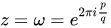
For λ rational, the summand is a root of unity , and thus
L
(
λ
,
s
,
α
)
{\displaystyle L(\lambda ,s,\alpha )}
λ
=
p
q
{\textstyle \lambda ={\frac {p}{q}}}
p
,
q
∈
Z
{\displaystyle p,q\in \mathbb {Z} }
q
>
0
{\displaystyle q>0}
z
=
ω
=
e
2
π
i
p
q
{\displaystyle z=\omega =e^{2\pi i{\frac {p}{q}}}}
ω
q
=
1
{\displaystyle \omega ^{q}=1}
Φ
(
ω
,
s
,
α
)
=
∑
n
=
0
∞
ω
n
(
n
+
α
)
s
=
∑
m
=
0
q
−
1
∑
n
=
0
∞
ω
q
n
+
m
(
q
n
+
m
+
α
)
s
=
∑
m
=
0
q
−
1
ω
m
q
−
s
ζ
(
s
,
m
+
α
q
)
{\displaystyle \Phi (\omega ,s,\alpha )=\sum _{n=0}^{\infty }{\frac {\omega ^{n}}{(n+\alpha )^{s}}}=\sum _{m=0}^{q-1}\sum _{n=0}^{\infty }{\frac {\omega ^{qn+m}}{(qn+m+\alpha )^{s}}}=\sum _{m=0}^{q-1}\omega ^{m}q^{-s}\zeta \left(s,{\frac {m+\alpha }{q}}\right)}
Various identities include:
Φ
(
z
,
s
,
a
)
=
z
n
Φ
(
z
,
s
,
a
+
n
)
+
∑
k
=
0
n
−
1
z
k
(
k
+
a
)
s
{\displaystyle \Phi (z,s,a)=z^{n}\Phi (z,s,a+n)+\sum _{k=0}^{n-1}{\frac {z^{k}}{(k+a)^{s}}}}
and
Φ
(
z
,
s
−
1
,
a
)
=
(
a
+
z
∂
∂
z
)
Φ
(
z
,
s
,
a
)
{\displaystyle \Phi (z,s-1,a)=\left(a+z{\frac {\partial }{\partial z}}\right)\Phi (z,s,a)}
and
Φ
(
z
,
s
+
1
,
a
)
=
−
1
s
∂
∂
a
Φ
(
z
,
s
,
a
)
.
{\displaystyle \Phi (z,s+1,a)=-{\frac {1}{s}}{\frac {\partial }{\partial a}}\Phi (z,s,a).}
Series representations
A series representation for the Lerch transcendent is given by
Φ
(
z
,
s
,
q
)
=
1
1
−
z
∑
n
=
0
∞
(
−
z
1
−
z
)
n
∑
k
=
0
n
(
−
1
)
k
(
n
k
)
(
q
+
k
)
−
s
.
{\displaystyle \Phi (z,s,q)={\frac {1}{1-z}}\sum _{n=0}^{\infty }\left({\frac {-z}{1-z}}\right)^{n}\sum _{k=0}^{n}(-1)^{k}{\binom {n}{k}}(q+k)^{-s}.}
(Note that
(
n
k
)
{\displaystyle {\tbinom {n}{k}}}
binomial coefficient .)
The series is valid for all s , and for complex z with Re(z )<1/2. Note a general resemblance to a similar series representation for the Hurwitz zeta function.[11]
A Taylor series in the first parameter was given by Arthur Erdélyi . It may be written as the following series, which is valid for[12]
|
log
(
z
)
|
<
2
π
;
s
≠
1
,
2
,
3
,
…
;
a
≠
0
,
−
1
,
−
2
,
…
{\displaystyle \left|\log(z)\right|<2\pi ;s\neq 1,2,3,\dots ;a\neq 0,-1,-2,\dots }
Φ
(
z
,
s
,
a
)
=
z
−
a
[
Γ
(
1
−
s
)
(
−
log
(
z
)
)
s
−
1
+
∑
k
=
0
∞
ζ
(
s
−
k
,
a
)
log
k
(
z
)
k
!
]
{\displaystyle \Phi (z,s,a)=z^{-a}\left[\Gamma (1-s)\left(-\log(z)\right)^{s-1}+\sum _{k=0}^{\infty }\zeta (s-k,a){\frac {\log ^{k}(z)}{k!}}\right]}
If n is a positive integer, then
Φ
(
z
,
n
,
a
)
=
z
−
a
{
∑
k
=
0
k
≠
n
−
1
∞
ζ
(
n
−
k
,
a
)
log
k
(
z
)
k
!
+
[
ψ
(
n
)
−
ψ
(
a
)
−
log
(
−
log
(
z
)
)
]
log
n
−
1
(
z
)
(
n
−
1
)
!
}
,
{\displaystyle \Phi (z,n,a)=z^{-a}\left\{\sum _{{k=0} \atop k\neq n-1}^{\infty }\zeta (n-k,a){\frac {\log ^{k}(z)}{k!}}+\left[\psi (n)-\psi (a)-\log(-\log(z))\right]{\frac {\log ^{n-1}(z)}{(n-1)!}}\right\},}
where
ψ
(
n
)
{\displaystyle \psi (n)}
digamma function .
A Taylor series in the third variable is given by
Φ
(
z
,
s
,
a
+
x
)
=
∑
k
=
0
∞
Φ
(
z
,
s
+
k
,
a
)
(
s
)
k
(
−
x
)
k
k
!
;
|
x
|
<
ℜ
(
a
)
,
{\displaystyle \Phi (z,s,a+x)=\sum _{k=0}^{\infty }\Phi (z,s+k,a)(s)_{k}{\frac {(-x)^{k}}{k!}};|x|<\Re (a),}
where
(
s
)
k
{\displaystyle (s)_{k}}
Pochhammer symbol .
Series at a = −n is given by
Φ
(
z
,
s
,
a
)
=
∑
k
=
0
n
z
k
(
a
+
k
)
s
+
z
n
∑
m
=
0
∞
(
1
−
m
−
s
)
m
Li
s
+
m
(
z
)
(
a
+
n
)
m
m
!
;
a
→
−
n
{\displaystyle \Phi (z,s,a)=\sum _{k=0}^{n}{\frac {z^{k}}{(a+k)^{s}}}+z^{n}\sum _{m=0}^{\infty }(1-m-s)_{m}\operatorname {Li} _{s+m}(z){\frac {(a+n)^{m}}{m!}};\ a\rightarrow -n}
A special case for n = 0 has the following series
Φ
(
z
,
s
,
a
)
=
1
a
s
+
∑
m
=
0
∞
(
1
−
m
−
s
)
m
Li
s
+
m
(
z
)
a
m
m
!
;
|
a
|
<
1
,
{\displaystyle \Phi (z,s,a)={\frac {1}{a^{s}}}+\sum _{m=0}^{\infty }(1-m-s)_{m}\operatorname {Li} _{s+m}(z){\frac {a^{m}}{m!}};|a|<1,}
where
Li
s
(
z
)
{\displaystyle \operatorname {Li} _{s}(z)}
polylogarithm .
An asymptotic series for
s
→
−
∞
{\displaystyle s\rightarrow -\infty }
Φ
(
z
,
s
,
a
)
=
z
−
a
Γ
(
1
−
s
)
∑
k
=
−
∞
∞
[
2
k
π
i
−
log
(
z
)
]
s
−
1
e
2
k
π
a
i
{\displaystyle \Phi (z,s,a)=z^{-a}\Gamma (1-s)\sum _{k=-\infty }^{\infty }[2k\pi i-\log(z)]^{s-1}e^{2k\pi ai}}
for
|
a
|
<
1
;
ℜ
(
s
)
<
0
;
z
∉
(
−
∞
,
0
)
{\displaystyle |a|<1;\Re (s)<0;z\notin (-\infty ,0)}
Φ
(
−
z
,
s
,
a
)
=
z
−
a
Γ
(
1
−
s
)
∑
k
=
−
∞
∞
[
(
2
k
+
1
)
π
i
−
log
(
z
)
]
s
−
1
e
(
2
k
+
1
)
π
a
i
{\displaystyle \Phi (-z,s,a)=z^{-a}\Gamma (1-s)\sum _{k=-\infty }^{\infty }[(2k+1)\pi i-\log(z)]^{s-1}e^{(2k+1)\pi ai}}
for
|
a
|
<
1
;
ℜ
(
s
)
<
0
;
z
∉
(
0
,
∞
)
.
{\displaystyle |a|<1;\Re (s)<0;z\notin (0,\infty ).}
An asymptotic series in the incomplete gamma function
Φ
(
z
,
s
,
a
)
=
1
2
a
s
+
1
z
a
∑
k
=
1
∞
e
−
2
π
i
(
k
−
1
)
a
Γ
(
1
−
s
,
a
(
−
2
π
i
(
k
−
1
)
−
log
(
z
)
)
)
(
−
2
π
i
(
k
−
1
)
−
log
(
z
)
)
1
−
s
+
e
2
π
i
k
a
Γ
(
1
−
s
,
a
(
2
π
i
k
−
log
(
z
)
)
)
(
2
π
i
k
−
log
(
z
)
)
1
−
s
{\displaystyle \Phi (z,s,a)={\frac {1}{2a^{s}}}+{\frac {1}{z^{a}}}\sum _{k=1}^{\infty }{\frac {e^{-2\pi i(k-1)a}\Gamma (1-s,a(-2\pi i(k-1)-\log(z)))}{(-2\pi i(k-1)-\log(z))^{1-s}}}+{\frac {e^{2\pi ika}\Gamma (1-s,a(2\pi ik-\log(z)))}{(2\pi ik-\log(z))^{1-s}}}}
for
|
a
|
<
1
;
ℜ
(
s
)
<
0.
{\displaystyle |a|<1;\Re (s)<0.}
The representation as a generalized hypergeometric function is[13]
Φ
(
z
,
s
,
α
)
=
1
α
s
s
+
1
F
s
(
1
,
α
,
α
,
α
,
⋯
1
+
α
,
1
+
α
,
1
+
α
,
⋯
∣
z
)
.
{\displaystyle \Phi (z,s,\alpha )={\frac {1}{\alpha ^{s}}}{}_{s+1}F_{s}\left({\begin{array}{c}1,\alpha ,\alpha ,\alpha ,\cdots \\1+\alpha ,1+\alpha ,1+\alpha ,\cdots \\\end{array}}\mid z\right).}
Asymptotic expansion
The polylogarithm function
L
i
n
(
z
)
{\displaystyle \mathrm {Li} _{n}(z)}
L
i
0
(
z
)
=
z
1
−
z
,
L
i
−
n
(
z
)
=
z
d
d
z
L
i
1
−
n
(
z
)
.
{\displaystyle \mathrm {Li} _{0}(z)={\frac {z}{1-z}},\qquad \mathrm {Li} _{-n}(z)=z{\frac {d}{dz}}\mathrm {Li} _{1-n}(z).}
Let
Ω
a
≡
{
C
∖
[
1
,
∞
)
if
ℜ
a
>
0
,
z
∈
C
,
|
z
|
<
1
if
ℜ
a
≤
0.
{\displaystyle \Omega _{a}\equiv {\begin{cases}\mathbb {C} \setminus [1,\infty )&{\text{if }}\Re a>0,\\{z\in \mathbb {C} ,|z|<1}&{\text{if }}\Re a\leq 0.\end{cases}}}
For
|
A
r
g
(
a
)
|
<
π
,
s
∈
C
{\displaystyle |\mathrm {Arg} (a)|<\pi ,s\in \mathbb {C} }
z
∈
Ω
a
{\displaystyle z\in \Omega _{a}}
Φ
(
z
,
s
,
a
)
{\displaystyle \Phi (z,s,a)}
a
{\displaystyle a}
s
{\displaystyle s}
z
{\displaystyle z}
Φ
(
z
,
s
,
a
)
=
1
1
−
z
1
a
s
+
∑
n
=
1
N
−
1
(
−
1
)
n
L
i
−
n
(
z
)
n
!
(
s
)
n
a
n
+
s
+
O
(
a
−
N
−
s
)
{\displaystyle \Phi (z,s,a)={\frac {1}{1-z}}{\frac {1}{a^{s}}}+\sum _{n=1}^{N-1}{\frac {(-1)^{n}\mathrm {Li} _{-n}(z)}{n!}}{\frac {(s)_{n}}{a^{n+s}}}+O(a^{-N-s})}
for
N
∈
N
{\displaystyle N\in \mathbb {N} }
(
s
)
n
=
s
(
s
+
1
)
⋯
(
s
+
n
−
1
)
{\displaystyle (s)_{n}=s(s+1)\cdots (s+n-1)}
Pochhammer symbol .[14]
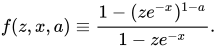
Let
f
(
z
,
x
,
a
)
≡
1
−
(
z
e
−
x
)
1
−
a
1
−
z
e
−
x
.
{\displaystyle f(z,x,a)\equiv {\frac {1-(ze^{-x})^{1-a}}{1-ze^{-x}}}.}
Let
C
n
(
z
,
a
)
{\displaystyle C_{n}(z,a)}
x
=
0
{\displaystyle x=0}
N
∈
N
,
ℜ
a
>
1
{\displaystyle N\in \mathbb {N} ,\Re a>1}
ℜ
s
>
0
{\displaystyle \Re s>0}
Φ
(
z
,
s
,
a
)
−
L
i
s
(
z
)
z
a
=
∑
n
=
0
N
−
1
C
n
(
z
,
a
)
(
s
)
n
a
n
+
s
+
O
(
(
ℜ
a
)
1
−
N
−
s
+
a
z
−
ℜ
a
)
,
{\displaystyle \Phi (z,s,a)-{\frac {\mathrm {Li} _{s}(z)}{z^{a}}}=\sum _{n=0}^{N-1}C_{n}(z,a){\frac {(s)_{n}}{a^{n+s}}}+O\left((\Re a)^{1-N-s}+az^{-\Re a}\right),}
as
ℜ
a
→
∞
{\displaystyle \Re a\to \infty }
[15]
Software
The Lerch transcendent is implemented as LerchPhi in Maple and Mathematica, and as lerchphi in mpmath and SymPy.
References
^ Lerch, Mathias (1887), "Note sur la fonction
K
(
w
,
x
,
s
)
=
∑
k
=
0
∞
e
2
k
π
i
x
(
w
+
k
)
s
{\displaystyle \scriptstyle {\mathfrak {K}}(w,x,s)=\sum _{k=0}^{\infty }{e^{2k\pi ix} \over (w+k)^{s}}}
", Acta Mathematica (in French), 11 (1– 4): 19– 24, doi :10.1007/BF02612318 , JFM 19.0438.01, MR 1554747, S2CID 121885446^ a b c d e f Guillera & Sondow 2008, p. 248–249
^ Weisstein, Eric W. "Inverse Tangent Integral". mathworld.wolfram.com . Retrieved 2024-10-13 . ^ The polygamma function has the series representation
ψ
(
m
)
(
z
)
=
(
−
1
)
m
+
1
m
!
∑
k
=
0
∞
1
(
z
+
k
)
m
+
1
{\displaystyle \psi ^{(m)}(z)=(-1)^{m+1}\,m!\sum _{k=0}^{\infty }{\frac {1}{(z+k)^{m+1}}}}
m > 0z
^ Weisstein, Eric W. "Polygamma Function". mathworld.wolfram.com . Retrieved 2024-10-14 . ^ Weisstein, Eric W. "Clausen Function". mathworld.wolfram.com . Retrieved 2024-10-14 . ^ Bateman & Erdélyi 1953, p. 27
^ Guillera & Sondow 2008, Lemma 2.1 and 2.2
^ Bateman & Erdélyi 1953, p. 28
^ "The Analytic Continuation of the Lerch Transcendent and the Riemann Zeta Function". 27 April 2020. Retrieved 28 April 2020 . ^ B. R. Johnson (1974). "Generalized Lerch zeta function". Pacific J. Math . 53 (1): 189– 193. doi :10.2140/pjm.1974.53.189 . ^ Gottschalk, J. E.; Maslen, E. N. (1988). "Reduction formulae for generalized hypergeometric functions of one variable". J. Phys. A . 21 (9): 1983– 1998. Bibcode :1988JPhA...21.1983G. doi :10.1088/0305-4470/21/9/015. ^ Ferreira, Chelo; López, José L. (October 2004). "Asymptotic expansions of the Hurwitz–Lerch zeta function". Journal of Mathematical Analysis and Applications . 298 (1): 210– 224. doi :10.1016/j.jmaa.2004.05.040 . ^ Cai, Xing Shi; López, José L. (10 June 2019). "A note on the asymptotic expansion of the Lerch's transcendent". Integral Transforms and Special Functions . 30 (10): 844– 855. arXiv :1806.01122 . doi :10.1080/10652469.2019.1627530. S2CID 119619877.
Apostol, T. M. (2010), "Lerch's Transcendent", in Olver, Frank W. J. ; Lozier, Daniel M.; Boisvert, Ronald F.; Clark, Charles W. (eds.), NIST Handbook of Mathematical Functions ISBN 978-0-521-19225-5 MR 2723248 Bateman, H. ; Erdélyi, A. (1953), Higher Transcendental Functions, Vol. I (PDF) , New York: McGraw-Hillz ,s ,v )", p. 27)Gradshteyn, Izrail Solomonovich ; Ryzhik, Iosif Moiseevich ; Geronimus, Yuri Veniaminovich ; Tseytlin, Michail Yulyevich ; Jeffrey, Alan (2015) [October 2014]. "9.55.". In Zwillinger, Daniel; Moll, Victor Hugo (eds.). Table of Integrals, Series, and Products ISBN 978-0-12-384933-5 LCCN 2014010276.Guillera, Jesus; Sondow, Jonathan (2008), "Double integrals and infinite products for some classical constants via analytic continuations of Lerch's transcendent", The Ramanujan Journal , 16 (3): 247– 270, arXiv :math.NT/0506319 , doi :10.1007/s11139-007-9102-0, MR 2429900, S2CID 119131640 Jackson, M. (1950), "On Lerch's transcendent and the basic bilateral hypergeometric series 2 ψ 2 ", J. London Math. Soc. , 25 (3): 189– 196, doi :10.1112/jlms/s1-25.3.189, MR 0036882 Johansson, F.; Blagouchine, Ia. (2019), "Computing Stieltjes constants using complex integration", Mathematics of Computation , 88 (318): 1829– 1850, arXiv :1804.01679 , doi :10.1090/mcom/3401, MR 3925487, S2CID 4619883 Laurinčikas, Antanas; Garunkštis, Ramūnas (2002), The Lerch zeta-function , Dordrecht: Kluwer Academic Publishers, ISBN 978-1-4020-1014-9 MR 1979048
External links
Aksenov, Sergej V.; Jentschura, Ulrich D. (2002), C and Mathematica Programs for Calculation of Lerch's Transcendent Ramunas Garunkstis, Home Page (2005) (Provides numerous references and preprints.)
Garunkstis, Ramunas (2004). "Approximation of the Lerch Zeta Function" (PDF) . Lithuanian Mathematical Journal . 44 (2): 140– 144. doi :10.1023/B:LIMA.0000033779.41365.a5. S2CID 123059665. Kanemitsu, S.; Tanigawa, Y.; Tsukada, H. (2015). "A generalization of Bochner's formula". Kanemitsu, S.; Tanigawa, Y.; Tsukada, H. (2004). "A generalization of Bochner's formula". Hardy-Ramanujan Journal . 27 . doi :10.46298/hrj.2004.150 . Weisstein, Eric W. "Lerch Transcendent". MathWorld Olver, Frank W. J. ; Lozier, Daniel M.; Boisvert, Ronald F.; Clark, Charles W., eds. (2010), "Lerch's Transcendent", NIST Handbook of Mathematical Functions ISBN 978-0-521-19225-5 MR 2723248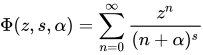



























![{\displaystyle \Phi (z,s,a)=z^{-a}\left[\Gamma (1-s)\left(-\log(z)\right)^{s-1}+\sum _{k=0}^{\infty }\zeta (s-k,a){\frac {\log ^{k}(z)}{k!}}\right]}](https://wikimedia.org/api/rest_v1/media/math/render/svg/ae3a9c24d8417a779c07014ddeecc82a705943b2)
![{\displaystyle \Phi (z,n,a)=z^{-a}\left\{\sum _{{k=0} \atop k\neq n-1}^{\infty }\zeta (n-k,a){\frac {\log ^{k}(z)}{k!}}+\left[\psi (n)-\psi (a)-\log(-\log(z))\right]{\frac {\log ^{n-1}(z)}{(n-1)!}}\right\},}](https://wikimedia.org/api/rest_v1/media/math/render/svg/6f97bb2052f7804ca5b0247792e7a427e3f9cee9)







![{\displaystyle \Phi (z,s,a)=z^{-a}\Gamma (1-s)\sum _{k=-\infty }^{\infty }[2k\pi i-\log(z)]^{s-1}e^{2k\pi ai}}](https://wikimedia.org/api/rest_v1/media/math/render/svg/cc6012b9bc8d368cab2f4b45595f1a25bf1ae8e6)

![{\displaystyle \Phi (-z,s,a)=z^{-a}\Gamma (1-s)\sum _{k=-\infty }^{\infty }[(2k+1)\pi i-\log(z)]^{s-1}e^{(2k+1)\pi ai}}](https://wikimedia.org/api/rest_v1/media/math/render/svg/0712d558ab9e56585b83e5a320cf89dbcba42cb9)