ミンコフスキー平面

Type of Benz planes

数学において、ミンコフスキー平面ヘルマン・ミンコフスキーにちなんで名付けられた)は、ベンツ平面の 1 つです(他の 2 つはメビウス平面ラゲール平面です)。

古典的な実ミンコフスキー平面

古典ミンコフスキー平面:2D/3Dモデル

ユークリッド距離の代わりに2 点に擬似ユークリッド距離を適用すると、双曲線の幾何学が得られます。擬似ユークリッド円は中点⁠を持つ双曲線だからです d ( P 1 , P 2 ) = ( x 1 x 2 ) 2 ( y 1 y 2 ) 2 {\displaystyle d(P_{1},P_{2})=(x'_{1}-x'_{2})^{2}-(y'_{1}-y'_{2})^{2}} P i = ( x i , y i ) {\displaystyle P_{i}=(x'_{i},y'_{i})} { P R 2 d ( P , M ) = r } {\displaystyle \{P\in \mathbb {R} ^{2}\mid d(P,M)=r\}} M {\displaystyle M}

座標変換 x i = x i + y i {\displaystyle x_{i}=x'_{i}+y'_{i}} , y i = x i y i {\displaystyle y_{i}=x'_{i}-y'_{i}} により、擬ユークリッド距離は d ( P 1 , P 2 ) = ( x 1 x 2 ) ( y 1 y 2 ) {\displaystyle d(P_{1},P_{2})=(x_{1}-x_{2})(y_{1}-y_{2})} と書き直すことができます。すると、双曲線はプライム記号のない座標軸に平行な 漸近線を持ちます。

次の完成形 (メビウス平面とラゲール平面を参照) は双曲線の幾何学 を均質化します。

  • の集合 P := ( R { } ) 2 = R 2 ( { } × R ) ( R × { } )   { ( , ) }   ,   R , {\displaystyle {\mathcal {P}}:=\left(\mathbb {R} \cup \left\{\infty \right\}\right)^{2}=\mathbb {R} ^{2}\cup \left(\left\{\infty \right\}\times \mathbb {R} \right)\cup \left(\mathbb {R} \times \left\{\infty \right\}\right)\ \cup \left\{\left(\infty ,\infty \right)\right\}\ ,\ \infty \notin \mathbb {R} ,}
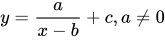
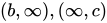
  • サイクルのセット Z := { { ( x , y ) R 2 y = a x + b } { ( , ) } a , b R , a 0 } { { ( x , y ) R 2 y = a x b + c , x b } { ( b , ) , ( , c ) } a , b , c R , a 0 } . {\displaystyle {\begin{aligned}{\mathcal {Z}}:={}&\left\{\left\{\left(x,y\right)\in \mathbb {R} ^{2}\mid y=ax+b\right\}\cup \left\{\left(\infty ,\infty \right)\right\}\mid a,b\in \mathbb {R} ,a\neq 0\right\}\\&\quad \cup \left\{\left\{\left(x,y\right)\in \mathbb {R} ^{2}\mid y={\frac {a}{x-b}}+c,x\neq b\right\}\cup \left\{\left(b,\infty \right),\left(\infty ,c\right)\right\}\mid a,b,c\in \mathbb {R} ,a\neq 0\right\}.\end{aligned}}}

入射構造は 古典的な実ミンコフスキー平面と呼ばれます ( P , Z , ) {\displaystyle ({\mathcal {P}},{\mathcal {Z}},\in )}

点の集合は、 ⁠ R 2 {\displaystyle \mathbb {R} ^{2}} 、 の 2 つのコピー、および点で構成されます。 R {\displaystyle \mathbb {R} } ( , ) {\displaystyle (\infty ,\infty )}

任意の直線は点で完成し、任意の双曲線は2 つの点で完成します (図を参照)。 y = a x + b , a 0 {\displaystyle y=ax+b,a\neq 0} ( , ) {\displaystyle (\infty ,\infty )} y = a x b + c , a 0 {\displaystyle y={\frac {a}{x-b}}+c,a\neq 0} ( b , ) , ( , c ) {\displaystyle (b,\infty ),(\infty ,c)}

またはの場合にのみ、 2 つのポイントはサイクルで接続できません ( x 1 , y 1 ) ( x 2 , y 2 ) {\displaystyle (x_{1},y_{1})\neq (x_{2},y_{2})} x 1 = x 2 {\displaystyle x_{1}=x_{2}} y 1 = y 2 {\displaystyle y_{1}=y_{2}}

定義:2点 は、の場合には(+)-平行( )でありの場合には(−)-平行( )です これらの関係はどちらも点の集合上の 同値関係です。 P 1 {\displaystyle P_{1}} P 2 {\displaystyle P_{2}} P 1 + P 2 {\displaystyle P_{1}\parallel _{+}P_{2}} x 1 = x 2 {\displaystyle x_{1}=x_{2}} P 1 P 2 {\displaystyle P_{1}\parallel _{-}P_{2}} y 1 = y 2 {\displaystyle y_{1}=y_{2}}

またはのとき、 2 点は平行( ) であるといわれます P 1 , P 2 {\displaystyle P_{1},P_{2}} P 1 P 2 {\displaystyle P_{1}\parallel P_{2}} P 1 + P 2 {\displaystyle P_{1}\parallel _{+}P_{2}} P 1 P 2 {\displaystyle P_{1}\parallel _{-}P_{2}}

上記の定義から次のことがわかります。

補題:

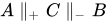
  • 平行でない点のペア A {\displaystyle A} に対して、となる点が 1 つだけ存在します B {\displaystyle B} C {\displaystyle C} A + C B {\displaystyle A\parallel _{+}C\parallel _{-}B}
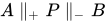
  • 任意の点と任意のサイクルに対して、 となる点がちょうど 2 つ存在します P {\displaystyle P} z {\displaystyle z} A , B z {\displaystyle A,B\in z} A + P B {\displaystyle A\parallel _{+}P\parallel _{-}B}
  • A {\displaystyle A} B {\displaystyle B} C {\displaystyle C} の 3 つの点が互いに平行でない場合、を含むサイクルが1 つだけ存在します z {\displaystyle z} A , B , C {\displaystyle A,B,C}
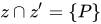
  • 任意のサイクル z {\displaystyle z} 、任意の点、任意の点、に対して、 つまり点⁠で接するようなサイクルが 1 つだけ存在します P z {\displaystyle P\in z} Q , P Q {\displaystyle Q,P\not \parallel Q} Q z {\displaystyle Q\notin z} z {\displaystyle z'} z z = { P } {\displaystyle z\cap z'=\{P\}} z {\displaystyle z} z {\displaystyle z'} P {\displaystyle P}

古典的なメビウス平面やラゲール平面と同様に、ミンコフスキー平面は、適切な二次曲面の平面切断の幾何学として記述できます。しかし、この場合、二次曲面は射影三次元空間に存在します。つまり、古典的な実ミンコフスキー平面は、 1枚双曲面(指数2の退化した二次曲面ではない) の平面切断の幾何学と同型です。

ミンコフスキー平面の公理

を点の集合、閉路の集合、および集合 上の2 つの同値関係((+)-平行) と((−)-平行) を持つ接続構造としますについて、およびを定義します 。同値類または は、それぞれ(+)-生成元および(−)-生成元と呼ばれます(古典的なミンコフスキー平面の空間モデルでは、生成元 は双曲面上の直線です)。2 点は、またはのとき平行( )と呼ばれます ( P , Z ; + , , ) {\displaystyle \left({\mathcal {P}},{\mathcal {Z}};\parallel _{+},\parallel _{-},\in \right)} P {\displaystyle {\mathcal {P}}} Z {\displaystyle {\mathcal {Z}}} + {\displaystyle \parallel _{+}} {\displaystyle \parallel _{-}} P {\displaystyle {\mathcal {P}}} P P {\displaystyle P\in {\mathcal {P}}} P ¯ + := { Q P Q + P } {\displaystyle {\overline {P}}_{+}:=\left\{Q\in {\mathcal {P}}\mid Q\parallel _{+}P\right\}} P ¯ := { Q P Q P } {\displaystyle {\overline {P}}_{-}:=\left\{Q\in {\mathcal {P}}\mid Q\parallel _{-}P\right\}} P ¯ + {\displaystyle {\overline {P}}_{+}} P ¯ {\displaystyle {\overline {P}}_{-}}
A , B {\displaystyle A,B} A B {\displaystyle A\parallel B} A + B {\displaystyle A\parallel _{+}B} A B {\displaystyle A\parallel _{-}B}

次の公理が成り立つ場合、入射構造はミンコフスキー平面と呼ばれます。 M := ( P , Z ; + , , ) {\displaystyle {\mathfrak {M}}:=({\mathcal {P}},{\mathcal {Z}};\parallel _{+},\parallel _{-},\in )}

ミンコフスキー公理-c1-c2
ミンコフスキー公理-c3-c4
  • C1 : 平行でない点の任意のペアに対して、となる点が 1 つだけ存在します A , B {\displaystyle A,B} C {\displaystyle C} A + C B {\displaystyle A\parallel _{+}C\parallel _{-}B}
  • C2 : 任意の点と任意のサイクルに対して、となる点がちょうど 2 つ存在します P {\displaystyle P} z {\displaystyle z} A , B z {\displaystyle A,B\in z} A + P B {\displaystyle A\parallel _{+}P\parallel _{-}B}
  • C3 :平行でない 2 つの点のいずれに対しても、を含むサイクルが 1 つ存在します A , B , C {\displaystyle A,B,C} z {\displaystyle z} A , B , C {\displaystyle A,B,C}
  • C4 : 任意のサイクル、任意の点、任意の点 、および に対して、、つまりが点 で接するようサイクルが 1 つだけ存在します z {\displaystyle z} P z {\displaystyle P\in z} Q , P Q {\displaystyle Q,P\not \parallel Q} Q z {\displaystyle Q\notin z} z {\displaystyle z'} z z = { P } {\displaystyle z\cap z'=\{P\}} z {\displaystyle z} z {\displaystyle z'} P {\displaystyle P}
  • C5 : 任意のサイクルには少なくとも3つの点が含まれます。少なくとも1つのサイクルと、に含まれない点が存在します z {\displaystyle z} P {\displaystyle P} z {\displaystyle z}

調査には、並列クラス (それぞれ C1、C2 に相当) に関する次のステートメントが有利です。

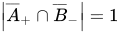
  • C1′ : 任意の2点 A {\displaystyle A} について、が成り立ちます B {\displaystyle B} | A ¯ + B ¯ | = 1 {\displaystyle \left|{\overline {A}}_{+}\cap {\overline {B}}_{-}\right|=1}
  • C2′ : 任意の点と任意のサイクルに対して次が成り立ちます: . P {\displaystyle P} z {\displaystyle z} | P ¯ + z | = 1 = | P ¯ z | {\displaystyle \left|{\overline {P}}_{+}\cap z\right|=1=\left|{\overline {P}}_{-}\cap z\right|}

公理の最初の帰結は

補題ミンコフスキー平面の場合、次が成り立つ M {\displaystyle {\mathfrak {M}}}

  1. 任意の点は少なくとも 1 つのサイクルに含まれます。
  2. どのジェネレータにも少なくとも 3 つのポイントが含まれます。
  3. 2 つの点が平行でない場合にのみ、それらの点を循環で接続できます。

メビウス平面やラゲール平面と同様に、剰余を介して線形幾何学への接続が得られます。

ミンコフスキー平面の場合局所構造を定義し 、それを点 P における剰余と呼びます。 M = ( P , Z ; + , , ) {\displaystyle {\mathfrak {M}}=({\mathcal {P}},{\mathcal {Z}};\parallel _{+},\parallel _{-},\in )} P P {\displaystyle P\in {\mathcal {P}}} A P := ( P P ¯ , { z { P ¯ } P z Z } { E P ¯ E E { P ¯ + , P ¯ } } , ) {\displaystyle {\mathfrak {A}}_{P}:=({\mathcal {P}}\setminus {\overline {P}},\{z\setminus \{{\overline {P}}\}\mid P\in z\in {\mathcal {Z}}\}\cup \{E\setminus {\overline {P}}\mid E\in {\mathcal {E}}\setminus \{{\overline {P}}_{+},{\overline {P}}_{-}\}\},\in )}

古典的なミンコフスキー平面実アフィン平面です A ( , ) {\displaystyle {\mathfrak {A}}_{(\infty ,\infty )}} R 2 {\displaystyle \mathbb {R} ^{2}}

公理 C1 から C4 および C1′、C2′ から直接得られる結論は次の 2 つの定理です。

定理-ミンコフスキー平面の場合、任意の剰余はアフィン平面である。 M = ( P , Z ; + , , ) {\displaystyle {\mathfrak {M}}=({\mathcal {P}},{\mathcal {Z}};\parallel _{+},\parallel ,\in )}

定理 2 つの同値関係を持つ接続構造と点の集合(上記参照) があるとします。 M = ( P , Z ; + , , ) {\displaystyle {\mathfrak {M}}=({\mathcal {P}},{\mathcal {Z}};\parallel _{+},\parallel _{-},\in )} + {\displaystyle \parallel _{+}} {\displaystyle \parallel _{-}} P {\displaystyle {\mathcal {P}}}

そして、任意の点に対して剰余がアフィン平面である 場合に限り、 はミンコフスキー平面となります。 M {\displaystyle {\mathfrak {M}}} P {\displaystyle P} A P {\displaystyle {\mathfrak {A}}_{P}}

最小モデル

ミンコフスキー平面:最小モデル

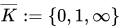
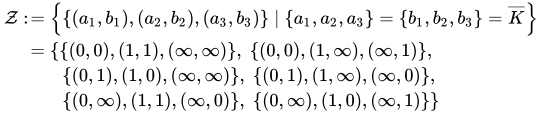
ミンコフスキー平面の最小モデルは、次の 3 つの要素の 集合上で確立できます。 K ¯ := { 0 , 1 , } {\displaystyle {\overline {K}}:=\{0,1,\infty \}} P := K ¯ 2 {\displaystyle {\mathcal {P}}:={\overline {K}}^{2}} Z : = { { ( a 1 , b 1 ) , ( a 2 , b 2 ) , ( a 3 , b 3 ) } { a 1 , a 2 , a 3 } = { b 1 , b 2 , b 3 } = K ¯ } = { { ( 0 , 0 ) , ( 1 , 1 ) , ( , ) } , { ( 0 , 0 ) , ( 1 , ) , ( , 1 ) } , { ( 0 , 1 ) , ( 1 , 0 ) , ( , ) } , { ( 0 , 1 ) , ( 1 , ) , ( , 0 ) } , { ( 0 , ) , ( 1 , 1 ) , ( , 0 ) } , { ( 0 , ) , ( 1 , 0 ) , ( , 1 ) } } {\displaystyle {\begin{aligned}{\mathcal {Z}}:\!&=\left\{\{(a_{1},b_{1}),(a_{2},b_{2}),(a_{3},b_{3})\}\mid \{a_{1},a_{2},a_{3}\}=\{b_{1},b_{2},b_{3}\}={\overline {K}}\right\}\\&=\{\{(0,0),(1,1),(\infty ,\infty )\},\;\{(0,0),(1,\infty ),(\infty ,1)\},\\&\qquad \{(0,1),(1,0),(\infty ,\infty )\},\;\{(0,1),(1,\infty ),(\infty ,0)\},\\&\qquad \{(0,\infty ),(1,1),(\infty ,0)\},\;\{(0,\infty ),(1,0),(\infty ,1)\}\}\end{aligned}}}

平行点:

  • ( x 1 , y 1 ) + ( x 2 , y 2 ) {\displaystyle (x_{1},y_{1})\parallel _{+}(x_{2},y_{2})} もし、そして、もし、 x 1 = x 2 {\displaystyle x_{1}=x_{2}}
  • ( x 1 , y 1 ) ( x 2 , y 2 ) {\displaystyle (x_{1},y_{1})\parallel _{-}(x_{2},y_{2})} y 1 = y 2 {\displaystyle y_{1}=y_{2}} の場合にのみ

したがって、そして | P | = 9 {\displaystyle \left|{\mathcal {P}}\right|=9} | Z | = 6 {\displaystyle \left|{\mathcal {Z}}\right|=6}

有限ミンコフスキー平面

有限ミンコフスキー平面の場合、C1′、C2′から次式が得られます。

補題を有限ミンコフスキー平面、すなわち とします。任意のサイクルのペアと任意の生成元のペアに対して、次が成り立ちます M = ( P , Z ; + , , ) {\displaystyle {\mathfrak {M}}=({\mathcal {P}},{\mathcal {Z}};\parallel _{+},\parallel _{-},\in )} | P | < {\displaystyle \left|{\mathcal {P}}\right|<\infty } z 1 , z 2 {\displaystyle z_{1},z_{2}} e 1 , e 2 {\displaystyle e_{1},e_{2}} | z 1 | = | z 2 | = | e 1 | = | e 2 | {\displaystyle \left|z_{1}\right|=\left|z_{2}\right|=\left|e_{1}\right|=\left|e_{2}\right|}

これにより、定義が生まれます
有限ミンコフスキー平面と のサイクルに対して、整数と呼びます M {\displaystyle {\mathfrak {M}}} z {\displaystyle z} M {\displaystyle {\mathfrak {M}}} n = | z | 1 {\displaystyle n=\left|z\right|-1} M {\displaystyle {\mathfrak {M}}}

単純な組み合わせの考察から、

補題有限ミンコフスキー平面の場合、次が成り立ちます。 M = ( P , Z ; + , , ) {\displaystyle {\mathfrak {M}}=({\mathcal {P}},{\mathcal {Z}};\parallel _{+},\parallel _{-},\in )}

  1. 任意の剰余(アフィン平面)には順序があります n {\displaystyle n}
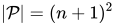
  2. | P | = ( n + 1 ) 2 {\displaystyle \left|{\mathcal {P}}\right|=(n+1)^{2}}
  3. | Z | = ( n + 1 ) n ( n 1 ) {\displaystyle \left|{\mathcal {Z}}\right|=(n+1)n(n-1)} .

ミケリアン・ミンコフスキーの飛行機

古典的な実モデルを一般化することで、 ミンコフスキー平面の最も重要な例が得られます。任意のフィールドに置き換えるだけで、いずれの場合でもミンコフスキー平面が得られます R {\displaystyle \mathbb {R} } K {\displaystyle K} M ( K ) = ( P , Z ; + , , ) {\displaystyle {\mathfrak {M}}(K)=({\mathcal {P}},{\mathcal {Z}};\parallel _{+},\parallel _{-},\in )}

メビウス平面やラゲール平面と同様に、ミゲルの定理はミンコフスキー平面の特徴的な性質です M ( K ) {\displaystyle {\mathfrak {M}}(K)}

ミケルの定理

定理 (ミケル):ミンコフスキー平面については次のことが成り立ちます。 M ( K ) {\displaystyle {\mathfrak {M}}(K)}

立方体の頂点に割り当てることができる8 つの非平行な点があり、5 つの面の点が同心円状の四重点に対応する場合、6 番目の点の四重点も同心円状になります。 P 1 , . . . , P 8 {\displaystyle P_{1},...,P_{8}}

(図では概要を把握しやすくするために、双曲線ではなく円が描かれています。)

定理 (Chen):ミンコフスキー平面だけがミケルの定理を満たします。 M ( K ) {\displaystyle {\mathfrak {M}}(K)}

最後の定理により、ミケリアン・ミンコフスキー平面と呼ばれます M ( K ) {\displaystyle {\mathfrak {M}}(K)}

注:ミンコフスキー平面の最小モデルはミケリアン です

これは、 (体 )を持つミンコフスキー平面と同型です M ( K ) {\displaystyle {\mathfrak {M}}(K)} K = GF ( 2 ) {\displaystyle K=\operatorname {GF} (2)} { 0 , 1 } {\displaystyle \{0,1\}}

驚くべき結果は

定理 (Heise):偶数次 のミンコフスキー平面はすべてミケリアンである。

注意:適切な立体射影により、次が示されます。 は、体 上の射影 3 次元空間における 1 枚の双曲面 (指数 2 の二次曲面) 上の平面切断の幾何学に同型です M ( K ) {\displaystyle {\mathfrak {M}}(K)} K {\displaystyle K}

注:ミケリアンではないミンコフスキー平面は数多く存在します(下記のウェブリンクを参照)。しかし、メビウス平面やラゲール平面とは異なり、「卵形ミンコフスキー平面」は存在しません。なぜなら、射影的3次元空間における指数2の任意の二次集合は二次曲面だからです(二次集合を参照)。

参照

参考文献

  • ヴァルター・ベンツ(1973) Vorlesungen über Geomerie der AlgebrenSpringer
  • フランシス・ビューケンハウト(編)(1995)『Handbook of Incidence Geometryエルゼビア ISBN 0-444-88355-X
  • 数学百科事典のベンツ飛行機
  • 講義ノート 平面円幾何学、メビウス平面、ラゲール平面、ミンコフスキー平面入門
Retrieved from "https://en.wikipedia.org/w/index.php?title=Minkowski_plane&oldid=1207322481"