This article relies largely or entirely on a single source. (March 2024) |

In statistical mechanics, the translational partition function, is that part of the partition function resulting from the movement (translation) of the center of mass. For a single atom or molecule in a low pressure gas, neglecting the interactions of molecules, the canonical ensemble can be approximated by:[1]

- where

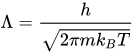
Here, V is the volume of the container holding the molecule (volume per single molecule so, e.g., for 1 mole of gas the container volume should be divided by the Avogadro number), Λ is the Thermal de Broglie wavelength, h is the Planck constant, m is the mass of a molecule, kB is the Boltzmann constant and T is the absolute temperature. This approximation is valid as long as Λ is much less than any dimension of the volume the atom or molecule is in. Since typical values of Λ are on the order of 10-100 pm, this is almost always an excellent approximation.
When considering a set of N non-interacting but identical atoms or molecules, when QT ≫ N , or equivalently when ρ Λ ≪ 1 where ρ is the density of particles, the total translational partition function can be written
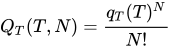

The factor of N! arises from the restriction of allowed N particle states due to Quantum exchange symmetry. Most substances form liquids or solids at temperatures much higher than when this approximation breaks down significantly.
See also
References
- ^ Donald A. McQuarrie, Statistical Mechanics, Harper \& Row, 1973
 | This quantum mechanics-related article is a stub. You can help Wikipedia by expanding it. |

 | This article about statistical mechanics is a stub. You can help Wikipedia by expanding it. |

