確率論 において 、 g期待値は、 Shige Peng によって最初に開発された後方 確率微分方程式 (BSDE)に基づく 非線形期待値 です 。 [1]
意味 確率空間が与えられ 、その空間上では ( d 次元) ウィーナー過程 となる。 によって生成される 濾過 、 すなわち が与えられ、が 測定可能 であるとする 。次式で与えられる BSDE を考える。
( Ω 、
F
、
P
)
{\displaystyle (\Omega ,{\mathcal {F}},\mathbb {P} )}
(
W
t
)
t ≥ 0
{\displaystyle (W_{t})_{t\geq 0}}
(
W
t
)
{\displaystyle (W_{t})}
F
t
= σ (
W
s
: s ∈ [ 0 、 t ] )
{\displaystyle {\mathcal {F}}_{t}=\sigma (W_{s}:s\in [0,t])}
X
{\displaystyle X}
F
T
{\displaystyle {\mathcal {F}}_{T}}
d
はい
t
= グラム ( t 、
はい
t
、
Z
t
) d t −
Z
t
d
W
t
はい
T
= X
{\displaystyle {\begin{aligned}dY_{t}&=g(t,Y_{t},Z_{t})\,dt-Z_{t}\,dW_{t}\\Y_{T}&=X\end{aligned}}}
すると、 のg期待値は で与えられます 。が m 次元ベクトルの場合 、 ( の各時点について )は m 次元ベクトル、 は行列であることに注意してください 。
X
{\displaystyle X}
E
グラム
[ X ] :=
はい
0
{\displaystyle \mathbb {E} ^{g}[X]:=Y_{0}}
X
{\displaystyle X}
はい
t
{\displaystyle Y_{t}}
t
{\displaystyle t}
Z
t
{\displaystyle Z_{t}}
メートル × d
{\displaystyle m\times d}
実際、 条件付き期待値 は で与えられ 、条件付き期待値の正式な定義と同様に、 任意の に対してが成り立ちます (関数 は 指示関数 です )。 [1]
E
グラム
[ X ∣
F
t
] :=
はい
t
{\displaystyle \mathbb {E} ^{g}[X\mid {\mathcal {F}}_{t}]:=Y_{t}}
E
グラム
[
1
あ
E
グラム
[ X ∣
F
t
] ] =
E
グラム
[
1
あ
X ]
{\displaystyle \mathbb {E} ^{g}[1_{A}\mathbb {E} ^{g}[X\mid {\mathcal {F}}_{t}]]=\mathbb {E} ^{g}[1_{A}X]}
あ ∈
F
t
{\displaystyle A\in {\mathcal {F}}_{t}}
1
{\displaystyle 1}
存在と唯一性 次を満たすものとします 。
グラム : [ 0 、 T ] ×
R
メートル
×
R
メートル × d
→
R
メートル
{\displaystyle g:[0,T]\times \mathbb {R} ^{m}\times \mathbb {R} ^{m\times d}\to \mathbb {R} ^{m}}
g
(
⋅
,
y
,
z
)
{\displaystyle g(\cdot ,y,z)}
あらゆるニーズ に 適応したプロセス です
F
t
{\displaystyle {\mathcal {F}}_{t}}
(
y
,
z
)
∈
R
m
×
R
m
×
d
{\displaystyle (y,z)\in \mathbb {R} ^{m}\times \mathbb {R} ^{m\times d}}
∫
0
T
|
g
(
t
,
0
,
0
)
|
d
t
∈
L
2
(
Ω
,
F
T
,
P
)
{\displaystyle \int _{0}^{T}|g(t,0,0)|\,dt\in L^{2}(\Omega ,{\mathcal {F}}_{T},\mathbb {P} )}
L2 空間 ( は のノルム )
|
⋅
|
{\displaystyle |\cdot |}
R
m
{\displaystyle \mathbb {R} ^{m}}
g
{\displaystyle g}
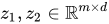
は において リプシッツ連続で ある 、すなわち任意の に対してであり 、 したがって ある定数に対して
(
y
,
z
)
{\displaystyle (y,z)}
y
1
,
y
2
∈
R
m
{\displaystyle y_{1},y_{2}\in \mathbb {R} ^{m}}
z
1
,
z
2
∈
R
m
×
d
{\displaystyle z_{1},z_{2}\in \mathbb {R} ^{m\times d}}
|
g
(
t
,
y
1
,
z
1
)
−
g
(
t
,
y
2
,
z
2
)
|
≤
C
(
|
y
1
−
y
2
|
+
|
z
1
−
z
2
|
)
{\displaystyle |g(t,y_{1},z_{1})-g(t,y_{2},z_{2})|\leq C(|y_{1}-y_{2}|+|z_{1}-z_{2}|)}
C
{\displaystyle C}
すると、任意の確率変数に対して、 確率微分方程式を満たす 適応プロセス の一意のペアが存在する。 [2]
X
∈
L
2
(
Ω
,
F
t
,
P
;
R
m
)
{\displaystyle X\in L^{2}(\Omega ,{\mathcal {F}}_{t},\mathbb {P} ;\mathbb {R} ^{m})}
F
t
{\displaystyle {\mathcal {F}}_{t}}
(
Y
,
Z
)
{\displaystyle (Y,Z)}
特に、 さらに次の条件を満たす場合:
g
{\displaystyle g}
g
{\displaystyle g}
時間的に連続している( )
t
{\displaystyle t}
g
(
t
,
y
,
0
)
≡
0
{\displaystyle g(t,y,0)\equiv 0}
すべての人のために
(
t
,
y
)
∈
[
0
,
T
]
×
R
m
{\displaystyle (t,y)\in [0,T]\times \mathbb {R} ^{m}}
すると、終端確率変数に対して 、解の過程は二乗積分可能であることが分かる 。したがって、は すべての時間に対して二乗積分可能である 。 [3]
X
∈
L
2
(
Ω
,
F
t
,
P
;
R
m
)
{\displaystyle X\in L^{2}(\Omega ,{\mathcal {F}}_{t},\mathbb {P} ;\mathbb {R} ^{m})}
(
Y
,
Z
)
{\displaystyle (Y,Z)}
E
g
[
X
|
F
t
]
{\displaystyle \mathbb {E} ^{g}[X|{\mathcal {F}}_{t}]}
t
{\displaystyle t}
参照
参考文献
^ ab Philippe Briand; François Coquet; Ying Hu; Jean Mémin; Shige Peng (2000). 「BSDEの逆比較定理とg期待値の関連特性」 (PDF) . Electronic Communications in Probability . 5 (13): 101– 117. ^ Peng, S. (2004). 「非線形期待値、非線形評価、およびリスク尺度」. ファイナンスにおける確率的手法 (PDF) . 数学講義ノート. 第1856巻. pp. 165– 138. doi :10.1007/978-3-540-44644-6_4. ISBN 978-3-540-22953-7 . 2016年3月3日時点の オリジナル (pdf)からアーカイブ 。 2012年 8月9日 閲覧。 ^ Chen, Z.; Chen, T.; Davison, M. (2005). 「ショケ期待値とペンのg期待値」. The Annals of Probability . 33 (3): 1179. arXiv : math/0506598 . doi :10.1214/009117904000001053. ^ Rosazza Gianin, E. (2006). 「g期待値によるリスク測定」. 保険:数学と経済学 . 39 : 19–65 . doi :10.1016/j.insmatheco.2006.01.002.


![{\displaystyle {\mathcal {F}}_{t}=\sigma (W_{s}:s\in [0,t])}](https://wikimedia.org/api/rest_v1/media/math/render/svg/e5fd3dd0bd7abe2482848dce8312a6af17171f75)



![{\displaystyle \mathbb {E} ^{g}[X]:=Y_{0}}](https://wikimedia.org/api/rest_v1/media/math/render/svg/08f5717c6fed37c8bda10a9ed6d5c33fb3c7b2e9)


![{\displaystyle \mathbb {E} ^{g}[X\mid {\mathcal {F}}_{t}]:=Y_{t}}](https://wikimedia.org/api/rest_v1/media/math/render/svg/167726477cb11d56e28e1dc79872f3406d2e8eec)
![{\displaystyle \mathbb {E} ^{g}[1_{A}\mathbb {E} ^{g}[X\mid {\mathcal {F}}_{t}]]=\mathbb {E} ^{g}[1_{A}X]}](https://wikimedia.org/api/rest_v1/media/math/render/svg/528245dffb3350c5e64f4c2123f113b1d73d004b)


![{\displaystyle g:[0,T]\times \mathbb {R} ^{m}\times \mathbb {R} ^{m\times d}\to \mathbb {R} ^{m}}](https://wikimedia.org/api/rest_v1/media/math/render/svg/09910ce7fbd5cdfbd3422b6dea1e2d6850abac33)











![{\displaystyle (t,y)\in [0,T]\times \mathbb {R} ^{m}}](https://wikimedia.org/api/rest_v1/media/math/render/svg/17a81acf0f98d9e357333b4986538397979576a2)
![{\displaystyle \mathbb {E} ^{g}[X|{\mathcal {F}}_{t}]}](https://wikimedia.org/api/rest_v1/media/math/render/svg/9a8258786149632cfed7b3ef57bf75aa83e9c383)
![{\displaystyle \rho _{g}(X):=\mathbb {E} ^{g}[-X]}](https://wikimedia.org/api/rest_v1/media/math/render/svg/e4e59f15553a5d72bd8ad7d1a9f35c63feb9d92d)
