Given a probability space with is a (d-dimensional) Wiener process (on that space). Given the filtration generated by , i.e. , let be measurable. Consider the BSDE given by:
Then the g-expectation for is given by . Note that if is an m-dimensional vector, then (for each time ) is an m-dimensional vector and is an matrix.
In fact the conditional expectation is given by and much like the formal definition for conditional expectation it follows that for any (and the function is the indicator function).[1]
^ a bPhilippe Briand; François Coquet; Ying Hu; Jean Mémin; Shige Peng (2000). "A Converse Comparison Theorem for BSDEs and Related Properties of g-Expectation" (PDF). Electronic Communications in Probability. 5 (13): 101–117.
^Peng, S. (2004). "Nonlinear Expectations, Nonlinear Evaluations and Risk Measures". Stochastic Methods in Finance (PDF). Lecture Notes in Mathematics. Vol. 1856. pp. 165–138. doi:10.1007/978-3-540-44644-6_4. ISBN978-3-540-22953-7. Archived from the original (pdf) on March 3, 2016. Retrieved August 9, 2012.
^Chen, Z.; Chen, T.; Davison, M. (2005). "Choquet expectation and Peng's g -expectation". The Annals of Probability. 33 (3): 1179. arXiv:math/0506598. doi:10.1214/009117904000001053.
^Rosazza Gianin, E. (2006). "Risk measures via g-expectations". Insurance: Mathematics and Economics. 39: 19–65. doi:10.1016/j.insmatheco.2006.01.002.


![{\displaystyle {\mathcal {F}}_{t}=\sigma (W_{s}:s\in [0,t])}](https://wikimedia.org/api/rest_v1/media/math/render/svg/e5fd3dd0bd7abe2482848dce8312a6af17171f75)



![{\displaystyle \mathbb {E} ^{g}[X]:=Y_{0}}](https://wikimedia.org/api/rest_v1/media/math/render/svg/08f5717c6fed37c8bda10a9ed6d5c33fb3c7b2e9)


![{\displaystyle \mathbb {E} ^{g}[X\mid {\mathcal {F}}_{t}]:=Y_{t}}](https://wikimedia.org/api/rest_v1/media/math/render/svg/167726477cb11d56e28e1dc79872f3406d2e8eec)
![{\displaystyle \mathbb {E} ^{g}[1_{A}\mathbb {E} ^{g}[X\mid {\mathcal {F}}_{t}]]=\mathbb {E} ^{g}[1_{A}X]}](https://wikimedia.org/api/rest_v1/media/math/render/svg/528245dffb3350c5e64f4c2123f113b1d73d004b)


![{\displaystyle g:[0,T]\times \mathbb {R} ^{m}\times \mathbb {R} ^{m\times d}\to \mathbb {R} ^{m}}](https://wikimedia.org/api/rest_v1/media/math/render/svg/09910ce7fbd5cdfbd3422b6dea1e2d6850abac33)






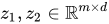





![{\displaystyle (t,y)\in [0,T]\times \mathbb {R} ^{m}}](https://wikimedia.org/api/rest_v1/media/math/render/svg/17a81acf0f98d9e357333b4986538397979576a2)
![{\displaystyle \mathbb {E} ^{g}[X|{\mathcal {F}}_{t}]}](https://wikimedia.org/api/rest_v1/media/math/render/svg/9a8258786149632cfed7b3ef57bf75aa83e9c383)
![{\displaystyle \rho _{g}(X):=\mathbb {E} ^{g}[-X]}](https://wikimedia.org/api/rest_v1/media/math/render/svg/e4e59f15553a5d72bd8ad7d1a9f35c63feb9d92d)
