Sequence space

Vector space of infinite sequences

In functional analysis and related areas of mathematics, a sequence space is a vector space whose elements are infinite sequences of real or complex numbers. Equivalently, it is a function space whose elements are functions from the natural numbers to the field K {\displaystyle \mathbb {K} } of real or complex numbers. The set of all such functions is naturally identified with the set of all possible infinite sequences with elements in K {\displaystyle \mathbb {K} } , and can be turned into a vector space under the operations of pointwise addition of functions and pointwise scalar multiplication. All sequence spaces are linear subspaces of this space. Sequence spaces are typically equipped with a norm, or at least the structure of a topological vector space.

The most important sequence spaces in analysis are the p {\displaystyle \textstyle \ell ^{p}} spaces, consisting of the p {\displaystyle p} -power summable sequences, with the p {\displaystyle p} -norm. These are special cases of L p {\displaystyle L^{p}} spaces for the counting measure on the set of natural numbers. Other important classes of sequences like convergent sequences or null sequences form sequence spaces, respectively denoted c {\displaystyle c} and c 0 {\displaystyle c_{0}} , with the sup norm. Any sequence space can also be equipped with the topology of pointwise convergence, under which it becomes a special kind of Fréchet space called FK-space.

Definition

A sequence x = ( x n ) n N {\displaystyle \textstyle x_{\bullet }=(x_{n})_{n\in \mathbb {N} }} in a set X {\displaystyle X} is an X {\displaystyle X} -valued map x : N X {\displaystyle x_{\bullet }:\mathbb {N} \to X} whose value at n N {\displaystyle n\in \mathbb {N} } is denoted by x n {\displaystyle x_{n}} instead of the usual parentheses notation x ( n ) {\displaystyle x(n)} .

Space of all sequences

Let K {\displaystyle \mathbb {K} } denote the field either of real or complex numbers. The set K N {\displaystyle \textstyle \mathbb {K} ^{\mathbb {N} }} of all sequences of elements of K {\displaystyle \mathbb {K} } is a vector space for componentwise addition ( x n ) n N + ( y n ) n N = ( x n + y n ) n N , {\displaystyle \left(x_{n}\right)_{n\in \mathbb {N} }+\left(y_{n}\right)_{n\in \mathbb {N} }=\left(x_{n}+y_{n}\right)_{n\in \mathbb {N} },} and componentwise scalar multiplication α ( x n ) n N = ( α x n ) n N . {\displaystyle \alpha \left(x_{n}\right)_{n\in \mathbb {N} }=\left(\alpha x_{n}\right)_{n\in \mathbb {N} }.}

A sequence space is any linear subspace of K N {\displaystyle \textstyle \mathbb {K} ^{\mathbb {N} }} .

As a topological space, K N {\displaystyle \textstyle \mathbb {K} ^{\mathbb {N} }} is naturally endowed with the product topology. Under this topology, K N {\displaystyle \textstyle \mathbb {K} ^{\mathbb {N} }} is Fréchet, meaning that it is a complete, metrizable, locally convex topological vector space (TVS). However, this topology is rather pathological: there are no continuous norms on K N {\displaystyle \textstyle \mathbb {K} ^{\mathbb {N} }} (and thus the product topology cannot be defined by any norm).[1] Among Fréchet spaces, K N {\displaystyle \textstyle \mathbb {K} ^{\mathbb {N} }} is minimal in having no continuous norms:

Theorem[1]Let X {\displaystyle X} be a Fréchet space over K {\displaystyle \mathbb {K} } . Then the following are equivalent:

  1. X {\displaystyle X} admits no continuous norm (that is, any continuous seminorm on X {\displaystyle X} has a nontrivial null space).
  2. X {\displaystyle X} contains a vector subspace TVS-isomorphic to K N {\displaystyle \textstyle \mathbb {K} ^{\mathbb {N} }} .
  3. X {\displaystyle X} contains a complemented vector subspace TVS-isomorphic to K N {\displaystyle \textstyle \mathbb {K} ^{\mathbb {N} }} .

But the product topology is also unavoidable: K N {\displaystyle \textstyle \mathbb {K} ^{\mathbb {N} }} does not admit a strictly coarser Hausdorff, locally convex topology.[1] For that reason, the study of sequences begins by finding a strict linear subspace of interest, and endowing it with a topology different from the subspace topology.

p spaces

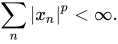
For 0 < p < {\displaystyle 0<p<\infty } , p {\displaystyle \textstyle \ell ^{p}} is the subspace of K N {\displaystyle \textstyle \mathbb {K} ^{\mathbb {N} }} consisting of all sequences x = ( x n ) n N {\displaystyle \textstyle x_{\bullet }=(x_{n})_{n\in \mathbb {N} }} satisfying n | x n | p < . {\displaystyle \sum _{n}|x_{n}|^{p}<\infty .}

If p 1 {\displaystyle p\geq 1} , then the real-valued function p {\displaystyle \|\cdot \|_{p}} on p {\displaystyle \textstyle \ell ^{p}} defined by x p   =   ( n | x n | p ) 1 / p  for all  x p {\displaystyle \|x\|_{p}~=~{\Bigl (}\sum _{n}|x_{n}|^{p}{\Bigr )}^{1/p}\qquad {\text{ for all }}x\in \ell ^{p}} defines a norm on p {\displaystyle \textstyle \ell ^{p}} . In fact, p {\displaystyle \textstyle \ell ^{p}} is a complete metric space with respect to this norm, and therefore is a Banach space.

If p = 2 {\displaystyle p=2} then 2 {\displaystyle \textstyle \ell ^{2}} is also a Hilbert space when endowed with its canonical inner product, called the Euclidean inner product, defined for all x , y p {\displaystyle \textstyle x_{\bullet },y_{\bullet }\in \ell ^{p}} by x , y   =   n x n ¯ y n . {\displaystyle \langle x_{\bullet },y_{\bullet }\rangle ~=~\sum _{n}{\overline {x_{n}\!}}\,y_{n}.} The canonical norm induced by this inner product is the usual 2 {\displaystyle \textstyle \ell ^{2}} -norm, meaning that x 2 = x , x {\displaystyle \textstyle \|\mathbf {x} \|_{2}={\sqrt {\langle \mathbf {x} ,\mathbf {x} \rangle }}} for all x p {\displaystyle \textstyle \mathbf {x} \in \ell ^{p}} .

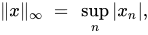
If p = {\displaystyle p=\infty } , then {\displaystyle \textstyle \ell ^{\infty }} is defined to be the space of all bounded sequences endowed with the norm x   =   sup n | x n | , {\displaystyle \|x\|_{\infty }~=~\sup _{n}|x_{n}|,} {\displaystyle \textstyle \ell ^{\infty }} is also a Banach space.

If 0 < p < 1 {\displaystyle 0<p<1} , then p {\displaystyle \textstyle \ell ^{p}} does not carry a norm, but rather a metric defined by d ( x , y )   =   n | x n y n | p . {\displaystyle d(x,y)~=~\sum _{n}\left|x_{n}-y_{n}\right|^{p}.}

c, c0 and c00

A convergent sequence is any sequence x K N {\displaystyle \textstyle x_{\bullet }\in \mathbb {K} ^{\mathbb {N} }} such that lim n x n {\displaystyle \textstyle \lim _{n\to \infty }x_{n}} exists. The set c {\displaystyle c} of all convergent sequences is a vector subspace of K N < {\displaystyle \textstyle \mathbb {K} ^{\mathbb {N} }<} called the space of convergent sequences. Since every convergent sequence is bounded, c {\displaystyle c} is a linear subspace of {\displaystyle \ell ^{\infty }} . Moreover, this sequence space is a closed subspace of {\displaystyle \textstyle \ell ^{\infty }} with respect to the supremum norm, and so it is a Banach space with respect to this norm.

A sequence that converges to 0 {\displaystyle 0} is called a null sequence and is said to vanish. The set of all sequences that converge to 0 {\displaystyle 0} is a closed vector subspace of c {\displaystyle c} that when endowed with the supremum norm becomes a Banach space that is denoted by c 0 {\displaystyle c_{0}} and is called the space of null sequences or the space of vanishing sequences.

The space of eventually zero sequences, c 00 {\displaystyle c_{00}} , is the subspace of c 0 {\displaystyle c_{0}} consisting of all sequences which have only finitely many nonzero elements. This is not a closed subspace and therefore is not a Banach space with respect to the infinity norm. For example, the sequence ( x n k ) k N {\displaystyle \textstyle (x_{nk})_{k\in \mathbb {N} }} where x n k = 1 / k {\displaystyle x_{nk}=1/k} for the first n {\displaystyle n} entries (for k = 1 , , n {\displaystyle k=1,\ldots ,n} ) and is zero everywhere else (that is, ( x n k ) k N = {\displaystyle \textstyle (x_{nk})_{k\in \mathbb {N} }={}\!} ( 1 , 1 2 , , {\displaystyle {\bigl (}1,{\tfrac {1}{2}},\ldots ,{}} 1 n 1 , 1 n , {\displaystyle {\tfrac {1}{n-1}},{\tfrac {1}{n}},{}} 0 , 0 , ) {\displaystyle 0,0,\ldots {\bigr )}} ) is a Cauchy sequence but it does not converge to a sequence in c 00 . {\displaystyle c_{00}.}

Space of all finite sequences

Let K = { ( x 1 , x 2 , ) K N : all but finitely many  x i  equal  0 } {\displaystyle \mathbb {K} ^{\infty }=\left\{\left(x_{1},x_{2},\ldots \right)\in \mathbb {K} ^{\mathbb {N} }:{\text{all but finitely many }}x_{i}{\text{ equal }}0\right\}}

denote the space of finite sequences over K {\displaystyle \mathbb {K} } . As a vector space, K {\displaystyle \textstyle \mathbb {K} ^{\infty }} is equal to c 00 {\displaystyle c_{00}} , but K {\displaystyle \textstyle \mathbb {K} ^{\infty }} has a different topology.

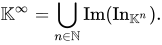
For every natural number n N {\displaystyle n\in \mathbb {N} } , let K n {\displaystyle \textstyle \mathbb {K} ^{n}} denote the usual Euclidean space endowed with the Euclidean topology and let In K n : K n K {\displaystyle \textstyle \operatorname {In} _{\mathbb {K} ^{n}}:\mathbb {K} ^{n}\to \mathbb {K} ^{\infty }} denote the canonical inclusion In K n ( x 1 , , x n ) = ( x 1 , , x n , 0 , 0 , ) . {\displaystyle \operatorname {In} _{\mathbb {K} ^{n}}\left(x_{1},\ldots ,x_{n}\right)=\left(x_{1},\ldots ,x_{n},0,0,\ldots \right).} The image of each inclusion is Im ( In K n ) = { ( x 1 , , x n , 0 , 0 , ) : x 1 , , x n K } = K n × { ( 0 , 0 , ) } {\displaystyle \operatorname {Im} \left(\operatorname {In} _{\mathbb {K} ^{n}}\right)=\left\{\left(x_{1},\ldots ,x_{n},0,0,\ldots \right):x_{1},\ldots ,x_{n}\in \mathbb {K} \right\}=\mathbb {K} ^{n}\times \left\{(0,0,\ldots )\right\}} and consequently, K = n N Im ( In K n ) . {\displaystyle \mathbb {K} ^{\infty }=\bigcup _{n\in \mathbb {N} }\operatorname {Im} \left(\operatorname {In} _{\mathbb {K} ^{n}}\right).}

This family of inclusions gives K {\displaystyle \textstyle \mathbb {K} ^{\infty }} a final topology τ {\displaystyle \textstyle \tau ^{\infty }} , defined to be the finest topology on K {\displaystyle \textstyle \mathbb {K} ^{\infty }} such that all the inclusions are continuous (an example of a coherent topology). With this topology, K {\displaystyle \textstyle \mathbb {K} ^{\infty }} becomes a complete, Hausdorff, locally convex, sequential, topological vector space that is not Fréchet–Urysohn. The topology τ {\displaystyle \textstyle \tau ^{\infty }} is also strictly finer than the subspace topology induced on K {\displaystyle \textstyle \mathbb {K} ^{\infty }} by K N {\displaystyle \textstyle \mathbb {K} ^{\mathbb {N} }} .

Convergence in τ {\displaystyle \textstyle \tau ^{\infty }} has a natural description: if v K {\displaystyle \textstyle v\in \mathbb {K} ^{\infty }} and v {\displaystyle v_{\bullet }} is a sequence in K {\displaystyle \textstyle \mathbb {K} ^{\infty }} then v v {\displaystyle v_{\bullet }\to v} in τ {\displaystyle \textstyle \tau ^{\infty }} if and only v {\displaystyle v_{\bullet }} is eventually contained in a single image Im ( In K n ) {\displaystyle \textstyle \operatorname {Im} \left(\operatorname {In} _{\mathbb {K} ^{n}}\right)} and v v {\displaystyle v_{\bullet }\to v} under the natural topology of that image.

Often, each image Im ( In K n ) {\displaystyle \textstyle \operatorname {Im} \left(\operatorname {In} _{\mathbb {K} ^{n}}\right)} is identified with the corresponding K n {\displaystyle \textstyle \mathbb {K} ^{n}} ; explicitly, the elements ( x 1 , , x n ) K n {\displaystyle \textstyle \left(x_{1},\ldots ,x_{n}\right)\in \mathbb {K} ^{n}} and ( x 1 , , x n , 0 , 0 , 0 , ) {\displaystyle \left(x_{1},\ldots ,x_{n},0,0,0,\ldots \right)} are identified. This is facilitated by the fact that the subspace topology on Im ( In K n ) {\displaystyle \textstyle \operatorname {Im} \left(\operatorname {In} _{\mathbb {K} ^{n}}\right)} , the quotient topology from the map In K n {\displaystyle \textstyle \operatorname {In} _{\mathbb {K} ^{n}}} , and the Euclidean topology on K n {\displaystyle \textstyle \mathbb {K} ^{n}} all coincide. With this identification, ( ( K , τ ) , ( In K n ) n N ) {\displaystyle \textstyle \left(\left(\mathbb {K} ^{\infty },\tau ^{\infty }\right),\left(\operatorname {In} _{\mathbb {K} ^{n}}\right)_{n\in \mathbb {N} }\right)} is the direct limit of the directed system ( ( K n ) n N , ( In K m K n ) m n N , N ) , {\displaystyle \textstyle \left(\left(\mathbb {K} ^{n}\right)_{n\in \mathbb {N} },\left(\operatorname {In} _{\mathbb {K} ^{m}\to \mathbb {K} ^{n}}\right)_{m\leq n\in \mathbb {N} },\mathbb {N} \right),} where every inclusion adds trailing zeros: In K m K n ( x 1 , , x m ) = ( x 1 , , x m , 0 , , 0 ) . {\displaystyle \operatorname {In} _{\mathbb {K} ^{m}\to \mathbb {K} ^{n}}\left(x_{1},\ldots ,x_{m}\right)=\left(x_{1},\ldots ,x_{m},0,\ldots ,0\right).} This shows ( K , τ ) {\displaystyle \textstyle \left(\mathbb {K} ^{\infty },\tau ^{\infty }\right)} is an LB-space.

Other sequence spaces

The space of bounded series, denote by bs, is the space of sequences x {\displaystyle x} for which sup n | i = 0 n x i | < . {\displaystyle \sup _{n}{\biggl \vert }\sum _{i=0}^{n}x_{i}{\biggr \vert }<\infty .}

This space, when equipped with the norm x b s = sup n | i = 0 n x i | , {\displaystyle \|x\|_{bs}=\sup _{n}{\biggl \vert }\sum _{i=0}^{n}x_{i}{\biggr \vert },}

is a Banach space isometrically isomorphic to , {\displaystyle \textstyle \ell ^{\infty },} via the linear mapping ( x n ) n N ( i = 0 n x i ) n N . {\displaystyle (x_{n})_{n\in \mathbb {N} }\mapsto {\biggl (}\sum _{i=0}^{n}x_{i}{\biggr )}_{n\in \mathbb {N} }.}

The subspace c s {\displaystyle cs} consisting of all convergent series is a subspace that goes over to the space c {\displaystyle c} under this isomorphism.

The space Φ {\displaystyle \Phi } or c 00 {\displaystyle c_{00}} is defined to be the space of all infinite sequences with only a finite number of non-zero terms (sequences with finite support). This set is dense in many sequence spaces.

Properties of p spaces and the space c0

The space 2 {\displaystyle \textstyle \ell ^{2}} is the only p {\displaystyle \textstyle \ell ^{p}} space that is a Hilbert space, since any norm that is induced by an inner product should satisfy the parallelogram law

x + y p 2 + x y p 2 = 2 x p 2 + 2 y p 2 . {\displaystyle \|x+y\|_{p}^{2}+\|x-y\|_{p}^{2}=2\|x\|_{p}^{2}+2\|y\|_{p}^{2}.}

Substituting two distinct unit vectors for x {\displaystyle x} and y {\displaystyle y} directly shows that the identity is not true unless p = 2 {\displaystyle p=2} .

Each p {\displaystyle \textstyle \ell ^{p}} is distinct, in that p {\displaystyle \textstyle \ell ^{p}} is a strict subset of s {\displaystyle \textstyle \ell ^{s}} whenever p < s {\displaystyle p<s} ; furthermore, p {\displaystyle \textstyle \ell ^{p}} is not linearly isomorphic to s {\displaystyle \textstyle \ell ^{s}} when p s {\displaystyle p\neq s} . In fact, by Pitt's theorem (Pitt 1936), every bounded linear operator from s {\displaystyle \textstyle \ell ^{s}} to p {\displaystyle \textstyle \ell ^{p}} is compact when p < s {\displaystyle p<s} . No such operator can be an isomorphism; and further, it cannot be an isomorphism on any infinite-dimensional subspace of s {\displaystyle \ell ^{s}} , and is thus said to be strictly singular.

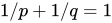
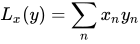
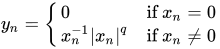
If 1 < p < {\displaystyle 1<p<\infty } , then the (continuous) dual space of p {\displaystyle \textstyle \ell ^{p}} is isometrically isomorphic to q {\displaystyle \textstyle \ell ^{q}} , where q {\displaystyle q} is the Hölder conjugate of p {\displaystyle p} : 1 / p + 1 / q = 1 {\displaystyle 1/p+1/q=1} . The specific isomorphism associates to an element x {\displaystyle x} of q {\displaystyle \textstyle \ell ^{q}} the functional L x ( y ) = n x n y n {\displaystyle L_{x}(y)=\sum _{n}x_{n}y_{n}} for y {\displaystyle y} in p {\displaystyle \textstyle \ell ^{p}} . Hölder's inequality implies that L x {\displaystyle L_{x}} is a bounded linear functional on p {\displaystyle \textstyle \ell ^{p}} , and in fact | L x ( y ) | x q y p {\displaystyle |L_{x}(y)|\leq \|x\|_{q}\,\|y\|_{p}} so that the operator norm satisfies L x ( p ) = d e f sup y p , y 0 | L x ( y ) | y p x q . {\displaystyle \|L_{x}\|_{(\ell ^{p})^{*}}\mathrel {\stackrel {\rm {def}}{=}} \sup _{y\in \ell ^{p},y\not =0}{\frac {|L_{x}(y)|}{\|y\|_{p}}}\leq \|x\|_{q}.} In fact, taking y {\displaystyle y} to be the element of p {\displaystyle \textstyle \ell ^{p}} with y n = { 0 if   x n = 0 x n 1 | x n | q if   x n 0 {\displaystyle y_{n}={\begin{cases}0&{\text{if}}\ x_{n}=0\\x_{n}^{-1}|x_{n}|^{q}&{\text{if}}~x_{n}\neq 0\end{cases}}} gives L x ( y ) = x q {\displaystyle L_{x}(y)=\|x\|_{q}} , so that in fact L x ( p ) = x q . {\displaystyle \|L_{x}\|_{(\ell ^{p})^{*}}=\|x\|_{q}.} Conversely, given a bounded linear functional L {\displaystyle L} on p {\displaystyle \textstyle \ell ^{p}} , the sequence defined by x n = L ( e n ) {\displaystyle x_{n}=L(e_{n})} lies in q {\displaystyle \textstyle \ell ^{q}} . Thus the mapping x L x {\displaystyle x\mapsto L_{x}} gives an isometry κ q : q ( p ) . {\displaystyle \kappa _{q}:\ell ^{q}\to (\ell ^{p})^{*}.}

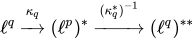
The map q κ q ( p ) ( κ q ) 1 ( q ) {\displaystyle \ell ^{q}\xrightarrow {\kappa _{q}} (\ell ^{p})^{*}\xrightarrow {(\kappa _{q}^{*})^{-1}} (\ell ^{q})^{**}} obtained by composing κ p {\displaystyle \kappa _{p}} with the inverse of its transpose coincides with the canonical injection of q {\displaystyle \textstyle \ell ^{q}} into its double dual. As a consequence q {\displaystyle \textstyle \ell ^{q}} is a reflexive space. By abuse of notation, it is typical to identify q {\displaystyle \textstyle \ell ^{q}} with the dual of p {\displaystyle \textstyle \ell ^{p}} : ( p ) = q {\displaystyle \textstyle (\ell ^{p})^{*}=\ell ^{q}} . Then reflexivity is understood by the sequence of identifications ( p ) = ( q ) = p {\displaystyle \textstyle (\ell ^{p})^{**}=(\ell ^{q})^{*}=\ell ^{p}} .

The space c 0 {\displaystyle c_{0}} is defined as the space of all sequences converging to zero, with norm identical to x {\displaystyle \|x\|_{\infty }} . It is a closed subspace of {\displaystyle \textstyle \ell ^{\infty }} , hence a Banach space. The dual of c 0 {\displaystyle c_{0}} is 1 {\displaystyle \textstyle \ell ^{1}} ; the dual of 1 {\displaystyle \textstyle \ell ^{1}} is {\displaystyle \textstyle \ell ^{\infty }} . For the case of natural numbers index set, the p {\displaystyle \textstyle \ell ^{p}} and c 0 {\displaystyle c_{0}} are separable, with the sole exception of {\displaystyle \textstyle \ell ^{\infty }} . The dual of {\displaystyle \textstyle \ell ^{\infty }} is the ba space.

The spaces c 0 {\displaystyle c_{0}} and p {\displaystyle \textstyle \ell ^{p}} (for 1 p < {\displaystyle 1\leq p<\infty } ) have a canonical unconditional Schauder basis { e i : i = 1 , 2 , } {\displaystyle \{e_{i}:i=1,2,\ldots \}} , where e i {\displaystyle e_{i}} is the sequence which is zero but for a 1 {\displaystyle 1} in the i {\displaystyle i} th entry.

The space ℓ1 has the Schur property: In ℓ1, any sequence that is weakly convergent is also strongly convergent (Schur 1921). However, since the weak topology on infinite-dimensional spaces is strictly weaker than the strong topology, there are nets in ℓ1 that are weak convergent but not strong convergent.

The p {\displaystyle \textstyle \ell ^{p}} spaces can be embedded into many Banach spaces. The question of whether every infinite-dimensional Banach space contains an isomorph of some p {\displaystyle \textstyle \ell ^{p}} or of c 0 {\displaystyle c_{0}} , was answered negatively by B. S. Tsirelson's construction of Tsirelson space in 1974. The dual statement, that every separable Banach space is linearly isometric to a quotient space of 1 {\displaystyle \textstyle \ell ^{1}} , was answered in the affirmative by Banach & Mazur (1933). That is, for every separable Banach space X {\displaystyle X} , there exists a quotient map Q : 1 X {\displaystyle \textstyle Q:\ell ^{1}\to X} , so that X {\displaystyle X} is isomorphic to 1 / ker Q {\displaystyle \textstyle \ell ^{1}/\ker Q} . In general, ker Q {\displaystyle \operatorname {ker} Q} is not complemented in 1 {\displaystyle \textstyle \ell ^{1}} , that is, there does not exist a subspace Y {\displaystyle Y} of 1 {\displaystyle \textstyle \ell ^{1}} such that 1 = Y ker Q {\displaystyle \textstyle \ell ^{1}=Y\oplus \ker Q} . In fact, 1 {\displaystyle \textstyle \ell ^{1}} has uncountably many uncomplemented subspaces that are not isomorphic to one another (for example, take X = p {\displaystyle \textstyle X=\ell ^{p}} ; since there are uncountably many such X {\displaystyle X} 's, and since no p {\displaystyle \textstyle \ell ^{p}} is isomorphic to any other, there are thus uncountably many ker Q's).

Except for the trivial finite-dimensional case, an unusual feature of q {\displaystyle \textstyle \ell ^{q}} is that it is not polynomially reflexive.

p spaces are increasing in p

For p [ 1 , ] {\displaystyle p\in [1,\infty ]} , the spaces p {\displaystyle \textstyle \ell ^{p}} are increasing in p {\displaystyle p} , with the inclusion operator being continuous: for 1 p < q {\displaystyle 1\leq p<q\leq \infty } , one has x q x p {\displaystyle \|x\|_{q}\leq \|x\|_{p}} . Indeed, the inequality is homogeneous in the x i {\displaystyle x_{i}} , so it is sufficient to prove it under the assumption that x p = 1 {\displaystyle \|x\|_{p}=1} . In this case, we need only show that | x i | q 1 {\displaystyle \textstyle \sum |x_{i}|^{q}\leq 1} for q > p {\displaystyle q>p} . But if x p = 1 {\displaystyle \|x\|_{p}=1} , then | x i | 1 {\displaystyle |x_{i}|\leq 1} for all i {\displaystyle i} , and then | x i | q {\displaystyle \textstyle \sum |x_{i}|^{q}\leq {}\!} | x i | p = 1 {\displaystyle \textstyle \sum |x_{i}|^{p}=1} .

2 is isomorphic to all separable, infinite dimensional Hilbert spaces

Let H {\displaystyle H} be a separable Hilbert space. Every orthogonal set in H {\displaystyle H} is at most countable (i.e. has finite dimension or 0 {\displaystyle \aleph _{0}} ).[2] The following two items are related:

  • If H {\displaystyle H} is infinite dimensional, then it is isomorphic to 2 {\displaystyle \textstyle \ell ^{2}} ,
  • If dim ( H ) = N {\displaystyle \operatorname {dim} (H)=N} , then H {\displaystyle H} is isomorphic to C N {\displaystyle \textstyle \mathbb {C} ^{N}} .

Properties of 1 spaces

A sequence of elements in 1 {\displaystyle \textstyle \ell ^{1}} converges in the space of complex sequences 1 {\displaystyle \textstyle \ell ^{1}} if and only if it converges weakly in this space.[3] If K {\displaystyle K} is a subset of this space, then the following are equivalent:[3]

  1. K {\displaystyle K} is compact;
  2. K {\displaystyle K} is weakly compact;
  3. K {\displaystyle K} is bounded, closed, and equismall at infinity.

Here K {\displaystyle K} being equismall at infinity means that for every ε > 0 {\displaystyle \varepsilon >0} , there exists a natural number n ε 0 {\displaystyle n_{\varepsilon }\geq 0} such that n = n ϵ | s n | < ε {\displaystyle \textstyle \sum _{n=n_{\epsilon }}^{\infty }|s_{n}|<\varepsilon } for all s = ( s n ) n = 1 K {\displaystyle \textstyle s=\left(s_{n}\right)_{n=1}^{\infty }\in K} .

See also

References

  1. ^ a b c Jarchow 1981, pp. 129–130.
  2. ^ Debnath, Lokenath; Mikusinski, Piotr (2005). Hilbert Spaces with Applications. Elsevier. pp. 120–121. ISBN 978-0-12-2084386.
  3. ^ a b Trèves 2006, pp. 451–458.

Bibliography

  • Banach, Stefan; Mazur, S. (1933), "Zur Theorie der linearen Dimension", Studia Mathematica, 4: 100–112, doi:10.4064/sm-4-1-100-112.
  • Dunford, Nelson; Schwartz, Jacob T. (1958), Linear operators, volume I, Wiley-Interscience.
  • Jarchow, Hans (1981). Locally convex spaces. Stuttgart: B.G. Teubner. ISBN 978-3-519-02224-4. OCLC 8210342.
  • Pitt, H.R. (1936), "A note on bilinear forms", J. London Math. Soc., 11 (3): 174–180, doi:10.1112/jlms/s1-11.3.174.
  • Narici, Lawrence; Beckenstein, Edward (2011). Topological Vector Spaces. Pure and applied mathematics (Second ed.). Boca Raton, FL: CRC Press. ISBN 978-1584888666. OCLC 144216834.
  • Schaefer, Helmut H.; Wolff, Manfred P. (1999). Topological Vector Spaces. GTM. Vol. 8 (Second ed.). New York, NY: Springer New York Imprint Springer. ISBN 978-1-4612-7155-0. OCLC 840278135.
  • Schur, J. (1921), "Über lineare Transformationen in der Theorie der unendlichen Reihen", Journal für die reine und angewandte Mathematik, 151: 79–111, doi:10.1515/crll.1921.151.79.
  • Trèves, François (2006) [1967]. Topological Vector Spaces, Distributions and Kernels. Mineola, N.Y.: Dover Publications. ISBN 978-0-486-45352-1. OCLC 853623322.
Retrieved from "https://en.wikipedia.org/w/index.php?title=Sequence_space&oldid=1333979572"