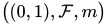
確率論 において、標準確率空間は 、ルベーグ・ロクリン確率空間 、または単にルベーグ空間 ウラジミール・ロクリン によって導入された特定の仮定を満たす確率空間 です。 非公式には、区間および/または有限または可算数の原子からなる確率空間です
標準確率空間の理論は、 1932年にフォン・ノイマン によって着想を得、 1940年にウラジミール・ロクリン によって形作られました。ロクリン氏は、ルベーグ測度 を備えた単位区間は 一般確率空間に比べて重要な利点を持つものの、確率論においてこれらの多くの空間を効果的に代替できることを示しました。単位区間の次元は障害にはなりません。これはノーバート・ウィーナー にも既に明らかでした。彼はウィーナー過程 (ブラウン運動 とも呼ばれる)を、単位区間から連続関数の空間への 測定可能な 写像 の形で構築しました。
略歴 標準確率空間の理論は、1932年にフォン・ノイマンによって始められ [ 1 ] ウラジミール・ロクリン によって形作られました[ 2 ]。 Haezendonck 1973 )、( de la Rue 1993 )、( Itô 1984、2.4 節)、および( Rudolph 1990 、第2章) を参照してください
今日では、標準確率空間は、標準ボレル空間を介して記述 集合論 の枠組みで扱われる場合があり(そしてしばしば扱われている)、例えば(Kechris 1995 、第17節)を参照のこと。このアプローチは、標準ボレル空間 の同型定理 に基づいている(Kechris 1995 、定理(15.6))。 測度論 に基づくRokhlinの代替アプローチは、記述集合論とは対照的に、空集合を 無視する。標準確率空間は、エルゴード理論 で日常的に用いられている。[ 3 ] [ 4 ]
定義 標準性に関する、よく知られている同値な定義の1つを、いくつかの準備の後、以下に示す。すべての確率空間は 完備 で あると仮定する
同型性 2 つの確率空間 間の同型 写像は、および が両方とも (測定可能かつ)測度保存写像 であるような可逆 写像です。 ( Ω 1 、 F 1 、 P 1 ) {\displaystyle \textstyle (\Omega_{1},{\mathcal{F}}_{1},P_{1})} ( Ω 2 、 F 2 、 P 2 ) {\displaystyle \textstyle (\Omega _{2},{\mathcal {F}}_{2},P_{2})} f : Ω 1 → Ω 2 {\displaystyle \textstyle f:\Omega _{1}\to \Omega _{2}} f {\displaystyle \textstyle f} f − 1 {\displaystyle \textstyle f^{-1}}
2 つの確率空間の間に同型性が存在する場合、それらの空間は同型です。
ゼロを法とする同型性 2つの確率空間 は、空集合 が存在し、確率空間 が同型である(シグマ体と確率測度が自然に備わっている)場合、 同型である( Ω 1 、 F 1 、 P 1 ) {\displaystyle \textstyle (\Omega_{1},{\mathcal{F}}_{1},P_{1})} ( Ω 2 、 F 2 、 P 2 ) {\displaystyle \textstyle (\Omega _{2},{\mathcal {F}}_{2},P_{2})} mod 0 {\displaystyle \textstyle \operatorname {mod} \,0} A 1 ⊂ Ω 1 {\displaystyle \textstyle A_{1}\subset \Omega _{1}} A 2 ⊂ Ω 2 {\displaystyle \textstyle A_{2}\subset \Omega _{2}} Ω 1 ∖ A 1 {\displaystyle \textstyle \Omega_{1}\setminusA_{1}} Ω 2 ∖ A 2 {\displaystyle \textstyle \Omega_{2}\setminusA_{2}}
標準確率空間 確率空間は、ルベーグ測度を持つ区間、有限または可算な原子の集合、あるいはその両方の組み合わせ(非結合和)と同型で ある場合、標準確率空間と呼ばれます mod 0 {\displaystyle \textstyle \operatorname {mod} \,0}
( Rokhlin 1952 、 2.4節 (20ページ))、( Haezendonck 1973 、命題6 (249ページ)および備考2 (250ページ))、( de la Rue 1993 、定理4-3)を参照。また、( Kechris 1995 、 17.F節)、( Itô 1984 、特に 2.4節および演習3.1(v))も参照。( Petersen 1983 、 16ページの定義4.5)では、測度は必ずしも確率的ではなく有限であると仮定されている。( Sinai 1994 、 16ページの定義1)では、アトムは許可されていない。
非標準確率空間の例
素朴なホワイトノイズ すべての関数の空間は、実数直線 のコピーの連続体の積と考えることができる。例えば、標準正規分布 のような 確率測度を与え、関数の空間を同一の確率空間 の連続体の積として扱うこともできる。積測度 は 上の確率測度である。素朴に考えると、 はホワイトノイズ を記述しているように見えるかもしれない。 f : R → R {\displaystyle \textstyle f:\mathbb{R}\to\mathbb{R}} R R {\displaystyle \textstyle \mathbb{R}^{\mathbb{R}}} R {\displaystyle \textstyle \mathbb {R} } R {\displaystyle \textstyle \mathbb {R} } γ = N ( 0 、 1 ) {\displaystyle \textstyle \gamma =N(0,1)} ( R 、 γ ) R {\displaystyle \textstyle (\mathbb {R} ,\gamma )^{\mathbb {R} }} ( R 、 γ ) {\displaystyle \textstyle (\mathbb {R} ,\gamma )} γ R {\displaystyle \textstyle \gamma ^{\mathbb {R} }} R R {\displaystyle \textstyle \mathbb{R}^{\mathbb{R}}} γ R {\displaystyle \textstyle \gamma ^{\mathbb {R} }}
しかし、ホワイトノイズ関数の0から1への積分は、N (0, 1)に分布する確率変数となるはずである。これに対し、の積分(0から1)は未定義である。また、 ƒ は ほぼ確実に 測定可能ではなく、 ƒ が測定可能である確率も未定義である。実際、もしXが(例えば)(0, 1)に一様分布し、 ƒ に依存しない確率変数である場合、ƒ ( X ) は全く確率変数ではない(測定可能性を欠く)。 f ∈ ( R 、 γ ) R {\displaystyle \textstyle f\in \textstyle (\mathbb{R},\gamma)^{\mathbb{R}}}
穴あき間隔 内部 ルベーグ測度が0であるが外部 ルベーグ測度が1である(したがって、極限まで非可測で ある)集合 とする。任意のルベーグ可測 に対してとなるような確率測度が上に存在する。(これがルベーグ測度である。)確率空間 上の事象および確率変数( と扱われる)は、確率空間 上の事象および確率変数と自然に1対1に対応する 。確率空間 はと同じくらい良いように見えるかもしれない。 Z ⊂ ( 0 、 1 ) {\displaystyle \textstyle Z\subset (0,1)} Z {\displaystyle \textstyle Z} m {\displaystyle \textstyle m} Z {\displaystyle \textstyle Z} m ( Z ∩ A ) = mes ( A ) {\displaystyle \textstyle m(Z\cap A)=\オペレータ名 {mes} (A)} A ⊂ ( 0 、 1 ) {\displaystyle \textstyle A\subset (0,1)} mes {\displaystyle \textstyle \operatorname {mes} } ( Z 、 m ) {\displaystyle \textstyle (Z,m)} mod 0 {\displaystyle \textstyle \operatorname {mod} \,0} ( ( 0 、 1 ) 、 mes ) {\displaystyle \textstyle ((0,1),\operatorname {mes} )} ( Z 、 m ) {\displaystyle \textstyle (Z,m)} ( ( 0 、 1 ) 、 mes ) {\displaystyle \textstyle ((0,1),\operatorname {mes} )}
しかし、そうではありません。によって定義される確率変数は上で一様分布します。 が与えられた場合、条件付き測度は、が基礎となる確率空間である限り、における単一の原子に過ぎません。しかし、の代わりに を使用すると、 の場合には条件付き測度は存在しません。 X {\displaystyle \textstyle X} X ( ω ) = ω {\displaystyle \textstyle X(\omega)=\omega} ( 0 、 1 ) {\displaystyle \textstyle (0,1)} X = x {\displaystyle \textstyle X=x} x {\displaystyle \textstyle x} ( ( 0 、 1 ) 、 mes ) {\displaystyle \textstyle ((0,1),\operatorname {mes} )} ( Z 、 m ) {\displaystyle \textstyle (Z,m)} x ∉ Z {\displaystyle \textstyle x\notin Z}
穴あき円も同様に構築されます。その事象と確率変数は通常の円の場合と同じです。回転群はそれらに自然に作用します。しかし、穴あき円には作用しません。
(ルドルフ1990、17 ページも参照)
余分な測定可能なセット 前の例のように、 と の形をした集合は任意のルベーグ可測集合であり、 はσ-代数であり、はルベーグσ-代数と を含む。 Z ⊂ ( 0 、 1 ) {\displaystyle \textstyle Z\subset (0,1)} ( A ∩ Z ) ∪ ( B ∖ Z ) 、 {\displaystyle \textstyle (A\cap Z)\cup (B\setminus Z),} A {\displaystyle \textstyle A} B {\displaystyle \textstyle B} F ; {\displaystyle \textstyle {\mathcal {F}};} Z 。 {\displaystyle \textstyle Z}
m ( ( A ∩ Z ) ∪ ( B ∖ Z ) ) = p mes ( A ) + ( 1 − p ) mes ( B ) {\displaystyle \displaystyle m{\big (}(A\cap Z)\cup (B\setminus Z){\big )}=p\,\operatorname {mes} (A)+(1-p)\operatorname {mes} (B)} は、ルベーグ測度を拡張する確率測度の一般形を与える。ここではパラメータである。具体的には、次のように選ぶ。ルベーグ測度のこのような拡張は、少なくとも無害であるように思えるかもしれない。 m {\displaystyle \textstyle m} ( ( 0 、 1 ) 、 F ) {\displaystyle \textstyle {\big (}(0,1),{\mathcal {F}}{\big )}} p ∈ [ 0 、 1 ] {\displaystyle \textstyle p\in [0,1]} p = 0.5 {\displaystyle \textstyle p=0.5.}
しかし、それはミシン目模様の隠された部分です。地図は
f ( x ) = { 0.5 x のために x ∈ Z 、 0.5 + 0.5 x のために x ∈ ( 0 、 1 ) ∖ Z {\displaystyle f(x)={\begin{cases}0.5x&{\text{for }}x\in Z,\\0.5+0.5x&{\text{for }}x\in (0,1)\setminus Z\end{cases}}} は、集合に対応する穿孔区間と 同型である。( ( 0 、 1 ) 、 F 、 m ) {\displaystyle \textstyle {\big (}(0,1),{\mathcal {F}},m{\big )}}
Z 1 = { 0.5 x : x ∈ Z } ∪ { 0.5 + 0.5 x : x ∈ ( 0 、 1 ) ∖ Z } 、 {\displaystyle \displaystyle Z_{1}=\{0.5x:x\in Z\}\cup \{0.5+0.5x:x\in (0,1)\setminus Z\}\,,} 内部のルベーグ測度が 0 だが外部のルベーグ測度が 1 の別のセット。
(ルドルフ1990、18 ページの演習2.11 も参照)。
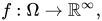
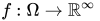
標準性の基準 与えられた確率空間の標準性は、からへの測定可能な写像の特定の性質と等価である。答え(標準的か否か)は、との選択に依存しない。この事実は非常に有用であり、との選択を与えられた に適応させることができる。すべてのケースを調べる必要はない。ランダム変数、ランダムベクトル、ランダムシーケンス、または2値ランダム変数のシーケンスとして扱われるイベントシーケンスを調べるのが便利かもしれない。( Ω 、 F 、 P ) {\displaystyle \textstyle (\Omega,{\mathcal {F}},P)} f {\displaystyle \textstyle f} ( Ω 、 F 、 P ) {\displaystyle \textstyle (\Omega,{\mathcal {F}},P)} ( X 、 Σ ) 。 {\displaystyle \textstyle (X,\Sigma ).} ( X 、 Σ ) {\displaystyle \textstyle (X,\Sigma )} f {\displaystyle \textstyle f} ( X 、 Σ ) {\displaystyle \textstyle (X,\Sigma )} f {\displaystyle \textstyle f} ( Ω 、 F 、 P ) 。 {\displaystyle \textstyle (\Omega ,{\mathcal {F}},P).} f : Ω → R 、 {\displaystyle \textstyle f:\Omega \to \mathbb {R} ,} f : Ω → R n , {\displaystyle \textstyle f:\Omega \to \mathbb {R} ^{n},} f : Ω → R ∞ , {\displaystyle \textstyle f:\Omega \to \mathbb {R} ^{\infty },} ( A 1 , A 2 , … ) {\displaystyle \textstyle (A_{1},A_{2},\dots )} f : Ω → { 0 , 1 } ∞ . {\displaystyle \textstyle f:\Omega \to \{0,1\}^{\infty }.}
(単射かつ 生成的であること)には2つの条件が課される。以下では、そのような条件が与えられていると仮定する。その存在に関する問題は後ほど扱う。 f {\displaystyle \textstyle f} f {\displaystyle \textstyle f}
確率空間は完全 であると仮定されます(そうでない場合は標準にはなりません)。 ( Ω , F , P ) {\displaystyle \textstyle (\Omega ,{\mathcal {F}},P)}
単一のランダム変数 測定可能な関数は、プッシュフォワード測度 を誘導します。これは、 f : Ω → R {\displaystyle \textstyle f:\Omega \to \mathbb {R} } f ∗ P {\displaystyle f_{*}P} μ {\displaystyle \textstyle \mu } R , {\displaystyle \textstyle \mathbb {R} ,}
μ ( B ) = ( f ∗ P ) ( B ) = P ( f − 1 ( B ) ) {\displaystyle \displaystyle \mu (B)=(f_{*}P)(B)=P{\big (}f^{-1}(B){\big )}} B ⊂ R . {\displaystyle \textstyle B\subset \mathbb {R} .} つまり、確率変数の分布である 。この像は常に完全な外測度の集合である。 f {\displaystyle f} f ( Ω ) {\displaystyle \textstyle f(\Omega )}
μ ∗ ( f ( Ω ) ) = inf B ⊃ f ( Ω ) μ ( B ) = inf B ⊃ f ( Ω ) P ( f − 1 ( B ) ) = P ( Ω ) = 1 , {\displaystyle \displaystyle \mu ^{*}{\big (}f(\Omega ){\big )}=\inf _{B\supset f(\Omega )}\mu (B)=\inf _{B\supset f(\Omega )}P(f^{-1}(B))=P(\Omega )=1,} しかし、その内部の音程は 異なる可能性がある(有孔音程を 参照)。言い換えれば、完全な音程 の集合である必要はない。f ( Ω ) {\displaystyle \textstyle f(\Omega )} μ . {\displaystyle \textstyle \mu .}
測定可能な関数は、すべてのボレル集合上で実行される逆像の σ-代数の に関する完備化 である場合に生成する と呼ばれます。 f : Ω → R {\displaystyle \textstyle f:\Omega \to \mathbb {R} } F {\displaystyle \textstyle {\mathcal {F}}} P {\displaystyle P} f − 1 ( B ) , {\displaystyle \textstyle f^{-1}(B),} B ⊂ R {\displaystyle \textstyle B\subset \mathbb {R} }
注意。 次の条件はが生成する ためには不十分です: 任意の に対して、 ( は対称差 を意味する)を満たすボレル集合が存在する。 f {\displaystyle \textstyle f} A ∈ F {\displaystyle \textstyle A\in {\mathcal {F}}} B ⊂ R {\displaystyle \textstyle B\subset \mathbb {R} } P ( A Δ f − 1 ( B ) ) = 0. {\displaystyle \textstyle P(A{\mathbin {\Delta }}f^{-1}(B))=0.} Δ {\displaystyle \textstyle \Delta }
定理。 測定可能な関数が単射かつ生成的である場合、次の2つの条件は同値である。 f : Ω → R {\displaystyle \textstyle f:\Omega \to \mathbb {R} }
μ ( f ( Ω ) ) = 1 {\displaystyle \mu (\textstyle f(\Omega ))=1} f ( Ω ) {\displaystyle \textstyle f(\Omega )} ( Ω , F , P ) {\displaystyle (\Omega ,{\mathcal {F}},P)\,} (伊藤1984 、第3.1節) も参照。
ランダムベクトル 任意の(の代わりに)に対して同じ定理が成り立ちます。測定可能な関数は、ランダム変数の有限列と考えることができ、 が生成関数である場合、そしてが によって生成されるσ-代数の完備化である場合に限りますR n {\displaystyle \mathbb {R} ^{n}\,} R {\displaystyle \mathbb {R} \,} f : Ω → R n {\displaystyle f:\Omega \to \mathbb {R} ^{n}\,} X 1 , … , X n : Ω → R , {\displaystyle X_{1},\dots ,X_{n}:\Omega \to \mathbb {R} ,\,} f {\displaystyle f\,} F {\displaystyle {\mathcal {F}}\,} X 1 , … , X n . {\displaystyle X_{1},\dots ,X_{n}.\,}
ランダムな数列 この定理は無限数列の空間でも成り立ちます。測定可能な関数はランダム変数の無限数列と考えることができ、σ-代数の完備化が生成関数であるためには ...R ∞ {\displaystyle \mathbb {R} ^{\infty }\,} f : Ω → R ∞ {\displaystyle f:\Omega \to \mathbb {R} ^{\infty }\,} X 1 , X 2 , ⋯ : Ω → R , {\displaystyle X_{1},X_{2},\dots :\Omega \to \mathbb {R} ,\,} f {\displaystyle f\,} F {\displaystyle {\mathcal {F}}\,} X 1 , X 2 , … . {\displaystyle X_{1},X_{2},\dots .\,}
一連の出来事 特に、確率変数が0と1の2つの値のみを取る場合、測定可能な関数と集合の列を扱う。関数が生成的であることは、σ-代数の完備化がX n {\displaystyle X_{n}\,} f : Ω → { 0 , 1 } ∞ {\displaystyle f:\Omega \to \{0,1\}^{\infty }\,} A 1 , A 2 , … ∈ F . {\displaystyle A_{1},A_{2},\ldots \in {\mathcal {F}}.\,} f {\displaystyle f\,} F {\displaystyle {\mathcal {F}}\,} A 1 , A 2 , … . {\displaystyle A_{1},A_{2},\dots .\,}
先駆的な研究 ( Rokhlin 1952 )では、単射で生成的な列は確率空間の基底 と呼ばれています( Rokhlin 1952 、2.1節を参照)。基底が完全 mod 0 と呼ばれるのは、完全測度である場合です( Rokhlin 1952 、2.2節を参照)。同じ節で、Rokhlin は、確率空間がある基底に関して mod 0 が完全であれば、他のすべての基底に関しても mod 0 が完全であることを証明し、この完全性によってルベーグ空間を定義しました。 ( Haezendonck 1973 、命題4および定義7) および ( Rudolph 1990 、2.3節、特に定理2.2) も参照してください。A 1 , A 2 , … {\displaystyle A_{1},A_{2},\ldots \,} f {\displaystyle f\,} ( Ω , F , P ) {\displaystyle (\Omega ,{\mathcal {F}},P)\,} f ( Ω ) {\displaystyle f(\Omega )\,} μ , {\displaystyle \mu ,\,}
上記で扱った4つのケースは互いに同値であり、可測空間とが互いに同型であるため統合できます。これらはすべて標準可測空間 (言い換えれば、標準ボレル空間) ですR , {\displaystyle \mathbb {R} ,\,} R n , {\displaystyle \mathbb {R} ^{n},\,} R ∞ {\displaystyle \mathbb {R} ^{\infty }\,} { 0 , 1 } ∞ {\displaystyle \{0,1\}^{\infty }\,}
から標準測定可能空間への入射的測定可能関数の存在は、の選択には依存しません。を選択すると、可算分離 である(ただし、Itô 1984 では分離可能 と呼ばれています)というよく知られた特性が得られます。 ( Ω , F , P ) {\displaystyle \textstyle (\Omega ,{\mathcal {F}},P)} ( X , Σ ) {\displaystyle \textstyle (X,\Sigma )} ( X , Σ ) . {\displaystyle \textstyle (X,\Sigma ).} ( X , Σ ) = { 0 , 1 } ∞ {\displaystyle \textstyle (X,\Sigma )=\{0,1\}^{\infty }}
から標準測定可能空間への生成測定可能関数の存在も、 の選択には依存しません。を選択すると、可算生成 (mod 0)としてよく知られている特性が得られます( Durrett 1996 、Exer. I.5 を参照)。 ( Ω , F , P ) {\displaystyle \textstyle (\Omega ,{\mathcal {F}},P)} ( X , Σ ) {\displaystyle \textstyle (X,\Sigma )} ( X , Σ ) . {\displaystyle \textstyle (X,\Sigma ).} ( X , Σ ) = { 0 , 1 } ∞ {\displaystyle \textstyle (X,\Sigma )=\{0,1\}^{\infty }}
確率空間 可算的に分離 可算的に生成 標準 ルベーグ測度を持つ区間 はい はい はい ナイーブホワイトノイズ いいえ いいえ いいえ 穴あき音程 はい はい いいえ
標準 確率空間から標準 可測空間へのすべての単射可測関数は生成的である。( Rokhlin 1952 、2.5節)、( Haezendonck 1973 、253ページの系2)、( de la Rue 1993 、定理3-4および3-5)を参照。この性質は、上記の「余分な可測集合」の節で扱った非標準確率空間には当てはまらない。
注意。 可算生成性は mod 0 同型に対して不変ですが、可算分離性は不変ではありません。実際、標準確率空間が可算分離であるためには、の濃度が 連続体 を超えない必要があります( Itô 1984 、Exer. 3.1(v) を参照)。標準確率空間は任意の濃度の空集合を含むことができるため、必ずしも可算分離である必要はありません。ただし、常に完全測度の可算分離部分集合を含みます。 ( Ω , F , P ) {\displaystyle \textstyle (\Omega ,{\mathcal {F}},P)} Ω {\displaystyle \textstyle \Omega }
同値の定義 を完備確率空間とし、その濃度は連続体を超えないものとする(一般的な場合はこの特殊なケースに還元される。上記の注意を参照)。 ( Ω , F , P ) {\displaystyle \textstyle (\Omega ,{\mathcal {F}},P)} Ω {\displaystyle \textstyle \Omega }
絶対的な測定可能性を介して 定義。 可算的に分離され、可算的に生成され、絶対的に測定可能である場合、標準的である ( Ω , F , P ) {\displaystyle \textstyle (\Omega ,{\mathcal {F}},P)}
( Rokhlin 1952 、2.3節末尾) および ( Haezendonck 1973 、248ページの注釈2) を参照。「絶対的に測定可能」とは、それを含む可算的に分離され、可算的に生成されたすべての確率空間において測定可能であることを意味する。
完全性を介して 定義。 可算的に分離され、完全である場合、標準です ( Ω , F , P ) {\displaystyle \textstyle (\Omega ,{\mathcal {F}},P)}
( Itô 1984 , 3.1節)を参照。「完全」とは, から への任意の測定可能な関数に対して,像測度が正則 であることを意味する。(ここ で,像測度はのボレル構造に関わらず,に属する逆像を持つすべての集合上で定義される。) ( Ω , F , P ) {\displaystyle \textstyle (\Omega ,{\mathcal {F}},P)} R {\displaystyle \mathbb {R} \,} F {\displaystyle \textstyle {\mathcal {F}}} R {\displaystyle \mathbb {R} \,}
位相を介して 定義: 上 に位相が 存在する場合、標準となる( Ω , F , P ) {\displaystyle \textstyle (\Omega ,{\mathcal {F}},P)} τ {\displaystyle \textstyle \tau } Ω {\displaystyle \textstyle \Omega }
位相空間は計量化可能 である。( Ω , τ ) {\displaystyle \textstyle (\Omega ,\tau )} F {\displaystyle \textstyle {\mathcal {F}}} τ {\displaystyle \textstyle \tau } 任意のに対して、次のようなコンパクト集合が存在する。ε > 0 {\displaystyle \textstyle \varepsilon >0} K {\displaystyle \textstyle K} ( Ω , τ ) {\displaystyle \textstyle (\Omega ,\tau )} P ( K ) ≥ 1 − ε . {\displaystyle \textstyle P(K)\geq 1-\varepsilon .} ( de la Rue 1993 、セクション 1) を参照してください。
標準性の検証 空間上のすべての確率分布は、それを標準確率空間に変換します。(ここで、確率分布とは、ボレルシグマ代数 上で最初に定義され、完成された確率測度を意味します。) R n {\displaystyle \textstyle \mathbb {R} ^{n}}
同じことはすべてのポーランド空間 にも当てはまります。( Rokhlin 1952 、第2.7節(p.24))、( Haezendonck 1973 、例1(p.248))、( de la Rue 1993 、定理2-3)、および( Itô 1984 、定理2.4.1)を参照してください。
たとえば、ウィーナー測度は、ポーランド空間(局所一様収束 の位相 を備えたすべての連続関数の空間)を標準確率空間に変換します。 C [ 0 , ∞ ) {\displaystyle \textstyle C[0,\infty )} [ 0 , ∞ ) → R , {\displaystyle \textstyle [0,\infty )\to \mathbb {R} ,}
別の例: ランダム変数のすべてのシーケンスについて、それらの結合分布は、シーケンスのポーランド空間 (積位相を持つ) を標準確率空間に変換し ます。 R ∞ {\displaystyle \textstyle \mathbb {R} ^{\infty }}
(したがって、位相空間 では非常に自然な次元 の概念は、標準的な確率空間ではまったく不適切です。)
2 つの標準確率空間の積は 標準確率空間です。
可算な空間の積についても同様のことが成り立ちます。( Rokhlin 1952 、第3.4節)、( Haezendonck 1973 、命題12)、( Itô 1984 、定理2.4.3)を参照してください。
標準確率空間の測定可能な部分集合は標準確率空間である。この集合は空集合ではなく、条件付き測度が与えられていると仮定する。( Rokhlin 1952 , 2.3節 (p. 14))および( Haezendonck 1973 , 命題5)を参照。
標準ボレル空間 上のあらゆる確率測度は、 それを標準確率空間に変換します。
標準性の利用
通常の条件付き確率 離散的な設定では、条件付き確率は別の確率測度であり、条件付き期待値は条件付き測度に関する(通常の)期待値として扱うことができます(条件付き期待値 を参照)。非離散的な設定では、条件の確率が0になる可能性があるため、条件付けは間接的に扱われることがよくあります(条件付き期待値 を参照) 。その結果、多くのよく知られた事実には特別な「条件付き」対応があります。例えば、期待値の線形性、イェンセンの不等式 (条件付き期待値 を参照)、ヘルダーの不等式 、単調収束定理 などです
確率空間 上のランダム変数が与えられている場合、条件付き測度、つまり、与えられたの条件付き分布 を構築しようとするのは自然なことです。一般にこれは不可能です(Durrett 1996 、4.1 節 (c) を参照)。しかし、標準的な 確率空間ではこれは可能であり、標準的な測度システム (Rokhlin 1952 、3.1 節を参照)としてよく知られています。これは、条件付き確率測度 (Itô 1984 、3.5 節を参照)、測度の崩壊 Kechris 1995 、演習 (17.35) を参照)、および通常の条件付き確率 Durrett 1996 、4.1 節 (c) を参照))と基本的に同じです。 Y {\displaystyle \textstyle Y} ( Ω , F , P ) {\displaystyle \textstyle (\Omega ,{\mathcal {F}},P)} P y {\displaystyle \textstyle P_{y}} ω ∈ Ω {\displaystyle \textstyle \omega \in \Omega } Y ( ω ) = y {\displaystyle \textstyle Y(\omega )=y} ( Ω , F , P ) {\displaystyle \textstyle (\Omega ,{\mathcal {F}},P)}
条件付きイェンセンの不等式は、(通常の)イェンセンの不等式を条件付き測度に適用したものに過ぎません。他の多くの事実についても同様のことが言えます。
2つの確率空間と測度保存写像が与えられた場合、像は全体を覆う必要はなく、空集合を見逃す可能性があります。 は1に等しくなければならないように見えるかもしれませんが、そうではありません。 の外部測度は1に等しくなりますが、内部測度は異なる場合があります。ただし、確率空間、が標準で ある場合、については、( de la Rue 1993 、定理3-2)を参照してください。も1対1である場合、すべての は、を満たします。したがって、は測定可能(かつ測度保存)です。( Rokhlin 1952、2.5 節(20ページ))および( de la Rue 1993 、定理3-5)を参照してください。また、( Haezendonck 1973 、命題9(およびその後の注釈)) も参照してください( Ω 1 , F 1 , P 1 ) {\displaystyle \textstyle (\Omega _{1},{\mathcal {F}}_{1},P_{1})} ( Ω 2 , F 2 , P 2 ) {\displaystyle \textstyle (\Omega _{2},{\mathcal {F}}_{2},P_{2})} f : Ω 1 → Ω 2 {\displaystyle \textstyle f:\Omega _{1}\to \Omega _{2}} f ( Ω 1 ) {\displaystyle \textstyle f(\Omega _{1})} Ω 2 {\displaystyle \textstyle \Omega _{2}} P 2 ( f ( Ω 1 ) ) {\displaystyle \textstyle P_{2}(f(\Omega _{1}))} f ( Ω 1 ) {\displaystyle \textstyle f(\Omega _{1})} ( Ω 1 , F 1 , P 1 ) {\displaystyle \textstyle (\Omega _{1},{\mathcal {F}}_{1},P_{1})} ( Ω 2 , F 2 , P 2 ) {\displaystyle \textstyle (\Omega _{2},{\mathcal {F}}_{2},P_{2})} P 2 ( f ( Ω 1 ) ) = 1 {\displaystyle \textstyle P_{2}(f(\Omega _{1}))=1} f {\displaystyle \textstyle f} A ∈ F 1 {\displaystyle \textstyle A\in {\mathcal {F}}_{1}} f ( A ) ∈ F 2 {\displaystyle \textstyle f(A)\in {\mathcal {F}}_{2}} P 2 ( f ( A ) ) = P 1 ( A ) {\displaystyle \textstyle P_{2}(f(A))=P_{1}(A)} f − 1 {\displaystyle \textstyle f^{-1}}
「測度空間において測度0の集合を無視する一貫した方法が存在する」(Petersen 1983、15 ページ)。数学者は、空集合を排除しようと努める中で、測定可能な集合や関数の同値類をしばしば用いる。確率空間の測定可能な部分集合の同値類は、測度代数 (または計量構造)と呼ばれるノルム付き完全ブール代数 を形成する。すべての測度保存写像は、基本的に に対して、測度代数の準同型写像を導く。 f : Ω 1 → Ω 2 {\displaystyle \textstyle f:\Omega _{1}\to \Omega _{2}} F {\displaystyle \textstyle F} F ( B ) = f − 1 ( B ) {\displaystyle \textstyle F(B)=f^{-1}(B)} B ∈ F 2 {\displaystyle \textstyle B\in {\mathcal {F}}_{2}}
測度代数の準同型写像はすべて測度保存写像に対応しなければならないように思われるかもしれないが、そうではない。しかし、標準的な 確率空間においては、それぞれが何らかの に対応する。( Rokhlin 1952 , Sect. 2.6 (p. 23) および 3.2)、( Kechris 1995 , Sect. 17.F)、( Petersen 1983 , Theorem 4.7 on page 17) を参照。 F {\displaystyle \textstyle F} f {\displaystyle \textstyle f}
参照 「標準確率空間」 、数学百科事典 EMS Press 、2001 [1994]
注
参考文献 Rokhlin, VA (1952),測度論の基本的考え方について (PDF) , Translations, vol. 71, American Mathematical Society, pp. 1– 54Рохлин、В。 А. (1949)、「Об основных понятиях теории меры」、 Математический Сборник (Новая Серия) 、 25 ( 67): 107–150 フォン・ノイマン、J. (1932)、「単純な図解による単数形図」、Annals of Mathematics 、第2シリーズ、33 (3): 574– 586、doi : 10.2307/1968536 、JSTOR 1968536 ハルモス, PR ;フォン・ノイマン, J. (1942)、「古典力学における演算子法 II」、Annals of Mathematics 、第2集、43 (2): 332– 350、doi : 10.2307/1968872 、JSTOR 1968872 Haezendonck, J. (1973)、「Abstract Lebesgue–Rohlin space」、Bulletin de la Société Mathématique de Belgique 、25 : 243–258 de la Rue, T. (1993)、「Espaces de Lebesgue」、Séminaire de Probabilités XXVII 、Lecture Notes in Mathematics、vol. 1557 年、シュプリンガー、ベルリン、 15 ~ 21ページ {{citation }}: CS1 maint: location missing publisher (link )ピーターセン、K.(1983)『エルゴード理論』 ケンブリッジ大学出版局 伊藤 憲一 (1984) 『確率論入門』 ケンブリッジ大学出版局ルドルフ、DJ(1990)、測定可能な力学の基礎:ルベーグ空間上のエルゴード理論 、オックスフォード:クラレンドン・プレス シナイ、Ya. G. (1994)、「エルゴード理論のトピックス」 、プリンストン大学出版局Kechris, AS (1995),古典的記述集合論 , SpringerDurrett, R. (1996)、「確率:理論と例」 (第2版)Wiener, N. (1958)、ランダム理論における非線形問題 、MIT Press







![{\displaystyle \textstyle p\in [0,1]}](https://wikimedia.org/api/rest_v1/media/math/render/svg/443da9647eb57aeafde3c68e28810231bf6e9fb2)