1405 Sibelius
| Discovery[1] | |
|---|---|
| Discovered by | Y. Väisälä |
| Discovery site | Turku Obs. |
| Discovery date | 12 September 1936 |
| Designations | |
| (1405) Sibelius | |
Named after | Jean Sibelius(Finnish composer)[2] |
| 1936 RE · 1951 CO1953 VK3 · 1963 ST | |
| main-belt ·Flora[3] | |
| Orbital characteristics[1] | |
| Epoch 4 September 2017 (JD 2458000.5) | |
| Uncertainty parameter 0 | |
| Observation arc | 66.40 yr (24,254 days) |
| Aphelion | 2.5817 AU |
| Perihelion | 1.9215 AU |
| 2.2516 AU | |
| Eccentricity | 0.1466 |
| 3.38 yr (1,234 days) | |
| 312.34° | |
| 0° 17m 30.12s / day | |
| Inclination | 7.0301° |
| 312.08° | |
| 95.795° | |
| Physical characteristics | |
| Dimensions | 6.21±0.35 km[4]6.810±0.098 km[5]7.175±0.089 km[6]7.20 km (taken)[3]7.204 km[7]9.26±1.95 km[8]12.18±1.1 km[9] |
| 6.051±0.001h[a][b] | |
| 0.1432±0.029[9]0.27±0.15[8]0.3191[7]0.3516±0.0646[6]0.388±0.040[5]0.458±0.068[4] | |
| S[3][10] | |
| 12.03 (R)[a] · 12.3[9] · 12.48[6] · 12.5[1][4][8] ·12.57±0.078[3][7] ·12.57±0.33[10] | |
1405 Sibelius (provisional designation1936 RE) is a stony Florian asteroid from the inner regions of the asteroid belt, approximately 8 kilometers in diameter. It was discovered on 12 September 1936, by Finnish astronomer Yrjö Väisälä at Turku Observatory in Southwest Finland.[11] The asteroid was named after composer Jean Sibelius.[2]
Orbit and classification
Sibelius is a member of the Flora family, one of the largest populations of stony asteroids in the entire main-belt. It orbits the Sun in the inner main-belt at a distance of 1.9–2.6 AU once every 3 years and 5 months (1,234 days). Its orbit has an eccentricity of 0.15 and an inclination of 7° with respect to the ecliptic.[1] The body's observation arc begins with an observation taken at Turku two weeks prior to its official discovery observation.[11]
Physical characteristics
Sibelius has been characterized as an S-type asteroid by the Pan-STARRS photometric survey.[10]
Rotation period
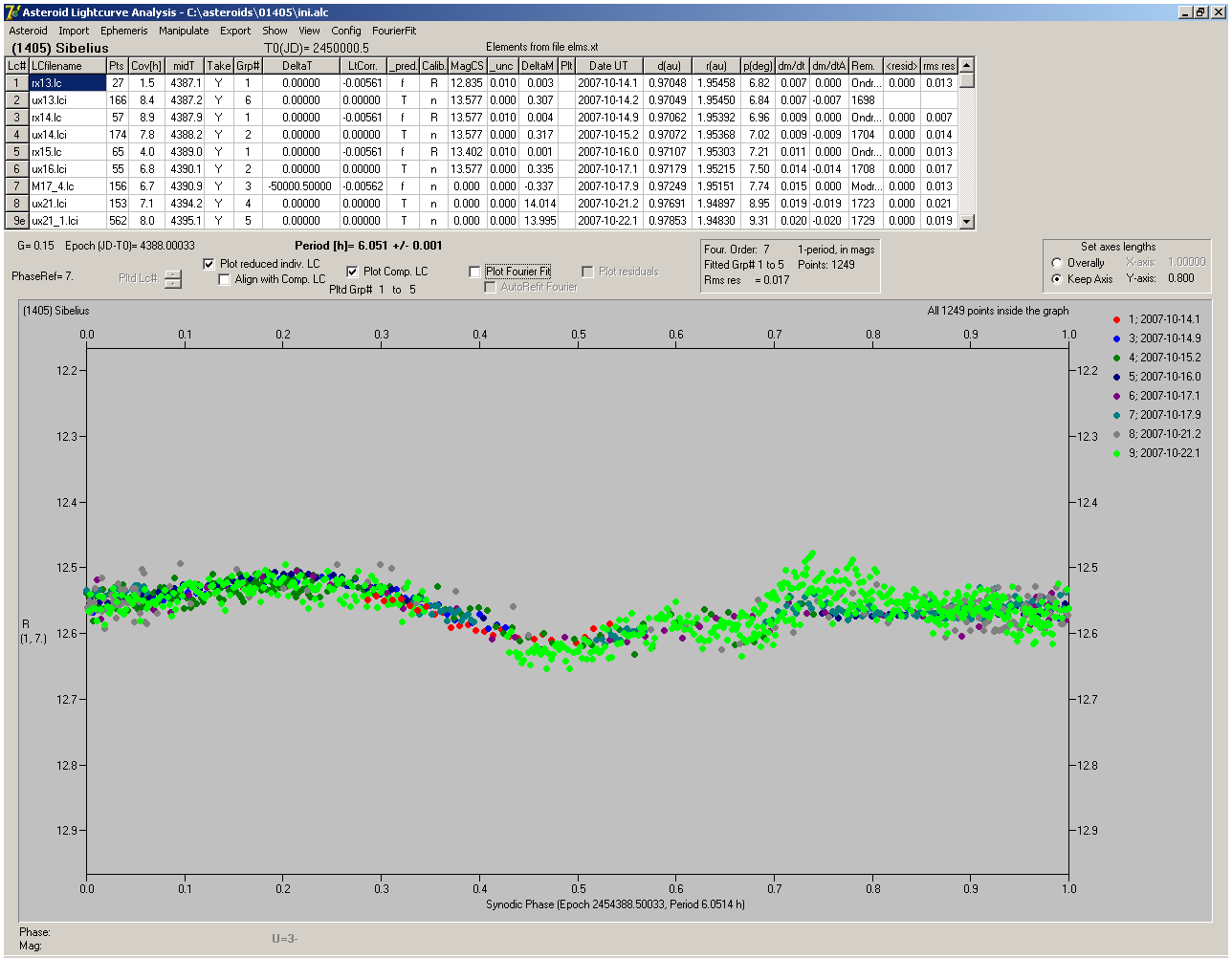
In October 2007, a rotational lightcurve of Sibelius was obtained from photometric observations taken by Petr Pravec at the Ondřejov Observatory in the Czech Republic. Lightcurve analysis gave a rotation period of 6.051 hours with a brightness variation of 0.11 magnitude (U=3-).[a][b]
Diameter and albedo
According to the surveys carried out by the Infrared Astronomical Satellite (IRAS) and NASA's Wide-field Infrared Survey Explorer (WISE) with its subsequent NEOWISE mission, Sibelius measures between 6.21 and 12.18 kilometres (3.86 and 7.57 mi) in diameter and its surface has an albedo between 0.14 and 0.48.[4][5][6][8][9] The Collaborative Asteroid Lightcurve Link adopts an albedo of 0.3191 and a diameter of 7.20 kilometres (4.47 mi) from Petr Pravec's revised WISE thermal observations.[3][7]
Naming
This minor planet was named for Jean Sibelius (1865–1957), Finnish violinist and composer of the late Romantic and early-modern periods.[2] The official naming citation was published by the Minor Planet Center on 20 February 1976 (M.P.C. 3928).[12]
Notes
- ^ abcPravec (2007) web: rotation period 6.051±0.001 hours with a brightness amplitude of 0.11 mag. Summary figures for (1405) Sibelius at Collaborative Asteroid Lightcurve Link and Pravec, P.; Wolf, M.; Sarounova, L. (2007)
- ^ abLightcurve plot of (1405) Sibelius from October 2007; unpublished data.
References
- ^ abcd"JPL Small-Body Database Browser: 1405 Sibelius (1936 RE)" (2017-07-02 last obs.). Jet Propulsion Laboratory. Retrieved 25 July 2017.
- ^ abcSchmadel, Lutz D. (2007). "(1405) Sibelius". Dictionary of Minor Planet Names – (1405) Sibelius. Springer Berlin Heidelberg. p. 113. doi:10.1007/978-3-540-29925-7_1406. ISBN 978-3-540-00238-3.
- ^ abcde"LCDB Data for (1405) Sibelius". Asteroid Lightcurve Database (LCDB). Retrieved 10 January 2017.
- ^ abcdMasiero, Joseph R.; Mainzer, A. K.; Grav, T.; Bauer, J. M.; Cutri, R. M.; Nugent, C.; et al. (November 2012). "Preliminary Analysis of WISE/NEOWISE 3-Band Cryogenic and Post-cryogenic Observations of Main Belt Asteroids". The Astrophysical Journal Letters. 759 (1): 5. arXiv:1209.5794. Bibcode:2012ApJ...759L...8M. doi:10.1088/2041-8205/759/1/L8. Retrieved 10 January 2017.
- ^ abcMasiero, Joseph R.; Mainzer, A. K.; Grav, T.; Bauer, J. M.; Cutri, R. M.; Dailey, J.; et al. (November 2011). "Main Belt Asteroids with WISE/NEOWISE. I. Preliminary Albedos and Diameters". The Astrophysical Journal. 741 (2): 20. arXiv:1109.4096. Bibcode:2011ApJ...741...68M. doi:10.1088/0004-637X/741/2/68. Retrieved 10 January 2017.
- ^ abcdMainzer, A.; Grav, T.; Masiero, J.; Hand, E.; Bauer, J.; Tholen, D.; et al. (November 2011). "NEOWISE Studies of Spectrophotometrically Classified Asteroids: Preliminary Results". The Astrophysical Journal. 741 (2): 25. arXiv:1109.6407. Bibcode:2011ApJ...741...90M. doi:10.1088/0004-637X/741/2/90.
- ^ abcdPravec, Petr; Harris, Alan W.; Kusnirák, Peter; Galád, Adrián; Hornoch, Kamil (September 2012). "Absolute magnitudes of asteroids and a revision of asteroid albedo estimates from WISE thermal observations". Icarus. 221 (1): 365–387. Bibcode:2012Icar..221..365P. doi:10.1016/j.icarus.2012.07.026. Retrieved 10 January 2017.
- ^ abcdNugent, C. R.; Mainzer, A.; Masiero, J.; Bauer, J.; Cutri, R. M.; Grav, T.; et al. (December 2015). "NEOWISE Reactivation Mission Year One: Preliminary Asteroid Diameters and Albedos". The Astrophysical Journal. 814 (2): 13. arXiv:1509.02522. Bibcode:2015ApJ...814..117N. doi:10.1088/0004-637X/814/2/117. Retrieved 10 January 2017.
- ^ abcdTedesco, E. F.; Noah, P. V.; Noah, M.; Price, S. D. (October 2004). "IRAS Minor Planet Survey V6.0". NASA Planetary Data System. 12: IRAS-A-FPA-3-RDR-IMPS-V6.0. Bibcode:2004PDSS...12.....T. Retrieved 22 October 2019.
- ^ abcVeres, Peter; Jedicke, Robert; Fitzsimmons, Alan; Denneau, Larry; Granvik, Mikael; Bolin, Bryce; et al. (November 2015). "Absolute magnitudes and slope parameters for 250,000 asteroids observed by Pan-STARRS PS1 - Preliminary results". Icarus. 261: 34–47. arXiv:1506.00762. Bibcode:2015Icar..261...34V. doi:10.1016/j.icarus.2015.08.007. Retrieved 10 January 2017.
- ^ ab"1405 Sibelius (1936 RE)". Minor Planet Center. Retrieved 10 January 2017.
- ^Schmadel, Lutz D. (2009). "Appendix – Publication Dates of the MPCs". Dictionary of Minor Planet Names – Addendum to Fifth Edition (2006–2008). Springer Berlin Heidelberg. p. 221. doi:10.1007/978-3-642-01965-4. ISBN 978-3-642-01964-7.
External links
- Asteroid Lightcurve Database (LCDB), query form (infoArchived 16 December 2017 at the Wayback Machine)
- Dictionary of Minor Planet Names, Google books
- Asteroids and comets rotation curves, CdR – Observatoire de Genève, Raoul Behrend
- Discovery Circumstances: Numbered Minor Planets (1)-(5000) – Minor Planet Center
- 1405 Sibelius at AstDyS-2, Asteroids—Dynamic Site
- 1405 Sibelius at the JPL Small-Body Database
