Bid–ask matrix
The bid–ask matrix is a matrix with elements corresponding with exchange rates between the assets. These rates are in physical units (e.g. number of stocks) and not with respect to any numeraire. The element of the matrix is the number of units of asset which can be exchanged for 1 unit of asset .


Mathematical definition
A matrix is a bid-ask matrix, if

![{\displaystyle \Pi =\left[\pi _{ij}\right]_{1\leq i,j\leq d}}](https://wikimedia.org/api/rest_v1/media/math/render/svg/2510a574941c9cd3d5d60a999f4c9e1f88aac21c)
- for . Any trade has a positive exchange rate.
- for . Can always trade 1 unit with itself.
- for . A direct exchange is always at most as expensive as a chain of exchanges.[1]



Example
Assume a market with 2 assets (A and B), such that units of A can be exchanged for 1 unit of B, and units of B can be exchanged for 1 unit of A. Then the bid–ask matrix is:


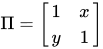
It is required that by rule 3.

With 3 assets, let be the number of units of i traded for 1 unit of j. The bid–ask matrix is:

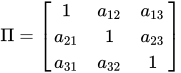
Rule 3 applies the following inequalities:


For higher values of d, note that 3-way trading satisfies Rule 3 as

Relation to solvency cone
If given a bid–ask matrix for assets such that and is the number of assets which with any non-negative quantity of them can be "discarded" (traditionally ). Then the solvency cone is the convex cone spanned by the unit vectors and the vectors .[1]

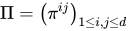


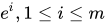

Similarly given a (constant) solvency cone it is possible to extract the bid–ask matrix from the bounding vectors.
Notes
- The bid–ask spread for pair is .
- If then that pair is frictionless.
- If a subset then that subset is frictionless.


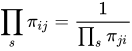
Arbitrage in bid-ask matrices
Arbitrage is where a profit is guaranteed.
If Rule 3 from above is true, then a bid-ask matrix (BAM) is arbitrage-free, otherwise arbitrage is present via buying from a middle vendor and then selling back to source.
Iterative computation
A method to determine if a BAM is arbitrage-free is as follows.
Consider n assets, with a BAM and a portfolio . Then


where the i-th entry of is the value of in terms of asset i.

Then the tensor product defined by
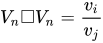
should resemble .
References
- ^ abSchachermayer, Walter (November 15, 2002). "The Fundamental Theorem of Asset Pricing under Proportional Transaction Costs in Finite Discrete Time".
{{cite journal}}: Cite journal requires|journal=(help)
