Boneh–Franklin scheme
The Boneh–Franklin scheme is an identity-based encryption system proposed by Dan Boneh and Matthew K. Franklin in 2001.[1] This article refers to the protocol version called BasicIdent. It is an application of pairings (Weil pairing) over elliptic curves and finite fields.
Groups and parameters
As the scheme is based upon pairings, all computations are performed in two groups, and :


For , let be prime, and consider the elliptic curve over . Note that this curve is not singular as only equals for the case which is excluded by the additional constraint.







Let be a prime factor of (which is the order of ) and find a point of order . is the set of points generated by :



is the subgroup of order of . We do not need to construct this group explicitly (this is done by the pairing) and thus don't have to find a generator.

is considered an additive group, being a subgroup of the additive group of points of , while is considered a multiplicative group, being a subgroup of the multiplicative group of the finite field .

Protocol description
Setup
The public key generator (PKG) chooses:
- the public groups (with generator ) and as stated above, with the size of depending on security parameter ,
- the corresponding pairing ,
- a random private master-key ,
- a public key ,
- a public hash function ,
- a public hash function for some fixed and
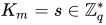
- the message space and the cipher space







Extraction
To create the public key for , the PKG computes

- and
- the private key which is given to the user.


Encryption
Given , the ciphertext is obtained as follows:


- ,
- choose random ,
- compute and
- set .




Note that is the PKG's public key and thus independent of the recipient's ID.

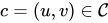
Decryption
Given , the plaintext can be retrieved using the private key:

Correctness
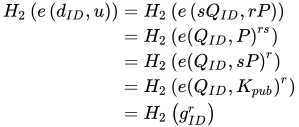
The primary step in both encryption and decryption is to employ the pairing and to generate a mask (like a symmetric key) that is xor'ed with the plaintext. So in order to verify correctness of the protocol, one has to verify that an honest sender and recipient end up with the same values here.

The encrypting entity uses , while for decryption, is applied. Due to the properties of pairings, it follows that:


Security
The security of the scheme depends on the hardness of the bilinear Diffie-Hellman problem (BDH) for the groups used. It has been proved that in a random-oracle model, the protocol is semantically secure under the BDH assumption.
Improvements
BasicIdent is not chosen ciphertext secure. However, there is a universal transformation method due to Fujisaki and Okamoto[2] that allows for conversion to a scheme having this property called FullIdent.
References
- ^Dan Boneh, Matthew K. Franklin, "Identity-Based Encryption from the Weil Pairing", Advances in Cryptology – Proceedings of CRYPTO 2001 (2001)
- ^Eiichiro Fujisaki, Tatsuaki Okamoto, "Secure Integration of Asymmetric and Symmetric Encryption Schemes", Advances in Cryptology – Proceedings of CRYPTO 99 (1999). Full version appeared in J. Cryptol. (2013) 26: 80–101
External links
