Washingtonia filifera
| Washingtonia filifera | |
|---|---|
 | |
| Native grove near Twentynine Palms, California | |
Scientific classification | |
| Kingdom: | Plantae |
| Clade: | Tracheophytes |
| Clade: | Angiosperms |
| Clade: | Monocots |
| Clade: | Commelinids |
| Order: | Arecales |
| Family: | Arecaceae |
| Tribe: | Trachycarpeae |
| Genus: | Washingtonia |
| Species: | W. filifera |
| Binomial name | |
| Washingtonia filifera | |
 | |
| Natural range | |
| Synonyms[3][4] | |
| |

Washingtonia filifera, commonly known as the California fan palm, or desert fan palm,[5] is a flowering plant in the family Arecaceae, native to the far southwestern United States and northwestern Mexico. It typically grows 15–20 m (49–66 ft) tall and 3–6 m (10–20 ft) wide,[6] with a sturdy, columnar trunk and waxy, fan-shaped (palmate) leaves. As a monocot, it is evergreen and exhibits a tree-like growth habit.
It is the only palm species native to the southwestern United States, forming groves around perennial water sources in the Colorado, Mojave, and Sonoran deserts.[7] These stands provide critical habitat for wildlife and were historically used by Indigenous peoples of the region for food, shelter, and materials.[8] Today the California fan palm is widely planted as an ornamental tree in arid and subtropical climates, though wild populations face pressures from groundwater decline, and habitat alteration.
In California, where the majority of its native groves occur, the species forms iconic desert oases such as the Oasis of Mara in Joshua Tree National Park, the Thousand Palms Oasis in the Coachella Valley Preserve, Lost Palms Oasis, and Fortynine Palms Oasis. Outside California, notable populations are protected at Castle Creek[9] in Arizona's Bradshaw Mountains, the Hassayampa River Preserve, and Kofa National Wildlife Refuge.
Taxonomy
The Latin specific epithetfilifera means "thread-bearing".[10]
The Plants of the World Online (POWO), curated by the Royal Botanic Gardens, Kew, currently recognizes three distinct infraspecifics of Washingtonia filifera: [2]
- Washingtonia filifera var. filifera
- Washingtonia filifera var. sonorae (S.Watson) M.E.Jones
Description
Washingtonia filifera is a stout, single-stemmed palm that typically grows 15–20 m (49–66 ft) tall.[6] The trunk is usually 0.3–0.9 m (1–3 ft) thick,[6] brown when exposed but often concealed beneath a dense skirt of persistent dead fronds. If left untrimmed, this thatch may extend the full length of the trunk, providing insulation against both heat and cold, reducing fire damage, and creating shelter for small animals.[6]

The crown is typically 3–6 m (10–20 ft)[6] across and consists of large, fan-shaped (palmate) leaves borne on petioles up to 2 m (6.6 ft) long. Petiole edges carry relatively small, blunt teeth compared with the more heavily armed Mexican fan palm[11][6](W. robusta), and their bases are predominantly green rather than reddish or brown.[11] The fronds themselves are a distinctive gray-blue-green, a color often used as a marker of genetic purity in the species.[6][12] Between the leaf segments are long, threadlike white fibers; in young individuals especially, these filaments can resemble tufts of cotton, giving rise to the informal name "cotton palm."
The Inflorescences are long, branched spadices that extend beyond the fronds and carry small, cream-colored flowers in late summer.[6] The fruit is a black drupe about 1–2 cm (0.4–0.8 in) in diameter, ripening in autumn and containing a single seed. Mature palms can produce thousands of fruits in a season, which are dispersed mainly by coyotes, foxes, and birds. Coyote dispersal is especially effective, with seeds carried long distances and showing improved germination after digestion.[6]
California fan palms typically live 80–150 years, with some individuals estimated to reach about 200 years.[6] They are well adapted to arid desert climates, surviving with minimal supplemental water and drawing heavily on groundwater through deep or shallow root systems depending on local conditions.[13][6]
Documented ambient extremes within its native range include summer highs up to about 57 °C (134 °F), such as at Furnace Creek,[14] and winter lows near -11 °C (12–13 °F).[6]
Distribution
Washingtonia filifera is the only palm species native to the southwestern United States, and the vast majority of its populations occur in southern California. Here it dominates spring-fed and stream-fed oases across the Colorado Desert,[7] with additional scattered stands in the Mojave Desert.[14]
Arizona
Outside California, the largest U.S. population is in central Arizona's lower Bradshaw Mountains,[9] where several groves occur along Castle Creek, a tributary of the Agua Fria River. Some of these groves lie on Bureau of Land Management land, while others are on private property. Along Castle Creek, the main spring sites are Dripping and Alkali Spring.

Castle Creek has also been proposed as the possible source of the seed from which Washingtonia filifera was first formally described in 1879, based on 19th-century reports and geographic coordinates that align closely with the site.[9] Other Arizona populations are found along the Gila River near Yuma,[15] at the Hassayampa River Preserve and nearby New River Preserve in Maricopa County, in portions of Pima and Pinal counties, and along the Colorado River in Mohave County. Although the species is considered globally secure, it is classified as critically imperiled (S1) within Arizona due to its limited and fragmented distribution.[16]
Nevada
In Nevada, isolated groves occur in Clark County, specifically at the Warm Springs Natural Area, Juanita Springs Ranch, Rogers Spring, and Blue Point Spring.[17][18]
However, the origin of these populations is debated. Some palms, such as those at Blue Point Spring, are thought to have been planted in the mid-20th century, while others, such as those at Juanita Springs, have been present since at least 1950 and show evidence of longer establishment.[18]

Baja California
In Mexico, the species is native only to Baja California, extending south to Bahía de los Ángeles.[19]
It has also become naturalized in warm springs near Death Valley, in extreme northwest Sonora, and in scattered locations in Texas, Florida, Hawaii, Utah, the U.S. Virgin Island, and overseas in Australia, Morocco, Egypt, Iraq, Spain, and Italy.[20][21]
Ecology
.jpg/1280px-Washingtonia_filifera_grove_(Palm_Springs).jpg)
Desert fan palms provide habitat for the giant palm-boring beetle, western yellow bat, hooded oriole, and many other bird species. Hooded orioles rely on the trees for food and places to build nests. Numerous insect species visit the hanging inflorescences that appear in late spring.[22]
Historically, natural oases are mainly restricted to areas downstream from the source of hot springs, though water is not always visible at the surface.
Today's oasis environment may have been protected from colder climatic changes over the course of its evolution. Thus, this palm is restricted by both water and climate to widely separated relict groves.[23] The trees in these groves show little if any genetic differentiation (through electrophoretic examination), suggesting that the genus is genetically very stable.
Fire adaptations
Fan palm oases have historically been subject to both natural and manmade fires. Fires are rarely fatal for the fan palm, but it is also not completely immune to them.
The fan palm's trunk is heavily resistant to burning. In most cases, the trunk is only at risk of losing some of its outer vascular layers during a fire. After those layers are ignited and burnt off, the remaining surface is left heavily charred, which fortifies the trunk against future flames. Subsequent burnings serve to char the trunk more, further increasing its fire resistance.
The palm's fronds are the most flammable portion of the tree. The unchecked buildup of dead fronds as a 'skirt' around the trunk can be especially dangerous in a crown fire. A severe accumulation of them could constitute enough kindling to completely burn through the trunk, killing the tree. However, if a palm can survive the burning of its fronds, they will take time to regrow, leaving it less susceptible to fire in the meantime.
Barring extreme, fatal conditions, fires are even conducive to the health and propagation of fan palms. The palms' reproduction process benefits from burnings, as fires help release saplings and clear away overgrowth from surrounding vegetation. Fires can also help palms conserve water by burning away their crowns and parts of their trunks, leading to a reduction in surface area and therefore decreased rates of evaporation and transpiration.[24]
Threats
Grazing animals can kill young plants through trampling, or by eating the terminus at the apical meristem, the growing portion of the plant. This may have kept palms restricted to a lesser range than indicated by the availability of water.
The palm boring beetle Dinapate wrightii (Bostrichidae) can chew through the trunks of this and other palms. Eventually, a continued infestation of beetles can kill various genera and species of palms. W. filifera appears to be resistant to the red palm weevil (Rhynchophorus ferrugineus) by a mechanism of antibiosis – production of compounds lethal to the larvae.[25][26][27]
Currently, the desert fan palm is experiencing a population and range expansion, perhaps due to global warming[28][29] or mustang control.
Uses
The sweet fruit pulp of the fan palm is edible.[30] The fruit is eaten raw, cooked, or ground into flour for cakes by Native Americans.[8] The Cahuilla and related tribes use the leaves to make sandals, roof thatch, and baskets. The woody petioles are used to make cooking utensils. The Moapa band of Paiutes and other Southern Paiute people have written memories of using this palm's seed, fruit, or leaves for various purposes, including as famine food.[17][31] The bud (known as heart of palm) is also eaten.[32]
Access
Joshua Tree National Park in the Mojave Desert preserves and protects healthy riparian palm habitat examples in the Little San Bernardino Mountains, and westward where water rises through the San Andreas Fault on the east valley side. One such location is the Fortynine Palms oasis. In the central Coachella Valley, the Indio Hills Palms State Reserve and nearby Coachella Valley Preserve, other large oases are protected and accessible. The Santa Rosa and San Jacinto Mountains National Monument, and Anza-Borrego Desert State Park both have large and diverse W. filifera canyon oasis habitats.
In Arizona, the largest protected groves of Washingtonia filifera are found in the lower Bradshaw Mountains at Castle Creek,[9] where a fenced population is maintained by the Bureau of Land Management. Additional populations occur at the Hassayampa River Preserve, managed by Maricopa County Parks, and at the New River Preserve, managed by the Desert Foothills Land Trust. A smaller but accessible grove is also protected at Kofa National Wildlife Refuge.
Cultivation
Washingtonia filifera is widely cultivated as an ornamental tree. It is one of the hardiest coryphoid palms, rated as hardy to USDA hardiness zone 8. It can survive brief temperatures of −10 °C (14 °F) with minor damage, and established plants have survived, with severe leaf damage, brief periods as low as −17 °C (1 °F). The plants grow best in arid or Mediterranean climates, but can be found in humid subtropical climates such as eastern Australia and the southeastern USA. It has gained the Royal Horticultural Society's Award of Garden Merit.[33][9]
Gallery
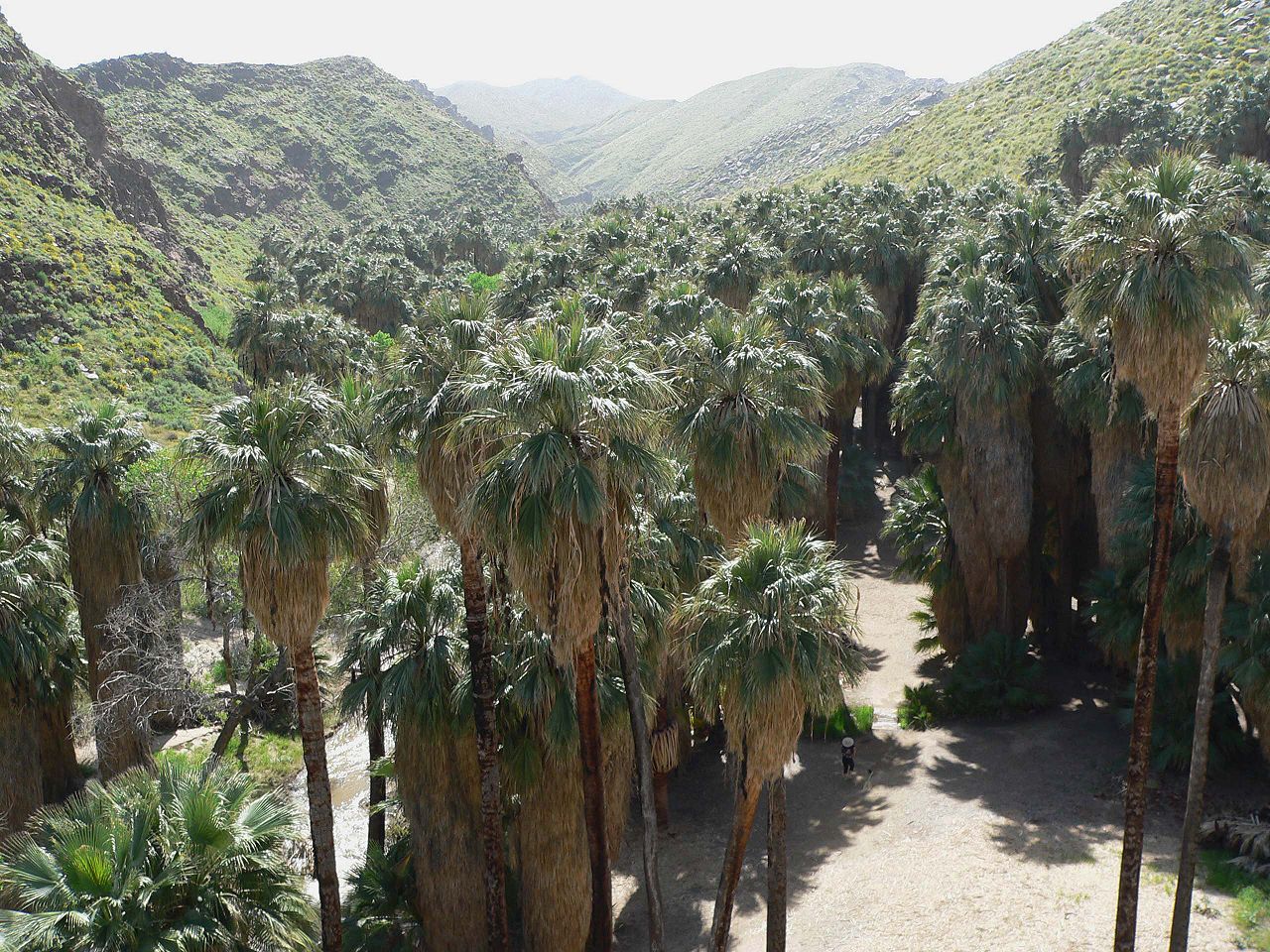
- W. filifera in Palm Canyon, Santa Rosa and San Jacinto Mountains National Monument
- W. filiferafrond with fibrous threads on leaf segments
- W. filifera seedlings at an oasis in Anza-Borrego Desert State Park
- W. filifera trees and fronds in Anza-Borrego Desert State Park
- W. filifera, inflorescence and the fruiting season


.jpg)


See also
- Washingtonia robusta Mexican fan palm
- Washingtonia × filibusta hybrid
References
- ^Carrero, C. (2021). "Washingtonia filifera". IUCN Red List of Threatened Species. 2021 e.T38725A59318379. doi:10.2305/IUCN.UK.2021-1.RLTS.T38725A59318379.en. Retrieved 12 November 2021.
- ^ ab"Washingtonia filifera (T.Moore & Mast.) H.Wendl. ex de Bary". Plants of the World Online. Royal Botanic Gardens, Kew. Retrieved 4 February 2026.
- ^"Washingtonia filifera (Linden ex André) H. Wendl. ex de Bary". Tropicos.org. Missouri Botanical Garden. Retrieved 20 June 2014.
- ^"Washingtonia filifera (Linden ex André) H.Wendl. ex de Bary". PlantList. 2013. Retrieved 20 June 2014.
- ^Cornett, J. W. (1986). "The Common Name of Washingtonia filifera". Principes. 30 (4): 153–55.
- ^ abcdefghijkl"Washingtonia filifera". www.fs.usda.gov. Retrieved 28 September 2025.
- ^ abCornett, James W. (1997). The Sonoran Desert: A Brief Natural History. Palm Springs, California: Palm Springs Desert Museum. ISBN 0-937794-27-9.
- ^ abCornett, James W. (2011). Indian Uses of Desert Plants (Third ed.). Palm Springs, California: Nature Trails Press. ISBN 978-0-937794-45-6.
- ^ abcdeMiller, Victor J. (1983). "Arizona's Own Palm: Washingtonia filifera".
- ^Harrison, Lorraine (2012). RHS Latin for Gardeners. UK: Mitchell Beazley. ISBN 978-1-84533-731-5.
- ^ ab"Comment peut-on voir la différence entre le Washingtonia filifera et le robusta? | La Palmeraie fr". Retrieved 28 September 2025.
- ^Villanueva-Almanza, Lorena; Landis, Jacob B.; Koenig, Daniel; Ezcurra, E. (March 2021). "Genetic and morphological differentiation in Washingtonia (Arecaceae): solving a century-old palm mystery". Botanical Journal of the Linnean Society. 196 (4): 506–523. doi:10.1093/botlinnean/boab009.
- ^"Find Trees & Learn | UA Campus Arboretum". apps.cals.arizona.edu. Retrieved 28 September 2025.
- ^ abCornett, James W. (1987). Naturalized Populations of the Desert Fan Palm, Washingtonia filifera, in Death Valley National Monument in Plant Biology of Eastern California. Los Angeles: White Mountain Research Station, University of California. pp. 167–74.
- ^Nothaft, Mark (22 March 2016). "Are palm trees native to Arizona?". Retrieved 26 March 2016.
Mark Fleming, curator of botany at the Arizona-Sonora Desert Museum of Tucson, says Washingtonia filifera, or the California fan palm, is the state's only naturally occurring variety and that they are found in pockets around southern California, Northern Mexico, and one or two pockets in Arizona.
- ^Maricopa County Parks & Recreation (29 September 2025). "Natural Resource Master Plan"(PDF).
- ^ abSpencer, W. (1995). "Washingtonia filifera: Nevada's rejected ancient Palm". xeri.com. Retrieved 21 June 2014.
- ^ abCornett, James W. (1988). "The Occurrence of the Desert Fan Palm, Washingtonia filifera, in Southern Nevada". Desert Plants.
- ^Wiggins, Ira L. (1980). Flora of Baja California. Stanford, California: Stanford University Press. p. 1025. ISBN 0-8047-1016-3.
- ^Govaerts, R. "Washingtonia filifera (Rafarin) H.Wendl. ex de Bary, Bot. Zeitung (Berlin) 37: LXI (1879)". World Checklist of Selected Plant Families. Retrieved 21 June 2014.
- ^"Plant Profile for Washingtonia filifera (California fan palm)". Natural Resources Conservation Service. United States Department of Agriculture. Retrieved 20 June 2014.
- ^Cornett, J. W. 1986. Arthropod visitors at Washingtonia filifera (Wendl) Flowers. Pan Pacific Entomologist 62(3):224–25.
- ^"Desert Fan Palms-Evidence suggests "Relict Genus"". www.xeri.com. Retrieved 10 December 2016.
- ^Vogl, Richard; McHargue, Lawrence (1966). "Vegetation of California Fan Palm Oases on the San Andreas Fault". Ecological Society of America. 47 (4): 532–40. Bibcode:1966Ecol...47..532V. doi:10.2307/1933929. JSTOR 1933929.
{{cite journal}}: CS1 maint: multiple names: authors list (link) - ^Nisson, N.; Hodel, D.; Hoddle, M. "Red Palm Weevil". Center for Invasive Species Research. University of California Riverside. Retrieved 20 June 2014.
- ^Dembilio, Ó.; Jacas, J.A.; Llácer, E. (August 2009). "Are the palms Washingtonia filifera and Chamaerops humilis suitable hosts for the red palm weevil, Rhynchophorus ferrugineus (Col. Curculionidae)?". Journal of Applied Entomology. 133 (7): 565–67. doi:10.1111/j.1439-0418.2009.01385.x. hdl:20.500.11939/5124. S2CID 85677945.
- ^Monroy, F.; Curir, P.; Clematis, F.; Cangelosi, B. (June 2016). "Susceptibility and possible resistance mechanisms in the palm species Phoenix dactylifera, Chamaerops humilis and Washingtonia filifera against Rhynchophorus ferrugineus (Olivier, 1790) (Coleoptera: Curculionidae)". Bulletin of Entomological Research. 106 (3): 341–46. doi:10.1017/S000748531500108X. ISSN 0007-4853. PMID 26976073. S2CID 206225113.
- ^Cornett, James W. (2010). Desert Palm Oasis (Second ed.). Palm Springs, California: Nature Trails Press. ISBN 978-0-937794-42-5.
- ^"global warming & W. filifera Palms – a rebuttal". www.xeri.com. Retrieved 10 December 2016.
- ^Little, Elbert L. (1994) [1980]. The Audubon Society Field Guide to North American Trees: Western Region (Chanticleer Press ed.). Knopf. p. 325. ISBN 0-394-50761-4.
- ^Spencer, W. (1995). "A report regarding: The Palm – Washingtonia filifera – in Moapa NV". xeri.com. Retrieved 21 June 2014.
- ^Peattie, Donald Culross (1953). A Natural History of Western Trees. New York: Bonanza Books. p. 299.
- ^"Washingtonia filifera: Washington palm". RHS Gardening. Royal Horticultural Society. Retrieved 17 March 2021.
External links

- Floridata.com: Washingtonia filifera
- Interactive Distribution Map for Washingtonia filiferaArchived 2 July 2017 at the Wayback Machine
- USDA Plants Profile: Washingtonia filifera (California fan palm)
- UC Jepson Manual treatment – Washingtonia filifera
- Calflora Database: Washingtonia filifera (California fan palm)
- Washingtonia filifera in Flora of North America
- Washingtonia filifera (California fan palm) – U.C. CalPhotos Gallery

- IUCN Red List least concern species
- Washingtonia
- Flora of the California desert regions
- Flora of the Coachella Valley
- Flora of Riverside County, California
- Flora of the Sonoran Deserts
- Natural history of the Colorado Desert
- Trees of Northern America
- Plants described in 1879
- Garden plants of North America
- Drought-tolerant trees
- Ornamental trees
- Taxa named by Maxwell T. Masters
- Taxa named by Thomas Moore (botanist)