Carex adusta
| Carex adusta | |
|---|---|
 | |
Scientific classification | |
| Kingdom: | Plantae |
| Clade: | Tracheophytes |
| Clade: | Angiosperms |
| Clade: | Monocots |
| Clade: | Commelinids |
| Order: | Poales |
| Family: | Cyperaceae |
| Genus: | Carex |
| Subgenus: | Carex subg. Vignea |
| Section: | Carex sect. Ovales |
| Species: | C. adusta |
| Binomial name | |
| Carex adusta | |
| Synonyms | |
List
| |
.jpg)
.jpg/1280px-Carex_adusta_iNat-178628397_(2x3).jpg)
Carex adusta, commonly known as the lesser brown sedge,[1]swarthy sedge,[2]browned sedge,[3] or Carex brûlé,[4] is a species of sedge (Carex) in the sectionOvales. First described scientifically in 1839 by Francis Boott, Adusta is Latin for "burnt," probably referring to the color.
Description
Carex adusta is a densely tuft-forming, perennial, rhizomatous, grass-like plant growing up to 32 inches in height. Leaves are simple and alternate, and are linear in shape.[5] The plants have densely clustered culms that grow 2.5–8 cm (1.0–3.1 in) high, and leaves measuring 7–25 cm (2.8–9.8 in) long by 2–3.5 mm wide.[3] Inflorescence consists of up to 15 spikes, clustered together.[6] The fruit is an obovate to elliptic achene.[4]
Distribution and habitat
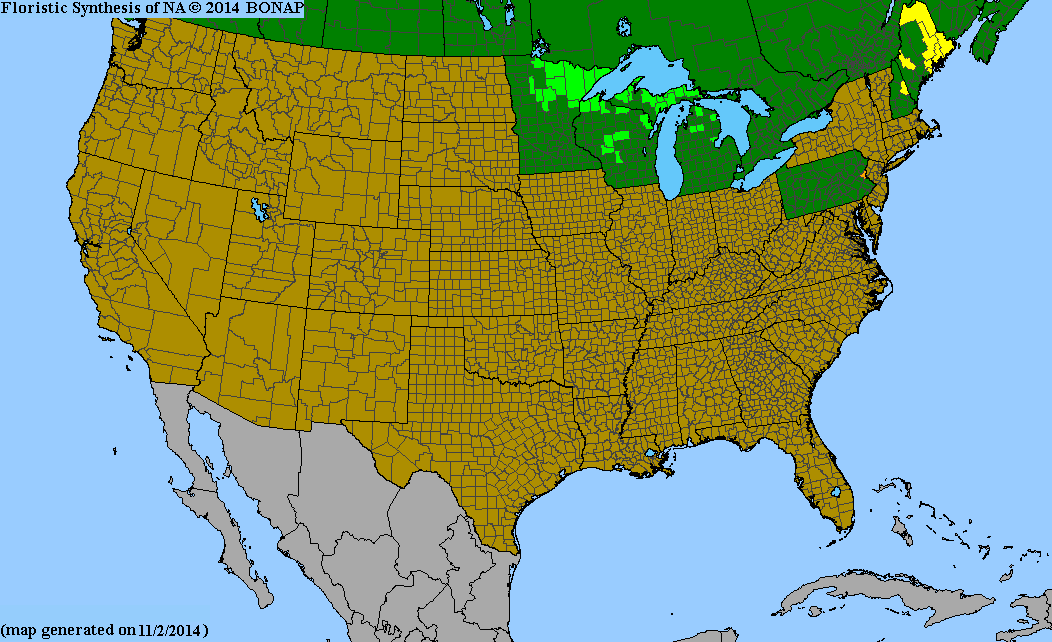
This species is found in Canada and the northeastern United States, where it grows in dry, acidic, sandy soils,[7][8] woodlands, road beds and disturbed sites.[9]
References
- ^Johnson T. (1998). CRC Ethnobotany Desk Reference. CRC Press. p. 151. ISBN 978-0-8493-1187-1.
- ^"Carex adusta (swarthy sedge): Go Botany". gobotany.nativeplanttrust.org. Retrieved 2025-02-27.
- ^ abLeighton AL. (2012). Sedges (Carex) of Saskatchewan. Flora of Saskatchewan. Vol. Fascicle 3. Regina, Canada: Nature Saskatchewan. p. 60. ISBN 978-0-921104-29-2.
- ^ ab"Carex adusta in Flora of North America @ efloras.org". www.efloras.org. Retrieved 2025-02-27.
- ^"Lady Bird Johnson Wildflower Center - The University of Texas at Austin". www.wildflower.org. Retrieved 2025-02-27.
- ^"Maine Natural Areas Program Rare Plant Fact Sheet for Carex adusta". www.maine.gov. Retrieved 2025-02-27.
- ^Kartesz, John T. (2014). "Carex adusta". County-level distribution map from the North American Plant Atlas (NAPA). Biota of North America Program (BONAP). Retrieved 15 April 2019.
- ^"Carex adusta Boott in W. J. Hooker". Flora of North America. www.eFloas.org. Retrieved 2014-12-19.
- ^"Carex adusta (swarthy sedge): Go Botany". gobotany.nativeplanttrust.org. Retrieved 2025-02-27.
 | This Carex article is a stub. You can help Wikipedia by adding missing information. |

