2つのランダムベクトルの相互相関行列は、ランダムベクトルのすべての要素のペアの相互相関を要素として含む行列です。相互相関行列は、様々なデジタル信号処理アルゴリズムで使用されます。
意味
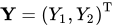
2つのランダムベクトル とに対して、それぞれが期待値と分散を持つランダム要素を含む場合、ととの相互相関行列は次のように定義される[ 1 ]:p.337。 



![{\displaystyle \operatorname {R} _{\mathbf {X} \mathbf {Y} }\triangleq \ \operatorname {E} [\mathbf {X} \mathbf {Y} ^{\rm {T}}]}](https://wikimedia.org/api/rest_v1/media/math/render/svg/1337f507d7cb6918d742ae2f029e0554013f7a58)
次元は です。成分ごとに書くと次のようになります。 
![{\displaystyle \operatorname {R} _{\mathbf {X} \mathbf {Y} }={\begin{bmatrix}\operatorname {E} [X_{1}Y_{1}]&\operatorname {E} [X_{1}Y_{2}]&\cdots &\operatorname {E} [X_{1}Y_{n}]\\\\\operatorname {E} [X_{2}Y_{1}]&\オペレーター名 {E} [X_{2}Y_{2}]&\cdots &\オペレーター名 {E} [X_{2}Y_{n}]\\\\\vdots &\vdots &\ddots &\vdots \\\\\オペレーター名 {E} [X_{m}Y_{1}]&\オペレーター名 {E} [X_{m}Y_{2}]&\cdots &\operatorname {E} [X_{m}Y_{n}]\\\\\end{bmatrix}}}](https://wikimedia.org/api/rest_v1/media/math/render/svg/dfaf0f3923eafd144f762732bbaa951102ed00bb)
ランダム ベクトルとは同じ次元である必要はなく、どちらもスカラー値である可能性があります。
例
たとえば、と がランダムベクトルである場合、 は 番目の要素が である行列になります。 


![{\displaystyle \operatorname {E} [X_{i}Y_{j}]}](https://wikimedia.org/api/rest_v1/media/math/render/svg/e511d6ea021c2d4b0579f621faec897ec52a1999)
複素ランダムベクトル
とが複素乱数ベクトルで、それぞれが期待値と分散を持つ乱数変数を含む場合、と の相互相関行列は次のように定義されます。 



![{\displaystyle \operatorname {R} _{\mathbf {Z} \mathbf {W} }\triangleq \ \operatorname {E} [\mathbf {Z} \mathbf {W} ^{\rm {H}}]}](https://wikimedia.org/api/rest_v1/media/math/render/svg/b96a25804b6f71adb2dd4366a18cc65e96553d88)
ここで はエルミート転置を表します。 
2つのランダムベクトルとが無相関であると言われるのは、
![{\displaystyle \operatorname {E} [\mathbf {X} \mathbf {Y} ^{\rm {T}}]=\operatorname {E} [\mathbf {X} ]\operatorname {E} [\mathbf {Y} ]^{\rm {T}}.}](https://wikimedia.org/api/rest_v1/media/math/render/svg/1a8bb45997c59ac08d38c6073ad03c832d11abf6)
相互共分散行列がゼロの場合にのみ、それらは無相関となります。 
2つの複素ランダムベクトル の場合、それらは相関がないと呼ばれます。
![{\displaystyle \operatorname {E} [\mathbf {Z} \mathbf {W} ^{\rm {H}}]=\operatorname {E} [\mathbf {Z} ]\operatorname {E} [\mathbf {W} ]^{\rm {H}}}](https://wikimedia.org/api/rest_v1/media/math/render/svg/e653a5949cb26600c65a6d23c16310eae1e9867f)
そして
![{\displaystyle \operatorname {E} [\mathbf {Z} \mathbf {W} ^{\rm {T}}]=\operatorname {E} [\mathbf {Z} ]\operatorname {E} [\mathbf {W} ]^{\rm {T}}.}](https://wikimedia.org/api/rest_v1/media/math/render/svg/500e14ec28154556c9b0aa741d1b036af7b7a67f)
プロパティ
相互共分散行列との関係
相互相関は、相互共分散行列と次のように関連しています。
![{\displaystyle \operatorname {K} _{\mathbf {X} \mathbf {Y} }=\operatorname {E} [(\mathbf {X} -\operatorname {E} [\mathbf {X} ])(\mathbf {Y} -\operatorname {E} [\mathbf {Y} ])^{\rm {T}}]=\operatorname {R} _{\mathbf {X} \mathbf {Y} }-\演算子名 {E} [\mathbf {X} ]\演算子名 {E} [\mathbf {Y} ]^{\rm {T}}}](https://wikimedia.org/api/rest_v1/media/math/render/svg/1d58fc3b03892e013a545da3322c2d4942d7314e)
- 複素ランダムベクトルの場合:
![{\displaystyle \operatorname {K} _{\mathbf {Z} \mathbf {W} }=\operatorname {E} [(\mathbf {Z} -\operatorname {E} [\mathbf {Z} ])(\mathbf {W} -\operatorname {E} [\mathbf {W} ])^{\rm {H}}]=\operatorname {R} _{\mathbf {Z} \mathbf {W} }-\演算子名 {E} [\mathbf {Z} ]\演算子名 {E} [\mathbf {W} ]^{\rm {H}}}](https://wikimedia.org/api/rest_v1/media/math/render/svg/e3b852cac5898146e76309d2f9d00ac163d1d65a)
参照
参考文献
さらに読む


