三角法 において、三角恒等式は 三角関数 を含む等式 であり、等式の両辺が定義されている発生変数 の任意の値に対して成立します。幾何学的には、これらは1つ以上の角度の特定の関数を含む 等式 です。これらは三角形の恒等式とは異なります。三角形の恒等式は、角度を含む可能性があるだけでなく、 三角形 の辺の長さやその他の長さも含む等式です。
これらの恒等式は、三角関数を含む式を簡略化する必要がある場合に便利です。重要な応用例としては、非三角関数の積分があります。一般的な手法としては、まず 三角関数に置換規則 を適用し、次に得られた積分を三角恒等式で簡略化します。
ピタゴラスの等式 三角関数とその単位円上の逆数。すべての直角三角形は相似、つまり対応する辺の比は同じです。sin、cos、tanの場合、単位長さの半径は、それらを定義する三角形の斜辺を形成します。逆数の恒等式は、この単位直線が斜辺ではなくなった三角形の辺の比として生じます。青色の三角形は恒等式 を示し、赤色の三角形は を示しています。1 + ベビーベッド 2 θ = csc 2 θ {\displaystyle 1+\cot^{2}\theta =\csc^{2}\theta } 日焼け 2 θ + 1 = 秒 2 θ {\displaystyle \tan^{2}\theta +1=\sec^{2}\theta } 正弦と余弦 の基本的な関係は、ピタゴラスの定理によって与えられます。
罪 2 θ + コス 2 θ = 1 、 {\displaystyle \sin^{2}\theta +\cos^{2}\theta =1,}
手段と手段罪 2 θ {\displaystyle \sin^{2}\theta } ( 罪 θ ) 2 {\displaystyle {(\sin \theta )}^{2}} コス 2 θ {\displaystyle \cos^{2}\theta } ( コス θ ) 2 。 {\displaystyle {(\cos \theta )}^{2}.}
これはピタゴラスの定理 の一種と見ることができ、単位円 の方程式から導かれます。この方程式は正弦または余弦のどちらについても解くことができます。 × 2 + y 2 = 1 {\displaystyle x^{2}+y^{2}=1}
罪 θ = ± 1 − コス 2 θ 、 コス θ = ± 1 − 罪 2 θ 。 {\displaystyle {\begin{aligned}\sin \theta &=\pm {\sqrt {1-\cos ^{2}\theta }},\\\cos \theta &=\pm {\sqrt {1-\sin ^{2}\theta }}.\end{aligned}}}
ここで、符号は象限によって決まり ますθ . {\displaystyle \theta .}
この恒等式を、、またはその両方で割ると、次の恒等式が得られます。 sin 2 θ {\displaystyle \sin ^{2}\theta } cos 2 θ {\displaystyle \cos ^{2}\theta } 1 + cot 2 θ = csc 2 θ 1 + tan 2 θ = sec 2 θ sec 2 θ + csc 2 θ = sec 2 θ csc 2 θ {\displaystyle {\begin{aligned}1+\cot ^{2}\theta &=\csc ^{2}\theta \\1+\tan ^{2}\theta &=\sec ^{2}\theta \\\sec ^{2}\theta +\csc ^{2}\theta &=\sec ^{2}\theta \csc ^{2}\theta \end{aligned}}}
これらの恒等式を使用すると、任意の三角関数を他の任意の関数(プラスまたはマイナスの符号 まで )で表現できます。
各三角関数を他の5つの関数のそれぞれについて表す。[ 1 ] に関しては sin θ {\displaystyle \sin \theta } csc θ {\displaystyle \csc \theta } cos θ {\displaystyle \cos \theta } sec θ {\displaystyle \sec \theta } tan θ {\displaystyle \tan \theta } cot θ {\displaystyle \cot \theta } sin θ = {\displaystyle \sin \theta =} sin θ {\displaystyle \sin \theta } 1 csc θ {\displaystyle {\frac {1}{\csc \theta }}} ± 1 − cos 2 θ {\displaystyle \pm {\sqrt {1-\cos ^{2}\theta }}} ± sec 2 θ − 1 sec θ {\displaystyle \pm {\frac {\sqrt {\sec ^{2}\theta -1}}{\sec \theta }}} ± tan θ 1 + tan 2 θ {\displaystyle \pm {\frac {\tan \theta }{\sqrt {1+\tan ^{2}\theta }}}} ± 1 1 + cot 2 θ {\displaystyle \pm {\frac {1}{\sqrt {1+\cot ^{2}\theta }}}} csc θ = {\displaystyle \csc \theta =} 1 sin θ {\displaystyle {\frac {1}{\sin \theta }}} csc θ {\displaystyle \csc \theta } ± 1 1 − cos 2 θ {\displaystyle \pm {\frac {1}{\sqrt {1-\cos ^{2}\theta }}}} ± sec θ sec 2 θ − 1 {\displaystyle \pm {\frac {\sec \theta }{\sqrt {\sec ^{2}\theta -1}}}} ± 1 + tan 2 θ tan θ {\displaystyle \pm {\frac {\sqrt {1+\tan ^{2}\theta }}{\tan \theta }}} ± 1 + cot 2 θ {\displaystyle \pm {\sqrt {1+\cot ^{2}\theta }}} cos θ = {\displaystyle \cos \theta =} ± 1 − sin 2 θ {\displaystyle \pm {\sqrt {1-\sin ^{2}\theta }}} ± csc 2 θ − 1 csc θ {\displaystyle \pm {\frac {\sqrt {\csc ^{2}\theta -1}}{\csc \theta }}} cos θ {\displaystyle \cos \theta } 1 sec θ {\displaystyle {\frac {1}{\sec \theta }}} ± 1 1 + tan 2 θ {\displaystyle \pm {\frac {1}{\sqrt {1+\tan ^{2}\theta }}}} ± cot θ 1 + cot 2 θ {\displaystyle \pm {\frac {\cot \theta }{\sqrt {1+\cot ^{2}\theta }}}} sec θ = {\displaystyle \sec \theta =} ± 1 1 − sin 2 θ {\displaystyle \pm {\frac {1}{\sqrt {1-\sin ^{2}\theta }}}} ± csc θ csc 2 θ − 1 {\displaystyle \pm {\frac {\csc \theta }{\sqrt {\csc ^{2}\theta -1}}}} 1 cos θ {\displaystyle {\frac {1}{\cos \theta }}} sec θ {\displaystyle \sec \theta } ± 1 + tan 2 θ {\displaystyle \pm {\sqrt {1+\tan ^{2}\theta }}} ± 1 + cot 2 θ cot θ {\displaystyle \pm {\frac {\sqrt {1+\cot ^{2}\theta }}{\cot \theta }}} tan θ = {\displaystyle \tan \theta =} ± sin θ 1 − sin 2 θ {\displaystyle \pm {\frac {\sin \theta }{\sqrt {1-\sin ^{2}\theta }}}} ± 1 csc 2 θ − 1 {\displaystyle \pm {\frac {1}{\sqrt {\csc ^{2}\theta -1}}}} ± 1 − cos 2 θ cos θ {\displaystyle \pm {\frac {\sqrt {1-\cos ^{2}\theta }}{\cos \theta }}} ± sec 2 θ − 1 {\displaystyle \pm {\sqrt {\sec ^{2}\theta -1}}} tan θ {\displaystyle \tan \theta } 1 cot θ {\displaystyle {\frac {1}{\cot \theta }}} cot θ = {\displaystyle \cot \theta =} ± 1 − sin 2 θ sin θ {\displaystyle \pm {\frac {\sqrt {1-\sin ^{2}\theta }}{\sin \theta }}} ± csc 2 θ − 1 {\displaystyle \pm {\sqrt {\csc ^{2}\theta -1}}} ± cos θ 1 − cos 2 θ {\displaystyle \pm {\frac {\cos \theta }{\sqrt {1-\cos ^{2}\theta }}}} ± 1 sec 2 θ − 1 {\displaystyle \pm {\frac {1}{\sqrt {\sec ^{2}\theta -1}}}} 1 tan θ {\displaystyle {\frac {1}{\tan \theta }}} cot θ {\displaystyle \cot \theta }
単位円を調べることによって、三角関数の次の特性を確立することができます。
反射 反射角を増分でシフトするときの座標( a 、b )の変換α {\displaystyle \alpha } π 4 {\displaystyle {\frac {\pi }{4}}} ユークリッドベクトル の方向が角度で表される場合、これは自由ベクトル(原点を起点とする)と正の単位ベクトルによって決まる角度です。同じ概念はユークリッド空間 内の直線にも適用でき、その場合の角度は、原点と正の 軸を通る直線に平行な線によって決まる角度です。方向を持つ直線(ベクトル)が方向を持つ直線について鏡映された場合、この鏡映された直線(ベクトル)の方向角は次の値を持ちます。 θ , {\displaystyle \theta ,} x {\displaystyle x} x {\displaystyle x} θ {\displaystyle \theta } α , {\displaystyle \alpha ,} θ ′ {\displaystyle \theta ^{\prime }} θ ′ = 2 α − θ . {\displaystyle \theta ^{\prime }=2\alpha -\theta .}
これらの角度の三角関数の値は、特定の角度に対して単純な恒等式を満たす。すなわち、等しいか、反対の符号を持つか、あるいは相補三角関数を用いるかのいずれかである。これらは縮約公式 とも呼ばれる。[ 2 ] θ , θ ′ {\displaystyle \theta ,\;\theta ^{\prime }} α {\displaystyle \alpha }
θ {\displaystyle \theta } [ 3 ] 奇数/偶数 恒等式 に反映されているα = 0 {\displaystyle \alpha =0} θ {\displaystyle \theta } α = π 4 {\displaystyle \alpha ={\frac {\pi }{4}}} θ {\displaystyle \theta } α = π 2 {\displaystyle \alpha ={\frac {\pi }{2}}} θ {\displaystyle \theta } α = 3 π 4 {\displaystyle \alpha ={\frac {3\pi }{4}}} θ {\displaystyle \theta } 比較し て反映されるα = π {\displaystyle \alpha =\pi } α = 0 {\displaystyle \alpha =0} sin ( − θ ) = − sin θ {\displaystyle \sin(-\theta )=-\sin \theta } sin ( π 2 − θ ) = cos θ {\displaystyle \sin \left({\tfrac {\pi }{2}}-\theta \right)=\cos \theta } sin ( π − θ ) = + sin θ {\displaystyle \sin(\pi -\theta )=+\sin \theta } sin ( 3 π 2 − θ ) = − cos θ {\displaystyle \sin \left({\tfrac {3\pi }{2}}-\theta \right)=-\cos \theta } sin ( 2 π − θ ) = − sin ( θ ) = sin ( − θ ) {\displaystyle \sin(2\pi -\theta )=-\sin(\theta )=\sin(-\theta )} cos ( − θ ) = + cos θ {\displaystyle \cos(-\theta )=+\cos \theta } cos ( π 2 − θ ) = sin θ {\displaystyle \cos \left({\tfrac {\pi }{2}}-\theta \right)=\sin \theta } cos ( π − θ ) = − cos θ {\displaystyle \cos(\pi -\theta )=-\cos \theta } cos ( 3 π 2 − θ ) = − sin θ {\displaystyle \cos \left({\tfrac {3\pi }{2}}-\theta \right)=-\sin \theta } cos ( 2 π − θ ) = + cos ( θ ) = cos ( − θ ) {\displaystyle \cos(2\pi -\theta )=+\cos(\theta )=\cos(-\theta )} tan ( − θ ) = − tan θ {\displaystyle \tan(-\theta )=-\tan \theta } tan ( π 2 − θ ) = cot θ {\displaystyle \tan \left({\tfrac {\pi }{2}}-\theta \right)=\cot \theta } tan ( π − θ ) = − tan θ {\displaystyle \tan(\pi -\theta )=-\tan \theta } tan ( 3 π 2 − θ ) = + cot θ {\displaystyle \tan \left({\tfrac {3\pi }{2}}-\theta \right)=+\cot \theta } tan ( 2 π − θ ) = − tan ( θ ) = tan ( − θ ) {\displaystyle \tan(2\pi -\theta )=-\tan(\theta )=\tan(-\theta )} csc ( − θ ) = − csc θ {\displaystyle \csc(-\theta )=-\csc \theta } csc ( π 2 − θ ) = sec θ {\displaystyle \csc \left({\tfrac {\pi }{2}}-\theta \right)=\sec \theta } csc ( π − θ ) = + csc θ {\displaystyle \csc(\pi -\theta )=+\csc \theta } csc ( 3 π 2 − θ ) = − sec θ {\displaystyle \csc \left({\tfrac {3\pi }{2}}-\theta \right)=-\sec \theta } csc ( 2 π − θ ) = − csc ( θ ) = csc ( − θ ) {\displaystyle \csc(2\pi -\theta )=-\csc(\theta )=\csc(-\theta )} sec ( − θ ) = + sec θ {\displaystyle \sec(-\theta )=+\sec \theta } sec ( π 2 − θ ) = csc θ {\displaystyle \sec \left({\tfrac {\pi }{2}}-\theta \right)=\csc \theta } sec ( π − θ ) = − sec θ {\displaystyle \sec(\pi -\theta )=-\sec \theta } sec ( 3 π 2 − θ ) = − csc θ {\displaystyle \sec \left({\tfrac {3\pi }{2}}-\theta \right)=-\csc \theta } sec ( 2 π − θ ) = + sec ( θ ) = sec ( − θ ) {\displaystyle \sec(2\pi -\theta )=+\sec(\theta )=\sec(-\theta )} cot ( − θ ) = − cot θ {\displaystyle \cot(-\theta )=-\cot \theta } cot ( π 2 − θ ) = tan θ {\displaystyle \cot \left({\tfrac {\pi }{2}}-\theta \right)=\tan \theta } cot ( π − θ ) = − cot θ {\displaystyle \cot(\pi -\theta )=-\cot \theta } cot ( 3 π 2 − θ ) = + tan θ {\displaystyle \cot \left({\tfrac {3\pi }{2}}-\theta \right)=+\tan \theta } cot ( 2 π − θ ) = − cot ( θ ) = cot ( − θ ) {\displaystyle \cot(2\pi -\theta )=-\cot(\theta )=\cot(-\theta )}
シフトと周期性 角度を増分でシフトするときの座標( a 、b )の変換θ {\displaystyle \theta } π 2 {\displaystyle {\frac {\pi }{2}}} 1四半期分シフト 半周期シフト フル期間シフト[ 4 ] 期間 sin ( θ ± π 2 ) = ± cos θ {\displaystyle \sin(\theta \pm {\tfrac {\pi }{2}})=\pm \cos \theta } sin ( θ + π ) = − sin θ {\displaystyle \sin(\theta +\pi )=-\sin \theta } sin ( θ + k ⋅ 2 π ) = + sin θ {\displaystyle \sin(\theta +k\cdot 2\pi )=+\sin \theta } 2 π {\displaystyle 2\pi } cos ( θ ± π 2 ) = ∓ sin θ {\displaystyle \cos(\theta \pm {\tfrac {\pi }{2}})=\mp \sin \theta } cos ( θ + π ) = − cos θ {\displaystyle \cos(\theta +\pi )=-\cos \theta } cos ( θ + k ⋅ 2 π ) = + cos θ {\displaystyle \cos(\theta +k\cdot 2\pi )=+\cos \theta } 2 π {\displaystyle 2\pi } csc ( θ ± π 2 ) = ± sec θ {\displaystyle \csc(\theta \pm {\tfrac {\pi }{2}})=\pm \sec \theta } csc ( θ + π ) = − csc θ {\displaystyle \csc(\theta +\pi )=-\csc \theta } csc ( θ + k ⋅ 2 π ) = + csc θ {\displaystyle \csc(\theta +k\cdot 2\pi )=+\csc \theta } 2 π {\displaystyle 2\pi } sec ( θ ± π 2 ) = ∓ csc θ {\displaystyle \sec(\theta \pm {\tfrac {\pi }{2}})=\mp \csc \theta } sec ( θ + π ) = − sec θ {\displaystyle \sec(\theta +\pi )=-\sec \theta } sec ( θ + k ⋅ 2 π ) = + sec θ {\displaystyle \sec(\theta +k\cdot 2\pi )=+\sec \theta } 2 π {\displaystyle 2\pi } tan ( θ ± π 4 ) = tan θ ± 1 1 ∓ tan θ {\displaystyle \tan(\theta \pm {\tfrac {\pi }{4}})={\tfrac {\tan \theta \pm 1}{1\mp \tan \theta }}} tan ( θ + π 2 ) = − cot θ {\displaystyle \tan(\theta +{\tfrac {\pi }{2}})=-\cot \theta } tan ( θ + k ⋅ π ) = + tan θ {\displaystyle \tan(\theta +k\cdot \pi )=+\tan \theta } π {\displaystyle \pi } cot ( θ ± π 4 ) = cot θ ∓ 1 1 ± cot θ {\displaystyle \cot(\theta \pm {\tfrac {\pi }{4}})={\tfrac {\cot \theta \mp 1}{1\pm \cot \theta }}} cot ( θ + π 2 ) = − tan θ {\displaystyle \cot(\theta +{\tfrac {\pi }{2}})=-\tan \theta } cot ( θ + k ⋅ π ) = + cot θ {\displaystyle \cot(\theta +k\cdot \pi )=+\cot \theta } π {\displaystyle \pi }
標識 三角関数の符号は角度の象限に依存する。sgnが符号関数 で ある場合、 − π < θ ≤ π {\displaystyle {-\pi }<\theta \leq \pi }
sgn ( sin θ ) = sgn ( csc θ ) = { + 1 if 0 < θ < π − 1 if − π < θ < 0 0 if θ ∈ { 0 , π } sgn ( cos θ ) = sgn ( sec θ ) = { + 1 if − π 2 < θ < π 2 − 1 if − π < θ < − π 2 or π 2 < θ < π 0 if θ ∈ { − π 2 , π 2 } sgn ( tan θ ) = sgn ( cot θ ) = { + 1 if − π < θ < − π 2 or 0 < θ < π 2 − 1 if − π 2 < θ < 0 or π 2 < θ < π 0 if θ ∈ { − π 2 , 0 , π 2 , π } {\displaystyle {\begin{aligned}\operatorname {sgn}(\sin \theta )=\operatorname {sgn}(\csc \theta )&={\begin{cases}+1&{\text{if}}\ \ 0<\theta <\pi \\-1&{\text{if}}\ \ {-\pi }<\theta <0\\0&{\text{if}}\ \ \theta \in \{0,\pi \}\end{cases}}\\[5mu]\operatorname {sgn}(\cos \theta )=\operatorname {sgn}(\sec \theta )&={\begin{cases}+1&{\text{if}}\ \ {-{\tfrac {\pi }{2}}}<\theta <{\tfrac {\pi }{2}}\\-1&{\text{if}}\ \ {-\pi }<\theta <-{\tfrac {\pi }{2}}\ \ {\text{or}}\ \ {\tfrac {\pi }{2}}<\theta <\pi \\0&{\text{if}}\ \ \theta \in {\bigl \{}{-{\tfrac {\pi }{2}}},{\tfrac {\pi }{2}}{\bigr \}}\end{cases}}\\[5mu]\operatorname {sgn}(\tan \theta )=\operatorname {sgn}(\cot \theta )&={\begin{cases}+1&{\text{if}}\ \ {-\pi }<\theta <-{\tfrac {\pi }{2}}\ \ {\text{or}}\ \ 0<\theta <{\tfrac {\pi }{2}}\\-1&{\text{if}}\ \ {-{\tfrac {\pi }{2}}}<\theta <0\ \ {\text{or}}\ \ {\tfrac {\pi }{2}}<\theta <\pi \\0&{\text{if}}\ \ \theta \in {\bigl \{}{-{\tfrac {\pi }{2}}},0,{\tfrac {\pi }{2}},\pi {\bigr \}}\end{cases}}\end{aligned}}}
三角関数は共通周期を持つ周期関数であるため、 θ の値が区間外にある場合、それらは繰り返し値を取ります(上記の§ シフトと周期性を参照)。正弦波または余弦波の符号は、正規化された 方形波 を定義するために使用できます。例えば、関数および は値±1 を取り、 2 π , {\displaystyle 2\pi ,} ( − π , π ] , {\displaystyle ({-\pi },\pi ],} sgn ( sin x ) {\displaystyle \operatorname {sgn}(\sin x)} sgn ( cos x ) {\displaystyle \operatorname {sgn}(\cos x)} π / 2
角度の和と差の恒等式 角度の和の三角関数の恒等式を導く幾何学的構成 とに対する角度差の恒等式を示す図sin ( α − β ) {\displaystyle \sin(\alpha -\beta )} cos ( α − β ) {\displaystyle \cos(\alpha -\beta )} これらは角度の加法定理と減法定理 (または公式 ) としても知られています。sin ( α + β ) = sin α cos β + cos α sin β sin ( α − β ) = sin α cos β − cos α sin β cos ( α + β ) = cos α cos β − sin α sin β cos ( α − β ) = cos α cos β + sin α sin β {\displaystyle {\begin{aligned}\sin(\alpha +\beta )&=\sin \alpha \cos \beta +\cos \alpha \sin \beta \\\sin(\alpha -\beta )&=\sin \alpha \cos \beta -\cos \alpha \sin \beta \\\cos(\alpha +\beta )&=\cos \alpha \cos \beta -\sin \alpha \sin \beta \\\cos(\alpha -\beta )&=\cos \alpha \cos \beta +\sin \alpha \sin \beta \end{aligned}}}
およびの角度差恒等式は、およびという事実を用いて、 を および に代入することで、角度和恒等式から導くことができます。また、図に示している角度和恒等式の若干修正版を用いることで、これらの恒等式を導くこともできます。 sin ( α − β ) {\displaystyle \sin(\alpha -\beta )} cos ( α − β ) {\displaystyle \cos(\alpha -\beta )} − β {\displaystyle -\beta } β {\displaystyle \beta } sin ( − β ) = − sin ( β ) {\displaystyle \sin(-\beta )=-\sin(\beta )} cos ( − β ) = cos ( β ) {\displaystyle \cos(-\beta )=\cos(\beta )}
これらの恒等式は次の表の最初の 2 行にまとめられています。この表には、他の三角関数の和と差の恒等式も含まれています。
正弦 sin ( α ± β ) {\displaystyle \sin(\alpha \pm \beta )} = {\displaystyle =} sin α cos β ± cos α sin β {\displaystyle \sin \alpha \cos \beta \pm \cos \alpha \sin \beta } [ 5 ] [ 6 ] 余弦 cos ( α ± β ) {\displaystyle \cos(\alpha \pm \beta )} = {\displaystyle =} cos α cos β ∓ sin α sin β {\displaystyle \cos \alpha \cos \beta \mp \sin \alpha \sin \beta } [ 6 ] [ 7 ] 正接 tan ( α ± β ) {\displaystyle \tan(\alpha \pm \beta )} = {\displaystyle =} tan α ± tan β 1 ∓ tan α tan β {\displaystyle {\frac {\tan \alpha \pm \tan \beta }{1\mp \tan \alpha \tan \beta }}} [ 6 ] [ 8 ] コセカント csc ( α ± β ) {\displaystyle \csc(\alpha \pm \beta )} = {\displaystyle =} sec α sec β csc α csc β sec α csc β ± csc α sec β {\displaystyle {\frac {\sec \alpha \sec \beta \csc \alpha \csc \beta }{\sec \alpha \csc \beta \pm \csc \alpha \sec \beta }}} [ 9 ] 割線 sec ( α ± β ) {\displaystyle \sec(\alpha \pm \beta )} = {\displaystyle =} sec α sec β csc α csc β csc α csc β ∓ sec α sec β {\displaystyle {\frac {\sec \alpha \sec \beta \csc \alpha \csc \beta }{\csc \alpha \csc \beta \mp \sec \alpha \sec \beta }}} [ 9 ] 余接 cot ( α ± β ) {\displaystyle \cot(\alpha \pm \beta )} = {\displaystyle =} cot α cot β ∓ 1 cot β ± cot α {\displaystyle {\frac {\cot \alpha \cot \beta \mp 1}{\cot \beta \pm \cot \alpha }}} [ 6 ] [ 10 ] アークサイン arcsin x ± arcsin y {\displaystyle \arcsin x\pm \arcsin y} = {\displaystyle =} arcsin ( x 1 − y 2 ± y 1 − x 2 y ) {\displaystyle \arcsin \left(x{\sqrt {1-y^{2}}}\pm y{\sqrt {1-x^{2}{\vphantom {y}}}}\right)} [ 11 ] アークコサイン arccos x ± arccos y {\displaystyle \arccos x\pm \arccos y} = {\displaystyle =} arccos ( x y ∓ ( 1 − x 2 ) ( 1 − y 2 ) ) {\displaystyle \arccos \left(xy\mp {\sqrt {\left(1-x^{2}\right)\left(1-y^{2}\right)}}\right)} [ 12 ] アークタンジェント arctan x ± arctan y {\displaystyle \arctan x\pm \arctan y} = {\displaystyle =} arctan ( x ± y 1 ∓ x y ) {\displaystyle \arctan \left({\frac {x\pm y}{1\mp xy}}\right)} [ 13 ] アークコタンジェント arccot x ± arccot y {\displaystyle \operatorname {arccot} x\pm \operatorname {arccot} y} = {\displaystyle =} arccot ( x y ∓ 1 y ± x ) {\displaystyle \operatorname {arccot} \left({\frac {xy\mp 1}{y\pm x}}\right)}
無限個の角度の和の正弦と余弦 級数が絶対収束する と ∑ i = 1 ∞ θ i {\textstyle \sum _{i=1}^{\infty }\theta _{i}}
sin ( ∑ i = 1 ∞ θ i ) = ∑ odd k ≥ 1 ( − 1 ) k − 1 2 ∑ A ⊆ { 1 , 2 , 3 , … } | A | = k ( ∏ i ∈ A sin θ i ∏ i ∉ A cos θ i ) cos ( ∑ i = 1 ∞ θ i ) = ∑ even k ≥ 0 ( − 1 ) k 2 ∑ A ⊆ { 1 , 2 , 3 , … } | A | = k ( ∏ i ∈ A sin θ i ∏ i ∉ A cos θ i ) . {\displaystyle {\begin{aligned}{\sin }{\biggl (}\sum _{i=1}^{\infty }\theta _{i}{\biggl )}&=\sum _{{\text{odd}}\ k\geq 1}(-1)^{\frac {k-1}{2}}\!\!\sum _{\begin{smallmatrix}A\subseteq \{\,1,2,3,\dots \,\}\\\left|A\right|=k\end{smallmatrix}}{\biggl (}\prod _{i\in A}\sin \theta _{i}\prod _{i\not \in A}\cos \theta _{i}{\biggr )}\\{\cos }{\biggl (}\sum _{i=1}^{\infty }\theta _{i}{\biggr )}&=\sum _{{\text{even}}\ k\geq 0}(-1)^{\frac {k}{2}}\,\sum _{\begin{smallmatrix}A\subseteq \{\,1,2,3,\dots \,\}\\\left|A\right|=k\end{smallmatrix}}{\biggl (}\prod _{i\in A}\sin \theta _{i}\prod _{i\not \in A}\cos \theta _{i}{\biggr )}.\end{aligned}}}
この級数は絶対収束するので、必然的に かつ となる。特に 、これら2つの恒等式には、有限個の角度の和の場合には見られない非対称性が現れている。つまり、各積において、正弦因子は有限個しか存在しないが、余弦因子は余有限個存在する。 正弦因子が無限個である項は、必然的にゼロとなる。 ∑ i = 1 ∞ θ i {\textstyle \sum _{i=1}^{\infty }\theta _{i}} lim i → ∞ θ i = 0 , {\textstyle \lim _{i\to \infty }\theta _{i}=0,} lim i → ∞ sin θ i = 0 , {\textstyle \lim _{i\to \infty }\sin \theta _{i}=0,} lim i → ∞ cos θ i = 1. {\textstyle \lim _{i\to \infty }\cos \theta _{i}=1.}
角度のうち有限個のみが非ゼロである場合、右辺の項のうち有限個のみが非ゼロとなります。これは、正弦因子のうち有限個を除くすべてがゼロとなるためです。さらに、各項において、余弦因子のうち有限個を除くすべてが1となります。 θ i {\displaystyle \theta _{i}}
和の正接と余接 (に対して)を変数の k次 基本対称多項式 とすると、 e k {\displaystyle e_{k}} k = 0 , 1 , 2 , 3 , … {\displaystyle k=0,1,2,3,\ldots } x i = tan θ i {\displaystyle x_{i}=\tan \theta _{i}} i = 0 , 1 , 2 , 3 , … , {\displaystyle i=0,1,2,3,\ldots ,}
e 0 = 1 e 1 = ∑ i x i = ∑ i tan θ i e 2 = ∑ i < j x i x j = ∑ i < j tan θ i tan θ j e 3 = ∑ i < j < k x i x j x k = ∑ i < j < k tan θ i tan θ j tan θ k ⋮ ⋮ {\displaystyle {\begin{aligned}e_{0}&=1\\[6pt]e_{1}&=\sum _{i}x_{i}&&=\sum _{i}\tan \theta _{i}\\[6pt]e_{2}&=\sum _{i<j}x_{i}x_{j}&&=\sum _{i<j}\tan \theta _{i}\tan \theta _{j}\\[6pt]e_{3}&=\sum _{i<j<k}x_{i}x_{j}x_{k}&&=\sum _{i<j<k}\tan \theta _{i}\tan \theta _{j}\tan \theta _{k}\\&\ \ \vdots &&\ \ \vdots \end{aligned}}}
それから
tan ( ∑ i θ i ) = e 1 − e 3 + e 5 − ⋯ e 0 − e 2 + e 4 − ⋯ . {\displaystyle \tan {\Bigl (}\sum _{i}\theta _{i}{\Bigr )}={\frac {e_{1}-e_{3}+e_{5}-\cdots }{e_{0}-e_{2}+e_{4}-\cdots }}.} tan ( ∑ i θ i ) = sin ( ∑ i θ i ) / ∏ i cos θ i cos ( ∑ i θ i ) / ∏ i cos θ i = ∑ odd k ≥ 1 ( − 1 ) k − 1 2 ∑ A ⊆ { 1 , 2 , 3 , … } | A | = k ∏ i ∈ A tan θ i ∑ even k ≥ 0 ( − 1 ) k 2 ∑ A ⊆ { 1 , 2 , 3 , … } | A | = k ∏ i ∈ A tan θ i = e 1 − e 3 + e 5 − ⋯ e 0 − e 2 + e 4 − ⋯ cot ( ∑ i θ i ) = e 0 − e 2 + e 4 − ⋯ e 1 − e 3 + e 5 − ⋯ {\displaystyle {\begin{aligned}\tan {\Bigl (}\sum _{i}\theta _{i}{\Bigr )}&={\frac {{\sin }{\bigl (}\sum _{i}\theta _{i}{\bigr )}/\prod _{i}\cos \theta _{i}}{{\cos }{\bigl (}\sum _{i}\theta _{i}{\bigr )}/\prod _{i}\cos \theta _{i}}}\\[10pt]&={\frac {\displaystyle \sum _{{\text{odd}}\ k\geq 1}(-1)^{\frac {k-1}{2}}\sum _{\begin{smallmatrix}A\subseteq \{1,2,3,\dots \}\\\left|A\right|=k\end{smallmatrix}}\prod _{i\in A}\tan \theta _{i}}{\displaystyle \sum _{{\text{even}}\ k\geq 0}~(-1)^{\frac {k}{2}}~~\sum _{\begin{smallmatrix}A\subseteq \{1,2,3,\dots \}\\\left|A\right|=k\end{smallmatrix}}\prod _{i\in A}\tan \theta _{i}}}={\frac {e_{1}-e_{3}+e_{5}-\cdots }{e_{0}-e_{2}+e_{4}-\cdots }}\\[10pt]\cot {\Bigl (}\sum _{i}\theta _{i}{\Bigr )}&={\frac {e_{0}-e_{2}+e_{4}-\cdots }{e_{1}-e_{3}+e_{5}-\cdots }}\end{aligned}}}
右側の項の数は左側の項の数によって決まります。
例えば: tan ( θ 1 + θ 2 ) = e 1 e 0 − e 2 = x 1 + x 2 1 − x 1 x 2 = tan θ 1 + tan θ 2 1 − tan θ 1 tan θ 2 , tan ( θ 1 + θ 2 + θ 3 ) = e 1 − e 3 e 0 − e 2 = ( x 1 + x 2 + x 3 ) − ( x 1 x 2 x 3 ) 1 − ( x 1 x 2 + x 1 x 3 + x 2 x 3 ) , tan ( θ 1 + θ 2 + θ 3 + θ 4 ) = e 1 − e 3 e 0 − e 2 + e 4 = ( x 1 + x 2 + x 3 + x 4 ) − ( x 1 x 2 x 3 + x 1 x 2 x 4 + x 1 x 3 x 4 + x 2 x 3 x 4 ) 1 − ( x 1 x 2 + x 1 x 3 + x 1 x 4 + x 2 x 3 + x 2 x 4 + x 3 x 4 ) + ( x 1 x 2 x 3 x 4 ) , {\displaystyle {\begin{aligned}\tan(\theta _{1}+\theta _{2})&={\frac {e_{1}}{e_{0}-e_{2}}}={\frac {x_{1}+x_{2}}{1\ -\ x_{1}x_{2}}}={\frac {\tan \theta _{1}+\tan \theta _{2}}{1\ -\ \tan \theta _{1}\tan \theta _{2}}},\\[8pt]\tan(\theta _{1}+\theta _{2}+\theta _{3})&={\frac {e_{1}-e_{3}}{e_{0}-e_{2}}}={\frac {(x_{1}+x_{2}+x_{3})\ -\ (x_{1}x_{2}x_{3})}{1\ -\ (x_{1}x_{2}+x_{1}x_{3}+x_{2}x_{3})}},\\[8pt]\tan(\theta _{1}+\theta _{2}+\theta _{3}+\theta _{4})&={\frac {e_{1}-e_{3}}{e_{0}-e_{2}+e_{4}}}\\[8pt]&={\frac {(x_{1}+x_{2}+x_{3}+x_{4})\ -\ (x_{1}x_{2}x_{3}+x_{1}x_{2}x_{4}+x_{1}x_{3}x_{4}+x_{2}x_{3}x_{4})}{1\ -\ (x_{1}x_{2}+x_{1}x_{3}+x_{1}x_{4}+x_{2}x_{3}+x_{2}x_{4}+x_{3}x_{4})\ +\ (x_{1}x_{2}x_{3}x_{4})}},\end{aligned}}}
などがある。有限個の項のみの場合は数学的帰納法 によって証明できる。[ 14 ] [ 15 ]
と仮定し、 a , b , c , d , p , q ∈ R {\textstyle a,b,c,d,p,q\in \mathbb {R} } i = − 1 {\textstyle i={\sqrt {-1}}}
a i + b c i + d = p i + q {\displaystyle {\frac {ai+b}{ci+d}}=pi+q} そして、が 任意の数であるとする。したがって、前述の分数は φ {\textstyle \varphi } tan φ = c d . {\textstyle \tan \varphi ={\tfrac {c}{d}}.} a c ≠ b d {\textstyle {\tfrac {a}{c}}\neq {\tfrac {b}{d}}} 0 / 0 [ 16 ] θ ∈ R {\textstyle \theta \in \mathbb {R} }
a tan θ + b c tan θ + d = p tan ( θ − φ ) + q . {\displaystyle {\frac {a\tan \theta +b}{c\tan \theta +d}}=p\tan(\theta -\varphi )+q.} (この分数の分母が 0 の場合、分数の値は となります。ここで、記号 はまたは を意味するのではなく、正または負の方向のいずれかに進むことによって に近づくものであり、直線の完成形は位相的に円になります。) ∞ {\textstyle \infty } ∞ {\textstyle \infty } + ∞ {\textstyle +\infty } − ∞ {\textstyle -\infty } ∞ {\textstyle \infty } R ∪ { ∞ } {\textstyle \mathbb {R} \cup \{\,\infty \,\}}
この恒等式から、すべてのコーシー分布に従う 確率変数の族は線形分数変換の下で閉じていることがすぐに示され、これは1976年以来知られている結果である。[ 17 ]
和の割線と余割線 sec ( ∑ i θ i ) = ∏ i sec θ i e 0 − e 2 + e 4 − ⋯ csc ( ∑ i θ i ) = ∏ i sec θ i e 1 − e 3 + e 5 − ⋯ {\displaystyle {\begin{aligned}{\sec }{\Bigl (}\sum _{i}\theta _{i}{\Bigr )}&={\frac {\prod _{i}\sec \theta _{i}}{e_{0}-e_{2}+e_{4}-\cdots }}\\[8pt]{\csc }{\Bigl (}\sum _{i}\theta _{i}{\Bigr )}&={\frac {\prod _{i}\sec \theta _{i}}{e_{1}-e_{3}+e_{5}-\cdots }}\end{aligned}}}
ここで、はn 変数のk 次基本対称多項式で あり、分母の項数と分子の積の因数は、左側の和の項数に依存します。[ 18 ] e k {\displaystyle e_{k}} x i = tan θ i , {\displaystyle x_{i}=\tan \theta _{i},} i = 1 , … , n , {\displaystyle i=1,\ldots ,n,}
例えば、
sec ( α + β + γ ) = sec α sec β sec γ 1 − tan α tan β − tan α tan γ − tan β tan γ csc ( α + β + γ ) = sec α sec β sec γ tan α + tan β + tan γ − tan α tan β tan γ . {\displaystyle {\begin{aligned}\sec(\alpha +\beta +\gamma )&={\frac {\sec \alpha \sec \beta \sec \gamma }{1-\tan \alpha \tan \beta -\tan \alpha \tan \gamma -\tan \beta \tan \gamma }}\\[8pt]\csc(\alpha +\beta +\gamma )&={\frac {\sec \alpha \sec \beta \sec \gamma }{\tan \alpha +\tan \beta +\tan \gamma -\tan \alpha \tan \beta \tan \gamma }}.\end{aligned}}}
プトレマイオスの定理と正弦の角和三角恒等式の関係を示す図。プトレマイオスの定理は、対辺の長さの積の和が対角線の長さの積に等しいことを述べています。これらの辺の長さを上図に示す sin と cos の値で表すと、正弦の角和三角恒等式sin( α + β ) = sin α cos β + cos α sin β が得られます。 プトレマイオスの定理は三角関数の恒等式の歴史において重要なもので、正弦と余弦の和と差の公式と等価な結果が初めて証明された方法である。それは、図に示すように、円周四辺 形において、対辺の長さの積の和が対角線の長さの積に等しいことを述べている。対角線または辺の1つが円の直径である特殊なケースでは、この定理から角度の和と差の三角関数の恒等式が直接導かれる。[ 19 ] A B C D {\displaystyle ABCD}
タレスの定理 によれば、 、、 はどちらも直角です。直角三角形と はどちらも長さ1の斜辺を共有しています。したがって、辺、、となります。 ∠ D A B {\displaystyle \angle DAB} ∠ D C B {\displaystyle \angle DCB} D A B {\displaystyle DAB} D C B {\displaystyle DCB} B D ¯ {\displaystyle {\overline {BD}}} A B ¯ = sin α {\displaystyle {\overline {AB}}=\sin \alpha } A D ¯ = cos α {\displaystyle {\overline {AD}}=\cos \alpha } B C ¯ = sin β {\displaystyle {\overline {BC}}=\sin \beta } C D ¯ = cos β {\displaystyle {\overline {CD}}=\cos \beta }
円周角 定理によれば、円の中心における弦が囲む中心角 は、角度 の2倍、つまり です。したがって、対称的な赤い三角形のペアはそれぞれ、中心に角度 を持ちます。これらの三角形の斜辺 の長さはそれぞれ であるため、 の長さは 、つまり単に です。四辺形のもう一方の対角線は直径で長さ1であるため、対角線の長さの積も です。 A C ¯ {\displaystyle {\overline {AC}}} ∠ A D C {\displaystyle \angle ADC} 2 ( α + β ) {\displaystyle 2(\alpha +\beta )} α + β {\displaystyle \alpha +\beta } 1 2 {\textstyle {\frac {1}{2}}} A C ¯ {\displaystyle {\overline {AC}}} 2 × 1 2 sin ( α + β ) {\textstyle 2\times {\frac {1}{2}}\sin(\alpha +\beta )} sin ( α + β ) {\displaystyle \sin(\alpha +\beta )} sin ( α + β ) {\displaystyle \sin(\alpha +\beta )}
これらの値をプトレマイオスの定理の という命題に代入すると、正弦の角和の三角恒等式が得られます。 の角度差の公式は、の代わりに を直径とすることで同様に導くことができます。[ 19 ] | A C ¯ | ⋅ | B D ¯ | = | A B ¯ | ⋅ | C D ¯ | + | A D ¯ | ⋅ | B C ¯ | {\displaystyle |{\overline {AC}}|\cdot |{\overline {BD}}|=|{\overline {AB}}|\cdot |{\overline {CD}}|+|{\overline {AD}}|\cdot |{\overline {BC}}|} sin ( α + β ) = sin α cos β + cos α sin β {\displaystyle \sin(\alpha +\beta )=\sin \alpha \cos \beta +\cos \alpha \sin \beta } sin ( α − β ) {\displaystyle \sin(\alpha -\beta )} C D ¯ {\displaystyle {\overline {CD}}} B D ¯ {\displaystyle {\overline {BD}}}
T n はn 次チェビシェフ多項式 である。cos ( n θ ) = T n ( cos θ ) {\displaystyle \cos(n\theta )=T_{n}(\cos \theta )} [ 20 ] ド・モアブルの公式 、iは 虚数単位 であるcos ( n θ ) + i sin ( n θ ) = ( cos θ + i sin θ ) n {\displaystyle \cos(n\theta )+i\sin(n\theta )=(\cos \theta +i\sin \theta )^{n}} [ 21 ]
正弦の二倍角の公式の視覚的な説明。上記の単位辺と角度を持つ二等辺三角形の面積は 2 θ {\displaystyle 2\theta } 1 / 2 sin θ cos θ {\displaystyle \sin \theta \cos \theta } 1 2 sin 2 θ {\textstyle {\tfrac {1}{2}}\sin 2\theta } sin 2 θ = 2 sin θ cos θ . {\displaystyle \sin 2\theta =2\sin \theta \cos \theta .} 角度の2倍の公式。[ 22 ] [ 23 ]
sin ( 2 θ ) = 2 sin θ cos θ = ( sin θ + cos θ ) 2 − 1 = 2 tan θ 1 + tan 2 θ cos ( 2 θ ) = cos 2 θ − sin 2 θ = 2 cos 2 θ − 1 = 1 − 2 sin 2 θ = 1 − tan 2 θ 1 + tan 2 θ tan ( 2 θ ) = 2 tan θ 1 − tan 2 θ cot ( 2 θ ) = cot 2 θ − 1 2 cot θ = 1 − tan 2 θ 2 tan θ sec ( 2 θ ) = sec 2 θ 2 − sec 2 θ = 1 + tan 2 θ 1 − tan 2 θ csc ( 2 θ ) = sec θ csc θ 2 = 1 + tan 2 θ 2 tan θ {\displaystyle {\begin{aligned}\sin(2\theta )&=2\sin \theta \cos \theta &&=(\sin \theta +\cos \theta )^{2}-1&&&={\frac {2\tan \theta }{1+\tan ^{2}\theta }}\\\cos(2\theta )&=\cos ^{2}\theta -\sin ^{2}\theta =2\cos ^{2}\theta -1&&=1-2\sin ^{2}\theta &&&={\frac {1-\tan ^{2}\theta }{1+\tan ^{2}\theta }}\\\tan(2\theta )&={\frac {2\tan \theta }{1-\tan ^{2}\theta }}\\\cot(2\theta )&={\frac {\cot ^{2}\theta -1}{2\cot \theta }}&&={\frac {1-\tan ^{2}\theta }{2\tan \theta }}\\\sec(2\theta )&={\frac {\sec ^{2}\theta }{2-\sec ^{2}\theta }}&&={\frac {1+\tan ^{2}\theta }{1-\tan ^{2}\theta }}\\\csc(2\theta )&={\frac {\sec \theta \csc \theta }{2}}&&={\frac {1+\tan ^{2}\theta }{2\tan \theta }}\\\end{aligned}}}
三角の公式[ 22 ]
sin ( 3 θ ) = 3 sin θ − 4 sin 3 θ = 4 sin θ sin ( π 3 − θ ) sin ( π 3 + θ ) cos ( 3 θ ) = 4 cos 3 θ − 3 cos θ = 4 cos θ cos ( π 3 − θ ) cos ( π 3 + θ ) tan ( 3 θ ) = 3 tan θ − tan 3 θ 1 − 3 tan 2 θ = tan θ tan ( π 3 − θ ) tan ( π 3 + θ ) cot ( 3 θ ) = 3 cot θ − cot 3 θ 1 − 3 cot 2 θ sec ( 3 θ ) = sec 3 θ 4 − 3 sec 2 θ csc ( 3 θ ) = csc 3 θ 3 csc 2 θ − 4 {\displaystyle {\begin{aligned}\sin(3\theta )&=3\sin \theta -4\sin ^{3}\theta &&=4\sin \theta \sin \left({\tfrac {\pi }{3}}-\theta \right)\sin \left({\tfrac {\pi }{3}}+\theta \right)\\\cos(3\theta )&=4\cos ^{3}\theta -3\cos \theta &&=4\cos \theta \cos \left({\tfrac {\pi }{3}}-\theta \right)\cos \left({\tfrac {\pi }{3}}+\theta \right)\\\tan(3\theta )&={\frac {3\tan \theta -\tan ^{3}\theta }{1-3\tan ^{2}\theta }}&&=\tan \theta \tan \left({\tfrac {\pi }{3}}-\theta \right)\tan \left({\tfrac {\pi }{3}}+\theta \right)\\\cot(3\theta )&={\frac {3\cot \theta -\cot ^{3}\theta }{1-3\cot ^{2}\theta }}\\\sec(3\theta )&={\frac {\sec ^{3}\theta }{4-3\sec ^{2}\theta }}\\\csc(3\theta )&={\frac {\csc ^{3}\theta }{3\csc ^{2}\theta -4}}\\\end{aligned}}}
多重角度の公式。[ 24 ]
sin ( n θ ) = ∑ k ∈ O + n ( − 1 ) k − 1 2 ( n k ) cos n − k θ sin k θ = sin θ ∑ i = 0 n + 1 2 ∑ j = 0 i ( − 1 ) i − j ( n 2 i + 1 ) ( i j ) cos n − 2 ( i − j ) − 1 θ = sin ( θ ) ∑ k = 0 ⌊ n − 1 2 ⌋ ( − 1 ) k ( 2 cos ( θ ) ) n − 2 k − 1 ( n − k − 1 k ) = 2 ( n − 1 ) ∏ k = 0 n − 1 sin ( k π n + θ ) cos ( n θ ) = ∑ k ∈ E 0 + n ( − 1 ) k 2 ( n k ) cos n − k θ sin k θ = ∑ i = 0 n 2 ∑ j = 0 i ( − 1 ) i − j ( n 2 i ) ( i j ) cos n − 2 ( i − j ) θ = ∑ k = 0 ⌊ n 2 ⌋ ( − 1 ) k ( 2 cos ( θ ) ) n − 2 k ( n − k k ) n 2 n − 2 k cos ( ( 2 n + 1 ) θ ) = ( − 1 ) n 2 2 n ∏ k = 0 2 n cos ( k π 2 n + 1 − θ ) cos ( 2 n θ ) = ( − 1 ) n 2 2 n − 1 ∏ k = 0 2 n − 1 cos ( ( 1 + 2 k ) π 4 n − θ ) tan ( n θ ) = ∑ k ∈ O + n ( − 1 ) k − 1 2 ( n k ) tan k θ ∑ k ∈ E 0 + n ( − 1 ) k 2 ( n k ) tan k θ O + = Positive odd integers E 0 + = Non-negative even integers {\displaystyle {\begin{aligned}\sin(n\theta )&=\sum _{k\in \mathbb {O} ^{+}}^{n}(-1)^{\frac {k-1}{2}}{n \choose k}\cos ^{n-k}\theta \sin ^{k}\theta =\sin \theta \sum _{i=0}^{\frac {n+1}{2}}\sum _{j=0}^{i}(-1)^{i-j}{n \choose 2i+1}{i \choose j}\cos ^{n-2(i-j)-1}\theta \\&=\sin(\theta )\sum _{k=0}^{\left\lfloor {\frac {n-1}{2}}\right\rfloor }(-1)^{k}{\bigl (}2\cos(\theta ){\bigr )}^{n-2k-1}{n-k-1 \choose k}\\&=2^{(n-1)}\prod _{k=0}^{n-1}\sin \left({\frac {k\pi }{n}}+\theta \right)\\\cos(n\theta )&=\sum _{k\in \mathbb {E} _{0}^{+}}^{n}(-1)^{\frac {k}{2}}{n \choose k}\cos ^{n-k}\theta \sin ^{k}\theta =\sum _{i=0}^{\frac {n}{2}}\sum _{j=0}^{i}(-1)^{i-j}{n \choose 2i}{i \choose j}\cos ^{n-2(i-j)}\theta \\&=\sum _{k=0}^{\left\lfloor {\frac {n}{2}}\right\rfloor }(-1)^{k}{(2\cos(\theta ))}^{n-2k}{n-k \choose k}{\frac {n}{2n-2k}}\\\cos {\bigl (}(2n+1)\theta {\bigr )}&=(-1)^{n}2^{2n}\prod _{k=0}^{2n}\cos \left({\frac {k\pi }{2n+1}}-\theta \right)\\\cos(2n\theta )&=(-1)^{n}2^{2n-1}\prod _{k=0}^{2n-1}\cos \left({\frac {(1+2k)\pi }{4n}}-\theta \right)\\\tan(n\theta )&={\frac {\displaystyle \sum _{k\in \mathbb {O} ^{+}}^{n}(-1)^{\frac {k-1}{2}}{n \choose k}\tan ^{k}\theta }{\displaystyle \sum _{k\in \mathbb {E} _{0}^{+}}^{n}(-1)^{\frac {k}{2}}{n \choose k}\tan ^{k}\theta }}\\\mathbb {O} ^{+}&={\text{Positive odd integers}}\\\mathbb {E} _{0}^{+}&={\text{Non-negative even integers}}\\\end{aligned}}}
チェビシェフ法 チェビシェフ法は、番目 と番目の値がわかっている場合にn 番目の倍数角度の式を見つけるための再帰 アルゴリズム です。[ 25 ] ( n − 1 ) {\displaystyle (n-1)} ( n − 2 ) {\displaystyle (n-2)}
cos ( n x ) {\displaystyle \cos(nx)} cos ( ( n − 1 ) x ) {\displaystyle \cos((n-1)x)} cos ( ( n − 2 ) x ) {\displaystyle \cos((n-2)x)} cos ( x ) {\displaystyle \cos(x)}
cos ( n x ) = 2 cos x cos ( ( n − 1 ) x ) − cos ( ( n − 2 ) x ) . {\displaystyle \cos(nx)=2\cos x\cos {\bigl (}(n-1)x{\bigr )}-\cos {\bigl (}(n-2)x{\bigr )}.}
これは、式を足し合わせることで証明できる。
cos ( ( n − 1 ) x + x ) = cos ( ( n − 1 ) x ) cos x − sin ( ( n − 1 ) x ) sin x cos ( ( n − 1 ) x − x ) = cos ( ( n − 1 ) x ) cos x + sin ( ( n − 1 ) x ) sin x {\displaystyle {\begin{aligned}\cos {\bigl (}(n-1)x+x{\bigr )}&=\cos {\bigl (}(n-1)x{\bigr )}\cos x-\sin {\bigl (}(n-1)x{\bigr )}\sin x\\\cos {\bigl (}(n-1)x-x{\bigr )}&=\cos {\bigl (}(n-1)x{\bigr )}\cos x+\sin {\bigl (}(n-1)x{\bigr )}\sin x\end{aligned}}}
帰納法により、 はいわゆる第一種チェビシェフ多項式の多項式であることがわかります。チェビシェフ多項式#三角関数の定義を 参照してください。 cos ( n x ) {\displaystyle \cos(nx)} cos x , {\displaystyle \cos x,}
同様に、はから 計算でき、sin ( n x ) {\displaystyle \sin(nx)} sin ( ( n − 1 ) x ) , {\displaystyle \sin((n-1)x),} sin ( ( n − 2 ) x ) , {\displaystyle \sin((n-2)x),} cos x {\displaystyle \cos x} sin ( n x ) = 2 cos x sin ( ( n − 1 ) x ) − sin ( ( n − 2 ) x ) {\displaystyle \sin(nx)=2\cos x\sin {\bigl (}(n-1)x{\bigr )}-\sin {\bigl (}(n-2)x{\bigr )}}
これは、およびの式を加えることで証明できる。sin ( ( n − 1 ) x + x ) {\displaystyle \sin((n-1)x+x)} sin ( ( n − 1 ) x − x ) . {\displaystyle \sin((n-1)x-x).}
チェビシェフ法と同様の目的を果たす接線については次のように書くことができます。
tan ( n x ) = tan ( ( n − 1 ) x ) + tan x 1 − tan ( ( n − 1 ) x ) tan x . {\displaystyle \tan(nx)={\frac {\tan {\bigl (}(n-1)x{\bigr )}+\tan x}{1-\tan {\bigl (}(n-1)x{\bigr )}\tan x}}\,.}
sin θ 2 = sgn ( sin θ 2 ) 1 − cos θ 2 cos θ 2 = sgn ( cos θ 2 ) 1 + cos θ 2 tan θ 2 = 1 − cos θ sin θ = sin θ 1 + cos θ = csc θ − cot θ = tan θ 1 + sec θ = sgn ( sin θ ) 1 − cos θ 1 + cos θ = − 1 + sgn ( cos θ ) 1 + tan 2 θ tan θ cot θ 2 = 1 + cos θ sin θ = sin θ 1 − cos θ = csc θ + cot θ = sgn ( sin θ ) 1 + cos θ 1 − cos θ sec θ 2 = sgn ( cos θ 2 ) 2 1 + cos θ csc θ 2 = sgn ( sin θ 2 ) 2 1 − cos θ {\displaystyle {\begin{aligned}\sin {\frac {\theta }{2}}&=\operatorname {sgn} \left(\sin {\frac {\theta }{2}}\right){\sqrt {\frac {1-\cos \theta }{2}}}\\[3pt]\cos {\frac {\theta }{2}}&=\operatorname {sgn} \left(\cos {\frac {\theta }{2}}\right){\sqrt {\frac {1+\cos \theta }{2}}}\\[3pt]\tan {\frac {\theta }{2}}&={\frac {1-\cos \theta }{\sin \theta }}={\frac {\sin \theta }{1+\cos \theta }}=\csc \theta -\cot \theta ={\frac {\tan \theta }{1+\sec {\theta }}}\\[6mu]&=\operatorname {sgn}(\sin \theta ){\sqrt {\frac {1-\cos \theta }{1+\cos \theta }}}={\frac {-1+\operatorname {sgn}(\cos \theta ){\sqrt {1+\tan ^{2}\theta }}}{\tan \theta }}\\[3pt]\cot {\frac {\theta }{2}}&={\frac {1+\cos \theta }{\sin \theta }}={\frac {\sin \theta }{1-\cos \theta }}=\csc \theta +\cot \theta =\operatorname {sgn}(\sin \theta ){\sqrt {\frac {1+\cos \theta }{1-\cos \theta }}}\\\sec {\frac {\theta }{2}}&=\operatorname {sgn} \left(\cos {\frac {\theta }{2}}\right){\sqrt {\frac {2}{1+\cos \theta }}}\\\csc {\frac {\theta }{2}}&=\operatorname {sgn} \left(\sin {\frac {\theta }{2}}\right){\sqrt {\frac {2}{1-\cos \theta }}}\\\end{aligned}}} [ 26 ] [ 27 ]
また tan η ± θ 2 = sin η ± sin θ cos η + cos θ tan ( θ 2 + π 4 ) = sec θ + tan θ 1 − sin θ 1 + sin θ = | 1 − tan θ 2 | | 1 + tan θ 2 | {\displaystyle {\begin{aligned}\tan {\frac {\eta \pm \theta }{2}}&={\frac {\sin \eta \pm \sin \theta }{\cos \eta +\cos \theta }}\\[3pt]\tan \left({\frac {\theta }{2}}+{\frac {\pi }{4}}\right)&=\sec \theta +\tan \theta \\[3pt]{\sqrt {\frac {1-\sin \theta }{1+\sin \theta }}}&={\frac {\left|1-\tan {\frac {\theta }{2}}\right|}{\left|1+\tan {\frac {\theta }{2}}\right|}}\end{aligned}}}
テーブル これらは、和と差の恒等式、または倍角の公式のいずれかを使用して表示できます。
正弦 余弦 正接 余接 二倍角の公式[ 28 ] [ 29 ] sin ( 2 θ ) = 2 sin θ cos θ = 2 tan θ 1 + tan 2 θ {\displaystyle {\begin{aligned}\sin(2\theta )&=2\sin \theta \cos \theta \ \\&={\frac {2\tan \theta }{1+\tan ^{2}\theta }}\end{aligned}}} cos ( 2 θ ) = cos 2 θ − sin 2 θ = 2 cos 2 θ − 1 = 1 − 2 sin 2 θ = 1 − tan 2 θ 1 + tan 2 θ {\displaystyle {\begin{aligned}\cos(2\theta )&=\cos ^{2}\theta -\sin ^{2}\theta \\&=2\cos ^{2}\theta -1\\&=1-2\sin ^{2}\theta \\&={\frac {1-\tan ^{2}\theta }{1+\tan ^{2}\theta }}\end{aligned}}} tan ( 2 θ ) = 2 tan θ 1 − tan 2 θ {\displaystyle \tan(2\theta )={\frac {2\tan \theta }{1-\tan ^{2}\theta }}} cot ( 2 θ ) = cot 2 θ − 1 2 cot θ {\displaystyle \cot(2\theta )={\frac {\cot ^{2}\theta -1}{2\cot \theta }}} 三角公式[ 20 ] [ 30 ] sin ( 3 θ ) = − sin 3 θ + 3 cos 2 θ sin θ = − 4 sin 3 θ + 3 sin θ {\displaystyle {\begin{aligned}\sin(3\theta )&=-\sin ^{3}\theta +3\cos ^{2}\theta \sin \theta \\&=-4\sin ^{3}\theta +3\sin \theta \end{aligned}}} cos ( 3 θ ) = cos 3 θ − 3 sin 2 θ cos θ = 4 cos 3 θ − 3 cos θ {\displaystyle {\begin{aligned}\cos(3\theta )&=\cos ^{3}\theta -3\sin ^{2}\theta \cos \theta \\&=4\cos ^{3}\theta -3\cos \theta \end{aligned}}} tan ( 3 θ ) = 3 tan θ − tan 3 θ 1 − 3 tan 2 θ {\displaystyle \tan(3\theta )={\frac {3\tan \theta -\tan ^{3}\theta }{1-3\tan ^{2}\theta }}} cot ( 3 θ ) = 3 cot θ − cot 3 θ 1 − 3 cot 2 θ {\displaystyle \cot(3\theta )={\frac {3\cot \theta -\cot ^{3}\theta }{1-3\cot ^{2}\theta }}} 半角の公式[ 26 ] [ 27 ] sin θ 2 = sgn ( sin θ 2 ) 1 − cos θ 2 ( or sin 2 θ 2 = 1 − cos θ 2 ) {\displaystyle {\begin{aligned}&\sin {\frac {\theta }{2}}=\operatorname {sgn} \left(\sin {\frac {\theta }{2}}\right){\sqrt {\frac {1-\cos \theta }{2}}}\\\\&\left({\text{or }}\sin ^{2}{\frac {\theta }{2}}={\frac {1-\cos \theta }{2}}\right)\end{aligned}}} cos θ 2 = sgn ( cos θ 2 ) 1 + cos θ 2 ( or cos 2 θ 2 = 1 + cos θ 2 ) {\displaystyle {\begin{aligned}&\cos {\frac {\theta }{2}}=\operatorname {sgn} \left(\cos {\frac {\theta }{2}}\right){\sqrt {\frac {1+\cos \theta }{2}}}\\\\&\left({\text{or }}\cos ^{2}{\frac {\theta }{2}}={\frac {1+\cos \theta }{2}}\right)\end{aligned}}} tan θ 2 = csc θ − cot θ = ± 1 − cos θ 1 + cos θ = sin θ 1 + cos θ = 1 − cos θ sin θ tan η + θ 2 = sin η + sin θ cos η + cos θ tan ( θ 2 + π 4 ) = sec θ + tan θ 1 − sin θ 1 + sin θ = | 1 − tan θ 2 | | 1 + tan θ 2 | tan θ 2 = tan θ 1 + 1 + tan 2 θ for θ ∈ ( − π 2 , π 2 ) {\displaystyle {\begin{aligned}\tan {\frac {\theta }{2}}&=\csc \theta -\cot \theta \\&=\pm \,{\sqrt {\frac {1-\cos \theta }{1+\cos \theta }}}\\[3pt]&={\frac {\sin \theta }{1+\cos \theta }}\\[3pt]&={\frac {1-\cos \theta }{\sin \theta }}\\[5pt]\tan {\frac {\eta +\theta }{2}}&={\frac {\sin \eta +\sin \theta }{\cos \eta +\cos \theta }}\\[5pt]\tan \left({\frac {\theta }{2}}+{\frac {\pi }{4}}\right)&=\sec \theta +\tan \theta \\[5pt]{\sqrt {\frac {1-\sin \theta }{1+\sin \theta }}}&={\frac {\left|1-\tan {\frac {\theta }{2}}\right|}{\left|1+\tan {\frac {\theta }{2}}\right|}}\\[5pt]\tan {\frac {\theta }{2}}&={\frac {\tan \theta }{1+{\sqrt {1+\tan ^{2}\theta }}}}\\&{\text{for }}\theta \in \left(-{\tfrac {\pi }{2}},{\tfrac {\pi }{2}}\right)\end{aligned}}} cot θ 2 = csc θ + cot θ = ± 1 + cos θ 1 − cos θ = sin θ 1 − cos θ = 1 + cos θ sin θ {\displaystyle {\begin{aligned}\cot {\frac {\theta }{2}}&=\csc \theta +\cot \theta \\&=\pm \,{\sqrt {\frac {1+\cos \theta }{1-\cos \theta }}}\\[3pt]&={\frac {\sin \theta }{1-\cos \theta }}\\[4pt]&={\frac {1+\cos \theta }{\sin \theta }}\end{aligned}}}
正弦と余弦の三重角の公式には単一の関数の累乗しか含まれないという事実により、コンパスと定規を使用して 角の三等分 を作成するという幾何学の問題を、三次方程式 を解くという代数の問題に関連付けることができ、これにより、与えられたツールを使用した 三等分は一般に不可能であることを証明できます。
1/3角の三角恒等式を計算する公式は存在しますが、3次方程式 4 x 3 − 3 x + d = 0 の零点を見つける必要があります。ここで、x は1/3角における余弦関数の値、d は 全角における余弦関数の既知の値です。しかし、この方程式の判別式 は正なので、この方程式には3つの実根があります(そのうち1つだけが1/3角の余弦の解です)。これらの解はいずれも、 3次根の 下で中間の複素数を使用しているため、実代数式に 還元できません 。
余弦二倍角の公式の 2 番目と 3 番目のバージョンを解くことによって得られます。
正弦 余弦 他の sin 2 θ = 1 − cos ( 2 θ ) 2 {\displaystyle \sin ^{2}\theta ={\frac {1-\cos(2\theta )}{2}}} cos 2 θ = 1 + cos ( 2 θ ) 2 {\displaystyle \cos ^{2}\theta ={\frac {1+\cos(2\theta )}{2}}} sin 2 θ cos 2 θ = 1 − cos ( 4 θ ) 8 {\displaystyle \sin ^{2}\theta \cos ^{2}\theta ={\frac {1-\cos(4\theta )}{8}}} sin 3 θ = 3 sin θ − sin ( 3 θ ) 4 {\displaystyle \sin ^{3}\theta ={\frac {3\sin \theta -\sin(3\theta )}{4}}} cos 3 θ = 3 cos θ + cos ( 3 θ ) 4 {\displaystyle \cos ^{3}\theta ={\frac {3\cos \theta +\cos(3\theta )}{4}}} sin 3 θ cos 3 θ = 3 sin ( 2 θ ) − sin ( 6 θ ) 32 {\displaystyle \sin ^{3}\theta \cos ^{3}\theta ={\frac {3\sin(2\theta )-\sin(6\theta )}{32}}} sin 4 θ = 3 − 4 cos ( 2 θ ) + cos ( 4 θ ) 8 {\displaystyle \sin ^{4}\theta ={\frac {3-4\cos(2\theta )+\cos(4\theta )}{8}}} cos 4 θ = 3 + 4 cos ( 2 θ ) + cos ( 4 θ ) 8 {\displaystyle \cos ^{4}\theta ={\frac {3+4\cos(2\theta )+\cos(4\theta )}{8}}} sin 4 θ cos 4 θ = 3 − 4 cos ( 4 θ ) + cos ( 8 θ ) 128 {\displaystyle \sin ^{4}\theta \cos ^{4}\theta ={\frac {3-4\cos(4\theta )+\cos(8\theta )}{128}}} sin 5 θ = 10 sin θ − 5 sin ( 3 θ ) + sin ( 5 θ ) 16 {\displaystyle \sin ^{5}\theta ={\frac {10\sin \theta -5\sin(3\theta )+\sin(5\theta )}{16}}} cos 5 θ = 10 cos θ + 5 cos ( 3 θ ) + cos ( 5 θ ) 16 {\displaystyle \cos ^{5}\theta ={\frac {10\cos \theta +5\cos(3\theta )+\cos(5\theta )}{16}}} sin 5 θ cos 5 θ = 10 sin ( 2 θ ) − 5 sin ( 6 θ ) + sin ( 10 θ ) 512 {\displaystyle \sin ^{5}\theta \cos ^{5}\theta ={\frac {10\sin(2\theta )-5\sin(6\theta )+\sin(10\theta )}{512}}}
コサインのべき乗減少公式:説明図。赤、オレンジ、青の三角形はすべて相似で、赤とオレンジの三角形は合同です。青の三角形の斜辺の長さは です。角はなので、その三角形の底辺の長さは です。この長さはとの長さの合計にも等しく、つまり です。したがって です。両辺を で割ると、コサインのべき乗減少公式が得られます。。コサインの半角公式は、を に置き換え、両辺の平方根を取ることで得られます。A D ¯ {\displaystyle {\overline {AD}}} 2 cos θ {\displaystyle 2\cos \theta } ∠ D A E {\displaystyle \angle DAE} θ {\displaystyle \theta } A E ¯ {\displaystyle {\overline {AE}}} 2 cos 2 θ {\displaystyle 2\cos ^{2}\theta } B D ¯ {\displaystyle {\overline {BD}}} A F ¯ {\displaystyle {\overline {AF}}} 1 + cos ( 2 θ ) {\displaystyle 1+\cos(2\theta )} 2 cos 2 θ = 1 + cos ( 2 θ ) {\displaystyle 2\cos ^{2}\theta =1+\cos(2\theta )} 2 {\displaystyle 2} cos 2 θ = {\displaystyle \cos ^{2}\theta =} 1 2 ( 1 + cos ( 2 θ ) ) {\textstyle {\frac {1}{2}}(1+\cos(2\theta ))} θ {\displaystyle \theta } θ / 2 {\displaystyle \theta /2} cos ( θ / 2 ) = ± ( 1 + cos θ ) / 2 . {\textstyle \cos \left(\theta /2\right)=\pm {\sqrt {\left(1+\cos \theta \right)/2}}.} 正弦波のべき乗減少公式:説明図。 青と緑の網掛けの三角形、および赤で縁取られた三角形は、すべて直角で相似であり、すべて角度 を含みます。赤で縁取られた三角形の斜辺の長さはなので、その辺の長さは です。線分の長さは で、 との長さの合計は の長さ、つまり 1に等しくなります。したがって、 です。両辺から を引き、2 で割ると、正弦波のべき乗減少公式 が得られます。 正弦波の半角公式は、 を で置き換え、両辺の平方根を取ることで得られます。この図は、垂直線分 において であることも示していることに注意してください。E B D {\displaystyle EBD} θ {\displaystyle \theta } B D ¯ {\displaystyle {\overline {BD}}} 2 sin θ {\displaystyle 2\sin \theta } D E ¯ {\displaystyle {\overline {DE}}} 2 sin 2 θ {\displaystyle 2\sin ^{2}\theta } A E ¯ {\displaystyle {\overline {AE}}} cos 2 θ {\displaystyle \cos 2\theta } A E ¯ {\displaystyle {\overline {AE}}} D E ¯ {\displaystyle {\overline {DE}}} A D ¯ {\displaystyle {\overline {AD}}} cos 2 θ + 2 sin 2 θ = 1 {\displaystyle \cos 2\theta +2\sin ^{2}\theta =1} cos 2 θ {\displaystyle \cos 2\theta } sin 2 θ = {\displaystyle \sin ^{2}\theta =} 1 2 ( 1 − cos ( 2 θ ) ) {\textstyle {\frac {1}{2}}(1-\cos(2\theta ))} θ {\displaystyle \theta } θ / 2 {\displaystyle \theta /2} sin ( θ / 2 ) = ± ( 1 − cos θ ) / 2 . {\textstyle \sin \left(\theta /2\right)=\pm {\sqrt {\left(1-\cos \theta \right)/2}}.} E B ¯ {\displaystyle {\overline {EB}}} sin 2 θ = 2 sin θ cos θ {\displaystyle \sin 2\theta =2\sin \theta \cos \theta }
一般にまたはのべき乗に関して、次が真であり、ド・モアブルの公式 、オイラーの公式 、および二項定理 を使用して導くことができます。 sin θ {\displaystyle \sin \theta } cos θ {\displaystyle \cos \theta }
n が ... の 場合cos n θ {\displaystyle \cos ^{n}\theta } sin n θ {\displaystyle \sin ^{n}\theta } n は奇数 cos n θ = 2 2 n ∑ k = 0 n − 1 2 ( n k ) cos ( ( n − 2 k ) θ ) {\displaystyle \cos ^{n}\theta ={\frac {2}{2^{n}}}\sum _{k=0}^{\frac {n-1}{2}}{\binom {n}{k}}\cos {{\big (}(n-2k)\theta {\big )}}} sin n θ = 2 2 n ∑ k = 0 n − 1 2 ( − 1 ) ( n − 1 2 − k ) ( n k ) sin ( ( n − 2 k ) θ ) {\displaystyle \sin ^{n}\theta ={\frac {2}{2^{n}}}\sum _{k=0}^{\frac {n-1}{2}}(-1)^{\left({\frac {n-1}{2}}-k\right)}{\binom {n}{k}}\sin {{\big (}(n-2k)\theta {\big )}}} n は偶数 cos n θ = 1 2 n ( n n 2 ) + 2 2 n ∑ k = 0 n 2 − 1 ( n k ) cos ( ( n − 2 k ) θ ) {\displaystyle \cos ^{n}\theta ={\frac {1}{2^{n}}}{\binom {n}{\frac {n}{2}}}+{\frac {2}{2^{n}}}\sum _{k=0}^{{\frac {n}{2}}-1}{\binom {n}{k}}\cos {{\big (}(n-2k)\theta {\big )}}} sin n θ = 1 2 n ( n n 2 ) + 2 2 n ∑ k = 0 n 2 − 1 ( − 1 ) ( n 2 − k ) ( n k ) cos ( ( n − 2 k ) θ ) {\displaystyle \sin ^{n}\theta ={\frac {1}{2^{n}}}{\binom {n}{\frac {n}{2}}}+{\frac {2}{2^{n}}}\sum _{k=0}^{{\frac {n}{2}}-1}(-1)^{\left({\frac {n}{2}}-k\right)}{\binom {n}{k}}\cos {{\big (}(n-2k)\theta {\big )}}}
積和と和積の恒等式 二等辺三角形 を用いた補綴計算における和差積余弦恒等式の証明積和恒等式[ 31 ] プロスタファエレシス公式は 、角加法定理 を用いて右辺を展開することで証明できます。歴史的には、これらの公式のうち最初の4つは、天文学的な計算に用いたヨハネス・ヴェルナー にちなんでヴェルナーの公式 として知られていました。[ 32 ] 変調の項 を、和積恒等式については ビート(音響) と位相検出器 の項を参照してください。
積和恒等式 異なる角度の 2 つの正弦または余弦の積は、それらの角度の和と差の三角関数の和に変換できます。
cos θ cos φ = 1 2 ( cos ( θ − φ ) + cos ( θ + φ ) ) , sin θ sin φ = 1 2 ( cos ( θ − φ ) − cos ( θ + φ ) ) , sin θ cos φ = 1 2 ( sin ( θ + φ ) + sin ( θ − φ ) ) , cos θ sin φ = 1 2 ( sin ( θ + φ ) − sin ( θ − φ ) ) . {\displaystyle {\begin{aligned}\cos \theta \,\cos \varphi &={\tfrac {1}{2}}{\bigl (}\!\!~\cos(\theta -\varphi )+\cos(\theta +\varphi ){\bigr )},\\[5mu]\sin \theta \,\sin \varphi &={\tfrac {1}{2}}{\bigl (}\!\!~\cos(\theta -\varphi )-\cos(\theta +\varphi ){\bigr )},\\[5mu]\sin \theta \,\cos \varphi &={\tfrac {1}{2}}{\bigl (}\!\!~\sin(\theta +\varphi )+\sin(\theta -\varphi ){\bigr )},\\[5mu]\cos \theta \,\sin \varphi &={\tfrac {1}{2}}{\bigl (}\!\!~\sin(\theta +\varphi )-\sin(\theta -\varphi ){\bigr )}.\end{aligned}}} tan θ tan φ = cos ( θ − φ ) − cos ( θ + φ ) cos ( θ − φ ) + cos ( θ + φ ) , tan θ tan φ = sin ( θ + φ ) + sin ( θ − φ ) sin ( θ + φ ) − sin ( θ − φ ) . {\displaystyle {\begin{aligned}\tan \theta \,\tan \varphi &={\frac {\cos(\theta -\varphi )-\cos(\theta +\varphi )}{\cos(\theta -\varphi )+\cos(\theta +\varphi )}},\\[5mu]{\frac {\tan \theta }{\tan \varphi }}&={\frac {\sin(\theta +\varphi )+\sin(\theta -\varphi )}{\sin(\theta +\varphi )-\sin(\theta -\varphi )}}.\end{aligned}}}
より一般的には、任意の数の正弦または余弦の積に対して、 ∏ k = 1 n cos θ k = 1 2 n ∑ e ∈ S cos ( e 1 θ 1 + ⋯ + e n θ n ) where e = ( e 1 , … , e n ) ∈ S = { 1 , − 1 } n , ∏ k = 1 n sin θ k = ( − 1 ) ⌊ n 2 ⌋ 2 n { ∑ e ∈ S cos ( e 1 θ 1 + ⋯ + e n θ n ) ∏ j = 1 n e j if n is even , ∑ e ∈ S sin ( e 1 θ 1 + ⋯ + e n θ n ) ∏ j = 1 n e j if n is odd . {\displaystyle {\begin{aligned}\prod _{k=1}^{n}\cos \theta _{k}&={\frac {1}{2^{n}}}\sum _{e\in S}\cos(e_{1}\theta _{1}+\cdots +e_{n}\theta _{n})\\[5mu]&{\text{where }}e=(e_{1},\ldots ,e_{n})\in S=\{1,-1\}^{n},\\\prod _{k=1}^{n}\sin \theta _{k}&={\frac {(-1)^{\left\lfloor {\frac {n}{2}}\right\rfloor }}{2^{n}}}{\begin{cases}\displaystyle \sum _{e\in S}\cos(e_{1}\theta _{1}+\cdots +e_{n}\theta _{n})\prod _{j=1}^{n}e_{j}\;{\text{if}}\;n\;{\text{is even}},\\\displaystyle \sum _{e\in S}\sin(e_{1}\theta _{1}+\cdots +e_{n}\theta _{n})\prod _{j=1}^{n}e_{j}\;{\text{if}}\;n\;{\text{is odd}}.\end{cases}}\end{aligned}}}
和積の恒等式 正弦と余弦の和と積の恒等式を示す図。青い直角三角形の角、赤い直角三角形の角 です。どちらも斜辺の長さは 1 です。補助角 (ここではおよび と呼びます) は、および となるように作図されます。したがって、 および となります。これにより、それぞれ底辺に斜辺と角を持つ、 2 つの合同な紫色の輪郭の三角形とを作成できます。赤い三角形と青い三角形の高さの合計は であり、これは紫色の三角形 1 つの高さの 2 倍、つまり に等しくなります。この式の とをおよび で 書き直すと、正弦の和と積の恒等式 が得られます。同様に、赤い三角形と青い三角形の幅の合計は、対応する余弦の恒等式 になります。θ {\displaystyle \theta } φ {\displaystyle \varphi } p {\displaystyle p} q {\displaystyle q} p = 1 2 ( θ + φ ) {\displaystyle p={\tfrac {1}{2}}(\theta +\varphi )} q = 1 2 ( θ − φ ) {\displaystyle q={\tfrac {1}{2}}(\theta -\varphi )} θ = p + q {\displaystyle \theta =p+q} φ = p − q {\displaystyle \varphi =p-q} A F G {\displaystyle AFG} F C E {\displaystyle FCE} cos q {\displaystyle \cos q} p {\displaystyle p} sin θ + sin φ {\displaystyle \sin \theta +\sin \varphi } 2 sin p cos q {\displaystyle 2\sin p\cos q} p {\displaystyle p} q {\displaystyle q} θ {\displaystyle \theta } φ {\displaystyle \varphi } sin θ + sin φ = 2 sin 1 2 ( θ + φ ) cos 1 2 ( θ − φ ) {\displaystyle \sin \theta +\sin \varphi =2\sin {\tfrac {1}{2}}(\theta +\varphi )\,\cos {\tfrac {1}{2}}(\theta -\varphi )} 2つの角度の正弦または余弦の和は、角度の平均と角度の差の半分の正弦または余弦の積に変換できます。[ 33 ]
sin θ + sin φ = 2 sin 1 2 ( θ + φ ) cos 1 2 ( θ − φ ) , sin θ − sin φ = 2 cos 1 2 ( θ + φ ) sin 1 2 ( θ − φ ) , cos θ + cos φ = 2 cos 1 2 ( θ + φ ) cos 1 2 ( θ − φ ) , cos θ − cos φ = − 2 sin 1 2 ( θ + φ ) sin 1 2 ( θ − φ ) . {\displaystyle {\begin{aligned}\sin \theta +\sin \varphi &=2\sin {\tfrac {1}{2}}(\theta +\varphi )\,\cos {\tfrac {1}{2}}(\theta -\varphi ),\\[5mu]\sin \theta -\sin \varphi &=2\cos {\tfrac {1}{2}}(\theta +\varphi )\,\sin {\tfrac {1}{2}}(\theta -\varphi ),\\[5mu]\cos \theta +\cos \varphi &=2\cos {\tfrac {1}{2}}(\theta +\varphi )\,\cos {\tfrac {1}{2}}(\theta -\varphi ),\\[5mu]\cos \theta -\cos \varphi &=-2\sin {\tfrac {1}{2}}(\theta +\varphi )\,\sin {\tfrac {1}{2}}(\theta -\varphi ).\end{aligned}}}
2つの角度の正接の和は、角度の正弦を余弦の積で割った商に変換できる。[ 33 ] tan θ ± tan φ = sin ( θ ± φ ) cos θ cos φ . {\displaystyle \tan \theta \pm \tan \varphi ={\frac {\sin(\theta \pm \varphi )}{\cos \theta \,\cos \varphi }}.}
シャルル・エルミートは 次の等式を証明した。[ 34 ] 複素数が π の整数倍の差を持たない とする。 a 1 , … , a n {\displaystyle a_{1},\ldots ,a_{n}}
A n , k = ∏ 1 ≤ j ≤ n j ≠ k cot ( a k − a j ) {\displaystyle A_{n,k}=\prod _{\begin{smallmatrix}1\leq j\leq n\\j\neq k\end{smallmatrix}}\cot(a_{k}-a_{j})}
(特に、空積 は1 である)。そして、 A 1 , 1 , {\displaystyle A_{1,1},}
cot ( z − a 1 ) ⋯ cot ( z − a n ) = cos n π 2 + ∑ k = 1 n A n , k cot ( z − a k ) . {\displaystyle \cot(z-a_{1})\cdots \cot(z-a_{n})=\cos {\frac {n\pi }{2}}+\sum _{k=1}^{n}A_{n,k}\cot(z-a_{k}).}
最も単純で自明でない例は n = 2 の
cot ( z − a 1 ) cot ( z − a 2 ) = − 1 + cot ( a 1 − a 2 ) cot ( z − a 1 ) + cot ( a 2 − a 1 ) cot ( z − a 2 ) . {\displaystyle \cot(z-a_{1})\cot(z-a_{2})=-1+\cot(a_{1}-a_{2})\cot(z-a_{1})+\cot(a_{2}-a_{1})\cot(z-a_{2}).}
三角関数の有限積 互いに素な 整数n 、mの 場合
∏ k = 1 n ( 2 a + 2 cos ( 2 π k m n + x ) ) = 2 ( T n ( a ) + ( − 1 ) n + m cos ( n x ) ) {\displaystyle \prod _{k=1}^{n}\left(2a+2\cos \left({\frac {2\pi km}{n}}+x\right)\right)=2\left(T_{n}(a)+{(-1)}^{n+m}\cos(nx)\right)}
ここで、T n はチェビシェフ多項式 です。
正弦関数には次の関係が成り立つ。
∏ k = 1 n − 1 sin ( k π n ) = n 2 n − 1 . {\displaystyle \prod _{k=1}^{n-1}\sin \left({\frac {k\pi }{n}}\right)={\frac {n}{2^{n-1}}}.}
より一般的には整数n > 0の場合[ 35 ]
sin ( n x ) = 2 n − 1 ∏ k = 0 n − 1 sin ( k π n + x ) = 2 n − 1 ∏ k = 1 n sin ( k π n − x ) . {\displaystyle \sin(nx)=2^{n-1}\prod _{k=0}^{n-1}\sin \left({\frac {k\pi }{n}}+x\right)=2^{n-1}\prod _{k=1}^{n}\sin \left({\frac {k\pi }{n}}-x\right).}
またはコード 関数で記述すると、 crd x ≡ 2 sin 1 2 x {\textstyle \operatorname {crd} x\equiv 2\sin {\tfrac {1}{2}}x}
crd ( n x ) = ∏ k = 1 n crd ( 2 k π n − x ) . {\displaystyle \operatorname {crd} (nx)=\prod _{k=1}^{n}\operatorname {crd} \left({\frac {2k\pi }{n}}-x\right).}
これは多項式を 線形因数に因数分解することから得られる(単位根を 参照)。任意の複素数z と整数n > 0 に対して、 z n − 1 {\textstyle z^{n}-1}
z n − 1 = ∏ k = 1 n ( z − exp 2 k i π n ) . {\displaystyle z^{n}-1=\prod _{k=1}^{n}\left(z-\exp {\frac {2ki\pi }{n}}\right).}
線形結合 周期または周波数が同じで位相シフトが異なる正弦波の 線形結合は 、周期または周波数が同じで位相シフトが異なる正弦波でもあることを知っておくことは、いくつかの目的において重要です。これは、正弦波 データのフィッティング において有用です。なぜなら、測定または観測されたデータは、以下の同相成分および直交成分の 基底の未知数a およびbと線形関係にあるため、 ヤコビアン は 、および と比較してより単純になるからです。 c {\displaystyle c} φ {\displaystyle \varphi }
正弦と余弦 正弦波と余弦波の線形結合、または高調波加算は、位相シフトと振幅のスケーリングされた単一の正弦波と同等である。[ 36 ] [ 37 ]
a cos x + b sin x = c cos ( x + φ ) {\displaystyle a\cos x+b\sin x=c\cos(x+\varphi )}
ここで、およびは次のように定義されます。 c {\displaystyle c} φ {\displaystyle \varphi }
c = sgn ( a ) a 2 + b 2 , φ = arctan ( − b a ) , {\displaystyle {\begin{aligned}c&=\operatorname {sgn}(a){\sqrt {a^{2}+b^{2}}},\\\varphi &=\arctan \left(-{\frac {b}{a}}\right),\end{aligned}}}
とすればa ≠ 0. {\displaystyle a\neq 0.}
任意の位相シフト より一般的には、任意の位相シフトに対して、
a sin ( x + θ a ) + b sin ( x + θ b ) = c sin ( x + φ ) {\displaystyle a\sin(x+\theta _{a})+b\sin(x+\theta _{b})=c\sin(x+\varphi )}
ここで、次を満たします。 c {\displaystyle c} φ {\displaystyle \varphi }
c 2 = a 2 + b 2 + 2 a b cos ( θ a − θ b ) , tan φ = a sin θ a + b sin θ b a cos θ a + b cos θ b . {\displaystyle {\begin{aligned}c^{2}&=a^{2}+b^{2}+2ab\cos \left(\theta _{a}-\theta _{b}\right),\\\tan \varphi &={\frac {a\sin \theta _{a}+b\sin \theta _{b}}{a\cos \theta _{a}+b\cos \theta _{b}}}.\end{aligned}}}
2つ以上の正弦波 一般的なケースは次の通りである[ 37 ]
∑ i a i sin ( x + θ i ) = a sin ( x + θ ) , {\displaystyle \sum _{i}a_{i}\sin(x+\theta _{i})=a\sin(x+\theta ),} a 2 = ∑ i , j a i a j cos ( θ i − θ j ) {\displaystyle a^{2}=\sum _{i,j}a_{i}a_{j}\cos(\theta _{i}-\theta _{j})} tan θ = ∑ i a i sin θ i ∑ i a i cos θ i . {\displaystyle \tan \theta ={\frac {\sum _{i}a_{i}\sin \theta _{i}}{\sum _{i}a_{i}\cos \theta _{i}}}.}
ジョゼフ・ルイ・ラグランジュ にちなんで名付けられたこれらの恒等式は 以下のとおりである。[ 38 ] [ 39 ] [ 40 ] ∑ k = 0 n sin k θ = cos 1 2 θ − cos ( ( n + 1 2 ) θ ) 2 sin 1 2 θ ∑ k = 1 n cos k θ = − sin 1 2 θ + sin ( ( n + 1 2 ) θ ) 2 sin 1 2 θ {\displaystyle {\begin{aligned}\sum _{k=0}^{n}\sin k\theta &={\frac {\cos {\tfrac {1}{2}}\theta -\cos \left(\left(n+{\tfrac {1}{2}}\right)\theta \right)}{2\sin {\tfrac {1}{2}}\theta }}\\[5pt]\sum _{k=1}^{n}\cos k\theta &={\frac {-\sin {\tfrac {1}{2}}\theta +\sin \left(\left(n+{\tfrac {1}{2}}\right)\theta \right)}{2\sin {\tfrac {1}{2}}\theta }}\end{aligned}}} θ ≢ 0 ( mod 2 π ) . {\displaystyle \theta \not \equiv 0{\pmod {2\pi }}.}
関連する関数としてディリクレ核 がある。
D n ( θ ) = 1 + 2 ∑ k = 1 n cos k θ = sin ( ( n + 1 2 ) θ ) sin 1 2 θ . {\displaystyle D_{n}(\theta )=1+2\sum _{k=1}^{n}\cos k\theta ={\frac {\sin \left(\left(n+{\tfrac {1}{2}}\right)\theta \right)}{\sin {\tfrac {1}{2}}\theta }}.}
同様のアイデンティティは[ 41 ]
∑ k = 1 n cos ( 2 k − 1 ) α = sin ( 2 n α ) 2 sin α . {\displaystyle \sum _{k=1}^{n}\cos(2k-1)\alpha ={\frac {\sin(2n\alpha )}{2\sin \alpha }}.}
証明は以下のとおりです。角度の和と差の恒等式 を用いて、 次の式を調べてみましょう。 sin ( A + B ) − sin ( A − B ) = 2 cos A sin B . {\displaystyle \sin(A+B)-\sin(A-B)=2\cos A\sin B.}
2 sin α ∑ k = 1 n cos ( 2 k − 1 ) α = 2 sin α cos α + 2 sin α cos 3 α + 2 sin α cos 5 α + ⋯ + 2 sin α cos ( 2 n − 1 ) α {\displaystyle 2\sin \alpha \sum _{k=1}^{n}\cos(2k-1)\alpha =2\sin \alpha \cos \alpha +2\sin \alpha \cos 3\alpha +2\sin \alpha \cos 5\alpha +\cdots +2\sin \alpha \cos(2n-1)\alpha }
2 sin α ∑ k = 1 n cos ( 2 k − 1 ) α = ∑ k = 1 n ( sin ( 2 k α ) − sin ( 2 ( k − 1 ) α ) ) = ( sin 2 α − sin 0 ) + ( sin 4 α − sin 2 α ) + ( sin 6 α − sin 4 α ) + ⋯ + ( sin ( 2 n α ) − sin ( 2 ( n − 1 ) α ) ) = sin ( 2 n α ) . {\displaystyle {\begin{aligned}&2\sin \alpha \sum _{k=1}^{n}\cos(2k-1)\alpha \\&\quad =\sum _{k=1}^{n}(\sin(2k\alpha )-\sin(2(k-1)\alpha ))\\&\quad =(\sin 2\alpha -\sin 0)+(\sin 4\alpha -\sin 2\alpha )+(\sin 6\alpha -\sin 4\alpha )+\cdots +(\sin(2n\alpha )-\sin(2(n-1)\alpha ))\\&\quad =\sin(2n\alpha ).\end{aligned}}}
したがって、この式を で割ると証明が完了します。 2 sin α {\displaystyle 2\sin \alpha }
が線形分数変換 で与えられ 、同様 に f ( x ) {\displaystyle f(x)} f ( x ) = ( cos α ) x − sin α ( sin α ) x + cos α , {\displaystyle f(x)={\frac {(\cos \alpha )x-\sin \alpha }{(\sin \alpha )x+\cos \alpha }},} g ( x ) = ( cos β ) x − sin β ( sin β ) x + cos β , {\displaystyle g(x)={\frac {(\cos \beta )x-\sin \beta }{(\sin \beta )x+\cos \beta }},} f ( g ( x ) ) = g ( f ( x ) ) = ( cos ( α + β ) ) x − sin ( α + β ) ( sin ( α + β ) ) x + cos ( α + β ) . {\displaystyle f{\big (}g(x){\big )}=g{\big (}f(x){\big )}={\frac {{\big (}\cos(\alpha +\beta ){\big )}x-\sin(\alpha +\beta )}{{\big (}\sin(\alpha +\beta ){\big )}x+\cos(\alpha +\beta )}}.}
もっと簡潔に言えば、もし私たちが上で述べたことをすべて受け入れるとすれば、 α {\displaystyle \alpha } f α {\displaystyle f_{\alpha }} f {\displaystyle f} f α ∘ f β = f α + β . {\displaystyle f_{\alpha }\circ f_{\beta }=f_{\alpha +\beta }.}
が直線の傾きである場合、その直線を角度θで回転させた傾きはx {\displaystyle x} f ( x ) {\displaystyle f(x)} − α . {\displaystyle -\alpha .}
複素指数関数との関係 オイラーの公式によれば、任意の実数x に対して、[ 42 ] iは 虚数単位 である。x に− x を代入すると、次のようになる。 e i x = cos x + i sin x , {\displaystyle e^{ix}=\cos x+i\sin x,} e − i x = cos ( − x ) + i sin ( − x ) = cos x − i sin x . {\displaystyle e^{-ix}=\cos(-x)+i\sin(-x)=\cos x-i\sin x.}
これら2つの方程式は、指数関数 を用いてコサインとサインを求めるのに使えます。具体的には、[ 43 ] [ 44 ] cos x = e i x + e − i x 2 {\displaystyle \cos x={\frac {e^{ix}+e^{-ix}}{2}}} sin x = e i x − e − i x 2 i {\displaystyle \sin x={\frac {e^{ix}-e^{-ix}}{2i}}}
これらの公式は、他の多くの三角関数の恒等式を証明するのに役立ちます。例えば、 e i ( θ + φ )e iθ e iφ
cos( θ + φ ) + i sin( θ + φ ) = (cos θ + i sin θ ) (cos φ + i sin φ ) = (cos θ cos φ − sin θ sin φ ) + i (cos θ sin φ + sin θ cos φ ) 。
左辺の実部が右辺の実部と等しいことは、余弦の角度の加法公式です。虚部が等しいことは、正弦の角度の加法公式です。
次の表は、三角関数とその逆関数を指数関数と複素対数 で表したものです。
関数 逆関数[ 45 ] sin θ = e i θ − e − i θ 2 i {\displaystyle \sin \theta ={\frac {e^{i\theta }-e^{-i\theta }}{2i}}} arcsin x = − i ln ( i x + 1 − x 2 ) {\displaystyle \arcsin x=-i\,\ln \left(ix+{\sqrt {1-x^{2}}}\right)} cos θ = e i θ + e − i θ 2 {\displaystyle \cos \theta ={\frac {e^{i\theta }+e^{-i\theta }}{2}}} arccos x = − i ln ( x + x 2 − 1 ) {\displaystyle \arccos x=-i\ln \left(x+{\sqrt {x^{2}-1}}\right)} tan θ = − i e i θ − e − i θ e i θ + e − i θ {\displaystyle \tan \theta =-i\,{\frac {e^{i\theta }-e^{-i\theta }}{e^{i\theta }+e^{-i\theta }}}} arctan x = i 2 ln ( i + x i − x ) {\displaystyle \arctan x={\frac {i}{2}}\ln \left({\frac {i+x}{i-x}}\right)} csc θ = 2 i e i θ − e − i θ {\displaystyle \csc \theta ={\frac {2i}{e^{i\theta }-e^{-i\theta }}}} arccsc x = − i ln ( i x + 1 − 1 x 2 ) {\displaystyle \operatorname {arccsc} x=-i\,\ln \left({\frac {i}{x}}+{\sqrt {1-{\frac {1}{x^{2}}}}}\right)} sec θ = 2 e i θ + e − i θ {\displaystyle \sec \theta ={\frac {2}{e^{i\theta }+e^{-i\theta }}}} arcsec x = − i ln ( 1 x + i 1 − 1 x 2 ) {\displaystyle \operatorname {arcsec} x=-i\,\ln \left({\frac {1}{x}}+i{\sqrt {1-{\frac {1}{x^{2}}}}}\right)} cot θ = i e i θ + e − i θ e i θ − e − i θ {\displaystyle \cot \theta =i\,{\frac {e^{i\theta }+e^{-i\theta }}{e^{i\theta }-e^{-i\theta }}}} arccot x = i 2 ln ( x − i x + i ) {\displaystyle \operatorname {arccot} x={\frac {i}{2}}\ln \left({\frac {x-i}{x+i}}\right)} cis θ = e i θ {\displaystyle \operatorname {cis} \theta =e^{i\theta }} arccis x = − i ln x {\displaystyle \operatorname {arccis} x=-i\ln x}
複素双曲線関数との関係 三角関数は複素 引数を持つ双曲線関数 から導かれる。その関係式は以下に示す[ 46 ] [ 47 ] sin x = − i sinh ( i x ) cos x = cosh ( i x ) tan x = − i tanh ( i x ) cot x = i coth ( i x ) sec x = sech ( i x ) csc x = i csch ( i x ) {\displaystyle {\begin{aligned}\sin x&=-i\sinh(ix)\\\cos x&=\cosh(ix)\\\tan x&=-i\tanh(ix)\\\cot x&=i\coth(ix)\\\sec x&=\operatorname {sech} (ix)\\\csc x&=i\operatorname {csch} (ix)\\\end{aligned}}}
シリーズ拡張 べき級数 展開を用いて三角関数を定義すると、次の恒等式が得られる。[ 48 ]
sin x = x − x 3 3 ! + x 5 5 ! − x 7 7 ! + ⋯ = ∑ n = 0 ∞ ( − 1 ) n x 2 n + 1 ( 2 n + 1 ) ! cos x = 1 − x 2 2 ! + x 4 4 ! − x 6 6 ! + ⋯ = ∑ n = 0 ∞ ( − 1 ) n x 2 n ( 2 n ) ! {\displaystyle {\begin{aligned}\sin x&=x-{\frac {x^{3}}{3!}}+{\frac {x^{5}}{5!}}-{\frac {x^{7}}{7!}}+\cdots &&=\sum _{n=0}^{\infty }(-1)^{n}{\frac {x^{2n+1}}{(2n+1)!}}\\\cos x&=1-{\frac {x^{2}}{2!}}+{\frac {x^{4}}{4!}}-{\frac {x^{6}}{6!}}+\cdots &&=\sum _{n=0}^{\infty }(-1)^{n}{\frac {x^{2n}}{(2n)!}}\end{aligned}}}
特殊関数 への応用では、三角関数の無限積公式が有用である。 [ 49 ] [ 50 ]
sin x = x ∏ n = 1 ∞ ( 1 − x 2 π 2 n 2 ) , cos x = ∏ n = 1 ∞ ( 1 − x 2 π 2 ( n − 1 2 ) ) 2 ) , sinh x = x ∏ n = 1 ∞ ( 1 + x 2 π 2 n 2 ) , cosh x = ∏ n = 1 ∞ ( 1 + x 2 π 2 ( n − 1 2 ) ) 2 ) . {\displaystyle {\begin{aligned}\sin x&=x\prod _{n=1}^{\infty }\left(1-{\frac {x^{2}}{\pi ^{2}n^{2}}}\right),&\cos x&=\prod _{n=1}^{\infty }\left(1-{\frac {x^{2}}{\pi ^{2}\left(n-{\frac {1}{2}}\right)\!{\vphantom {)}}^{2}}}\right),\\[10mu]\sinh x&=x\prod _{n=1}^{\infty }\left(1+{\frac {x^{2}}{\pi ^{2}n^{2}}}\right),&\cosh x&=\prod _{n=1}^{\infty }\left(1+{\frac {x^{2}}{\pi ^{2}\left(n-{\frac {1}{2}}\right)\!{\vphantom {)}}^{2}}}\right).\end{aligned}}}
逆三角関数 次の恒等式は三角関数と逆三角関数を合成した結果を与える。[ 51 ]
sin ( arcsin x ) = x cos ( arcsin x ) = 1 − x 2 tan ( arcsin x ) = x 1 − x 2 sin ( arccos x ) = 1 − x 2 cos ( arccos x ) = x tan ( arccos x ) = 1 − x 2 x sin ( arctan x ) = x 1 + x 2 cos ( arctan x ) = 1 1 + x 2 tan ( arctan x ) = x sin ( arccsc x ) = 1 x cos ( arccsc x ) = 1 − 1 x 2 tan ( arccsc x ) = 1 x 1 − 1 x 2 sin ( arcsec x ) = 1 − 1 x 2 cos ( arcsec x ) = 1 x tan ( arcsec x ) = x 1 − 1 x 2 sin ( arccot x ) = 1 1 + x 2 cos ( arccot x ) = x 1 + x 2 tan ( arccot x ) = 1 x {\displaystyle {\begin{aligned}\sin(\arcsin x)&=x&\cos(\arcsin x)&={\sqrt {1-x^{2}}}&\tan(\arcsin x)&={\frac {x}{\sqrt {1-x^{2}}}}\\\sin(\arccos x)&={\sqrt {1-x^{2}}}&\cos(\arccos x)&=x&\tan(\arccos x)&={\frac {\sqrt {1-x^{2}}}{x}}\\\sin(\arctan x)&={\frac {x}{\sqrt {1+x^{2}}}}&\cos(\arctan x)&={\frac {1}{\sqrt {1+x^{2}}}}&\tan(\arctan x)&=x\\\sin(\operatorname {arccsc} x)&={\frac {1}{x}}&\cos(\operatorname {arccsc} x)&={\sqrt {1-{\frac {1}{x^{2}}}}}&\tan(\operatorname {arccsc} x)&={\frac {1}{x{\sqrt {1-{\frac {1}{x^{2}}}}}}}\\\sin(\operatorname {arcsec} x)&={\sqrt {1-{\frac {1}{x^{2}}}}}&\cos(\operatorname {arcsec} x)&={\frac {1}{x}}&\tan(\operatorname {arcsec} x)&=x{\sqrt {1-{\frac {1}{x^{2}}}}}\\\sin(\operatorname {arccot} x)&={\frac {1}{\sqrt {1+x^{2}}}}&\cos(\operatorname {arccot} x)&={\frac {x}{\sqrt {1+x^{2}}}}&\tan(\operatorname {arccot} x)&={\frac {1}{x}}\\\end{aligned}}}
上記の各式の両辺の逆数 をとると、 の式が得られます 。上記の式の右辺は常に反転されます。例えば、 の式は: ですが、 との 式は: csc = 1 sin , sec = 1 cos , and cot = 1 tan . {\displaystyle \csc ={\frac {1}{\sin }},\;\sec ={\frac {1}{\cos }},{\text{ and }}\cot ={\frac {1}{\tan }}.} cot ( arcsin x ) {\displaystyle \cot(\arcsin x)} cot ( arcsin x ) = 1 tan ( arcsin x ) = 1 x 1 − x 2 = 1 − x 2 x {\displaystyle \cot(\arcsin x)={\frac {1}{\tan(\arcsin x)}}={\frac {1}{\frac {x}{\sqrt {1-x^{2}}}}}={\frac {\sqrt {1-x^{2}}}{x}}} csc ( arccos x ) {\displaystyle \csc(\arccos x)} sec ( arccos x ) {\displaystyle \sec(\arccos x)} csc ( arccos x ) = 1 sin ( arccos x ) = 1 1 − x 2 and sec ( arccos x ) = 1 cos ( arccos x ) = 1 x . {\displaystyle \csc(\arccos x)={\frac {1}{\sin(\arccos x)}}={\frac {1}{\sqrt {1-x^{2}}}}\qquad {\text{ and }}\quad \sec(\arccos x)={\frac {1}{\cos(\arccos x)}}={\frac {1}{x}}.}
反射恒等式 から以下の恒等式が導かれる。これらは、およびが関連する関数の領域内にあるときはいつでも成立する。 x , r , s , − x , − r , {\displaystyle x,r,s,-x,-r,} − s {\displaystyle -s} π 2 = arcsin ( x ) + arccos ( x ) = arctan ( r ) + arccot ( r ) = arcsec ( s ) + arccsc ( s ) π = arccos ( x ) + arccos ( − x ) = arccot ( r ) + arccot ( − r ) = arcsec ( s ) + arcsec ( − s ) 0 = arcsin ( x ) + arcsin ( − x ) = arctan ( r ) + arctan ( − r ) = arccsc ( s ) + arccsc ( − s ) {\displaystyle {\begin{alignedat}{9}{\frac {\pi }{2}}~&=~\arcsin(x)&&+\arccos(x)~&&=~\arctan(r)&&+\operatorname {arccot}(r)~&&=~\operatorname {arcsec}(s)&&+\operatorname {arccsc}(s)\\[0.4ex]\pi ~&=~\arccos(x)&&+\arccos(-x)~&&=~\operatorname {arccot}(r)&&+\operatorname {arccot}(-r)~&&=~\operatorname {arcsec}(s)&&+\operatorname {arcsec}(-s)\\[0.4ex]0~&=~\arcsin(x)&&+\arcsin(-x)~&&=~\arctan(r)&&+\arctan(-r)~&&=~\operatorname {arccsc}(s)&&+\operatorname {arccsc}(-s)\\[1.0ex]\end{alignedat}}}
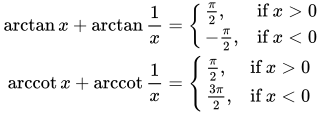
また、[ 52 ] arctan x + arctan 1 x = { π 2 , if x > 0 − π 2 , if x < 0 arccot x + arccot 1 x = { π 2 , if x > 0 3 π 2 , if x < 0 {\displaystyle {\begin{aligned}\arctan x+\arctan {\dfrac {1}{x}}&={\begin{cases}{\frac {\pi }{2}},&{\text{if }}x>0\\-{\frac {\pi }{2}},&{\text{if }}x<0\end{cases}}\\\operatorname {arccot} x+\operatorname {arccot} {\dfrac {1}{x}}&={\begin{cases}{\frac {\pi }{2}},&{\text{if }}x>0\\{\frac {3\pi }{2}},&{\text{if }}x<0\end{cases}}\\\end{aligned}}} arccos 1 x = arcsec x and arcsec 1 x = arccos x {\displaystyle \arccos {\frac {1}{x}}=\operatorname {arcsec} x\qquad {\text{ and }}\qquad \operatorname {arcsec} {\frac {1}{x}}=\arccos x} arcsin 1 x = arccsc x and arccsc 1 x = arcsin x {\displaystyle \arcsin {\frac {1}{x}}=\operatorname {arccsc} x\qquad {\text{ and }}\qquad \operatorname {arccsc} {\frac {1}{x}}=\arcsin x}
逆正接 関数は級数的に展開できる。[ 53 ] arctan ( n x ) = ∑ m = 1 n arctan x 1 + ( m − 1 ) m x 2 {\displaystyle \arctan(nx)=\sum _{m=1}^{n}\arctan {\frac {x}{1+(m-1)mx^{2}}}}
変数のない恒等式 逆正接 関数に関しては[ 52 ] arctan 1 2 = arctan 1 3 + arctan 1 7 . {\displaystyle \arctan {\frac {1}{2}}=\arctan {\frac {1}{3}}+\arctan {\frac {1}{7}}.}
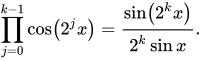
モリーの法則 として知られる奇妙な法則は、 cos 20 ∘ ⋅ cos 40 ∘ ⋅ cos 80 ∘ = 1 8 , {\displaystyle \cos 20^{\circ }\cdot \cos 40^{\circ }\cdot \cos 80^{\circ }={\frac {1}{8}},}
は、1 つの変数を含む恒等式の特殊なケースです。 ∏ j = 0 k − 1 cos ( 2 j x ) = sin ( 2 k x ) 2 k sin x . {\displaystyle \prod _{j=0}^{k-1}\cos \left(2^{j}x\right)={\frac {\sin \left(2^{k}x\right)}{2^{k}\sin x}}.}
同様に、 は との恒等式の特殊なケースです。 sin 20 ∘ ⋅ sin 40 ∘ ⋅ sin 80 ∘ = 3 8 {\displaystyle \sin 20^{\circ }\cdot \sin 40^{\circ }\cdot \sin 80^{\circ }={\frac {\sqrt {3}}{8}}} x = 20 ∘ {\displaystyle x=20^{\circ }} sin x ⋅ sin ( 60 ∘ − x ) ⋅ sin ( 60 ∘ + x ) = sin 3 x 4 . {\displaystyle \sin x\cdot \sin \left(60^{\circ }-x\right)\cdot \sin \left(60^{\circ }+x\right)={\frac {\sin 3x}{4}}.}
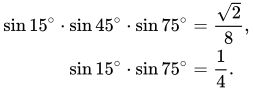
この場合、 x = 15 ∘ {\displaystyle x=15^{\circ }} sin 15 ∘ ⋅ sin 45 ∘ ⋅ sin 75 ∘ = 2 8 , sin 15 ∘ ⋅ sin 75 ∘ = 1 4 . {\displaystyle {\begin{aligned}\sin 15^{\circ }\cdot \sin 45^{\circ }\cdot \sin 75^{\circ }&={\frac {\sqrt {2}}{8}},\\\sin 15^{\circ }\cdot \sin 75^{\circ }&={\frac {1}{4}}.\end{aligned}}}
この場合、 x = 10 ∘ {\displaystyle x=10^{\circ }} sin 10 ∘ ⋅ sin 50 ∘ ⋅ sin 70 ∘ = 1 8 . {\displaystyle \sin 10^{\circ }\cdot \sin 50^{\circ }\cdot \sin 70^{\circ }={\frac {1}{8}}.}
同じコサイン恒等式は cos x ⋅ cos ( 60 ∘ − x ) ⋅ cos ( 60 ∘ + x ) = cos 3 x 4 . {\displaystyle \cos x\cdot \cos \left(60^{\circ }-x\right)\cdot \cos \left(60^{\circ }+x\right)={\frac {\cos 3x}{4}}.}
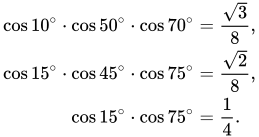
同様に、 cos 10 ∘ ⋅ cos 50 ∘ ⋅ cos 70 ∘ = 3 8 , cos 15 ∘ ⋅ cos 45 ∘ ⋅ cos 75 ∘ = 2 8 , cos 15 ∘ ⋅ cos 75 ∘ = 1 4 . {\displaystyle {\begin{aligned}\cos 10^{\circ }\cdot \cos 50^{\circ }\cdot \cos 70^{\circ }&={\frac {\sqrt {3}}{8}},\\\cos 15^{\circ }\cdot \cos 45^{\circ }\cdot \cos 75^{\circ }&={\frac {\sqrt {2}}{8}},\\\cos 15^{\circ }\cdot \cos 75^{\circ }&={\frac {1}{4}}.\end{aligned}}}
同様に、 tan 50 ∘ ⋅ tan 60 ∘ ⋅ tan 70 ∘ = tan 80 ∘ , tan 40 ∘ ⋅ tan 30 ∘ ⋅ tan 20 ∘ = tan 10 ∘ . {\displaystyle {\begin{aligned}\tan 50^{\circ }\cdot \tan 60^{\circ }\cdot \tan 70^{\circ }&=\tan 80^{\circ },\\\tan 40^{\circ }\cdot \tan 30^{\circ }\cdot \tan 20^{\circ }&=\tan 10^{\circ }.\end{aligned}}}
以下は、変数を含む恒等式に簡単に一般化できるものではないかもしれません (ただし、以下の説明を参照してください)。 cos 24 ∘ + cos 48 ∘ + cos 96 ∘ + cos 168 ∘ = 1 2 . {\displaystyle \cos 24^{\circ }+\cos 48^{\circ }+\cos 96^{\circ }+\cos 168^{\circ }={\frac {1}{2}}.}
分母が 21 であるこの等式を考慮すると、度測定はラジアン測定よりも適切ではなくなります。 cos 2 π 21 + cos ( 2 ⋅ 2 π 21 ) + cos ( 4 ⋅ 2 π 21 ) + cos ( 5 ⋅ 2 π 21 ) + cos ( 8 ⋅ 2 π 21 ) + cos ( 10 ⋅ 2 π 21 ) = 1 2 . {\displaystyle \cos {\frac {2\pi }{21}}+\cos \left(2\cdot {\frac {2\pi }{21}}\right)+\cos \left(4\cdot {\frac {2\pi }{21}}\right)+\cos \left(5\cdot {\frac {2\pi }{21}}\right)+\cos \left(8\cdot {\frac {2\pi }{21}}\right)+\cos \left(10\cdot {\frac {2\pi }{21}}\right)={\frac {1}{2}}.}
因数1、2、4、5、8、10はパターンを明確にし始めるかもしれません。それらは、より小さい整数です。 21 / 2 と互いに素 である(または共通の素因数 を持たない)。最後のいくつかの例は、既約円分多項式 に関する基本事実の系である。すなわち、余弦はこれらの多項式の零点の実部である。零点の和は、 (上記の最後の例では)21で評価されたメビウス関数 である。上記の例では零点の半分しか存在しない。この最後の例の前の2つの恒等式も同様に、21をそれぞれ10と15に置き換えて得られる。
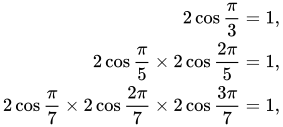
他のコサイン恒等式には以下が含まれる:[ 54 ] 2 cos π 3 = 1 , 2 cos π 5 × 2 cos 2 π 5 = 1 , 2 cos π 7 × 2 cos 2 π 7 × 2 cos 3 π 7 = 1 , {\displaystyle {\begin{aligned}2\cos {\frac {\pi }{3}}&=1,\\2\cos {\frac {\pi }{5}}\times 2\cos {\frac {2\pi }{5}}&=1,\\2\cos {\frac {\pi }{7}}\times 2\cos {\frac {2\pi }{7}}\times 2\cos {\frac {3\pi }{7}}&=1,\end{aligned}}} cos π 3 + cos π 5 × cos 2 π 5 + cos π 7 × cos 2 π 7 × cos 3 π 7 + ⋯ = 1. {\displaystyle \cos {\frac {\pi }{3}}+\cos {\frac {\pi }{5}}\times \cos {\frac {2\pi }{5}}+\cos {\frac {\pi }{7}}\times \cos {\frac {2\pi }{7}}\times \cos {\frac {3\pi }{7}}+\dots =1.}
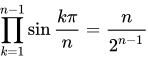
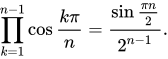
これらの奇妙なアイデンティティの多くは、次のようなより一般的な事実から生じています。[ 55 ] ∏ k = 1 n − 1 sin k π n = n 2 n − 1 {\displaystyle \prod _{k=1}^{n-1}\sin {\frac {k\pi }{n}}={\frac {n}{2^{n-1}}}} ∏ k = 1 n − 1 cos k π n = sin π n 2 2 n − 1 . {\displaystyle \prod _{k=1}^{n-1}\cos {\frac {k\pi }{n}}={\frac {\sin {\frac {\pi n}{2}}}{2^{n-1}}}.}
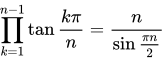
これらを組み合わせると ∏ k = 1 n − 1 tan k π n = n sin π n 2 {\displaystyle \prod _{k=1}^{n-1}\tan {\frac {k\pi }{n}}={\frac {n}{\sin {\frac {\pi n}{2}}}}}
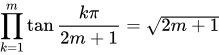
n が奇数( )の場合には対称性を利用して n = 2 m + 1 {\displaystyle n=2m+1} ∏ k = 1 m tan k π 2 m + 1 = 2 m + 1 {\displaystyle \prod _{k=1}^{m}\tan {\frac {k\pi }{2m+1}}={\sqrt {2m+1}}}
バターワースローパスフィルタ の伝達関数は、多項式と極を用いて表すことができます。周波数をカットオフ周波数 と設定することで、次の恒等式が証明されます。 ∏ k = 1 n sin ( 2 k − 1 ) π 4 n = ∏ k = 1 n cos ( 2 k − 1 ) π 4 n = 2 2 n {\displaystyle \prod _{k=1}^{n}\sin {\frac {\left(2k-1\right)\pi }{4n}}=\prod _{k=1}^{n}\cos {\frac {\left(2k-1\right)\pi }{4n}}={\frac {\sqrt {2}}{2^{n}}}}
π の計算π を 大きな桁数 まで効率的に計算する 方法は、マチン による次の変数なしの恒等式に基づいています。これはマチン風の式 として知られています。 あるいは、レオンハルト・オイラー の恒等式を使うこともできます。 あるいは、ピタゴラス数列を 使うこともできます。 π 4 = 4 arctan 1 5 − arctan 1 239 {\displaystyle {\frac {\pi }{4}}=4\arctan {\frac {1}{5}}-\arctan {\frac {1}{239}}} π 4 = 5 arctan 1 7 + 2 arctan 3 79 {\displaystyle {\frac {\pi }{4}}=5\arctan {\frac {1}{7}}+2\arctan {\frac {3}{79}}} π = arccos 4 5 + arccos 5 13 + arccos 16 65 = arcsin 3 5 + arcsin 12 13 + arcsin 63 65 . {\displaystyle \pi =\arccos {\frac {4}{5}}+\arccos {\frac {5}{13}}+\arccos {\frac {16}{65}}=\arcsin {\frac {3}{5}}+\arcsin {\frac {12}{13}}+\arcsin {\frac {63}{65}}.}
その他には以下のものがある: [ 56 ] [ 52 ] π 4 = arctan 1 2 + arctan 1 3 , {\displaystyle {\frac {\pi }{4}}=\arctan {\frac {1}{2}}+\arctan {\frac {1}{3}},} π = arctan 1 + arctan 2 + arctan 3 , {\displaystyle \pi =\arctan 1+\arctan 2+\arctan 3,} π 4 = 2 arctan 1 3 + arctan 1 7 . {\displaystyle {\frac {\pi }{4}}=2\arctan {\frac {1}{3}}+\arctan {\frac {1}{7}}.}
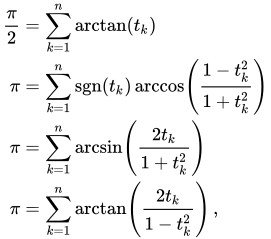
一般に、 θ n = Σ となる数t 1 , ..., t n −1n −1 k =1t k π /4, 3 π /4)t n π /2 − θ n θ n とします。この最後の式は、 t 1 , ..., t n −1 を接線とする角度の和のコタンジェントの公式を用いて直接計算することができ、その値は (-1, 1) の範囲になります。特に、 t 1 , ..., t n −1値 が全て有理数である場合、計算されたt n は 有理数 に なり ます 。 π 2 = ∑ k = 1 n arctan ( t k ) π = ∑ k = 1 n sgn ( t k ) arccos ( 1 − t k 2 1 + t k 2 ) π = ∑ k = 1 n arcsin ( 2 t k 1 + t k 2 ) π = ∑ k = 1 n arctan ( 2 t k 1 − t k 2 ) , {\displaystyle {\begin{aligned}{\frac {\pi }{2}}&=\sum _{k=1}^{n}\arctan(t_{k})\\\pi &=\sum _{k=1}^{n}\operatorname {sgn}(t_{k})\arccos \left({\frac {1-t_{k}^{2}}{1+t_{k}^{2}}}\right)\\\pi &=\sum _{k=1}^{n}\arcsin \left({\frac {2t_{k}}{1+t_{k}^{2}}}\right)\\\pi &=\sum _{k=1}^{n}\arctan \left({\frac {2t_{k}}{1-t_{k}^{2}}}\right)\,,\end{aligned}}}
最初の式を除くすべての式では、正接半角の公式を使用しています。最初の2つの式は、t k 値の1つ以上が(-1, 1)の 範囲外であっても有効です。t = p / q (2 t , 1 − t 2 , 1 + t 2 ) の値は、ピタゴラスの定理(2 pq , q 2 − p 2 , q 2 + p 2 ) に比例することに注意してください。
たとえば、n = 3a 、 b 、 c 、 d > 0 と なります。 π 2 = arctan ( a b ) + arctan ( c d ) + arctan ( b d − a c a d + b c ) {\displaystyle {\frac {\pi }{2}}=\arctan \left({\frac {a}{b}}\right)+\arctan \left({\frac {c}{d}}\right)+\arctan \left({\frac {bd-ac}{ad+bc}}\right)}
ユークリッドの恒等式 ユークリッドは『 原論 sin 2 18 ∘ + sin 2 30 ∘ = sin 2 36 ∘ . {\displaystyle \sin ^{2}18^{\circ }+\sin ^{2}30^{\circ }=\sin ^{2}36^{\circ }.}
プトレマイオスは この命題を使って、『アルマゲスト』 弦の表 のいくつかの角度を計算しました。
三角関数の合成 これらの恒等式は三角関数の三角関数に関係している:[ 57 ]
cos ( t sin x ) = J 0 ( t ) + 2 ∑ k = 1 ∞ J 2 k ( t ) cos ( 2 k x ) {\displaystyle \cos(t\sin x)=J_{0}(t)+2\sum _{k=1}^{\infty }J_{2k}(t)\cos(2kx)} sin ( t sin x ) = 2 ∑ k = 0 ∞ J 2 k + 1 ( t ) sin ( ( 2 k + 1 ) x ) {\displaystyle \sin(t\sin x)=2\sum _{k=0}^{\infty }J_{2k+1}(t)\sin {\big (}(2k+1)x{\big )}} cos ( t cos x ) = J 0 ( t ) + 2 ∑ k = 1 ∞ ( − 1 ) k J 2 k ( t ) cos ( 2 k x ) {\displaystyle \cos(t\cos x)=J_{0}(t)+2\sum _{k=1}^{\infty }(-1)^{k}J_{2k}(t)\cos(2kx)} sin ( t cos x ) = 2 ∑ k = 0 ∞ ( − 1 ) k J 2 k + 1 ( t ) cos ( ( 2 k + 1 ) x ) {\displaystyle \sin(t\cos x)=2\sum _{k=0}^{\infty }(-1)^{k}J_{2k+1}(t)\cos {\big (}(2k+1)x{\big )}} ここで、J i はベッセル関数 です。
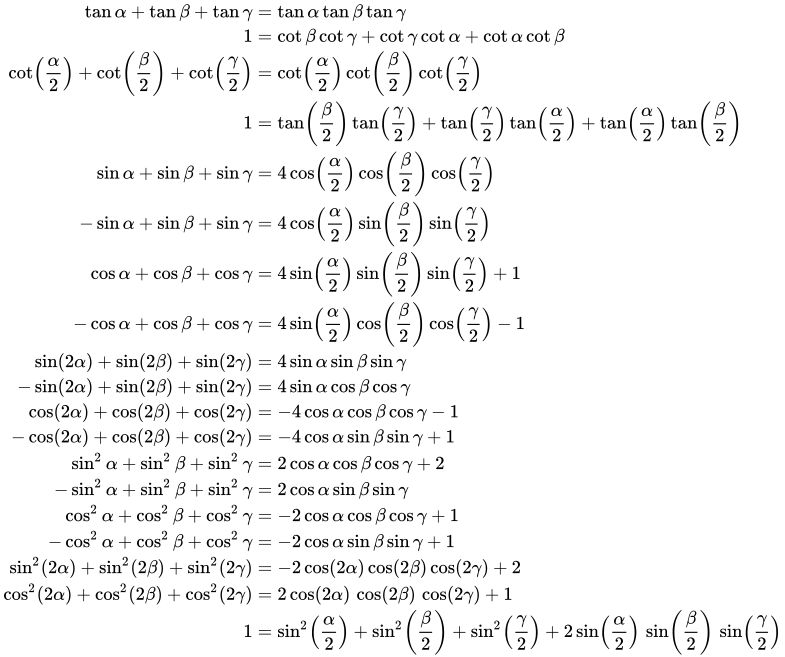
α + β + γ = 180°の場合のさらなる「条件付き」恒等式条件付き三角関数恒等式 は、三角関数の引数に指定された条件が満たされる場合に成立する三角関数恒等式である。[ 58 ] [ 59 ] α + β + γ = 180 ∘ , {\displaystyle \alpha +\beta +\gamma =180^{\circ },} tan α + tan β + tan γ = tan α tan β tan γ 1 = cot β cot γ + cot γ cot α + cot α cot β cot ( α 2 ) + cot ( β 2 ) + cot ( γ 2 ) = cot ( α 2 ) cot ( β 2 ) cot ( γ 2 ) 1 = tan ( β 2 ) tan ( γ 2 ) + tan ( γ 2 ) tan ( α 2 ) + tan ( α 2 ) tan ( β 2 ) sin α + sin β + sin γ = 4 cos ( α 2 ) cos ( β 2 ) cos ( γ 2 ) − sin α + sin β + sin γ = 4 cos ( α 2 ) sin ( β 2 ) sin ( γ 2 ) cos α + cos β + cos γ = 4 sin ( α 2 ) sin ( β 2 ) sin ( γ 2 ) + 1 − cos α + cos β + cos γ = 4 sin ( α 2 ) cos ( β 2 ) cos ( γ 2 ) − 1 sin ( 2 α ) + sin ( 2 β ) + sin ( 2 γ ) = 4 sin α sin β sin γ − sin ( 2 α ) + sin ( 2 β ) + sin ( 2 γ ) = 4 sin α cos β cos γ cos ( 2 α ) + cos ( 2 β ) + cos ( 2 γ ) = − 4 cos α cos β cos γ − 1 − cos ( 2 α ) + cos ( 2 β ) + cos ( 2 γ ) = − 4 cos α sin β sin γ + 1 sin 2 α + sin 2 β + sin 2 γ = 2 cos α cos β cos γ + 2 − sin 2 α + sin 2 β + sin 2 γ = 2 cos α sin β sin γ cos 2 α + cos 2 β + cos 2 γ = − 2 cos α cos β cos γ + 1 − cos 2 α + cos 2 β + cos 2 γ = − 2 cos α sin β sin γ + 1 sin 2 ( 2 α ) + sin 2 ( 2 β ) + sin 2 ( 2 γ ) = − 2 cos ( 2 α ) cos ( 2 β ) cos ( 2 γ ) + 2 cos 2 ( 2 α ) + cos 2 ( 2 β ) + cos 2 ( 2 γ ) = 2 cos ( 2 α ) cos ( 2 β ) cos ( 2 γ ) + 1 1 = sin 2 ( α 2 ) + sin 2 ( β 2 ) + sin 2 ( γ 2 ) + 2 sin ( α 2 ) sin ( β 2 ) sin ( γ 2 ) {\displaystyle {\begin{aligned}\tan \alpha +\tan \beta +\tan \gamma &=\tan \alpha \tan \beta \tan \gamma \\1&=\cot \beta \cot \gamma +\cot \gamma \cot \alpha +\cot \alpha \cot \beta \\\cot \left({\frac {\alpha }{2}}\right)+\cot \left({\frac {\beta }{2}}\right)+\cot \left({\frac {\gamma }{2}}\right)&=\cot \left({\frac {\alpha }{2}}\right)\cot \left({\frac {\beta }{2}}\right)\cot \left({\frac {\gamma }{2}}\right)\\1&=\tan \left({\frac {\beta }{2}}\right)\tan \left({\frac {\gamma }{2}}\right)+\tan \left({\frac {\gamma }{2}}\right)\tan \left({\frac {\alpha }{2}}\right)+\tan \left({\frac {\alpha }{2}}\right)\tan \left({\frac {\beta }{2}}\right)\\\sin \alpha +\sin \beta +\sin \gamma &=4\cos \left({\frac {\alpha }{2}}\right)\cos \left({\frac {\beta }{2}}\right)\cos \left({\frac {\gamma }{2}}\right)\\-\sin \alpha +\sin \beta +\sin \gamma &=4\cos \left({\frac {\alpha }{2}}\right)\sin \left({\frac {\beta }{2}}\right)\sin \left({\frac {\gamma }{2}}\right)\\\cos \alpha +\cos \beta +\cos \gamma &=4\sin \left({\frac {\alpha }{2}}\right)\sin \left({\frac {\beta }{2}}\right)\sin \left({\frac {\gamma }{2}}\right)+1\\-\cos \alpha +\cos \beta +\cos \gamma &=4\sin \left({\frac {\alpha }{2}}\right)\cos \left({\frac {\beta }{2}}\right)\cos \left({\frac {\gamma }{2}}\right)-1\\\sin(2\alpha )+\sin(2\beta )+\sin(2\gamma )&=4\sin \alpha \sin \beta \sin \gamma \\-\sin(2\alpha )+\sin(2\beta )+\sin(2\gamma )&=4\sin \alpha \cos \beta \cos \gamma \\\cos(2\alpha )+\cos(2\beta )+\cos(2\gamma )&=-4\cos \alpha \cos \beta \cos \gamma -1\\-\cos(2\alpha )+\cos(2\beta )+\cos(2\gamma )&=-4\cos \alpha \sin \beta \sin \gamma +1\\\sin ^{2}\alpha +\sin ^{2}\beta +\sin ^{2}\gamma &=2\cos \alpha \cos \beta \cos \gamma +2\\-\sin ^{2}\alpha +\sin ^{2}\beta +\sin ^{2}\gamma &=2\cos \alpha \sin \beta \sin \gamma \\\cos ^{2}\alpha +\cos ^{2}\beta +\cos ^{2}\gamma &=-2\cos \alpha \cos \beta \cos \gamma +1\\-\cos ^{2}\alpha +\cos ^{2}\beta +\cos ^{2}\gamma &=-2\cos \alpha \sin \beta \sin \gamma +1\\\sin ^{2}(2\alpha )+\sin ^{2}(2\beta )+\sin ^{2}(2\gamma )&=-2\cos(2\alpha )\cos(2\beta )\cos(2\gamma )+2\\\cos ^{2}(2\alpha )+\cos ^{2}(2\beta )+\cos ^{2}(2\gamma )&=2\cos(2\alpha )\,\cos(2\beta )\,\cos(2\gamma )+1\\1&=\sin ^{2}\left({\frac {\alpha }{2}}\right)+\sin ^{2}\left({\frac {\beta }{2}}\right)+\sin ^{2}\left({\frac {\gamma }{2}}\right)+2\sin \left({\frac {\alpha }{2}}\right)\,\sin \left({\frac {\beta }{2}}\right)\,\sin \left({\frac {\gamma }{2}}\right)\end{aligned}}}
歴史的な速記法 正弦、隠正弦 、半正弦 、そして正割は 航海 に用いられました。例えば、半正弦の公式は 球面上の2点間の距離を計算するために用いられました。現在ではほとんど使われていません。
その他
ディリクレ核 ディリクレ核 D n ( x )1 + 2 cos x + 2 cos ( 2 x ) + 2 cos ( 3 x ) + ⋯ + 2 cos ( n x ) = sin ( ( n + 1 2 ) x ) sin ( 1 2 x ) . {\displaystyle 1+2\cos x+2\cos(2x)+2\cos(3x)+\cdots +2\cos(nx)={\frac {\sin \left(\left(n+{\frac {1}{2}}\right)x\right)}{\sin \left({\frac {1}{2}}x\right)}}.}
周期の積分可能な関数 とディリクレ核の畳み込みは、その関数の次数フーリエ近似と一致する。任意 の測度 または一般化関数 についても同様のことが成り立つ。 2 π {\displaystyle 2\pi } n {\displaystyle n}
接線半角置換 とすると[ 60 ] cis x t = tan x 2 , {\displaystyle t=\tan {\frac {x}{2}},} sin x = 2 t 1 + t 2 ; cos x = 1 − t 2 1 + t 2 ; e i x = 1 + i t 1 − i t ; d x = 2 d t 1 + t 2 , {\displaystyle \sin x={\frac {2t}{1+t^{2}}};\qquad \cos x={\frac {1-t^{2}}{1+t^{2}}};\qquad e^{ix}={\frac {1+it}{1-it}};\qquad dx={\frac {2\,dt}{1+t^{2}}},} e i x = cos x + i sin x , {\displaystyle e^{ix}=\cos x+i\sin x,}
tan t {\displaystyle t} × / 2 は微積分 で使用されているため、 は sin x {\displaystyle \sin x} 2トン / 1 + t 2 cos x {\displaystyle \cos x} 1 − t 2 / 1 + t 2 d xは 2日t / 1 + t 2 それらの原始導関数 を求めることができます。 sin x {\displaystyle \sin x} cos x {\displaystyle \cos x} t {\displaystyle t}
cos θ 2 ⋅ cos θ 4 ⋅ cos θ 8 ⋯ = ∏ n = 1 ∞ cos θ 2 n = sin θ θ = sinc θ . {\displaystyle \cos {\frac {\theta }{2}}\cdot \cos {\frac {\theta }{4}}\cdot \cos {\frac {\theta }{8}}\cdots =\prod _{n=1}^{\infty }\cos {\frac {\theta }{2^{n}}}={\frac {\sin \theta }{\theta }}=\operatorname {sinc} \theta .}
参照
参考文献 ^ アブラモウィッツ、ミルトン 、ステガン 、アイリーン・アン編 (1983) [1964年6月]。「第4章、式4.3.45」 。『数式、グラフ、数表付き数学関数ハンドブック 。ISBN 978-0-486-61272-0 LCCN 64-60036 . MR 0167642 . LCCN 65-12253 .^ セルビー 1970、188 ページ^ アブラモヴィッツとステガン、p. 72、4.3.13–15 ^ アブラモヴィッツとステガン、p. 72、4.3.7–9 ^ アブラモヴィッツとステガン、p. 72、4.3.16 ^ a b c d ワイスタイン、エリック W. 「三角関数の加算公式」 。 マスワールド 。 ^ アブラモヴィッツとステガン、p. 72、4.3.17 ^ アブラモヴィッツとステガン、p. 72、4.3.18 ^ a b 「角度の和と差の恒等式」 www.milefoot.com . 2019年10月12日 閲覧 。 ^ アブラモヴィッツとステガン、p. 72、4.3.19 ^ アブラモヴィッツとステガン、p. 80、4.4.32 ^ アブラモヴィッツとステガン、p. 80、4.4.33 ^ アブラモヴィッツとステガン、p. 80、4.4.34 ^ Bronstein, Manuel (1989). 「実初等関数の簡略化」. Gonnet, GH (編). Proceedings of the ACM- SIGSAM 1989 International Symposium on Symbolic and Algebraic Computation . ISSAC '89 (Portland US-OR, 1989-07). New York: ACM . pp. 207– 211. doi : 10.1145/74540.74566 . ISBN 0-89791-325-6 ^ マイケル・ハーディ (2016). 「無限和の接線と割線について」アメリカ数学月刊誌 、第123巻、第7号、701–703ページ。https ://doi.org/10.4169/amer.math.monthly.123.7.701 ^ ハーディ、マイケル (2025). 「線形分数変換におけるコーシー族の不変性」 アメリカ数学月刊誌 . 132 (5): 453– 455. doi : 10.1080/00029890.2025.2459048 . ^ Knight, FB (1976). 「コーシー型の特徴づけ」. アメリカ数学会誌 . 1976 : 130–135 . ^ ハーディ、マイケル (2016). 「無限和の接線と割線について」 アメリカ 数学月刊誌 . 123 (7): 701– 703. doi : 10.4169/amer.math.monthly.123.7.701 . ^ a b 「正弦定理、余弦定理、プトレマイオスの定理」 。 ^ a b Weisstein, Eric W. 「 多角形公式」 MathWorld . ^ アブラモヴィッツとステガン、p. 74、4.3.48 ^ a b セルビー 1970、190 ページ^ 引用エラー: 名前付き参照 が呼び出されましたが、定義されていません ( ヘルプ ページを 参照してください)。 A&S^ Weisstein, Eric W. 「Multiple-Angle Formulas」 . mathworld.wolfram.com . 2022年2月6日 閲覧 。 ^ Ward, Ken. 「多重角度の再帰式」 ケン ・ワードの数学ページ 。 ^ a b アブラモウィッツ、ミルトン 、 ステガン、アイリーン・ アン編 (1983) [1964年6月]。 「第4章、式4.3.20-22」 。 『数式、グラフ、数表付き数学関数ハンドブック 』。応用数学シリーズ 。第55巻(1972年12月発行の第10刷に訂正を加えた第9刷、初版)。ワシントンD.C.、ニューヨーク:米国商務省、国立標準局、ドーバー出版。p. 72。ISBN 978-0-486-61272-0 LCCN 64-60036 . MR 0167642 . LCCN 65-12253 .^ a b Weisstein, Eric W. 「 半角の公式」 。MathWorld 。 ^ アブラモヴィッツとステガン、p. 72、4.3.24–26 ^ Weisstein, Eric W. 「Double-Angle Formulas」 . MathWorld . ^ アブラモヴィッツとステガン、p. 72、4.3.27–28 ^ アブラモヴィッツとステガン、p. 72、4.3.31–33 ^ イヴス、ハワード (1990). 『数学史入門』 (第6版). フィラデルフィア: サンダース大学出版. p. 309. ISBN 0-03-029558-0 OCLC 20842510 .^ a b アブラモヴィッツとステガン、p. 72、4.3.34–39 ^ ジョンソン、ウォーレン・P. (2010年4月). 「エルミート流三角関数恒等式」. アメリカ数学月刊誌 . 117 (4): 311– 327. doi : 10.4169/000298910x480784 . S2CID 29690311 . ^ 「製品アイデンティティの複数の角度」 。 ^ Apostol, TM (1967) 微積分学. 第2版. ニューヨーク, NY, Wiley. 334-335ページ. ^ a b Weisstein, Eric W. 「 調和加法定理」 。MathWorld 。 ^ オルティス・ムニス、エディ(1953年2月)「ラグランジュの三角関数恒等式を用いた静電気学および電磁気学における様々な公式の導出法」 アメリカ物理学会誌 21 ( 2): 140. Bibcode : 1953AmJPh..21..140M . doi : 10.1119/1.1933371 . ^ Agarwal, Ravi P.; O'Regan, Donal (2008). 『常微分方程式と偏微分方程式:特殊関数、フーリエ級数、境界値問題』 (イラスト版). Springer Science & Business Media. p. 185. ISBN 978-0-387-79146-3 185ページの抜粋 ^ ジェフリー・アラン、ダイ・フイフイ (2008). 「セクション2.4.1.6」. 数式と積分ハンドブック (第4版). アカデミック・プレス. ISBN 978-0-12-374288-9 ^ フェイ、テンプルH.; クロッパーズ、P.ヘンドリック (2001). 「ギブスの現象」 . 国際科学技術数学教育ジャーナル . 32 (1): 73– 89. doi : 10.1080/00207390117151 . ^ アブラモヴィッツとステガン、p. 74、4.3.47 ^ アブラモヴィッツとステガン、p. 71、4.3.2 ^ アブラモヴィッツとステガン、p. 71、4.3.1 ^ アブラモヴィッツとステガン、p. 80、4.4.26–31 ^ ホーキンス、フェイス・メアリー; ホーキンス、JQ(1969年3月1日) 『複素数と初等複素関数 』ロンドン:マクドナルド・テクニカル&サイエンティフィック・ロンドン(1968年出版)p. 122. ISBN 978-0356025056 ^ Markushevich, AI (1966). 『注目すべき正弦関数 』 ニューヨーク: American Elsevier Publishing Company, Inc. pp. 35– 37, 81. ISBN 978-1483256313 ^ アブラモヴィッツとステガン、p. 74、4.3.65–66 ^ アブラモヴィッツとステガン、p. 75、4.3.89–90 ^ アブラモヴィッツとステガン、p. 85、4.5.68–69 ^ アブラモウィッツ&ステグン 1972 、p.73、4.3.45^ a b c Wu, Rex H. 「言葉のない証明:オイラーの逆正接恒等式」、数学マガジン 77(3)、2004年6月、p.189。 ^ SM Abrarov; RK Jagpal; R. Siddiqui; BM Quine (2021)、「πの2項Machin型式における大きな整数のアルゴリズム的決定」、 Mathematics 、 9 (17)、2162、 arXiv : 2107.01027 、 doi : 10.3390/math9172162 ^ ハンブル、スティーブ(2004年11月)「おばあちゃんの恒等式」 Mathematical Gazette 88 : 524–525 . doi : 10.1017 /s0025557200176223 . S2CID 125105552 . ^ Weisstein, Eric W. 「 正弦波」 。MathWorld 。 ^ Harris, Edward M. 「アークタンジェントの合計」、Roger B. Nelson 著『Proofs Without Words 』(1993 年、アメリカ数学協会)39 ページ。 ^ ミルトン・アブラモウィッツとアイリーン・ステガン著『数式、グラフ、数学表を収録した数学関数ハンドブック 』ドーバー出版 、ニューヨーク、1972年、数式9.1.42–9.1.45^ えー。 KC Joshi、クリシュナの IIT MATHEMATIKA 。クリシュナ・プラカシャン・メディア。メーラト、インド。 636ページ。 ^ Cagnoli、Antonio (1808)、 Trigonométrie rectilinge et sphérique 、p. 27. ^ アブラモヴィッツとステガン、p. 72、4.3.23
参考文献
外部リンク 






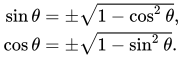


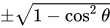
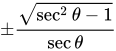
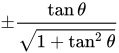


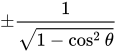
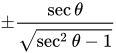
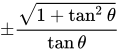
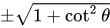

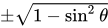
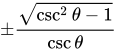

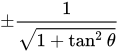
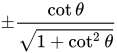

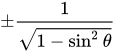
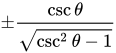

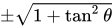
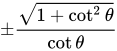

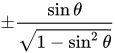
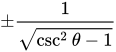
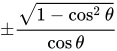
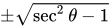


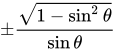
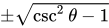
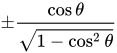
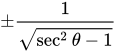





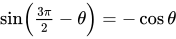




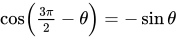




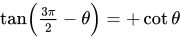




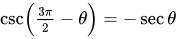




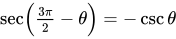




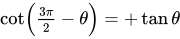



















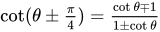



![{\displaystyle {\begin{aligned}\operatorname {sgn} (\sin \theta )=\operatorname {sgn} (\csc \theta )&={\begin{cases}+1&{\text{if}}\ \ 0<\theta <\pi \\-1&{\text{if}}\ \ {-\pi \theta <0\\0&{\text{if}}\ \ \theta \in \{0,\pi \}\end{cases}}\\[5mu]\operatorname {sgn} (\cos \theta )=\operatorname {sgn} (\sec \theta )&={\begin{cases}+1&{\text{if}}\ \ {-{\tfrac {\pi }{2}}\theta <{\tfrac {\pi }{2}}\\-1&{\text{if}}\ \ {-\pi <\theta <-{\tfrac {\pi }{2}}\ \ {\text{or}}\ \ {\tfrac {\pi }{2}\theta <\pi \\0&{\text{if}}\ \ \theta \in {\bigl \{}{-{\tfrac {\pi }{2}}},{\tfrac {\pi }{2}}{\bigr \}}\end{cases}}\\[5mu]\operatorname {sgn} (\tan \theta )=\operatorname {sgn} (\cot \theta )&={\begin{cases}+1&{\text{if}}\ \ {-\pi <\theta <-{\tfrac {\pi }{2}}\ \ {\text{or}}\ \ 0<\theta <{\tfrac {\pi }{2}}\\-1&{\text{if}}\ \ {-{\tfrac {\pi }{2}}\theta <0\ \ {\text{or}}\ \ {\tfrac {\pi }{2}\theta <\pi \\0&{\text{if}}\ \ \theta \in {\bigl \{}{-{\tfrac {\pi }{2}}},0,{\tfrac {\pi }{2}},\pi {\bigr \}}\end{cases}}\end{aligned}}}](https://wikimedia.org/api/rest_v1/media/math/render/svg/3885aee3a70a73da0b369ad2f21a8122f4e78587)

![{\displaystyle ({-\pi },\pi ],}](https://wikimedia.org/api/rest_v1/media/math/render/svg/122328145a5f3a4162d21b4fbb5f4d1149932d2b)


_and_cos(a-b).svg)


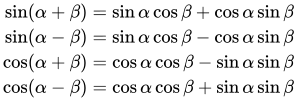










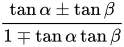

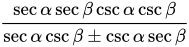

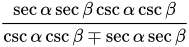

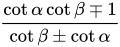





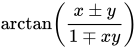

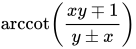

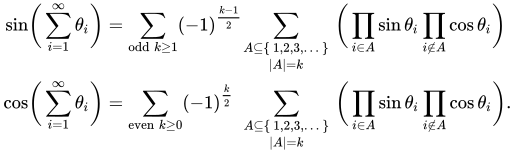







![{\displaystyle {\begin{aligned}e_{0}&=1\\[6pt]e_{1}&=\sum _{i}x_{i}&&=\sum _{i}\tan \theta _{i}\\[6pt]e_{2}&=\sum _{i<j}x_{i}x_{j}&&=\sum _{i<j}\tan \theta _{i}\tan \theta _{j}\\[6pt]e_{3}&=\sum _{i<j<k}x_{i}x_{j}x_{k}&&=\sum _{i<j<k}\tan \theta _{i}\tan \theta _{j}\tan \theta _{k}\\&\ \ \vdots &&\ \ \vdots \end{aligned}}}](https://wikimedia.org/api/rest_v1/media/math/render/svg/cb1927ae2be96f5156e18813a20486fdb0ff72f1)

![{\displaystyle {\begin{aligned}\tan {\Bigl (}\sum _{i}\theta _{i}{\Bigr )}&={\frac {{\sin }{\bigl (}\sum _{i}\theta _{i}{\bigr )}/\prod _{i}\cos \theta _{i}}{{\cos }{\bigl (}\sum _{i}\theta _{i}{\bigr )}/\prod _{i}\cos \theta _{i}}}\\[10pt]&={\frac {\displaystyle \sum _{{\text{odd}}\ k\geq 1}(-1)^{\frac {k-1}{2}}\sum _{\begin{smallmatrix}A\subseteq \{1,2,3,\dots \}\\\left|A\right|=k\end{smallmatrix}}\prod _{i\in A}\tan \theta _{i}}{\displaystyle \sum _{{\text{even}}\ k\geq 0}~(-1)^{\frac {k}{2}}~~\sum _{\begin{smallmatrix}A\subseteq \{1,2,3,\dots \}\\\left|A\right|=k\end{smallmatrix}}\prod _{i\in A}\tan \theta _{i}}}={\frac {e_{1}-e_{3}+e_{5}-\cdots }{e_{0}-e_{2}+e_{4}-\cdots }}\\[10pt]\cot {\Bigl (}\sum _{i}\theta _{i}{\Bigr )}&={\frac {e_{0}-e_{2}+e_{4}-\cdots }{e_{1}-e_{3}+e_{5}-\cdots }}\end{aligned}}}](https://wikimedia.org/api/rest_v1/media/math/render/svg/55ff3a24e1e073c731c170651eca41efdad72212)
![{\displaystyle {\begin{aligned}\tan(\theta _{1}+\theta _{2})&={\frac {e_{1}}{e_{0}-e_{2}}}={\frac {x_{1}+x_{2}}{1\ -\ x_{1}x_{2}}}={\frac {\tan \theta _{1}+\tan \theta _{2}}{1\ -\ \tan \theta _{1}\tan \theta _{2}}},\\[8pt]\tan(\theta _{1}+\theta _{2}+\theta _{3})&={\frac {e_{1}-e_{3}}{e_{0}-e_{2}}}={\frac {(x_{1}+x_{2}+x_{3})\ -\ (x_{1}x_{2}x_{3})}{1\ -\ (x_{1}x_{2}+x_{1}x_{3}+x_{2}x_{3})}},\\[8pt]\tan(\theta _{1}+\theta _{2}+\theta _{3}+\theta _{4})&={\frac {e_{1}-e_{3}}{e_{0}-e_{2}+e_{4}}}\\[8pt]&={\frac {(x_{1}+x_{2}+x_{3}+x_{4})\ -\ (x_{1}x_{2}x_{3}+x_{1}x_{2}x_{4}+x_{1}x_{3}x_{4}+x_{2}x_{3}x_{4})}{1\ -\ (x_{1}x_{2}+x_{1}x_{3}+x_{1}x_{4}+x_{2}x_{3}+x_{2}x_{4}+x_{3}x_{4})\ +\ (x_{1}x_{2}x_{3}x_{4})}},\end{aligned}}}](https://wikimedia.org/api/rest_v1/media/math/render/svg/4c9196b8ab5e0aef6cf7d7fec7d7546f2a6e7d2f)


![{\displaystyle {\begin{aligned}{\sec}{\Bigl (}\sum_{i}\theta_{i}{\Bigr)}&={\frac{\prod_{i}\sec\theta_{i}}{e_{0}-e_{2}+e_{4}-\cdots}}\\[8pt]{\csc}{\Bigl (}\sum_{i}\theta_{i}{\Bigr)}&={\frac{\prod_{i}\sec\theta_{i}}{e_{1}-e_{3}+e_{5}-\cdots}}\end{aligned}}}](https://wikimedia.org/api/rest_v1/media/math/render/svg/b24f2b169fbe11608507c63f5bb728e03b2b4957)


![{\displaystyle {\begin{aligned}\sec(\alpha +\beta +\gamma )&={\frac {\sec \alpha \sec \beta \sec \gamma }{1-\tan \alpha \tan \beta -\tan \alpha \tan \gamma -\tan \beta \tan \gamma }}\\[8pt]\csc(\alpha +\beta +\gamma )&={\frac {\sec \alpha \sec \beta \sec \gamma }{\tan \alpha +\tan \beta +\tan \gamma -\tan \alpha \tan \beta \tan \gamma }}.\end{aligned}}}](https://wikimedia.org/api/rest_v1/media/math/render/svg/e082e69aab7a9c782f590f3a93262ba3101899b7)


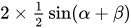











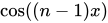
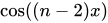


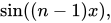
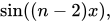





![{\displaystyle {\begin{aligned}\sin {\frac {\theta }{2}}&=\operatorname {sgn} \left(\sin {\frac {\theta }{2}}\right){\sqrt {\frac {1-\cos \theta }{2}}}\\[3pt]\cos {\frac {\theta }{2}}&=\operatorname {sgn} \left(\cos {\frac {\theta }{2}}\right){\sqrt {\frac {1+\cos \theta }{2}}}\\[3pt]\tan {\frac {\theta }{2}}&={\frac {1-\cos \theta }{\sin \theta }}={\frac {\sin \theta }{1+\cos \theta }}=\csc \theta -\cot \theta ={\frac {\tan \theta }{1+\sec {\theta }}}\\[6mu]&=\operatorname {sgn} (\sin \theta ){\sqrt {\frac {1-\cos \theta }{1+\cos \theta }}}={\frac {-1+\operatorname {sgn} (\cos \theta ){\sqrt {1+\tan ^{2}\theta }}}{\tan \theta }}\\[3pt]\cot {\frac {\theta }{2}}&={\frac {1+\cos \theta }{\sin \theta }}={\frac {\sin \theta }{1-\cos \theta }}=\csc \theta +\cot \theta =\operatorname {sgn} (\sin \theta ){\sqrt {\frac {1+\cos \theta }{1-\cos \theta }}}\\\sec {\frac {\theta }{2}}&=\operatorname {sgn} \left(\cos {\frac {\theta }{2}}\right){\sqrt {\frac {2}{1+\cos \theta }}}\\\csc {\frac {\theta }{2}}&=\operatorname {sgn} \left(\sin {\frac {\theta }{2}}\right){\sqrt {\frac {2}{1-\cos \theta }}}\\\end{aligned}}}](https://wikimedia.org/api/rest_v1/media/math/render/svg/d53d104c73c4b28f1dd7bfa5d2b0c7207c68cd87)
![{\displaystyle {\begin{aligned}\tan {\frac {\eta \pm \theta }{2}}&={\frac {\sin \eta \pm \sin \theta }{\cos \eta +\cos \theta }}\\[3pt]\tan \left({\frac {\theta }{2}}+{\frac {\pi }{4}}\right)&=\sec \theta +\tan \theta \\[3pt]{\sqrt {\frac {1-\sin \theta }{1+\sin \theta }}}&={\frac {\left|1-\tan {\frac {\theta }{2}}\right|}{\left|1+\tan {\frac {\theta }{2}}\right|}}\end{aligned}}}](https://wikimedia.org/api/rest_v1/media/math/render/svg/639270245e163f1afa8682ac8aa12086db43dce1)
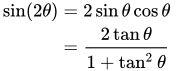
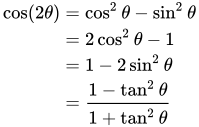
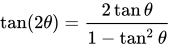
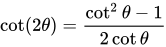


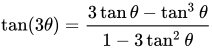
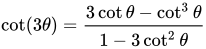
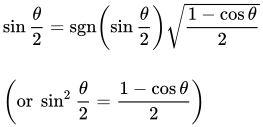
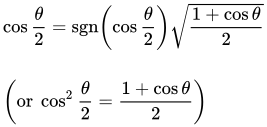
![{\displaystyle {\begin{aligned}\tan {\frac {\theta }{2}}&=\csc \theta -\cot \theta \\&=\pm \,{\sqrt {\frac {1-\cos \theta }{1+\cos \theta }}}\\[3pt]&={\frac {\sin \theta }{1+\cos \theta }}\\[3pt]&={\frac {1-\cos \theta }{\sin \theta }}\\[5pt]\tan {\frac {\eta +\theta }{2}}&={\frac {\sin \eta +\sin \theta }{\cos \eta +\cos \theta }}\\[5pt]\tan \left({\frac {\theta }{2}}+{\frac {\pi }{4}}\right)&=\sec \theta +\tan \theta \\[5pt]{\sqrt {\frac {1-\sin \theta }{1+\sin \theta }}}&={\frac {\left|1-\tan {\frac {\theta }{2}}\right|}{\left|1+\tan {\frac {\theta }{2}}\right|}}\\[5pt]\tan {\frac {\theta }{2}}&={\frac {\tan \theta }{1+{\sqrt {1+\tan ^{2}\theta }}}}\\&{\text{for }}\theta \in \left(-{\tfrac {\pi }{2}},{\tfrac {\pi }{2}}\right)\end{aligned}}}](https://wikimedia.org/api/rest_v1/media/math/render/svg/3cab50a58d64b8c3341fb4f7646888bbbc67ea0c)
![{\displaystyle {\begin{aligned}\cot {\frac {\theta }{2}}&=\csc \theta +\cot \theta \\&=\pm \,{\sqrt {\frac {1+\cos \theta }{1-\cos \theta }}}\\[3pt]&={\frac {\sin \theta }{1-\cos \theta }}\\[4pt]&={\frac {1+\cos \theta }{\sin \theta }}\end{aligned}}}](https://wikimedia.org/api/rest_v1/media/math/render/svg/5c9be831a310f112ffc6e5790bc705dc7b070b87)
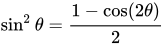
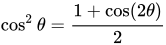
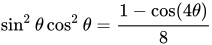
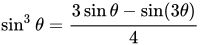
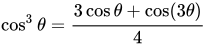











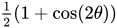












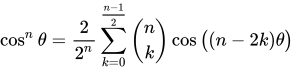




![{\displaystyle {\begin{aligned}\cos \theta \,\cos \varphi &={\tfrac {1}{2}}{\bigl (}\!\!~\cos(\theta -\varphi )+\cos(\theta +\varphi ){\bigr )},\\[5mu]\sin \theta \,\sin \varphi &={\tfrac {1}{2}}{\bigl (}\!\!~\cos(\theta -\varphi )-\cos(\theta +\varphi ){\bigr )},\\[5mu]\sin \theta \,\cos \varphi &={\tfrac {1}{2}}{\bigl (}\!\!~\sin(\theta +\varphi )+\sin(\theta -\varphi ){\bigr )},\\[5mu]\cos \theta \,\sin \varphi &={\tfrac {1}{2}}{\bigl (}\!\!~\sin(\theta +\varphi )-\sin(\theta -\varphi ){\bigr )}.\end{aligned}}}](https://wikimedia.org/api/rest_v1/media/math/render/svg/dcd715f4b6380798a701537d9c067f28cc371efa)
![{\displaystyle {\begin{aligned}\tan \theta \,\tan \varphi &={\frac {\cos(\theta -\varphi )-\cos(\theta +\varphi )}{\cos(\theta -\varphi )+\cos(\theta +\varphi )}},\\[5mu]{\frac {\tan \theta }{\tan \varphi }}&={\frac {\sin(\theta +\varphi )+\sin(\theta -\varphi )}{\sin(\theta +\varphi )-\sin(\theta -\varphi )}}.\end{aligned}}}](https://wikimedia.org/api/rest_v1/media/math/render/svg/69a3a5dee2394b1ed85551729df20f0abd6770b7)
![{\displaystyle {\begin{aligned}\prod _{k=1}^{n}\cos \theta _{k}&={\frac {1}{2^{n}}}\sum _{e\in S}\cos(e_{1}\theta _{1}+\cdots +e_{n}\theta _{n})\\[5mu]&{\text{where }}e=(e_{1},\ldots ,e_{n})\in S=\{1,-1\}^{n},\\\prod _{k=1}^{n}\sin \theta _{k}&={\frac {(-1)^{\left\lfloor {\frac {n}{2}}\right\rfloor }}{2^{n}}}{\begin{cases}\displaystyle \sum _{e\in S}\cos(e_{1}\theta _{1}+\cdots +e_{n}\theta _{n})\prod _{j=1}^{n}e_{j}\;{\text{if}}\;n\;{\text{が偶数の場合}},\\\displaystyle \sum _{e\in S}\sin(e_{1}\theta _{1}+\cdots +e_{n}\theta _{n})\prod _{j=1}^{n}e_{j}\;{\text{if}}\;n\;{\text{が奇数の場合}}.\end{cases}}\end{aligned}}}](https://wikimedia.org/api/rest_v1/media/math/render/svg/106ce6115e77f036a95a2096bc66b01927e5dff9)


![{\displaystyle {\begin{aligned}\sin \theta +\sin \varphi &=2\sin {\tfrac {1}{2}}(\theta +\varphi )\,\cos {\tfrac {1}{2}}(\theta -\varphi ),\\[5mu]\sin \theta -\sin \varphi &=2\cos {\tfrac {1}{2}}(\theta +\varphi )\,\sin {\tfrac {1}{2}}(\theta -\varphi ),\\[5mu]\cos \theta +\cos \varphi &=2\cos {\tfrac {1}{2}}(\theta +\varphi )\,\cos {\tfrac {1}{2}}(\theta -\varphi ),\\[5mu]\cos \theta -\cos \varphi &=-2\sin {\tfrac {1}{2}}(\theta +\varphi )\,\sin {\tfrac {1}{2}}(\theta -\varphi ).\end{aligned}}}](https://wikimedia.org/api/rest_v1/media/math/render/svg/3676cbeab42be735d5fb198d843eeec23ee9b763)


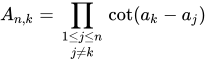




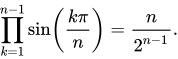

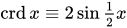



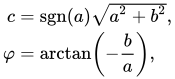


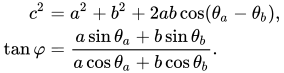

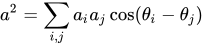
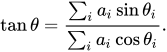
![{\displaystyle {\begin{aligned}\sum _{k=0}^{n}\sin k\theta &={\frac {\cos {\tfrac {1}{2}}\theta -\cos \left(\left(n+{\tfrac {1}{2}}\right)\theta \right)}{2\sin {\tfrac {1}{2}}\theta }}\\[5pt]\sum _{k=1}^{n}\cos k\theta &={\frac {-\sin {\tfrac {1}{2}}\theta +\sin \left(\left(n+{\tfrac {1}{2}}\right)\theta \right)}{2\sin {\tfrac {1}{2}}\theta }}\end{aligned}}}](https://wikimedia.org/api/rest_v1/media/math/render/svg/4679d7bb8112018d06e7d3a849bbe4ce024ff148)


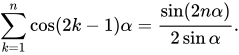



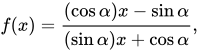
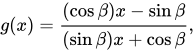





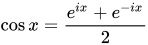
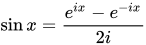
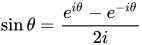

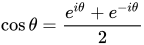

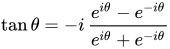
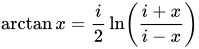
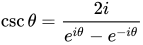

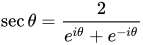

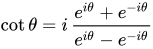
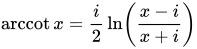




![{\displaystyle {\begin{aligned}\sin x&=x\prod _{n=1}^{\infty }\left(1-{\frac {x^{2}}{\pi ^{2}n^{2}}}\right),&\cos x&=\prod _{n=1}^{\infty }\left(1-{\frac {x^{2}}{\pi ^{2}\left(n-{\frac {1}{2}}\right)\!{\vphantom {)}}^{2}}}\right),\\[10mu]\sinh x&=x\prod _{n=1}^{\infty }\left(1+{\frac {x^{2}}{\pi ^{2}n^{2}}}\right),&\cosh x&=\prod _{n=1}^{\infty }\left(1+{\frac {x^{2}}{\pi ^{2}\left(n-{\frac {1}{2}}\right)\!{\vphantom {)}}^{2}}}\right).\end{aligned}}}](https://wikimedia.org/api/rest_v1/media/math/render/svg/6d43e1176a38b1e6b653837eb782ae79735783ac)


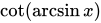

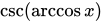
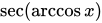



![{\displaystyle {\begin{alignedat}{9}{\frac {\pi }{2}}~&=~\arcsin(x)&&+\arccos(x)~&&=~\arctan(r)&&+\operatorname {arccot} (r)~&&=~\operatorname {arcsec} (s)&&+\operatorname {arccsc} (s)\\[0.4ex]\pi ~&=~\arccos(x)&&+\arccos(-x)~&&=~\operatorname {arccot} (r)&&+\operatorname {arccot} (-r)~&&=~\operatorname {arcsec} (s)&&+\operatorname {arcsec} (-s)\\[0.4ex]0~&=~\arcsin(x)&&+\arcsin(-x)~&&=~\arctan(r)&&+\arctan(-r)~&&=~\operatorname {arccsc} (s)&&+\operatorname {arccsc} (-s)\\[1.0ex]\end{alignedat}}}](https://wikimedia.org/api/rest_v1/media/math/render/svg/839db041f421b4af5890106450e2b4d3e9e183d4)