Drypetes deplanchei subsp. affinis
| Drypetes deplanchei subsp. affinis | |
|---|---|
 | |
| Leaves and fruit | |
Scientific classification | |
| Kingdom: | Plantae |
| Clade: | Tracheophytes |
| Clade: | Angiosperms |
| Clade: | Eudicots |
| Clade: | Rosids |
| Order: | Malpighiales |
| Family: | Putranjivaceae |
| Genus: | Drypetes |
| Species: | |
| Subspecies: | D. d. subsp. affinis |
| Trinomial name | |
| Drypetes deplanchei subsp. affinis | |
| Synonyms | |
| |

Drypetes deplanchei subsp. affinis, commonly known as greybark or grey bark, is a flowering plant in the Putranjivaceaefamily. The subspecific epithetaffinis ("similar to") alludes to its similarity to Drypetes sepiaria of India and Sri Lanka.[1]
Description
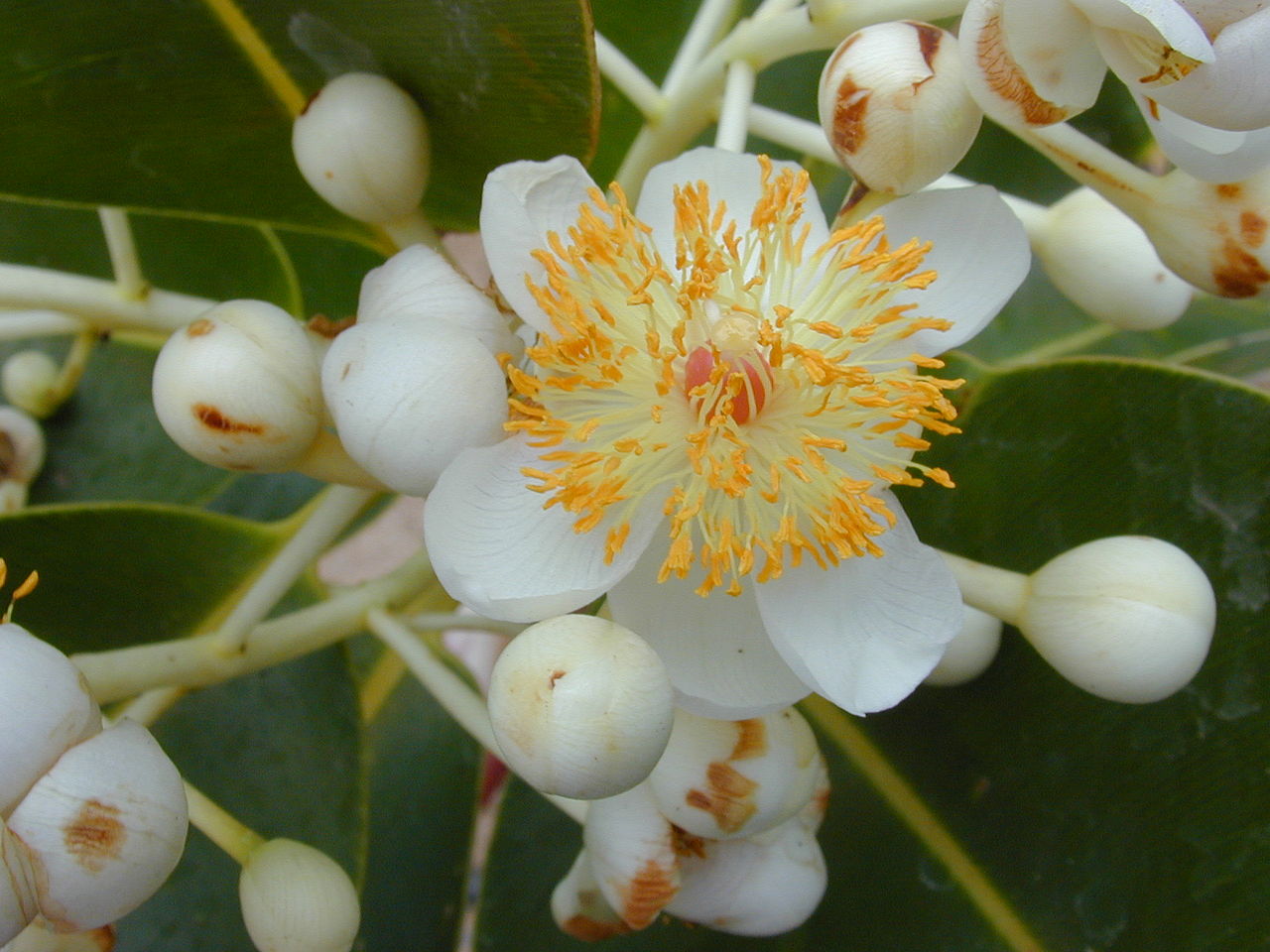
It is a tree growing to 16 m in height, with smooth, pale grey bark often mottled pink with lichens. The leathery, oval leaves are usually 50–80 mm long and 30–40 mm wide. The small green flowers are 6 mm across, appearing from the end of December to late January. The oval, orange-red to yellow fruits are 20–25 mm long.[1][2]
Distribution and habitat
The subspecies is endemic to Australia's subtropicalLord Howe Island in the Tasman Sea. There it is one of the most common and widespread trees in the lowlands.[1][2]
References
- ^ abcd" Drypetes deplanchei subsp. affinis ". Flora of Australia Online: Data derived from Flora of Australia Volume 49 (1994). Australian Biological Resources Study (ABRS). Retrieved 2014-02-26.
- ^ abHutton, Ian (1998). The Australian Geographic Book of Lord Howe Island. Sydney: Australian Geographic. p. 139. ISBN 978-1-876276-27-0.
 | This Malpighiales article is a stub. You can help Wikipedia by adding missing information. |

